The Cold-Water Test: How Candy Syrup Was Judged Before Thermometers
Before candy thermometers, cooks tested sugar syrup by hand. Here's what the cold-water test measures and why it decided whether candied fruit held its shine.
Introduction
Candying fruit is, at its core, a preservation technique dressed up as a treat: a piece of fruit is repeatedly coated or soaked in sugar syrup until enough water has been replaced by sugar that spoilage organisms can no longer take hold. Early 20th century Central European households did this by hand, and the entire process rested on one detail — getting the syrup to exactly the right consistency before the fruit went in or was dipped.
Get the syrup wrong, and the whole batch fails. Too thin, and the fruit stays sticky and won’t keep. Too far gone, and the sugar turns brittle and separates instead of coating cleanly. Home cooks of the era didn’t have thermometers built for this range, so they developed a simple manual test that told them, within a few degrees, exactly when to pull the pot off the heat.
The Cold-Water Test, Step by Step
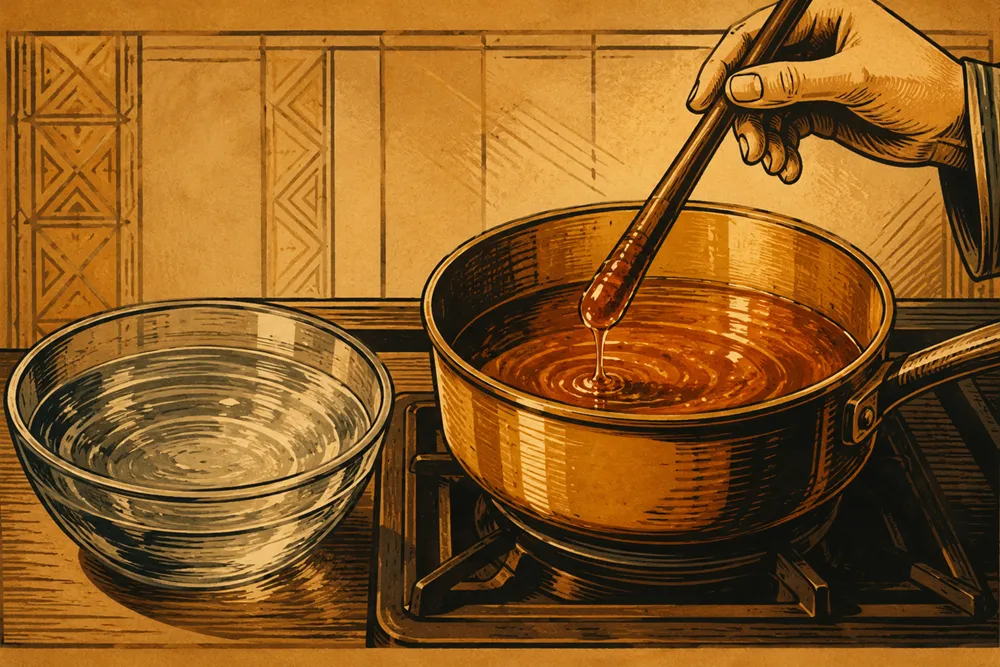
The method itself is straightforward. A small wooden stick is dipped first in cold water, then briefly into the boiling syrup, then back into the cold water. Whatever syrup clung to the stick sets almost instantly in the cold water, and that sample is what gets tested — bent between the fingers to see how it behaves.
If the sugar breaks cleanly and crackles rather than bending or smearing, the syrup has reached what modern candy making calls the hard crack stage — roughly 146-154°C (295-309°F). At this point, sucrose has been concentrated enough that almost no water remains in the syrup; what’s left will set into a hard, glass-like shell as it cools. This is the exact texture needed for a candy coating that stays crisp rather than turning tacky in storage.
Below that temperature, the syrup still holds too much water and will re-liquefy or turn sticky at room temperature. Push past it, and the sugar starts to caramelize and lose the clear, glassy finish that makes candied fruit look appealing.
Why Some Recipes Add Glucose Syrup
Period recipes for this kind of syrup often call for a small measured amount of glucose syrup — sold at the time as “candy syrup” — added to the sugar and water before cooking. This isn’t a flavoring; it’s a crystallization control.
Plain sucrose syrup, cooked and cooled without any interference, has a strong tendency to recrystallize — the sugar molecules snap back into an ordered lattice, and the coating turns grainy and dull instead of staying smooth and glass-clear. Glucose syrup is a different sugar (mostly glucose rather than sucrose), and mixing it in physically gets in the way of that recrystallization process. The syrup cools into a smooth, transparent shell instead of a crumbly one.
This is the same principle behind adding corn syrup, cream of tartar, or a splash of lemon juice to modern candy recipes — different tools, same underlying chemistry.
Practical Takeaways
- The cold-water test is checking for the hard crack stage, roughly 146-154°C (295-309°F) — a candy thermometer reading in that range confirms the same thing the manual test does.
- A small amount of glucose or invert syrup keeps the finished coating smooth by interfering with sugar crystallization.
- Undercooked syrup won’t set properly; overcooked syrup starts to caramelize and lose clarity — the window is narrower than it looks.
- Have your fruit fully prepared before the syrup is ready. Once it hits the hard crack stage, there’s very little time to work before it needs to come off the heat.
Attic Recipes — digitizing and adapting Central European home cooking from the early twentieth century.
Frequently Asked Questions
01What is the hard crack stage in candy making?▶
It's the point where a sugar syrup, cooled quickly in cold water, sets into a brittle thread that snaps cleanly rather than bending. It corresponds to roughly 146-154°C (295-309°F), the temperature range most modern candy thermometers mark as 'hard crack.'
02Why do some old syrup recipes call for glucose syrup or corn syrup?▶
A small amount of glucose or invert syrup interferes with how sugar crystals form as the syrup cools, which keeps the finished coating glassy and smooth instead of turning grainy.
03Can I use a candy thermometer instead of the cold-water test?▶
Yes. A thermometer reading of 146-154°C (295-309°F) corresponds to the same stage the cold-water test is checking for. The manual test is simply what cooks relied on before thermometers were standard kitchen equipment.
04What happens if the syrup doesn't reach the hard crack stage?▶
The coating stays soft, sticky, or syrupy instead of setting into a firm, glossy shell, and candied fruit made with it typically won't keep as well in storage.