How to Ferment Whole Cabbage Heads (Traditional Method)
How Central European households fermented whole cabbage heads in barrels — salt ratios, weighting, and the routine that kept it from spoiling.
Introduction
Shredded sour cabbage and whole fermented cabbage heads come from the same basic process, but they’re made for different jobs in the kitchen. Shredding cabbage before fermenting it produces the loose, tangy strands used in slaws and braises. Fermenting whole heads instead keeps each leaf intact, softened just enough to peel apart and wrap around a filling — which is exactly what a dish like stuffed cabbage rolls needs.
This method takes longer and asks for more equipment than shredded cabbage — a barrel, a weight, a routine of checking and draining the brine over several weeks. Home cooks of the era treated it as a seasonal project, timed to fill a barrel in autumn that would keep the household in usable cabbage leaves well into spring.
What follows is a walk-through of that traditional barrel method: how to prepare the vessel, how the cabbage and salt go in, and the ongoing care that keeps a large batch fermenting safely rather than spoiling.
Preparing the Barrel
The barrel itself gets attention before a single cabbage head goes in. It’s rinsed with hot water, covered, and left to sit overnight, then scrubbed the next day with a clean, new brush. The barrel is set in its final spot right away and raised off the ground — traditionally on three stones or bricks — with enough clearance underneath for a good-sized pot, since brine will need to be drained out and returned to the barrel repeatedly over the following weeks.
Raising the barrel and fitting a drain point isn’t just convenience. Once the barrel is full of tightly packed cabbage heads and brine, it’s too heavy to move, so any access for maintenance has to be built in from the start.
Layering the Cabbage
Firm, medium-sized heads work best — too small and there’s more surface area relative to volume for spoilage to start; too large and the heads pack unevenly. Outer leaves are removed, the heads are washed in cold water, and they’re placed into the barrel in order, core end facing up.
Salt goes into the center of the barrel as the heads are layered in, traditionally kept together as a single block rather than scattered loose, so it dissolves gradually into the surrounding water rather than all at once. A ring of whole hot peppers and cleaned horseradish root is layered in between the heads as they go — a combination that shows up repeatedly in period preservation methods, likely valued as much for flavor as for its mild antimicrobial contribution to the brine. Once the barrel is fully layered, it’s topped off with cold water.
Weighing It Down
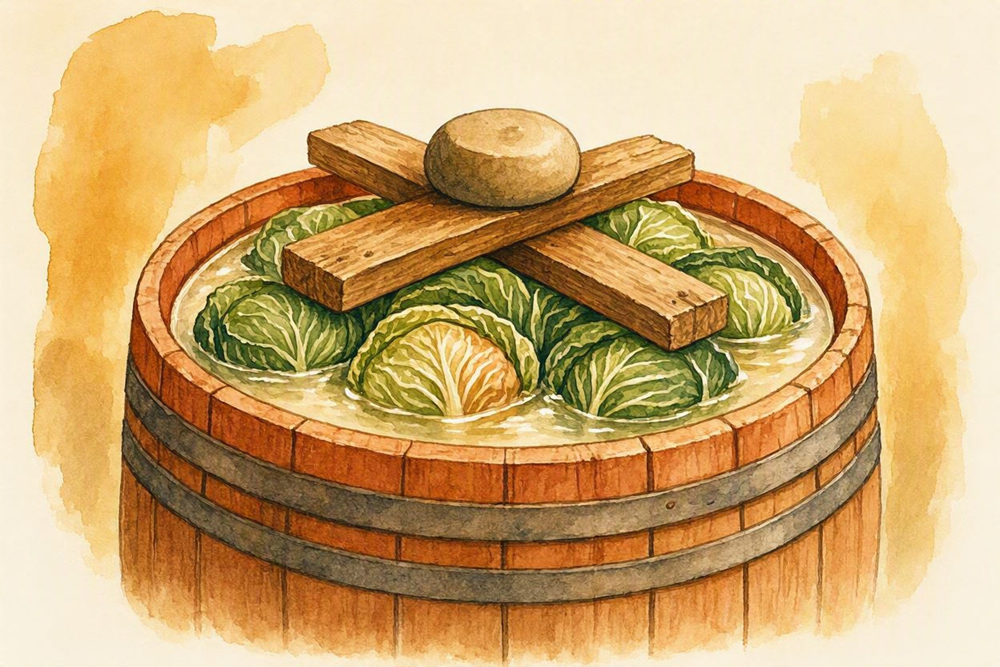
A wooden cross — traditionally cut to the exact dimensions of the barrel or vat — sits directly on the cabbage once the barrel is filled, and needs to hold firmly in place. A large, hard stone goes on top of the cross to weigh everything down, and the stone itself gets the same preparation as the barrel: scalded with hot water and scrubbed clean before use.
Not every stone is suitable. Traditional guidance specifically warns against soft, white, crumbly stone — a type prone to gradually breaking down and leaching into the brine, which affects both flavor and safety. A hard, dense stone that won’t wear away under weeks of contact with salty brine is the better choice.
The Weekly Routine
The cabbage is covered with a clean cloth, and for the first several weeks, the brine is decanted twice a week: a pot goes under the drain, the board and stone are lifted, the brine is drawn off, then poured straight back into the barrel. This keeps the brine from turning ropy or stringy and helps the cabbage ferment at a steady pace. Later in the process, once fermentation has settled into a slower rhythm, the same routine drops to once a week, alongside simply keeping the surface of the barrel clean.
Handled this way, a batch of whole-head cabbage can hold up well into the following spring — a long runway for a single autumn project.
Why This Method Works
Salt does two jobs at once in this process: it draws water out of the cabbage to help form the brine, and it creates an environment that favors lactic acid bacteria over the microorganisms that cause spoilage. As those bacteria consume the natural sugars in the cabbage, they produce lactic acid, which lowers the pH and makes the brine increasingly inhospitable to anything that isn’t already adapted to a salty, acidic environment.
Keeping the cabbage fully submerged under the weighted cross matters just as much as the salt. Lactic acid fermentation is anaerobic, so oxygen exposure — which happens wherever a head pokes above the brine line — gives mold and spoilage organisms a foothold that the submerged cabbage doesn’t have.
Food Safety Notes
A brine strength in the range of roughly 5–6% salt to water by weight, as this method calls for, sits well above the minimum concentration generally used for safe vegetable fermentation, and it’s part of why whole-head fermentation tends to be saltier than shredded cabbage. Submersion is not optional — any cabbage that floats above the brine line should be pushed back under or removed. Check the barrel periodically for mold, an off or rotten smell, or unusual sliminess in the brine, and discard any affected portion rather than assuming it can be salvaged. A natural stone is traditional for weighing the cabbage down, but a food-grade fermentation weight or a well-sanitized heavy plate avoids any risk of a soft stone breaking down or introducing contaminants into the brine.
Practical Takeaways
- Whole-head fermentation trades speed for leaves you can actually peel apart and stuff, unlike shredded sour cabbage.
- A firm barrel setup, raised off the ground with drainage access, makes the weeks of maintenance manageable.
- A brine around 5–6% salt to water, full submersion, and a hard, food-safe weight are the core safety points to get right.
- Decanting the brine twice weekly at first, then weekly later on, keeps the fermentation moving steadily rather than stalling.
Attic Recipes — digitizing and adapting Central European home cooking from the early twentieth century.
Frequently Asked Questions
01Why are cabbage heads fermented whole instead of shredded?▶
Fermenting whole heads keeps the leaves intact and pliable, which makes them well suited for stuffing, such as in cabbage rolls, rather than for dishes that call for shredded sour cabbage.
02How much salt should I use for whole-head cabbage fermentation?▶
A brine strength of roughly 5–6% salt to water by weight is typical for whole heads, noticeably saltier than the 2–3% often used for shredded cabbage, since the dense heads ferment more slowly.
03Why is a weight placed on top of the cabbage?▶
The weight keeps every head fully submerged under the brine, which blocks oxygen and helps prevent mold or spoilage from forming on any exposed surface.
04How long does whole-head fermentation take?▶
Depending on the temperature, whole cabbage heads typically take several weeks to a few months to fully ferment, and can keep well into spring when stored properly.
05Can I use something other than a stone to weigh down the cabbage?▶
Yes — a food-grade ceramic or glass fermentation weight, or a sanitized heavy plate, works as a safer modern substitute for a natural stone.