What Is Fatback? The Forgotten Fat That Built Central European Cooking
Fatback — raw pork back fat — was the backbone of Central European kitchens for centuries. Here's what it is, how to use it, and why it's worth knowing.
Introduction
You have probably walked past it in the refrigerator section without a second glance — a dense white slab, wrapped in paper, labeled simply “pork fat” or, if you are in a Central or Eastern European supermarket, salo or szalonna. No recipe suggestions on the label. No marketing copy. Just fat.
For most of the twentieth century, this unremarkable block was the most important ingredient in millions of Central European kitchens. It greased the pans, layered the pastries, preserved the meat, and waterproofed the boots. (Yes, really.) Understanding what fatback actually is — and why it behaves the way it does — unlocks an entire category of historical recipes that have been quietly disappearing from home kitchens for the past fifty years.
This guide is for anyone who has picked up a piece of fatback and had no idea what to do with it. It covers what it is, how it differs from lard, how to use it safely, and why it ended up in that refrigerator case in the first place.
What Is Fatback, Exactly?
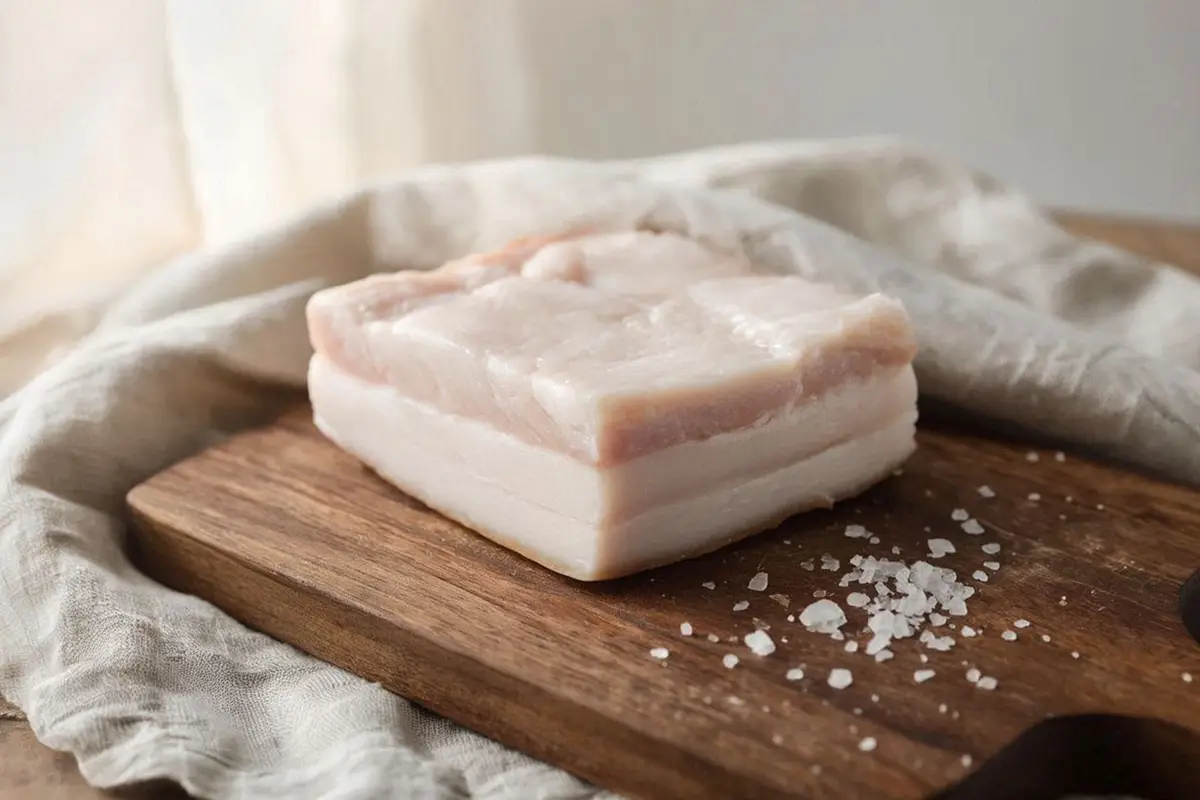
Fatback is the subcutaneous fat layer from the back of a pig — the thick white deposit that sits just beneath the skin, running from the shoulder to the rump. It is raw, unprocessed, and sold exactly as it comes from the animal: chilled, solid, and either with or without the skin attached.
It is not bacon (which is cured and smoked). It is not salt pork (which is heavily salted). It is not lard (which is rendered and liquid). It is simply raw pork fat, and that distinction matters enormously once you start cooking with it.
What it looks like: A solid white-to-ivory slab, typically 2–5cm thick, with a firm texture similar to cold butter. The skin side, if present, is pale and smooth. Cut open, it has a clean, faintly sweet smell — nothing rancid or sharp.
Where it comes from on the pig: The back fat is the leanest and cleanest fat deposit on the animal. It contains almost no muscle fibers, which is why it renders so smoothly and handles so predictably in pastry.
Fatback vs. Lard: Why the Difference Matters
This is the question that trips people up most often. The two products look similar in a recipe and are made from the same part of the animal — but they behave completely differently in the kitchen.
Fatback is raw. It still contains water (roughly 10–15% by weight), a small amount of protein, and its original cellular structure is intact. When you bake with raw fatback, that water turns to steam and pushes the dough layers apart. This is the mechanism behind the flakiness of traditional Central European pastries laminated with fat.
Lard is rendered fatback — the fat has been gently melted, the water and proteins driven off, and the result strained and cooled. The final product is almost pure triglyceride, shelf-stable, and very smooth. It fries beautifully and makes extraordinarily tender pie crusts, but it cannot create steam layers in pastry because there is no water left.
The short version: use fatback when a recipe specifically calls for raw or unrendered fat, particularly in laminated doughs. Use lard for everything else.
How Fatback Was Used Historically
In the early twentieth century, a household that kept pigs rarely bought cooking fat. The autumn slaughter produced everything needed for the year ahead, and fatback was at the center of that economy.
As a cooking medium: Thinly sliced fatback was rendered directly in the pan at the start of cooking. The rendered fat was used to fry onions, brown meat, and start soups and stews. The crispy solid pieces left behind — known across the region by names like čvarci or tepertő — were eaten as a snack or crumbled into bread dough.
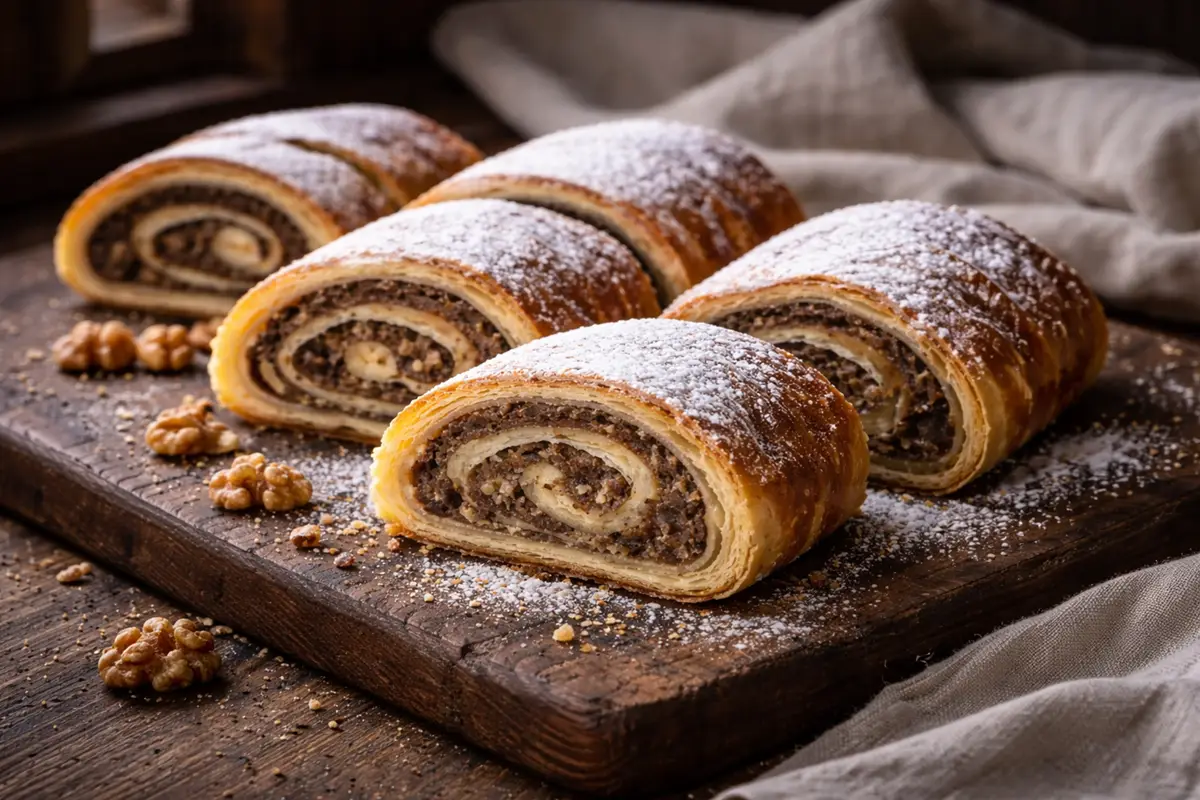
In pastry: Raw fatback was incorporated into laminated doughs to create flaky layers — the same principle as modern croissant or puff pastry, but without the precision folding. The walnut rolls, strudels, and layered pastries of the region relied on this technique almost universally before butter became affordable and accessible.
As a preservative: Thick fatback was packed around cooked meats — particularly duck and goose — to create a seal against air, an early form of confit. Whole sausages and cured meats were stored submerged in rendered lard in ceramic crocks throughout winter.
Beyond the kitchen: Fatback was also used topically for chapped skin and cracked heels, and applied as a warming compress for chest colds. Whether or not these applications were effective is a separate question, but they tell us how central this ingredient was to daily life — treated as a household staple with uses well beyond cooking.
How to Use Fatback Today
Buying it: Look for fatback at traditional butchers, farmers’ markets, or Central and Eastern European grocery stores. In larger supermarkets, it may appear in the pork or charcuterie section, sometimes labeled “pork back fat” or “fresh lard.” Ask for it without the skin if you plan to grind it for pastry; skin-on is fine for rendering.
Storing it: Raw fatback is perishable. Refrigerate and use within 3–5 days of purchase, or freeze for up to 3 months. Wrap tightly in plastic or vacuum-seal; fat absorbs odors quickly in an open refrigerator.
Rendering it into lard: Cut into small cubes, place in a heavy pot over the lowest possible heat, and allow to melt slowly — this takes 1–2 hours. Do not rush with high heat; scorched lard is bitter and smells unpleasant. Strain through a fine sieve into a glass jar and refrigerate. Home-rendered lard keeps for up to 3 months refrigerated, or up to 1 year frozen.
In laminated pastry: Use cold, firm fatback — grind it finely or chop very finely with a knife. Keep everything cold throughout the process. If the fat begins to soften and smear rather than staying in distinct pieces, refrigerate the dough for 15–20 minutes before continuing.
For frying: Slice thinly and render directly in the pan over medium heat until the solids are golden. Remove the solids, then fry in the remaining fat. This produces a more flavourful cooking fat than plain lard and is the traditional starting point for many Central European dishes.
A Note on Health and Safety
Fatback is calorie-dense — approximately 810 kcal per 100g raw weight, per USDA data — and high in saturated fat. This is not a reason to avoid it entirely, but it is a reason to use it as traditional recipes intended: as a functional ingredient in specific quantities, not as a general-purpose cooking fat for daily use.
A few practical points worth knowing:
Raw fatback must be cooked. Unlike cured products such as bacon or salami, raw fatback has not been treated to reduce pathogens. It must always be cooked through before consumption. In laminated pastry, the internal temperature during baking will be sufficient. Do not eat raw fatback directly.
Source matters. Fatback from a reputable butcher or supermarket operating under EU or equivalent food safety regulations is safe to handle and cook with normal kitchen hygiene. Avoid fatback from unknown or unregulated sources.
Cardiovascular and dietary considerations. Individuals with diagnosed heart disease, hypercholesterolaemia, or on medically prescribed low-saturated-fat diets should consult their doctor before incorporating fatback into regular cooking. This post does not constitute dietary advice.
Caloric density in context. A tablespoon of rendered lard (approximately 13g) contains around 115 kcal. Be aware of this when scaling recipes, particularly pastries and stews in which fat is a primary ingredient.
Practical Takeaways
- Fatback and lard are not the same. Raw fatback contains water; rendered lard does not. They cannot always be swapped.
- For laminated pastry, you need raw fatback. The water creates steam, which creates layers. Rendered lard will not produce the same result.
- For frying and braising, either works. Render fatback first, or use store-bought lard interchangeably.
- Buy fresh, store cold, cook thoroughly. Fatback is perishable and must always be cooked before eating.
- It is a minimally processed ingredient. One item on the label, nothing added. Used in traditional quantities, it is not the health problem it was framed as in the late twentieth century — but moderation and individual health context still apply.
Attic Recipes — digitizing and adapting Central European home cooking from the early twentieth century.
Frequently Asked Questions
01What exactly is fatback, and how is it different from lard?▶
Fatback is raw, unsalted pork back fat — the thick layer that runs along the pig's spine. Lard is the finished product: fatback slowly melted down, strained, and cooled into a smooth, shelf-stable cooking fat. The key difference is water — raw fatback still contains it, rendered lard does not. That distinction matters more than it sounds: in laminated pastry, the water in raw fatback creates steam during baking and forms layers. Lard cannot do this.
02Is fatback the same as salt pork or bacon?▶
No, though the three are related. Salt pork is fatback cured in salt, which changes its flavor and extends its shelf life. Bacon comes from the belly of the pig — not the back — and is almost always both cured and smoked. Raw fatback has none of that saltiness or smokiness. It is a neutral fat, which is exactly why traditional recipes prize it: it adds richness without dominating the dish.
03What does fatback taste like?▶
On its own, raw fatback is mildly porky and fatty — not particularly interesting. Its real value emerges with heat and time. Slow-rendered, it becomes sweet and nutty. Fried into cracklings, it turns golden and deeply savory. Used to lard a piece of meat, it melts in slowly and keeps the meat moist from the inside. The flavor is a foundation, not a feature.
04Where can I buy fatback today?▶
In Central and Eastern Europe, fatback is increasingly available in larger supermarkets and discount chains. In Western Europe and North America, your best source is a traditional butcher or a farmers' market — ask for 'back fat' or 'pork fatback', skin-on or skinless depending on use. Ethnic grocery stores serving Eastern European, Southern US, or Latin American communities often stock it regularly.
05How do I use fatback in cooking?▶
There are several classic techniques. For larding, cut thin strips and thread them through lean meat before roasting to baste it from the inside. For barding, wrap thin slices around the outside of poultry or lean roasts. For rendering, dice it small and cook it low and slow until the fat melts out and the solids turn into cracklings — both are usable. For flavoring, sweat small cubes gently at the start of a stew or soup to release fat and flavor before adding other ingredients.
06Can I substitute something else if I cannot find fatback?▶
It depends on the recipe. For laminated pastry, there is no true substitute — the water content in raw fatback is what creates the layers, and rendered lard cannot replicate this. For larding and barding, thinly sliced pancetta or fatty bacon can work, though they will add salt and smokiness. For enriching stews, purchased lard or olive oil can stand in, though you will lose some of the characteristic pork flavor.
07Is fatback safe to eat?▶
Raw fatback must always be cooked before consumption — unlike cured products, it has not been treated to reduce pathogens. Cooked and used in the quantities typical of traditional recipes, it is safe for healthy adults. Those on medically restricted low-fat diets should consult their doctor. Fatback is mostly saturated fat, though current nutritional research presents a more nuanced picture than the low-fat consensus of the late twentieth century suggested.
08How do I store fatback, and how long does it keep?▶
Raw fatback should be refrigerated and used within a week, or frozen for up to six months. Wrap it well — pork fat absorbs odors easily. Once rendered into lard, it keeps in a sealed jar in the refrigerator for several months, or in the freezer almost indefinitely.
09What is the role of fatback in traditional Central European cooking?▶
For several centuries, fatback was the primary cooking fat across much of Central Europe — particularly in regions without easy access to olive oil or butter. Lard rendered from fatback was used for frying, baking, and preserving. The cracklings left over from rendering were eaten as a snack or stirred into breads. Raw fatback enriched sausages, kept lean meats moist during roasting, and built the base flavor of soups and stews. It was, in short, the fat that made the cuisine work.