Clear Beef Soup
A slowly simmered and strained beef soup clarified with whole eggs and root vegetables, yielding a clean, deeply flavoured broth served as a first course.
Quick Summary
A slowly simmered and strained beef soup clarified with whole eggs and root vegetables, yielding a clean, deeply flavoured broth served as a first course.
Historical recipe
Modernised adaptation of an early 20th‑century source. Not independently kitchen-tested by Attic Recipes. Quantities, temperatures, and food safety guidance have been updated for a contemporary kitchen — results may vary and errors may exist. Nutritional values, where provided, are estimates only and have not been laboratory tested. Always follow current food safety guidelines for your region. If you have a health condition, allergy, or dietary requirement, consult a qualified professional before preparing this recipe.
Use of this recipe is entirely at your own risk and subject to our Terms of Service and Privacy Policy. Attic Recipes accepts no liability for any adverse outcome.
- Eggs
- Celery
Additional notes
-
Note
This recipe uses whole eggs as a clarification agent. The eggs are cooked throughout the simmering process and are fully removed by straining — they do not remain in the finished broth. No raw egg consumption is involved.
- 1
Mince or finely grind the beef brisket. Place it in a large heavy-bottomed pot. Beat the 3 whole eggs lightly and add them to the meat along with the salt, peppercorns, and all the julienned root vegetables. Mix everything together well.
- 2
Gradually add the 2 litres of cold water to the meat and vegetable mixture, pouring slowly and stirring as you go. The water must be cold — this is essential for the clarification to work. Mix the entire contents of the pot thoroughly before placing it on the heat.
Tip Starting with cold water and cold meat allows the proteins to dissolve gradually into the liquid before they coagulate, which is what draws out impurities and produces a clearer result. - 3
Place the pot over medium-low heat. Stir frequently as the soup heats up to prevent the meat and vegetables from settling and scorching on the bottom. Do not leave unattended at this stage.
- 4
While the soup is heating, halve the head of garlic crosswise and char the cut sides in a dry pan over high heat until dark and fragrant. Add the charred garlic to the pot.
Tip Charred garlic adds depth and a faint smokiness to the broth. This is a period technique that also helps colour the soup a warm amber tone. - 5
As the soup approaches a boil, the egg proteins and meat will begin to coagulate and rise to the surface, forming a raft that traps impurities. Once the soup comes to a boil and the raft has formed, stop stirring. Reduce the heat to the lowest possible simmer.
- 6
Move the pot to the edge of the burner or use a heat diffuser to maintain the gentlest possible simmer. Leave to cook undisturbed for 1 to 2 hours. The broth will gradually clarify beneath the raft.
- 7
Remove the pot from the heat. Carefully ladle the broth through a fine-mesh sieve lined with a clean white linen or muslin cloth into a clean pot or large bowl. Do not press the solids — let the broth drip through under its own weight for the clearest result.
- 8
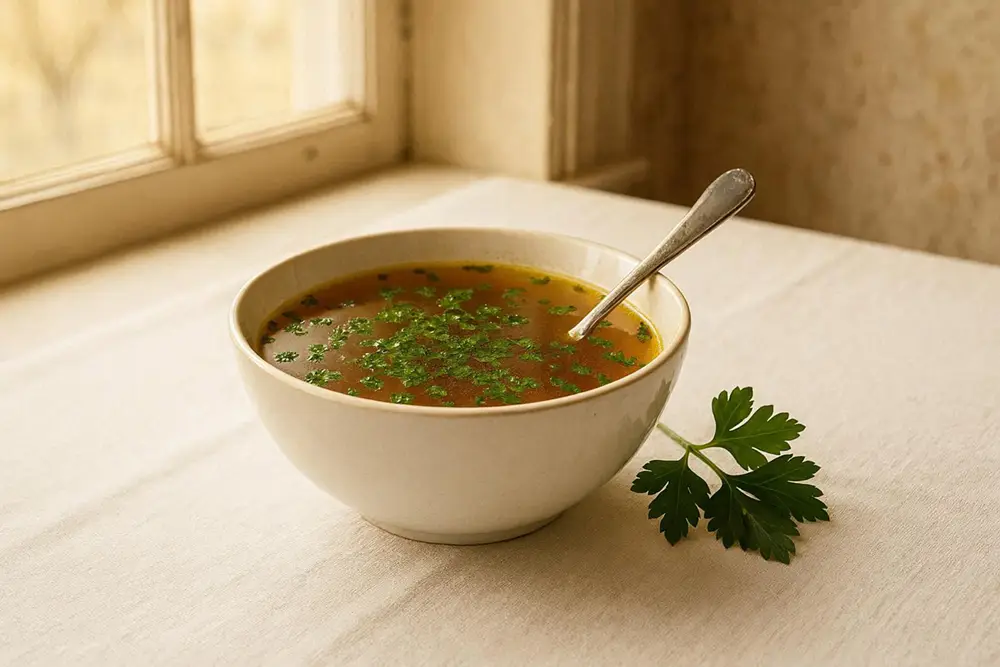
The finished broth should be clear and amber-coloured. Taste and adjust salt. Serve hot in bowls or white teacups. Garnish as desired — see serving suggestions.
Nutrition Information per 1 serving (approx. 400ml)
Nutritional values are approximate estimates and may vary based on specific ingredients used, preparation methods, and portion sizes.
Serving Suggestions
Serve hot in deep bowls or white teacups as a first course. Traditional garnishes from the period include small fried dough peas (tiny flour-and-egg dumplings fried in fat until golden), fine noodles, or a julienne of lightly cooked vegetables. The broth also makes an excellent base for other soups and sauces and can be refrigerated for up to 3 days or frozen for up to 3 months.
About This Recipe
Clear beef soup sits at the intersection of French technique and Central European home cooking. The method — simmering ground meat and vegetables in cold water, then straining the result through linen — is borrowed from the French consommé tradition, which dominated middle-class entertaining across the region in the early 20th century. But where the classical French approach uses egg whites alone for clarification, this recipe uses whole eggs. The result is slightly less crystalline than a professional consommé, but no less flavourful — and considerably more forgiving.
The process is slow and requires attention, but not skill in the conventional sense. The main task is patience: keeping the heat low, resisting the urge to stir once the raft forms, and allowing gravity to do the straining rather than forcing the broth through the cloth. Interference at any of these stages clouds the soup.
Served in a white teacup, as period sources suggest, the amber broth is quietly elegant — a first course that signals care without demanding spectacle.
Why It Works
The clarification works because of protein coagulation. Ground beef contains soluble proteins that, when dissolved in cold water and then slowly heated, denature and bind together into a network that traps fine particles, fat droplets, and other impurities as it rises to the surface. Whole eggs accelerate this process: both the whites and the yolks contribute proteins that join the coagulating raft, though the yolks also add a small amount of fat and colour that egg-white-only clarification would avoid.
Charred garlic serves two functions. The Maillard compounds on the cut surface add roasted depth to the broth, and the sugars caramelize slightly, contributing to the warm amber colour that distinguishes a well-made clear soup from a pale, flat one.
Cold water at the start is not optional. Adding hot water would cause the proteins to seize immediately on contact with the meat rather than dissolving gradually into the liquid first — the raft would form too early and too unevenly, and the result would be cloudy.
Modern Kitchen Tips
Use the lowest possible heat once the raft has formed. A simmer so gentle that only the occasional bubble breaks the surface is ideal. If your stovetop runs hot, use a heat diffuser or move the pot half off the burner.
When straining, line your sieve with a clean cloth that has been rinsed in cold water and wrung out — a dry cloth absorbs too much broth. Set the sieve over a deep bowl or clean pot and ladle the broth through gently. Never pour from the pot directly, as disturbing the raft will cloud the broth.
If the finished broth is slightly cloudy, it can be re-clarified by repeating the process with one additional egg white, but this is rarely necessary for a home-kitchen result.
A classic of early 20th century home cooking, preserved and adapted for the modern kitchen.
The Story Behind This Recipe
Historical Context
This recipe appears in period sources under the French name 'konsomé' (consommé), reflecting the strong French culinary influence on Central European middle-class cooking of the early 20th century. The classical French consommé technique uses egg whites only for clarification, as the whites coagulate and trap impurities without adding colour or fat. This recipe uses whole eggs — yolks included — which was a common home-kitchen adaptation of the French method. The result is a less perfectly clear but richly flavoured broth, and the technique was widely understood as a simplified version of the professional approach. The original cut of meat is named 'meso od kapka' — a period term corresponding to the German Deckel, now known as brisket. Charred garlic as a flavouring and colouring agent was a standard period trick in clear soup cookery.
Modern Kitchen Adaptation
No significant changes have been made to the original method. The whole-egg clarification is retained as written, as it is the defining characteristic of this home-style version and distinguishes it from a classical consommé. Cooks who prefer the classical approach may substitute the 3 whole eggs with 3 egg whites only, which will produce a clearer, more neutral broth. The meat cut 'meso od kapka' is interpreted here as beef brisket, which is the closest modern equivalent to the period term. All vegetable quantities are estimated, as the original specifies only 'half' of each root without stating a weight.
This recipe is an independent modern adaptation developed from historical sources in the public domain. It is provided for informational and educational purposes only and does not constitute professional dietary, nutritional, or medical advice. Food preparation involves inherent risks. The reader assumes full responsibility for safe food handling, ingredient sourcing, and adherence to current local food safety guidelines. The site operator accepts no liability for outcomes resulting from the preparation or consumption of this recipe.
One recipe.
Every week.
You Might Also Like
More recipes from the same category
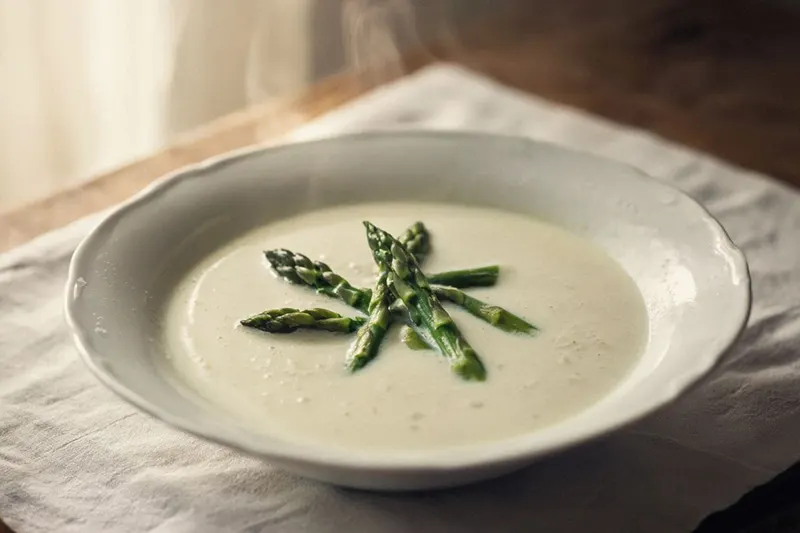
Asparagus Tip Soup
A silky, cream-enriched asparagus soup built on a white roux and finished with tempered egg yolks — an elegant first course from early 20th century cooking.
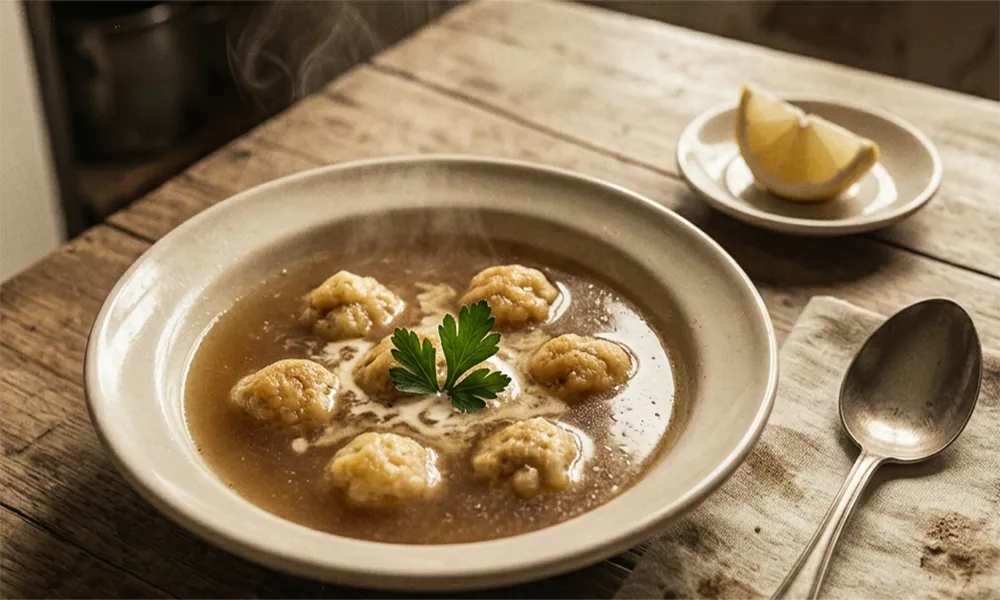
Beef Broth with Stuffed Dough Dumplings
Rich beef bone broth simmered with golden pan-fried dumplings stuffed with seasoned ground beef, finished with a light roux and fresh lemon juice.

Bean Soup Cooked with Beef
White beans and beef shoulder slow-simmered with a bouquet garni, finished in the oven with a paprika-spiced pan roux. A deeply satisfying one-pot meal.