Cream Cake with Apricot Marmalade
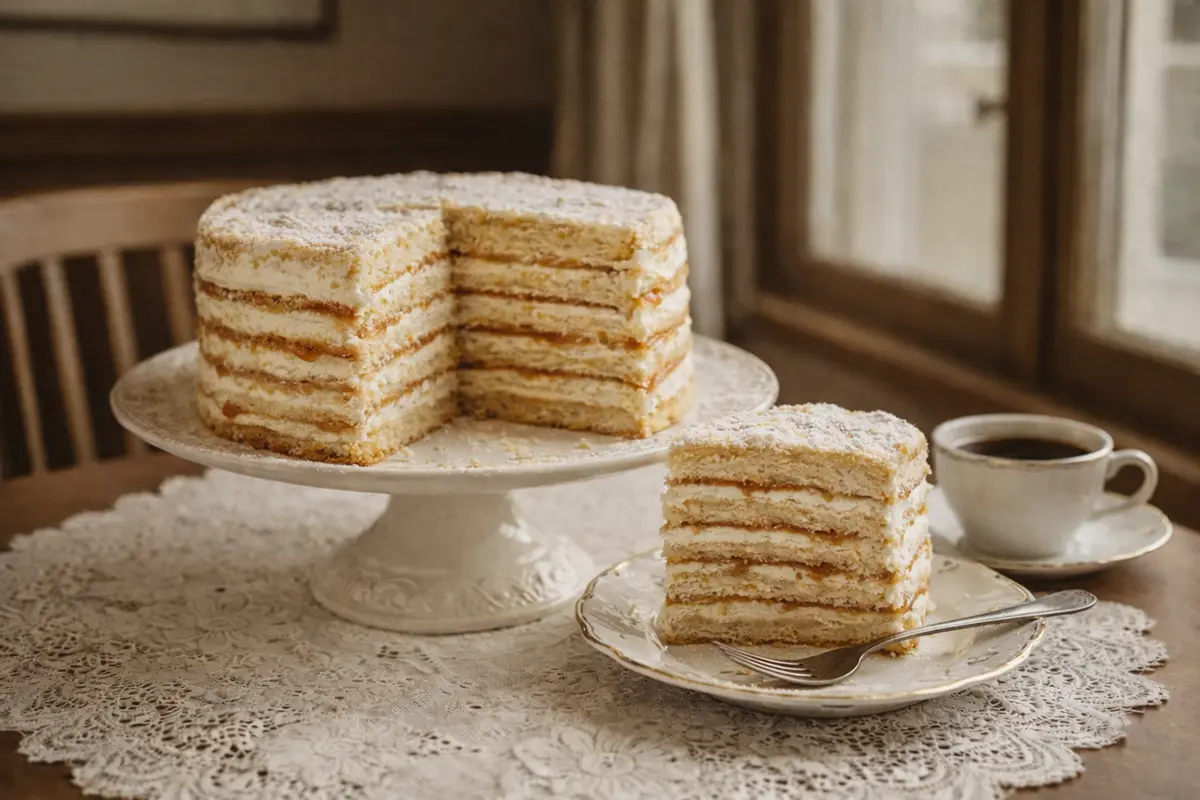
Elegant six-layer almond cake with apricot meringue filling — a refined 1930s Central European torte requiring patience and precision.
Quick Summary
Elegant six-layer almond cake with apricot meringue filling — a refined 1930s Central European torte requiring patience and precision.
Historical recipe
Modernised adaptation of an early 20th‑century source. Not independently kitchen-tested by Attic Recipes. Quantities, temperatures, and food safety guidance have been updated for a contemporary kitchen — results may vary and errors may exist. Nutritional values, where provided, are estimates only and have not been laboratory tested. Always follow current food safety guidelines for your region. If you have a health condition, allergy, or dietary requirement, consult a qualified professional before preparing this recipe.
Use of this recipe is entirely at your own risk and subject to our Terms of Service and Privacy Policy. Attic Recipes accepts no liability for any adverse outcome.
- Dairy
- Eggs
- Gluten
- Tree Nuts
Safety note
The apricot meringue filling contains raw egg whites that are not fully cooked. The brief oven drying step (150°C, 10–15 minutes) is insufficient to guarantee pasteurization of the egg whites at the centre of the filling. Raw egg whites carry a risk of Salmonella contamination. Not recommended for pregnant women, young children, elderly individuals, or anyone with a compromised immune system.
Use Swiss meringue instead: heat egg whites and sugar together in a double boiler, stirring constantly, until the mixture reaches 74°C (165°F), then beat to stiff peaks. This produces a fully pasteurized filling that is safe for all groups.
Additional notes
-
Caution
Contains tree nuts (almonds). One of the 14 major allergens under EU Regulation 1169/2011 and a FALCPA-listed allergen. Always disclose the almond content when serving to others.
There is no in-recipe substitution that eliminates this allergen.
-
Note
High sugar content (36g per slice). Not suitable in large quantities for those with diabetes or insulin sensitivity.
Original: Bake thin sheets until golden, then briefly dry the assembled cake
- 1
Sift 280g of flour onto a clean work surface or large mixing board. Create a well in the center.
- 2
Add 280g softened butter (cut into pieces), 280g powdered sugar, and 280g finely chopped blanched almonds to the flour.
- 3
Add 6 egg yolks to the mixture. Using your hands or a pastry cutter, mix all ingredients together until well combined.
Tip Work quickly so the butter doesn't melt from hand warmth. - 4
Knead the dough thoroughly until smooth and cohesive, about 5–7 minutes. The dough should be pliable but not sticky.
- 5
Divide the dough into 6 equal portions (approximately 230g each). Shape each portion into a disk and wrap in plastic.
- 6
Preheat your oven to 175°C conventional (155°C fan-assisted). Prepare 6 sheets of parchment paper cut to fit your cake tin (approximately 23cm round).
- 7
Working with one portion at a time, place dough on parchment and cover with another sheet. Roll or press with your hands into a very thin, even layer covering the entire parchment circle.
Tip The thinner the layers, the more elegant the final cake. - 8
Transfer the parchment with dough to a baking sheet. Bake for 8–12 minutes until edges are golden brown. Repeat with remaining portions, baking one sheet at a time.
- 9
Immediately after baking, trim each sheet to uniform size using a cake ring or plate as a guide while still warm. Cool completely on wire racks.
Tip Save the trimmings — they can be crushed and used to decorate the sides. - 10
Place the cooled baked sheets in an airtight container and let them rest for at least 48 hours at room temperature. This allows them to firm up properly — the layers will be easier to handle and the assembled cake will hold together better.
- 11
After the resting period, prepare the filling: In a bowl, thoroughly mix 6 tablespoons of apricot jam with 6 tablespoons of powdered sugar until smooth.
- 12
In a separate clean, dry bowl, beat the 6 egg whites until foamy. Add the cream of tartar (or lemon juice) and continue whisking until stiff peaks form — 3–5 minutes with an electric mixer.
Tip Make sure no yolk contaminates the whites, and the bowl is completely grease-free. - 13
Gently fold the stiffly beaten egg whites into the apricot-sugar mixture using a spatula. Fold carefully to maintain volume, but ensure thorough incorporation.
- 14
Place the first sheet on a serving plate. Spread a thin, even layer of the apricot meringue filling on top. Repeat with remaining sheets, stacking them carefully.
- 15
Spread the remaining filling generously on top of the cake, creating swirls or a smooth finish as desired.
- 16
Preheat oven to 150°C conventional (130°C fan-assisted). Place the assembled cake in the oven for 10–15 minutes to lightly dry and set the meringue topping. Watch carefully to avoid over-browning.
- 17
Remove from oven and let cool completely, at least 2 hours. For best flavor and texture, refrigerate overnight before serving.
- 18
Cut into slices with a sharp, thin knife, wiping clean between cuts. Dust with additional powdered sugar if desired before serving.
Nutrition Information per 1 slice (1/12 of recipe)
Nutritional values are approximate estimates and may vary based on specific ingredients used, preparation methods, and portion sizes.
Pro Tips
- Grind almonds yourself from blanched almonds for best flavor and texture
- If meringue begins to weep, use it immediately or add 1 tsp cornstarch to stabilize
- Store leftover cake refrigerated, covered, for up to 4 days
Serving Suggestions
Serve at room temperature with afternoon coffee or tea. Traditional accompaniments include whipped cream rosettes and fresh apricot slices. This elegant cake is suited to formal celebrations. Pairs well with sweet dessert wine or strong espresso to balance the sweetness.
About This Recipe
A masterpiece of patience and precision. This elegant six-layer almond torte with apricot meringue filling requires advance planning — the baked layers rest for two full days before assembly — but rewards that patience with something genuinely spectacular. The layers are thin, crisp, and deeply nutty; the filling is light and sharply fruity; the whole thing improves overnight in the refrigerator as everything settles into each other.
Why the Two-Day Rest
The baked almond sheets come out of the oven slightly fragile. Left to rest in an airtight container for 48 hours, they firm and stabilize — the residual moisture redistributes evenly through the layers, making them easier to handle and stack without cracking. Attempting to assemble the cake while the sheets are still fresh will result in breakage. The rest is not optional.
On the Filling
The filling is raw egg white meringue folded into sweetened apricot jam. It is airy, sharp, and fragrant — and it begins to deflate within 20–30 minutes of being made. Assemble quickly once the filling is ready. If you are serving this to vulnerable individuals (pregnant women, young children, elderly guests), use Swiss meringue instead: heat the egg whites and sugar in a double boiler to 74°C before beating. The result is functionally identical and fully pasteurized.
A classic of early 20th century home cooking, preserved and adapted for the modern kitchen.
The Story Behind This Recipe
Historical Context
This sophisticated torte reflects the refined pastry traditions of 1930s Central European baking — a region with a long history of elaborate layered cakes built on almond dough, fruit preserves, and beaten egg whites. The unusual instruction to rest the baked layers for two days demonstrates the patience and advance planning required in traditional baking. These multi-day cakes were prepared for important celebrations and special occasions, with the extended preparation time being part of the ritual of hospitality.
Modern Kitchen Adaptation
For easier handling, roll dough between parchment sheets and freeze for 15 minutes before baking. A food processor can blend almonds to fine texture quickly. Swiss meringue — heating egg whites with sugar to 74°C before beating — creates a fully pasteurized, more stable filling that is safer for vulnerable individuals and less likely to weep. The 48-hour rest can be reduced to overnight if pressed for time, though texture will not be quite as refined. Store assembled cake refrigerated and bring to room temperature 30 minutes before serving.
This recipe is an independent modern adaptation developed from historical sources in the public domain. It is provided for informational and educational purposes only and does not constitute professional dietary, nutritional, or medical advice. Food preparation involves inherent risks. The reader assumes full responsibility for safe food handling, ingredient sourcing, and adherence to current local food safety guidelines. The site operator accepts no liability for outcomes resulting from the preparation or consumption of this recipe.
One recipe.
Every week.
You Might Also Like
More recipes from the same category

Almond Gurabije Cookies
Small lemon-scented cookies made with lard and egg yolk, indented in the center, coated in whipped egg white, and rolled in sugar and chopped almonds.
Velvet Apple & Meringue Gratin
A decadent vintage dessert featuring apples slow-cooked in a butter-sugar syrup, topped with a cloud of lemon-scented meringue.
Apricot Cream Torte
Traditional apricot cream cake combining sponge, vanilla custard, and meringue for a timeless European flavor.