Layered Almond Torte with Two Fillings
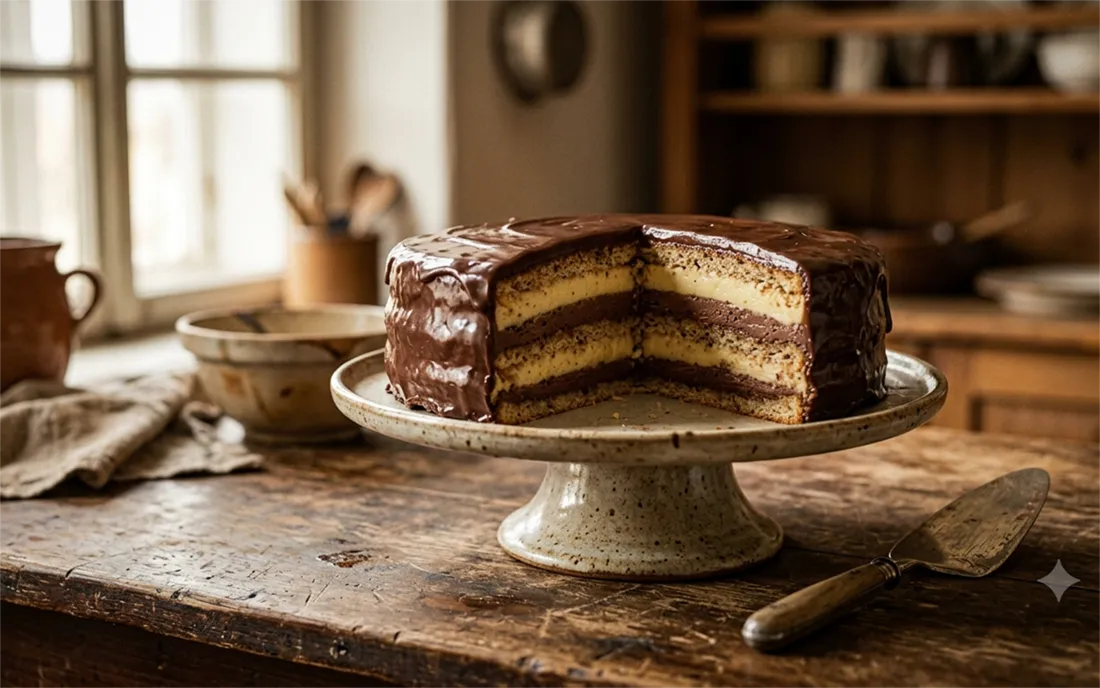
A rich four-layer almond torte with two contrasting fillings — vanilla custard and chocolate-hazelnut — finished in a poured chocolate glaze.
Quick Summary
A rich four-layer almond torte with a vanilla custard filling and a chocolate-hazelnut filling, finished in a poured chocolate glaze. Made from nine eggs and ground almonds, the layers bake in about 20 minutes each.
This recipe uses How to Blanch Almonds: The Technique Behind the White Kernel — prepare it in advance if you haven't already.
Historical recipe
Modernised adaptation of an early 20th‑century source. Not independently kitchen-tested by Attic Recipes. Quantities, temperatures, and food safety guidance have been updated for a contemporary kitchen — results may vary and errors may exist. Nutritional values, where provided, are estimates only and have not been laboratory tested. Always follow current food safety guidelines for your region. If you have a health condition, allergy, or dietary requirement, consult a qualified professional before preparing this recipe.
Use of this recipe is entirely at your own risk and subject to our Terms of Service and Privacy Policy. Attic Recipes accepts no liability for any adverse outcome.
- Eggs
- Dairy
- Gluten
- Tree Nuts
Additional notes
-
Note
This torte is high in saturated fat (19g per serving), largely from the butter and chocolate used in both fillings and the batter. Those managing saturated fat intake, including people with cardiovascular risk factors, may want to serve smaller portions.
-
Note
The breadcrumbs in the almond layers are soaked in rum, adding a small amount of alcohol to the finished torte. Not recommended for pregnant women, children under 18, or anyone avoiding alcohol.
-
Warning
The vanilla custard filling contains eggs cooked over a bain-marie. Whisk constantly and cook to at least 74°C (165°F) to ensure the eggs are fully set; undercooked egg-based fillings carry a risk of foodborne illness, particularly for pregnant women, young children, the elderly, and immunocompromised individuals.
-
Caution
The chocolate glaze involves boiling sugar syrup, which can cause severe burns if it contacts skin. Handle the hot syrup and finished glaze with care, and keep children away from the stove during this step.
- 1
In a large bowl, beat the 180g softened butter with the 160g softened chocolate and 180g sugar until well combined.
- 2
Add the 9 egg yolks one at a time, beating well after each addition.
- 3
Fold in the 180g ground unpeeled almonds and the 2 tbsp breadcrumbs soaked in 1 tbsp rum.
Tip Squeeze any excess rum from the breadcrumbs before folding them in, so the batter doesn't become too wet. - 4
Whip the 9 egg whites to stiff peaks and gently fold into the batter in two or three additions, keeping as much volume as possible.
- 5
Divide the batter evenly among 4 buttered and flour-dusted 20cm round cake pans.
- 6
Bake at 180°C (350°F) / 160°C fan for 15-20 minutes, until a skewer inserted in the center comes out clean. Cool the layers completely in their pans, about 60 minutes, before filling.
- 7
For the vanilla custard filling, whisk the 5 eggs with 180g sugar in a heatproof bowl until well combined.
- 8
Add the 1 tbsp flour and 8g vanilla sugar, then set the bowl over a pot of gently simmering water (bain-marie), making sure the bowl does not touch the water.
- 9
Whisk constantly over the simmering water until the mixture thickens and reaches 74°C (165°F), then remove from heat and let cool.
Tip Constant whisking prevents the eggs from scrambling; the filling is ready when it coats the back of a spoon. - 10
For the chocolate-hazelnut filling, beat the 180g softened butter with the 160g softened chocolate until smooth.
- 11
Fold in the 40g toasted, peeled, and finely ground hazelnuts until evenly combined.
- 12
To assemble, place one almond layer on a serving plate and spread with a portion of the vanilla custard filling. Top with a second layer and spread with a portion of the chocolate-hazelnut filling. Repeat, alternating fillings, until all 4 layers are stacked and both fillings are used.
- 13
For the glaze, combine the 3 tbsp water and 160g granulated sugar in a small saucepan and bring to a boil.
Tip Use a heavy-bottomed pan and keep a close eye on the syrup — it can go from ready to scorched quickly. - 14
Once the syrup boils, add the 140g grated chocolate, stir to combine, and remove from the heat immediately.
- 15
Working quickly before the glaze sets, pour it over the top of the torte and smooth it evenly over the top and sides with a warm spatula.
Serving Suggestions
Slice thinly, as this is a very rich torte — a small wedge with black coffee or a glass of dessert wine is traditional. Bring to room temperature for about 20 minutes before serving for the best texture.
About This Recipe
Some tortes are built for speed; this one is built for occasion. Four thin almond layers, ground with the skins left on for extra depth of flavor, are stacked with two distinct fillings — a soft vanilla custard and a dense chocolate-hazelnut cream — then finished with a glossy poured chocolate glaze. It’s the kind of dessert that used to signal a birthday, a holiday, or a guest worth impressing, and the layering technique still holds up today.
The recipe asks for patience rather than skill: nothing here is technically difficult, but there are several components to prepare and cool before assembly, which makes it a good project for an afternoon rather than a last-minute bake.
Why It Works
Grinding the almonds with their skins still on, rather than using blanched almond flour, adds both texture and a slightly bitter, toasted depth that balances the sweetness of the two fillings. Whipping the egg whites separately and folding them in at the end keeps the almond layers light despite the amount of butter and ground nuts in the batter — without this step, the layers would bake dense and heavy rather than tender. Cooking the custard filling slowly over a bain-marie, rather than directly over heat, prevents the eggs from scrambling while still allowing the mixture to thicken properly.
Modern Kitchen Tips
Bake the almond layers a day ahead if it helps split up the work — they hold up well wrapped and left at room temperature overnight. When assembling, use a serrated knife to level any domed layers before stacking, so the finished torte sits flat and slices cleanly. If the chocolate glaze starts to set before you’ve finished pouring it, a few seconds of gentle warmth (a hairdryer on low, held a short distance away, or a very brief pass over low heat) will loosen it again.
A classic of early 20th century home baking, preserved and adapted for the modern kitchen.
The Story Behind This Recipe
Historical Context
Early 20th century recipes for this torte typically called for unpeeled almonds ground with their skins on, which gave the layers a coarser texture and deeper flavor than blanched almond flour. The traditional approach did not specify a rum quantity for soaking the breadcrumbs — the crumbs were simply moistened until soft. Home bakers of the period also judged the baking time by eye rather than by a fixed oven temperature, since domestic ovens rarely had thermostats.
Modern Kitchen Adaptation
The oven temperature (180°C / 350°F), rum quantity for the breadcrumbs (1 tbsp), vanilla sugar amount (8g, one standard packet), and pan size (4x 20cm) are estimated, since the traditional approach specified none of these precisely. The custard filling is cooked to a specific safe temperature (74°C / 165°F) with constant whisking over a bain-marie, a tempering step that reduces the risk of the eggs scrambling or remaining undercooked. For an alcohol-free version, the rum used to soak the breadcrumbs can be replaced with an equal amount of milk or orange juice, though this changes the flavor profile slightly.
This recipe is an independent modern adaptation developed from historical sources in the public domain. It is provided for informational and educational purposes only and does not constitute professional dietary, nutritional, or medical advice. Food preparation involves inherent risks. The reader assumes full responsibility for safe food handling, ingredient sourcing, and adherence to current local food safety guidelines. The site operator accepts no liability for outcomes resulting from the preparation or consumption of this recipe.
One recipe.
Every week.
You Might Also Like
More recipes from the same category
Almond Gurabije Cookies
Small lemon-scented cookies made with lard and egg yolk, indented in the center, coated in whipped egg white, and rolled in sugar and chopped almonds.
Velvet Apple & Meringue Gratin
A decadent vintage dessert featuring apples slow-cooked in a butter-sugar syrup, topped with a cloud of lemon-scented meringue.
Apricot Cream Torte
Traditional apricot cream cake combining sponge, vanilla custard, and meringue for a timeless European flavor.