Lazy Cinnamon Pie
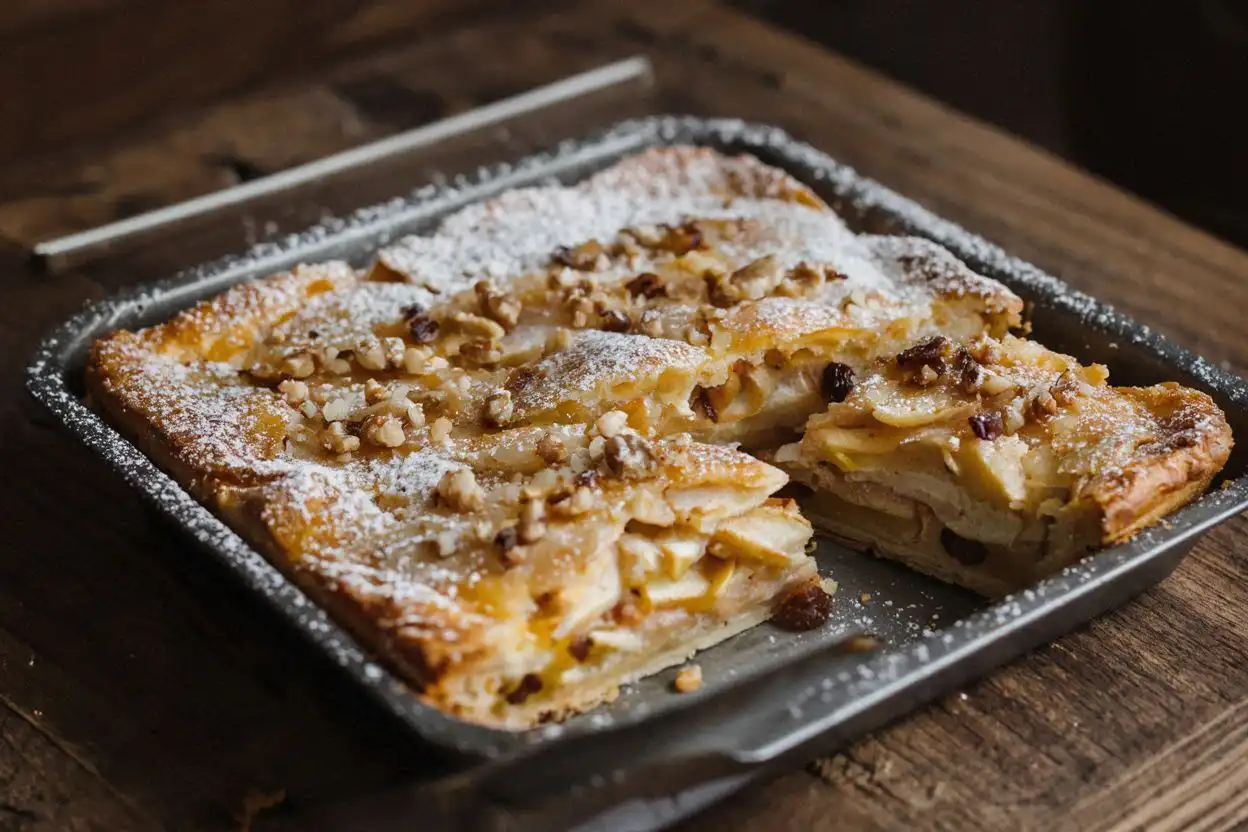
Traditional apple pie with cinnamon, raisins, and walnuts — simple buttery dough with layers of thinly sliced sour apples. No lattice, no fuss.
Quick Summary
Traditional apple pie with cinnamon, raisins, and walnuts — simple buttery dough with layers of thinly sliced sour apples. No lattice, no fuss.
Historical recipe
Modernised adaptation of an early 20th‑century source. Not independently kitchen-tested by Attic Recipes. Quantities, temperatures, and food safety guidance have been updated for a contemporary kitchen — results may vary and errors may exist. Nutritional values, where provided, are estimates only and have not been laboratory tested. Always follow current food safety guidelines for your region. If you have a health condition, allergy, or dietary requirement, consult a qualified professional before preparing this recipe.
Use of this recipe is entirely at your own risk and subject to our Terms of Service and Privacy Policy. Attic Recipes accepts no liability for any adverse outcome.
- Dairy
- Eggs
- Gluten
- Tree Nuts
- Sulphites
Additional notes
-
Warning
Contains walnuts (tree nuts), a major allergen under EU Regulation 1169/2011 and US FALCPA. Not suitable for individuals with tree nut allergies. Always check with guests before serving.
Omit walnuts entirely or substitute with sunflower seeds for a nut-free version.
-
Caution
Raisins may contain sulphites (SO₂) used as a preservative. Check packaging if serving to individuals with sulphite sensitivity or asthma.
Original: Original says 'place in oven, bake' — written for a wood stove. Modern ovens at 180°C for 30–40 minutes give consistent results.
- 1
Beat together butter, powdered sugar, and egg yolks until light and fluffy, about 3–4 minutes.
Tip Room temperature butter is essential here — cold butter will not cream properly. - 2
Add cinnamon and baking soda to the butter mixture and combine well.
- 3
Gradually add flour, mixing until you have a soft, pliable dough. Divide into two equal portions.
Original “Gradually add flour to the beaten mass, knead the dough, then divide it into two halves.”
Tip The dough should be soft but not sticky — add flour a tablespoon at a time if needed. - 4
Peel apples and slice thinly, about 3mm. Toss with 1 tablespoon of lemon juice and a pinch of extra cinnamon.
Tip Thin slices cook evenly and create distinct layers in the finished pie. The lemon juice prevents browning and also activates the baking soda in the dough as the layers bake together. - 5
Drain the soaked raisins and pat dry with paper towel.
Original “125 grams of raisins, which should be kept in hot water for a while beforehand.”
- 6
Preheat oven to 180°C / 160°C fan (350°F). Grease a baking tray approximately 30x20cm. Roll out or press half the dough into the bottom of the tray.
Tip If dough is too soft to roll, press it directly into the pan with your fingers — that is the lazy method and it works perfectly. - 7
Layer the sliced apples evenly over the dough. Scatter the drained raisins on top.
- 8
Roll out the second portion of dough and place over the apple filling. Alternatively, chill the dough for 20 minutes and grate it directly over the top for a rustic, crumblier finish.
Original “Cover the fruit with the second half of the dough.”
- 9
Brush the top with reserved egg whites. Mix crushed walnuts with coarse sugar and sprinkle evenly over the surface.
Original “Brush the surface of the dough with the remaining egg whites, level it evenly, then sprinkle with coarsely powdered sugar mixed with a handful of coarsely crushed walnuts.”
- 10
Bake at 180°C / 160°C fan for 30–40 minutes until golden brown.
Original “Place in the oven, bake.”
- 11
Dust with powdered sugar while still warm. Cool slightly before slicing into squares.
Original “Sprinkle with sugar while still warm, and serve.”
Nutrition Information per 1 slice (1/9 of pie)
Nutritional values are approximate estimates and may vary based on specific ingredients used, preparation methods, and portion sizes.
Pro Tips
- Do not skip soaking the raisins — dry raisins absorb moisture from the filling and can burn
- Sour apples give the best result — sweet apples make the filling too sugary and wet
- For the top layer, try grating chilled dough over the filling for a lighter, crumblier finish
- Add a splash of rum or brandy to the raisin soaking liquid for extra depth
- Leftovers keep well for 3–4 days covered at room temperature
Serving Suggestions
Best served slightly warm with whipped cream or vanilla ice cream. Works well as an afternoon pastry with coffee or tea. Keeps covered at room temperature for 3–4 days.
About This Recipe
The name says it all — this is the pie you make when you want something genuinely good without spending the afternoon in the kitchen. Two-layer buttery dough, tart apple filling with raisins, walnut-sugar crust on top. Thirty-five minutes in the oven and it is done.
Early versions of this recipe list 4 kilograms of flour — enough for a bakery batch, not a home kitchen. This adaptation uses 450 grams, the practical equivalent for a standard pie. Everything else follows the traditional technique.
The Lazy Method
The dough is forgiving. If it is too soft to roll, press it into the pan with your fingers — that is the lazy method and it produces exactly the same result. For the top layer, chilling the dough for 20 minutes and then grating it over the filling gives a lighter, more crumbly finish than rolling. Both approaches are correct.
The apple layer should be thin. Three millimeters allows the slices to cook through without releasing too much water. Thick slices stay firm in the center and make the pie wet.
Autumn Timing
This recipe is built around sour autumn apples at their peak — Granny Smith, Braeburn, or any firm tart variety. Sweet apples (Golden Delicious, Fuji) produce a filling that is too sugary and too wet. The tartness balances the butter and sugar in the dough.
Make it in September or October when apples are at their best and it will be noticeably better than any other time of year.
A classic of early 20th century home cooking, preserved and adapted for the modern kitchen.
The Story Behind This Recipe
Historical Context
This pie belongs to the simple layered pastry tradition common across Central Europe in the early 20th century — related to German Blechkuchen and Austrian Blechpastete. The name 'lazy' refers to the unfussy preparation: no lattice work, no blind-baking, no intricate shaping. Layer, top, and bake. The buttery dough with cinnamon and apple filling was a practical way to use autumn harvests, and the walnut-sugar topping adds a satisfying crunch with minimal effort.
Modern Kitchen Adaptation
The original was written for a wood stove with no temperature guidance. Modern ovens at 180°C / 160°C fan for 30–40 minutes give consistent results. Soaking raisins in rum instead of water adds depth — traditional versions do not specify liquid type. The grating method for the top layer (chilling the dough first for 20 minutes) produces a particularly attractive rustic finish. Lard is the historically correct fat; butter is used here as a modern alternative.
This recipe is an independent modern adaptation developed from historical sources in the public domain. It is provided for informational and educational purposes only and does not constitute professional dietary, nutritional, or medical advice. Food preparation involves inherent risks. The reader assumes full responsibility for safe food handling, ingredient sourcing, and adherence to current local food safety guidelines. The site operator accepts no liability for outcomes resulting from the preparation or consumption of this recipe.
One recipe.
Every week.
You Might Also Like
More recipes from the same category
Almond Gurabije Cookies
Small lemon-scented cookies made with lard and egg yolk, indented in the center, coated in whipped egg white, and rolled in sugar and chopped almonds.
Velvet Apple & Meringue Gratin
A decadent vintage dessert featuring apples slow-cooked in a butter-sugar syrup, topped with a cloud of lemon-scented meringue.
Apricot Cream Torte
Traditional apricot cream cake combining sponge, vanilla custard, and meringue for a timeless European flavor.