Sour Cream Walnut Rolls
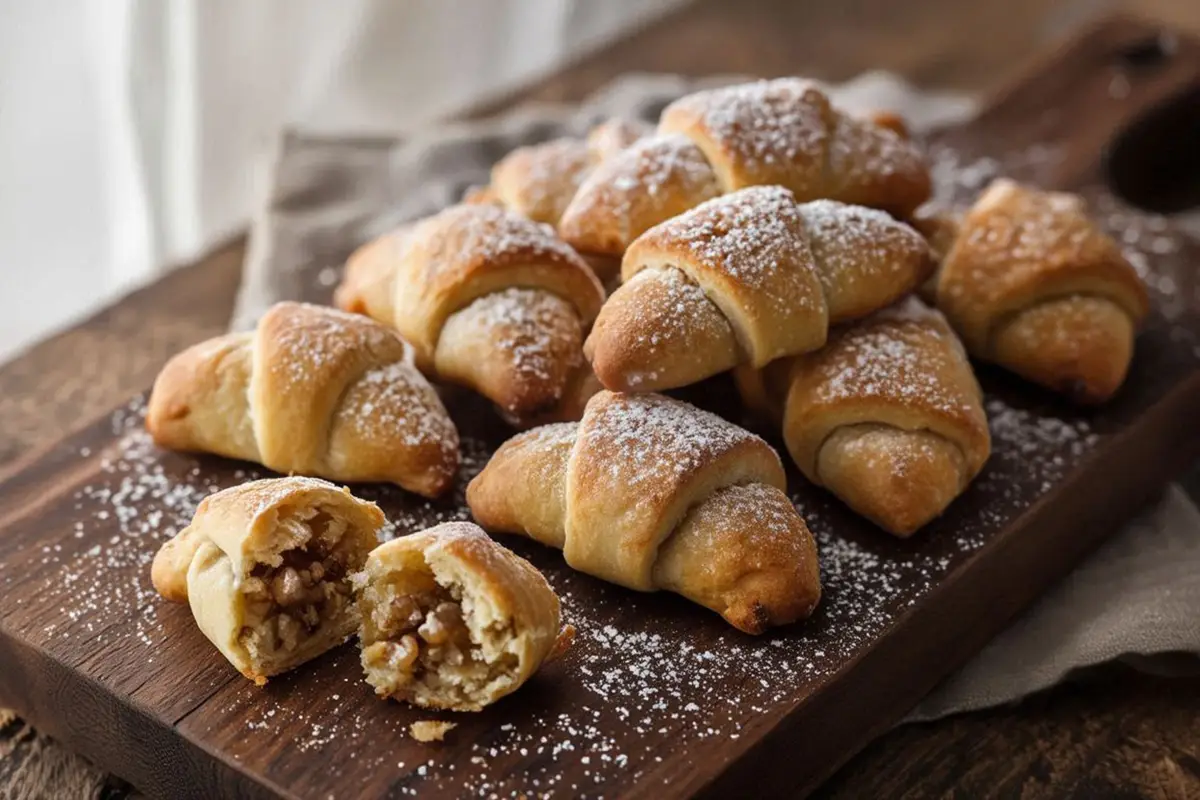
Tender yeast rolls enriched with sour cream and egg yolks, filled with a sweet walnut paste. A rich Central European pastry.
Quick Summary
Tender yeast rolls enriched with sour cream and egg yolks, filled with a sweet walnut paste. A rich Central European pastry.
Historical recipe
Modernised adaptation of an early 20th‑century source. Not independently kitchen-tested by Attic Recipes. Quantities, temperatures, and food safety guidance have been updated for a contemporary kitchen — results may vary and errors may exist. Nutritional values, where provided, are estimates only and have not been laboratory tested. Always follow current food safety guidelines for your region. If you have a health condition, allergy, or dietary requirement, consult a qualified professional before preparing this recipe.
Use of this recipe is entirely at your own risk and subject to our Terms of Service and Privacy Policy. Attic Recipes accepts no liability for any adverse outcome.
- Dairy
- Eggs
- Gluten
- Tree Nuts
Additional notes
-
Caution
Hot sugar work: The walnut filling becomes extremely hot during cooking. Avoid skin contact to prevent burns.
-
Caution
Contains egg yolks. Ensure rolls are baked until golden to reach safe internal temperatures.
If serving to immunocompromised individuals, substitute the egg white glaze with a light brush of milk.
-
Caution
Contains tree nuts (walnuts, optionally almonds). Not suitable for those with tree nut allergies.
For a nut-free version, substitute the walnut filling with a thick jam or poppy seed filling.
- 1
Crumble the fresh yeast into 30ml of warm milk (37°C). Add a pinch of salt, stir gently, and leave to activate for 8–10 minutes until foamy.
Tip If using active dry yeast, add 1 teaspoon of the powdered sugar to help it activate. - 2
In a large bowl, beat the 5 egg yolks with 2 tablespoons of powdered sugar until pale and slightly thickened. Add the 4 tablespoons of sour cream and the beaten softened butter, mixing well after each addition.
Tip The butter must be truly soft — if it's too cold it will create lumps in the dough. - 3
Add the activated yeast mixture to the egg mixture. Gradually incorporate the 500g of flour, mixing until a soft, slightly sticky dough forms.
Tip This is an enriched dough — it should be soft and pliable, not stiff. Resist adding too much flour. - 4
Turn the dough onto a lightly floured board. Knead briefly (2–3 minutes) just to smooth it out. Cover with a clean cloth and rest for 10 minutes.
- 5
While the dough rests, make the filling: combine the 140g ground walnuts, 140g sugar, and 50ml milk in a small saucepan. Cook over medium heat, stirring constantly, until the mixture thickens into a spreadable paste, about 5–7 minutes. Remove from heat and cool completely.
Tip The filling must be fully cooled before use — warm filling will melt the dough when rolling. - 6
Preheat the oven to 185°C (365°F) or 165°C (330°F) for fan ovens. Butter the baking sheet.
- 7
Roll the dough out on a floured surface to about 4–5mm thickness. Cut into squares, approximately 8x8cm.
Tip Work quickly — this enriched dough softens fast in a warm kitchen. Chill briefly if it becomes too soft to handle. - 8
Place a small spoonful of cooled walnut filling in the center of each square. Fold the corners over the filling and roll or pinch into a small roll shape. Place seam-side down on the prepared baking sheet.
- 9
Brush each roll lightly with beaten egg white. Sprinkle with ground almonds or walnuts.
- 10
Bake for 20–25 minutes until deep golden brown.
Tip Watch carefully from 18 minutes — the high butter and egg yolk content means these brown quickly. - 11
Remove from the oven and immediately dust generously with vanilla sugar while still hot so it adheres.
Nutrition Information per 1 roll (approx. 43g)
Nutritional values are approximate estimates and may vary based on specific ingredients used, preparation methods, and portion sizes.
Serving Suggestions
Serve the same day, slightly warm or at room temperature. Excellent with strong coffee or tea. The rolls also freeze well — cool completely, freeze in a single layer, then store in a sealed bag for up to one month. Dust with fresh vanilla sugar after thawing.
About This Recipe
If you are looking for the perfect delicate sweet after coffee, these small, golden rolls are exactly what you need. They are built on one of the most forgiving and satisfying enriched doughs in the Central European baking tradition — softened butter, egg yolks, and sour cream worked into a yeast dough for a crumb that is tender almost to the point of flaking. The walnut filling, boiled down with sugar and just a little milk, sets dense and fudgy inside each roll, a perfect contrast to the pillowy dough around it.
Why It Works
The combination of sour cream and egg yolks in the dough serves a dual purpose: the fat from the yolks enriches the crumb and slows gluten development, while the acidity in the sour cream tenderizes the dough further and adds a very faint tang that keeps the sweetness from being cloying. The short rest of 10 minutes — rather than a full proofing rise — is characteristic of quick-enriched pastry of this period, producing a denser, more biscuit-like structure than a fully proofed roll.
The walnut filling is deliberately dry. With only 50ml of milk to the ground walnuts and sugar, it cooks down into a paste that holds its shape when the dough folds around it, preventing the rolls from becoming soggy at the base during baking.
Make-Ahead Notes
The dough can be made the evening before and refrigerated overnight after the 10-minute rest, covered tightly. Cold dough is actually easier to roll and cut cleanly. Allow 15 minutes at room temperature before rolling. The walnut filling can also be made a day ahead and stored covered in the refrigerator.
The Story Behind This Recipe
Historical Context
Enriched yeast doughs made with egg yolks, sour cream, and generous amounts of butter were a hallmark of Central European middle-class baking. The technique of resting the dough briefly rather than allowing a long rise reflects a style of quick-enriched pastry common in early 20th century home kitchens, where time and practicality shaped the recipe.
Modern Kitchen Adaptation
The original use of fresh yeast remains the best choice here for flavor and lift. Active dry yeast works as a substitute. The walnut filling is deliberately concentrated to produce a dense, fudgy paste, which prevents the rolls from becoming soggy during baking.
This recipe is an independent modern adaptation developed from historical sources in the public domain. It is provided for informational and educational purposes only and does not constitute professional dietary, nutritional, or medical advice. Food preparation involves inherent risks. The reader assumes full responsibility for safe food handling, ingredient sourcing, and adherence to current local food safety guidelines. The site operator accepts no liability for outcomes resulting from the preparation or consumption of this recipe.
One recipe.
Every week.
You Might Also Like
More recipes from the same category
Almond Gurabije Cookies
Small lemon-scented cookies made with lard and egg yolk, indented in the center, coated in whipped egg white, and rolled in sugar and chopped almonds.
Velvet Apple & Meringue Gratin
A decadent vintage dessert featuring apples slow-cooked in a butter-sugar syrup, topped with a cloud of lemon-scented meringue.
Apricot Cream Torte
Traditional apricot cream cake combining sponge, vanilla custard, and meringue for a timeless European flavor.