Sour Soup (Kisela Čorba)
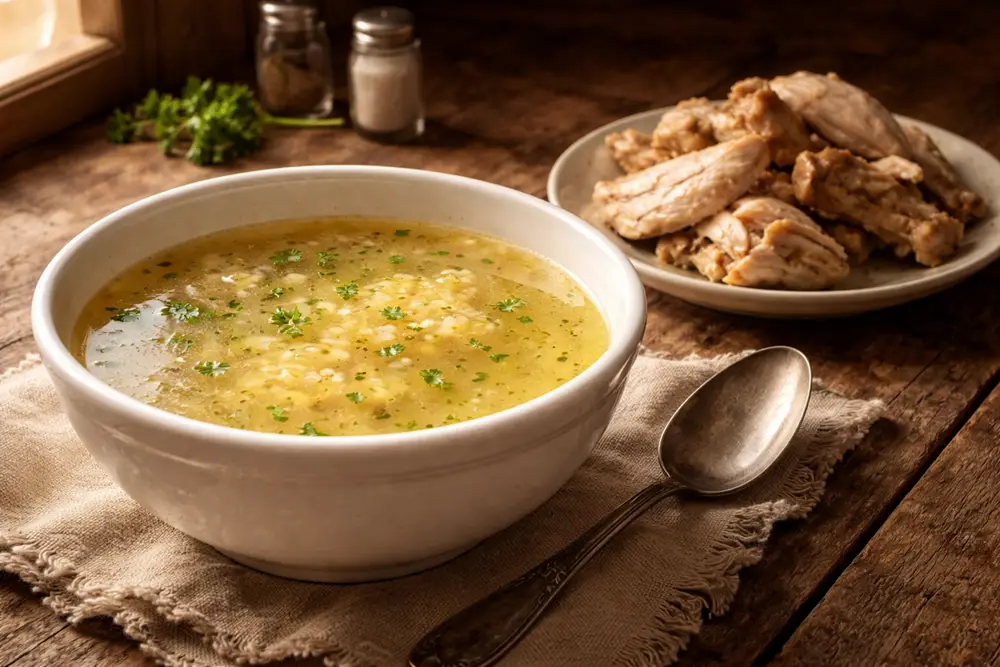
A clear poultry broth thickened with egg yolks and mileram, sharpened with wine vinegar or lemon juice, served with rice and meat on the side.
Quick Summary
A clear poultry broth thickened with egg yolks and mileram, sharpened with wine vinegar or lemon juice, served with rice and meat on the side.
Historical recipe
Modernised adaptation of an early 20th‑century source. Not independently kitchen-tested by Attic Recipes. Quantities, temperatures, and food safety guidance have been updated for a contemporary kitchen — results may vary and errors may exist. Nutritional values, where provided, are estimates only and have not been laboratory tested. Always follow current food safety guidelines for your region. If you have a health condition, allergy, or dietary requirement, consult a qualified professional before preparing this recipe.
Use of this recipe is entirely at your own risk and subject to our Terms of Service and Privacy Policy. Attic Recipes accepts no liability for any adverse outcome.
- Eggs
- Dairy
- Celery
Additional notes
-
Warning
This recipe uses egg yolks finished in hot broth. The liaison does not reach 74°C (165°F) — the safe minimum for egg-thickened sauces. Pregnant women, elderly individuals, immunocompromised persons, and young children should use pasteurised egg yolks.
Pasteurised liquid egg yolks (available in most supermarkets) can be substituted in equal quantity with no change to the method.
-
Note
This recipe contains celery, a declared EU allergen under Regulation 1169/2011. The celery is used in the stock and strained out before serving, but trace amounts may remain in the broth.
- 1
Place the 500g chicken pieces in a large stockpot. Cover with 1500ml cold water — the meat should be fully submerged. Bring to a gentle boil over medium heat. As foam rises to the surface, skim it off continuously with a spoon until no more appears, approximately 5–8 minutes.
Tip Starting in cold water draws more flavour into the broth. Do not rush to a rolling boil — a gentle simmer produces a clearer stock. - 2
Add the 30g parsley sprigs, 80g celery, 100g carrot, 80g parsnip, whole yellow onion, 5 peppercorns, and the dried pepper pod if using. Reduce heat to a low, steady simmer. Cook uncovered for 60–75 minutes until the meat is completely tender and easily pulls away from the bone.
- 3
Once the meat is cooked through, add 1 tsp salt. Taste and adjust. Carefully ladle out 150ml of hot broth into a small saucepan for cooking the rice.
- 4
Add the 60g white rice to the 150ml hot broth in the small saucepan. Bring to a boil, then reduce to a low simmer. Cook for 20 minutes until the rice is fully cooked and has absorbed most of the broth. Set aside.
- 5
Remove the chicken pieces from the stockpot. Arrange the meat on a separate serving dish, cover loosely to keep warm. Strain the remaining broth through a fine-mesh strainer into a clean pot, discarding the spent vegetables. The broth should be clear and golden.
- 6
Allow the strained broth to cool slightly — it should be very hot but not at a rolling boil. In a heatproof serving bowl, place the 2 egg yolks. Add 1 tbsp wine vinegar or lemon juice and whisk well until fully combined. Gradually whisk in 2–3 tbsp of the warm (not boiling) broth to begin tempering the yolks.
Tip The broth added in this step should be warm, not scalding — use broth that has been sitting for 2–3 minutes off the heat. This protects the yolks from curdling before the full liaison is formed. - 7
Add the 60ml mileram to the tempered yolk mixture and whisk until smooth and fully incorporated. Then, while whisking constantly, slowly pour the remaining hot broth through the strainer and into the yolk-mileram mixture in a thin, steady stream. Do not stop stirring.
Tip If the broth is too hot and the eggs begin to scramble, the soup cannot be rescued. When in doubt, let the broth cool an extra minute before pouring. - 8
Add the cooked rice to the finished soup and stir gently to combine. Taste and adjust seasoning — a little more vinegar or lemon juice can be added at this stage for a sharper finish. Serve immediately in warmed bowls, with the meat arranged separately on the side.
Nutrition Information per 1 serving (approx. 350ml soup + rice + meat portion)
Nutritional values are approximate estimates and may vary based on specific ingredients used, preparation methods, and portion sizes.
Serving Suggestions
Serve the soup in warmed deep bowls with rice already added. The meat is traditionally arranged on a separate plate and served alongside — not submerged in the soup. A slice of crusty white bread is the standard accompaniment. A small additional drizzle of wine vinegar at the table allows guests to adjust sourness to taste.
About This Recipe
This is a broth that finishes itself with egg yolks and sour cream — a liaison that turns a straightforward poultry stock into something silky, lightly sour, and more substantial than it looks. No flour, no starch, no cream stirred in at the start. The body comes entirely from the yolks and mileram whisked into the hot broth at the end.
The sourness is the point. Wine vinegar or lemon juice is added directly to the yolk mixture before tempering, so the acid is distributed throughout the soup rather than sitting on the surface. The result is a broth that is neither sharp nor mild but somewhere precisely in between — the kind of balance that is easy to eat a full bowl of without noticing how rich it is.
The meat is served separately, on its own plate alongside the soup. This is not incidental — it keeps the broth clear and prevents the chicken from overcooking in the liquid while guests are eating.
Why It Works
The liaison technique — egg yolks whisked with a small amount of warm broth before the full volume is added — is a thermal management step. Raw egg yolks begin to scramble at around 70°C. A pot of simmering stock is well above this. Adding yolks directly to boiling broth produces scrambled eggs, not a smooth soup.
Tempering works by raising the temperature of the yolks gradually. A small amount of warm broth brings the yolks up to a temperature where they can receive more heat without curdling. By the time the full volume of broth is added, the yolks are warm enough to blend rather than seize. The mileram — with its fat and protein — provides additional buffer, further slowing the rate at which the proteins tighten.
The vinegar or lemon juice does two things: it adds the sourness the recipe is named for, and its acidity slightly stabilises the egg proteins, making the liaison marginally more resistant to curdling. This is the same principle behind adding a small amount of acid to custards.
Modern Kitchen Tips
A fine-mesh strainer is important here — the broth must be clear before the liaison is added. A cloudy, vegetable-heavy broth makes it harder to judge the final texture and muddies the clean sourness of the finished soup.
If the liaison begins to show small flecks of cooked egg, strain the finished soup through a fine sieve before serving. It will not be smooth, but it will be salvageable.
The soup does not reheat well once the liaison has been added — the yolks will scramble on a second heating. Make only as much as will be eaten immediately. The plain strained broth keeps refrigerated for 3 days and can be reheated and finished with a fresh liaison to order.
A festive soup from early 20th century Central European home cooking — built on patience, a good stock, and the precise moment when hot broth meets cold yolk.
The Story Behind This Recipe
Historical Context
Home cooks of the period described this as 'our national soup' — the dish that opened every festive lunch without exception, valued even by those unfamiliar with the cuisine. The technique of finishing a broth with egg yolks and sour cream was standard in middle-class Central European households of the era, producing a soup that is neither fully clear nor cream-based but something in between — silky, lightly sour, and rich without being heavy. The original gave no quantities for any ingredient except the egg yolks (two) and the rice ratio (two and a half parts broth to one part rice). All other amounts were left to the cook's experience. Poultry mince (živinski sitnež) was listed alongside whole chicken and turkey as a valid base — useful for using up trimmings.
Modern Kitchen Adaptation
All ingredient quantities except the egg yolks and rice ratio are estimated from period practice and standard stock ratios; all are marked accordingly. The tempering step — whisking a small amount of warm broth into the yolks before adding the full volume — is essential for food safety and texture and is not described explicitly in the original. The original instructs to pour the broth directly onto the yolks while stirring; the modern approach reverses this (yolks into broth gradually) for greater control. Mileram may be replaced with full-fat plain sour cream or crème fraîche in equal quantity.
This recipe is an independent modern adaptation developed from historical sources in the public domain. It is provided for informational and educational purposes only and does not constitute professional dietary, nutritional, or medical advice. Food preparation involves inherent risks. The reader assumes full responsibility for safe food handling, ingredient sourcing, and adherence to current local food safety guidelines. The site operator accepts no liability for outcomes resulting from the preparation or consumption of this recipe.
One recipe.
Every week.
You Might Also Like
More recipes from the same category
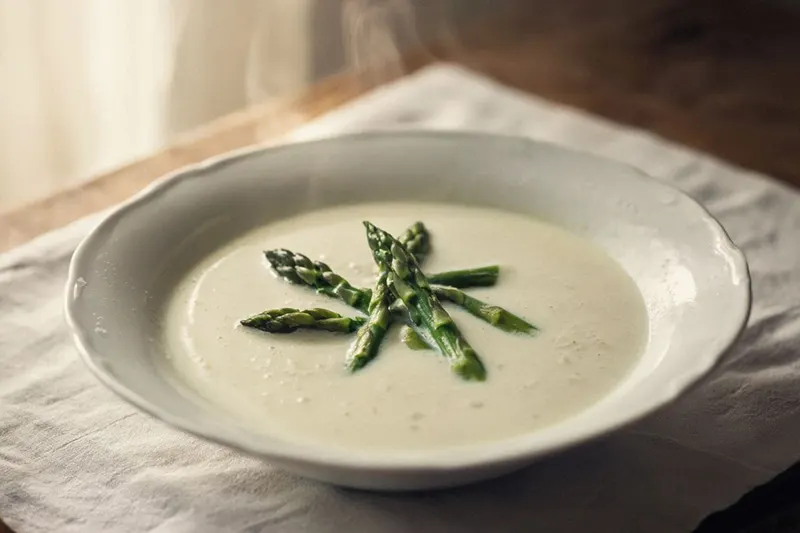
Asparagus Tip Soup
A silky, cream-enriched asparagus soup built on a white roux and finished with tempered egg yolks — an elegant first course from early 20th century cooking.
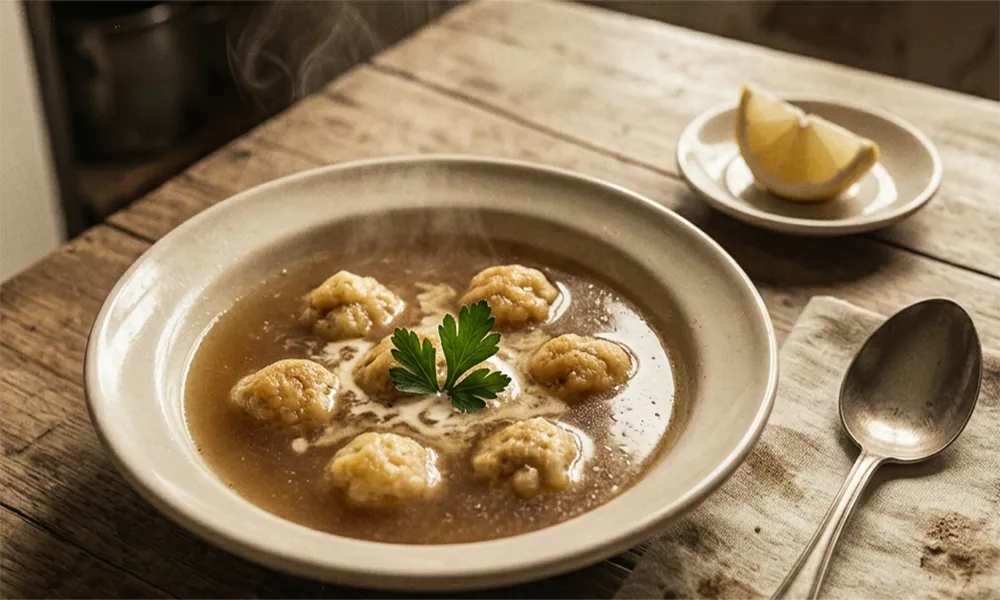
Beef Broth with Stuffed Dough Dumplings
Rich beef bone broth simmered with golden pan-fried dumplings stuffed with seasoned ground beef, finished with a light roux and fresh lemon juice.
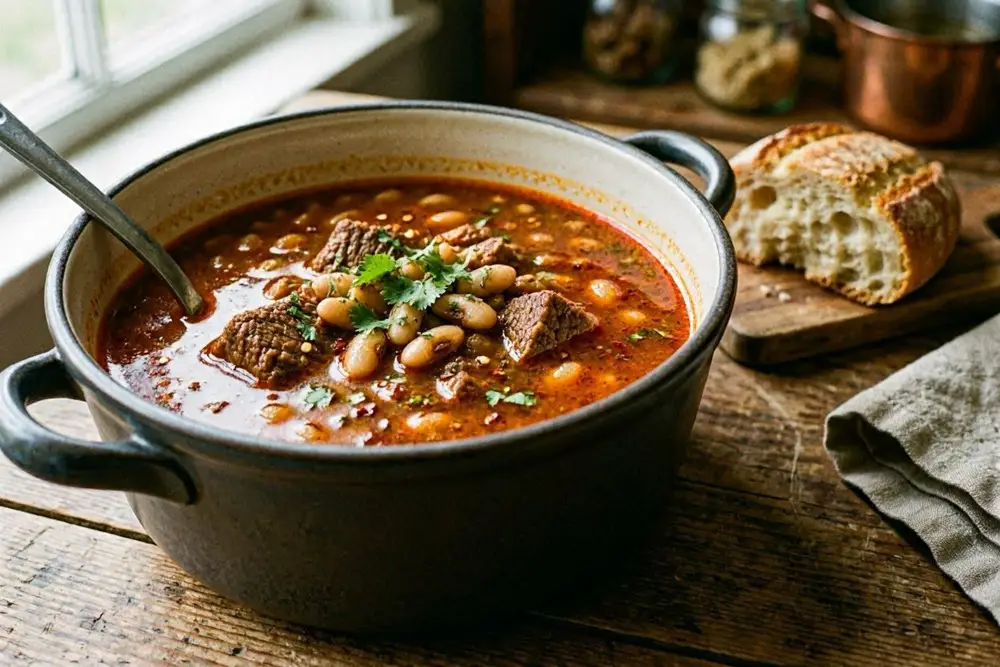
Bean Soup Cooked with Beef
White beans and beef shoulder slow-simmered with a bouquet garni, finished in the oven with a paprika-spiced pan roux. A deeply satisfying one-pot meal.