Veal Sweetbread and Caul Fat Soup
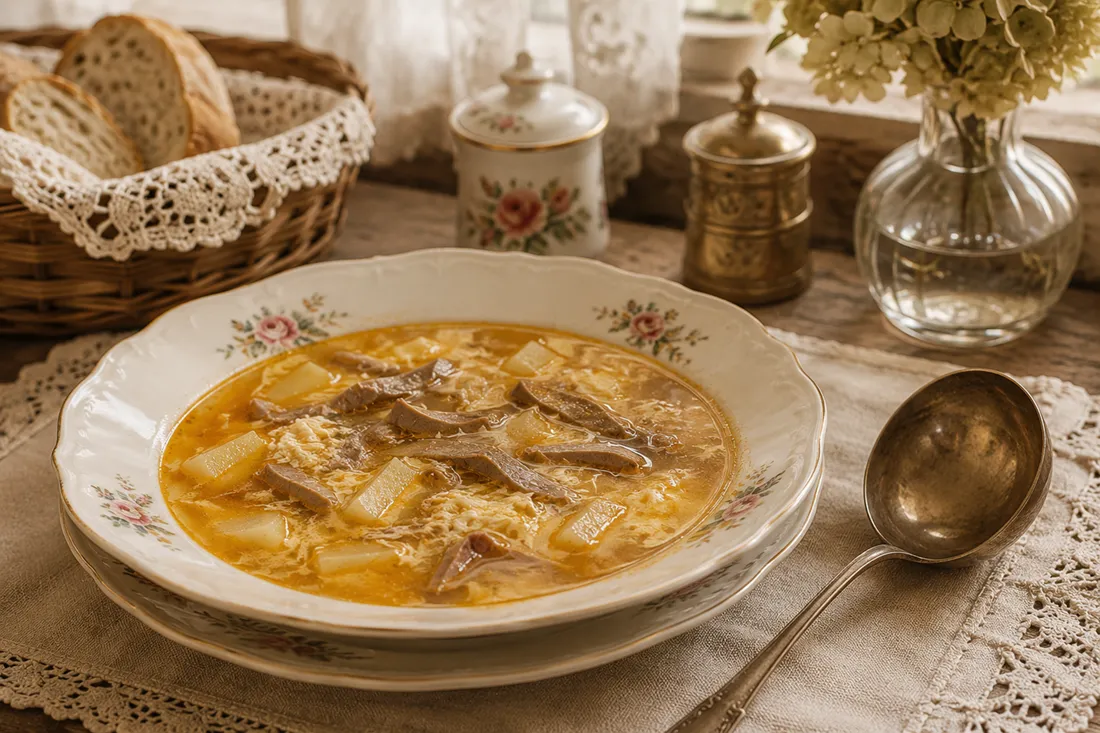
A rich, traditional soup of veal sweetbreads and caul fat with root vegetables and a light roux, finished with egg yolk and sour cream.
Quick Summary
This Central European offal soup simmers soaked veal sweetbreads and caul fat with root vegetables and a paprika roux. Taking 90 minutes to prepare, it is finished with a tempered egg yolk and sour cream mixture for a rich, silky broth.
Historical recipe
Modernised adaptation of an early 20th‑century source. Not independently kitchen-tested by Attic Recipes. Quantities, temperatures, and food safety guidance have been updated for a contemporary kitchen — results may vary and errors may exist. Nutritional values, where provided, are estimates only and have not been laboratory tested. Always follow current food safety guidelines for your region. If you have a health condition, allergy, or dietary requirement, consult a qualified professional before preparing this recipe.
Use of this recipe is entirely at your own risk and subject to our Terms of Service and Privacy Policy. Attic Recipes accepts no liability for any adverse outcome.
- Eggs
- Dairy
- Gluten
Additional notes
-
Warning
The egg yolk and sour cream mixture must be properly tempered with hot broth, then briefly reheated (without boiling) to ensure it reaches a safe temperature throughout. Raw or undercooked egg poses a food safety risk, particularly for pregnant women, young children, older adults, and immunocompromised individuals.
-
Caution
Sweetbreads and caul fat are highly perishable organ meats. Use the freshest product available, ideally purchased the same day or the day before cooking, and don't leave either at room temperature longer than necessary during preparation.
-
Note
This soup is very high in fat and cholesterol, largely from the caul fat and sweetbreads. Those managing cholesterol or fat intake may want to keep portions moderate, or skim rendered fat from the broth before serving.
- 1
Place the sweetbreads and caul fat in a bowl of cold water. Refrigerate and soak for 1-3 hours, changing the water once or twice, to draw out blood and impurities.
Tip This step isn't in the original method, which calls only for a quick rinse in hot water. A longer cold soak gives a cleaner-tasting, paler broth and is standard modern practice for organ meats — don't skip it. - 2
Drain, then briefly rinse the sweetbreads and caul fat under hot water.
- 3
Place both in a large pot and cover with the {0003}. Bring to a boil, then simmer for a minimum of 30 minutes.
- 4
Add the {0004}, {0005}, and {0006} to the pot. Season with the {0007}.
- 5
Meanwhile, make the roux: melt the {0008} in a small saucepan, add the {0009}, and cook over low heat, stirring, until lightly golden — not browned.
Tip This is a light soup roux, not a dark one. Keep the heat gentle so the flour doesn't scorch. - 6
Add the {0010} and {0011} to the roux and stir briefly, just until fragrant.
Tip Take the pan off the heat before adding the paprika if it's browning quickly — scorched paprika turns bitter. - 7
Whisk in enough cold water to loosen the roux into a smooth, pourable slurry, then stir it into the pot with the sweetbreads and vegetables.
- 8
Once the roux is added, keep the soup at a gentle simmer — do not let it boil hard. Cook for up to 30 minutes more, until the sweetbreads are tender.
- 9
In a mixing bowl or the serving bowl, whisk together the {0012}, {0013}, and {0014}.
- 10
Ladle a small amount of the hot soup into the egg-and-cream mixture first, stirring constantly, then gradually add the rest of the soup in a thin stream, stirring the whole time.
Tip This tempering step is what keeps the yolk from scrambling or curdling. Never pour the egg-and-cream mixture directly into the boiling pot. - 11
Return the tempered soup to low heat and warm through gently for a minute or two, stirring — do not let it boil.
Tip This ensures the yolk is fully cooked through rather than just warmed, without curdling it. This step isn't in the original but is a safer modern practice whenever raw egg yolk is tempered into a hot liquid. - 12
Remove the sweetbreads and caul fat, slice into thin strips on a cutting board, and return to the soup.
- 13
Serve immediately, hot.
Nutrition Information per 1 bowl (approx 450-500g including broth)
Nutritional values are approximate estimates and may vary based on specific ingredients used, preparation methods, and portion sizes.
Serving Suggestions
Serve hot, immediately after slicing in the sweetbread and caul fat, with crusty bread on the side. Traditionally a first course rather than a standalone meal, given how rich it is.
About This Recipe
This soup asks something of the cook before it asks anything of a stove: sourcing. Veal sweetbreads and caul fat aren’t cuts most butchers keep on hand, which makes this less an everyday recipe and more an occasional one, built around ingredients that reward planning ahead.
Once you have them, the technique itself is a study in restraint. The sweetbreads and caul fat simmer gently with a classic trio of root vegetables, thickened only lightly with a paprika-tinted roux, and finished the way many soups of this style were — with a tempered mixture of egg yolk, sour cream, and a touch of vinegar stirred in at the very end, giving the broth a silky body without ever needing cream in bulk.
It’s a soup that rewards patience on both ends: in tracking down the ingredients, and in taking the final tempering step slowly enough to get it right.
Why It Works
Sweetbreads are glandular tissue, not muscle, which is why they behave so differently in the pot — they’re delicate, prone to breaking down if handled roughly, and benefit from a cold water soak beforehand to draw out blood that would otherwise cloud and darken the broth. Caul fat, being almost entirely fat with a lace-like membrane structure, renders slowly as it simmers, which is what gives this soup its characteristic richness without any cream added directly to the pot.
The tempering step at the end is doing real technical work, not just adding flavor. Egg yolk proteins begin to set around 65-70°C (149-158°F); poured directly into a simmering pot, they’d scramble into visible curds almost instantly. Introducing hot broth gradually, a little at a time, raises the yolk mixture’s temperature slowly enough that the proteins unfold and thicken smoothly instead of clumping — the same principle behind a custard or a hollandaise.
Modern Kitchen Tips
If your butcher can only get you caul fat as a full piece rather than a half, freeze the remainder tightly wrapped — it holds up well and is worth having on hand for other offal dishes. When tempering the egg mixture, work with the bowl close to the pot and pour in a slow, steady stream while whisking; rushing this step is the most common way to end up with visible curds in the finished soup.
A classic of early 20th century home cooking, preserved and adapted for the modern kitchen.
The Story Behind This Recipe
Historical Context
Dishes built around sweetbreads and caul fat reflect a period when no part of the animal went unused — these are two of the more delicate, quickly perishable organ cuts, prized rather than treated as an afterthought. The technique of finishing a roux-thickened soup with a tempered egg yolk and sour cream was a common way of the era to give a broth richness and a velvety texture without heavy cream. The traditional approach left several quantities — the salt, the paprika, the vinegar — to the cook's judgment, a common convention for seasoning at the time.
Modern Kitchen Adaptation
The most significant change from the original is food safety: this version adds a 1-3 hour cold water soak for the sweetbreads and caul fat before cooking, which draws out blood and impurities and gives a cleaner broth. The original goes straight from a quick hot-water rinse into the pot. The tempering step for the egg yolk and sour cream is also followed by a brief, gentle reheat — not part of the original — to make sure the yolk is fully cooked through rather than merely warmed, since it's never boiled directly. The caul fat quantity is estimated in grams, since the original measures it as a fraction of a whole caul rather than by weight. The amount of root vegetables is read here as two each of carrot, parsnip, and parsley root, since the original phrasing is ambiguous about whether it means two roots total or two of each. Salt, paprika, and vinegar quantities are all estimated from the original's 'to taste' and 'a little.' Note that this soup is naturally very high in fat and cholesterol, largely from the caul fat itself — skimming rendered fat from the surface before serving will noticeably reduce this if you prefer a lighter result.
This recipe is an independent modern adaptation developed from historical sources in the public domain. It is provided for informational and educational purposes only and does not constitute professional dietary, nutritional, or medical advice. Food preparation involves inherent risks. The reader assumes full responsibility for safe food handling, ingredient sourcing, and adherence to current local food safety guidelines. The site operator accepts no liability for outcomes resulting from the preparation or consumption of this recipe.
One recipe.
Every week.
You Might Also Like
More recipes you'll enjoy
Cold Beef Consommé
A fully clarified beef and chicken broth, simmered for hours and clarified with egg whites, then served ice-cold in cups without any garnish.
Veal Trotter Soup with Egg and Vinegar Finish
A rich, collagen-thickened soup made from slow-simmered veal trotters, finished with a tangy egg and wine vinegar mixture and served with toasted bread cubes.
Veal and Parmesan Soup Quenelles (Minestra)
Finely puréed veal and ham, enriched with Parmesan and a soft bread paste, formed into small dumplings and poached in hot broth for an elegant soup course.