The Disputed Origins of Ćevapčići: From Ottoman Kebap to a Regional Classic
Where grilled minced meat rolls trace back to, how the name traces to Ottoman-era Turkish, and why the dish varies across southeastern Europe.
Introduction
Few dishes travel as widely, and get claimed by as many kitchens, as the small grilled rolls of minced meat known today as ćevapčići. Order them in one country and they arrive short and plump; order them two borders over and they’re long and slender, served with a completely different set of accompaniments. The name itself is a clue to how the dish moved: it comes from a word that isn’t originally local to any of the places that now claim it as their own.
Understanding where this dish actually comes from means untangling several centuries of culinary exchange, and being honest about where the historical record gets thin. This post lays out what’s genuinely known, what’s widely believed but harder to pin down, and why the dish looks so different depending on where you order it.
From Kebap to Ćevapčići: Tracing the Name
The word “ćevap” derives from the Turkish “kebap,” meaning grilled or roasted meat, a term that entered the vocabulary of southeastern Europe during the centuries of Ottoman administration in the region. “Ćevapčići” is simply the diminutive form, meaning something closer to “little kebaps.” The linguistic path is well established and relatively uncontroversial: this is one of a large family of grilled and skewered meat dishes that spread through Ottoman-administered territory and were adapted locally over time, taking on new forms, ingredients, and names as they moved.
That linguistic clarity, though, doesn’t settle the question of exactly where the specific dish known today — small hand-shaped rolls of seasoned minced meat, grilled without skewers — first took its current form.
Where Did It Begin? A Contested Origin
Most food historians and regional sources point to Bosnia and Herzegovina as the place where this particular style crystallized, with the cities of Sarajevo and Banja Luka most often credited as early centers, each associated with its own distinct local style. That attribution is common enough to be treated as the closest thing to a consensus. It is not, however, an uncontested fact in the way a documented invention date would be — culinary dishes that spread through oral and domestic tradition rarely have a clean paper trail, and grilled minced meat in various forms appears in multiple food traditions across the region that were all under Ottoman influence during overlapping periods. The precise sequence of who adapted what from whom, and when, is genuinely difficult to reconstruct with certainty.
What’s clearer is what happened after: the dish spread widely enough, and became embedded deeply enough in home cooking and street food across multiple countries in the region, that it’s now considered a signature dish in several national culinary identities simultaneously rather than belonging exclusively to one.
Regional Variations: Length, Meat, and Accompaniments
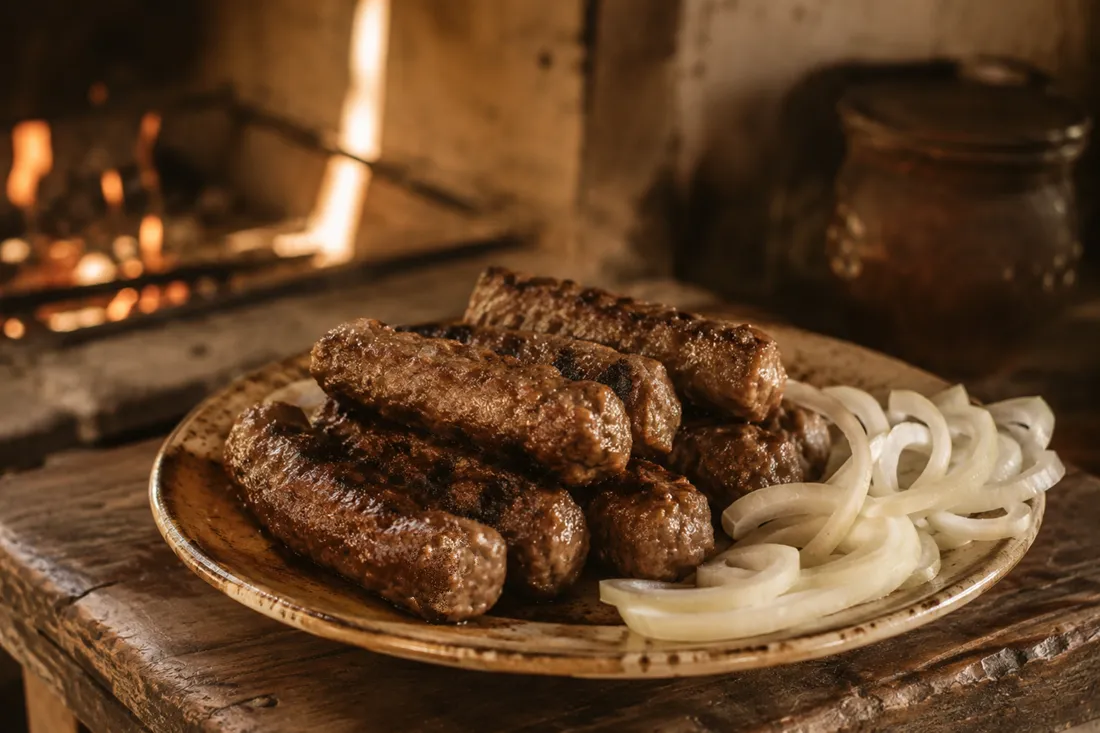
The differences between regional versions aren’t minor. Length is one of the most visible markers: Bosnian versions tend to run shorter, often around 5cm, while Serbian versions are typically longer, closer to 10cm, and versions found in Bulgaria and Romania can be longer still. Meat choice varies too — while beef-only or beef-and-pork blends are common today, historical versions across the region also used veal and lamb, often depending on what was locally available and on religious dietary practices in a given community.
Accompaniments follow the same pattern of local adaptation. Flatbread served alongside the meat goes by different names in different places — somun in some traditions, lepinja in others — and the condiments served with it range from raw onion and ajvar to kaymak or sour cream, each pairing reflecting local produce and taste rather than a single fixed formula.
Practical Takeaways
The short version: the name is Ottoman in origin, the dish most likely took its current form somewhere in Bosnia and Herzegovina, and from there it spread and diversified across the wider region to the point that no single country can fully claim it today. The exact when and how of that early spread is genuinely uncertain, and any account that states it with total confidence is oversimplifying a messier, more interesting history. What’s not in dispute is that the dish became, over generations, a fixture of home and street food across a wide stretch of southeastern Europe — which is exactly why it now comes in so many different shapes, sizes, and accompaniments depending on where you happen to be eating it.
Attic Recipes — digitizing and adapting Central European home cooking from the early twentieth century.
Frequently Asked Questions
01Where do ćevapčići originally come from?▶
Most historical sources point to Bosnia and Herzegovina, with Sarajevo and Banja Luka widely cited as early centers of the dish, though the exact origin is still debated among food historians.
02What does the name 'ćevapčići' mean?▶
It's a diminutive form of 'ćevap,' which itself comes from the Turkish word 'kebap,' meaning grilled or roasted meat — a term introduced to the region during the Ottoman period.
03Why are ćevapčići a different size in different countries?▶
Local tradition varies: versions in Bosnia and Herzegovina tend to be shorter, around 5cm, while Serbian versions are typically longer, closer to 10cm, and versions in Bulgaria and Romania can be longer still.
04What meat is traditionally used?▶
Beef is common today, but historical and regional versions also use veal, lamb, pork, or blends of these, depending on local availability and tradition.
05What are ćevapčići traditionally served with?▶
Common accompaniments include flatbread such as somun or lepinja, raw onion, and regional condiments like ajvar or kaymak, though exact pairings vary by country.