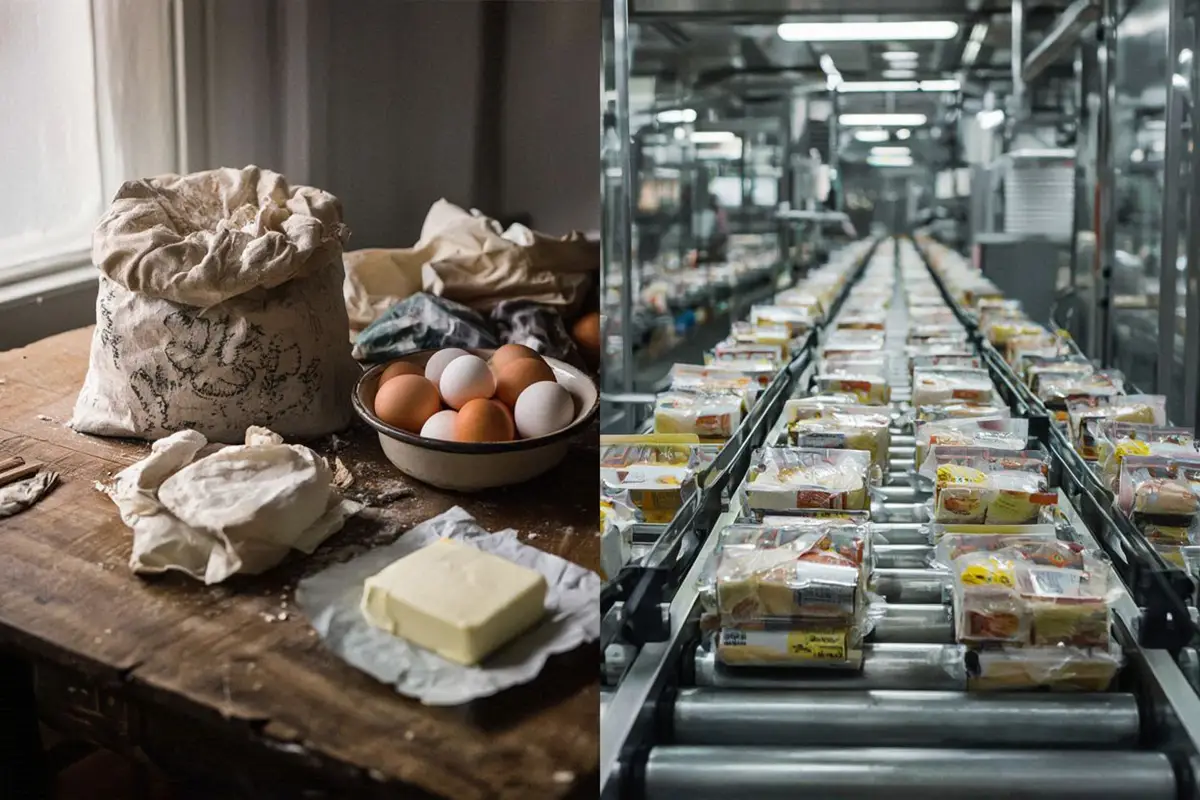
How Industrialization Changed What Is in Your Food
Between 1900 and 1980, the food supply changed more than in the previous thousand years. Here is what changed, how it happened, and what the evidence shows.
A Transformation Without a Single Cause
The food that most people in industrialized countries eat today would be largely unrecognizable to a cook working from an early 20th century recipe collection. Not in appearance — much of it is designed to look familiar — but in composition. The ingredients, the processes used to create them, and the proportion of the diet they represent have changed fundamentally over the course of the twentieth century.
This did not happen because of a single decision or a single technology. It happened as a series of overlapping developments — in chemistry, in agriculture, in refrigeration, in retail, in regulation — that accumulated into a transformation of the food supply that has no historical precedent in its speed or scale.
Understanding what changed, when, and why is not a nostalgic exercise. It is the necessary context for understanding why old recipes work the way they do, and why many of the ingredients they assume as a baseline are no longer the default.
The First Wave: Canning, Margarine, and Shelf Stability (1860s–1930s)
Industrial food processing began in the second half of the nineteenth century, driven primarily by military logistics and the need to feed growing urban populations that were increasingly disconnected from food production.
Canning, developed in the early 1800s and industrialized after the American Civil War, made it possible to preserve food for months or years without salt, smoke, or fermentation. It was a genuine technological achievement that also changed what food tasted and behaved like — canned vegetables are softer, more uniform, and nutritionally different from fresh ones, with heat-sensitive vitamins reduced during processing.1
Margarine, invented in France in 1869 as a cheaper substitute for butter, was originally made from beef tallow and skimmed milk. It bore little resemblance to the partially hydrogenated vegetable oil margarines that became common in the mid-twentieth century. Its introduction established the principle — which would become central to food industrialization — that manufactured substitutes for whole foods could be sold on price and shelf stability grounds regardless of compositional differences.
By the 1930s, when the cookbook that underlies this site was written, these technologies existed but had not yet displaced traditional food at the household level in Central Europe. The cookbook assumes whole ingredients because those were still what most households worked with.
Hydrogenation: The Fat That Changed Everything (1900s–1960s)
The single chemical process with the largest impact on the twentieth-century food supply was hydrogenation — the addition of hydrogen to unsaturated vegetable oils under pressure in the presence of a metal catalyst, converting liquid oils into solid or semi-solid fats.
The process was developed by German chemist Wilhelm Normann, who conducted his first successful experiment in 1901 and received the German patent in 1902. Procter & Gamble acquired the U.S. rights to the process in 1909 and in June 1911 launched Crisco — the first shortening made entirely from hydrogenated vegetable oil, originally cottonseed oil — marketing it as a healthier and more economical alternative to lard and butter.2
Hydrogenation solved two problems for food manufacturers: it made cheap vegetable oils behave like solid animal fats at room temperature, and it dramatically extended shelf life by reducing the oxidation that makes liquid oils go rancid.
The health implications took decades to become clear. Partial hydrogenation produces trans fatty acids — geometric isomers of naturally occurring unsaturated fats — that are not found in significant quantities in natural foods. Research beginning in the 1990s established that industrial trans fats raise LDL cholesterol, lower HDL cholesterol, and increase cardiovascular disease risk more than any other dietary fat, including saturated fat.3
The regulatory response was slow. Denmark banned industrial trans fats in 2003. The United States FDA declared partially hydrogenated oils no longer Generally Recognized As Safe only in 2015, with full compliance required by 2020.4 During the intervening decades — roughly 1950 to 2000 — partially hydrogenated vegetable oils were a dominant ingredient in processed foods across the industrialized world, present in margarine, baked goods, fried foods, crackers, and many other products, often replacing the animal fats that earlier generations had used without apparent harm.
The irony is precise: the replacement of traditional animal fats with industrially processed vegetable fats — promoted as a health improvement — produced a dietary fat with demonstrably worse health outcomes. The animal fats in old recipes were displaced by a technology whose risks were not understood at the time of its adoption.
Refined Seed Oils: A Different Problem (1950s–present)
Separate from hydrogenation, the widespread adoption of refined seed oils — soybean, corn, sunflower, cottonseed — as cooking and manufacturing fats represents a different change in the fat composition of the diet.
These oils are high in polyunsaturated fatty acids, particularly omega-6 linoleic acid. Consumption of omega-6 fatty acids has increased dramatically in industrialized countries over the twentieth century, while omega-3 consumption has remained relatively stable or declined, shifting the omega-6 to omega-3 ratio from an estimated historical range of roughly 1:1 to 4:1, to ratios of 15:1 to 20:1 in typical modern Western diets.5
Whether this shift has health consequences is an area of active research and genuine scientific debate. Some studies associate high omega-6 intake with increased inflammation markers; others do not find this effect at typical dietary levels. This is contested territory and should be understood as such — not as settled science in either direction.6
What is not contested is that the fat composition of the food supply changed substantially and rapidly in the twentieth century, in ways that have no precedent in prior human dietary history.
Sugar: Quantity and Form (1800s–present)
Sugar consumption in Europe and North America has increased continuously since the early 1800s, when the industrialization of sugar production from beet and cane made it cheap enough for general household use. The historian Sidney Mintz documented this trajectory in detail, describing how sugar moved from luxury item to everyday staple across the nineteenth century.7
The more recent development — beginning in the 1970s — is the introduction of high-fructose corn syrup (called glucose-fructose syrup in Europe), a liquid sweetener produced from corn starch by enzymatic conversion. It is cheaper than sucrose, easier to handle in industrial food production, and sweeter per unit volume. It became the dominant sweetener in soft drinks and many processed foods in North America, and a significant ingredient in processed foods globally.8
The health debate around high-fructose corn syrup specifically, versus sucrose, is ongoing and not fully resolved — the metabolic difference between the two at typical consumption levels remains contested. What is clearer is the trajectory: total added sugar in the diet increased substantially across the twentieth century, and the sources shifted from household sugar used in home cooking to sugar added invisibly during industrial food manufacturing, making it harder for individuals to track or control intake.
Old recipes use sugar as a deliberate ingredient in specific quantities for specific purposes. Ultra-processed foods contain added sugar as a manufacturing input in products where consumers do not expect it — bread, sauces, cured meats, condiments — at levels that accumulate across a day’s eating without being legible as “eating sugar.”
The NOVA Classification and Ultra-Processed Food (2009–present)
The most useful framework for understanding the transformation of the food supply is the NOVA classification, developed by Carlos Monteiro and colleagues at the University of São Paulo, first published in 2009 and refined subsequently.9
NOVA classifies foods into four groups based on the extent and purpose of processing, not nutrient content:
Group 1 — unprocessed or minimally processed foods: fresh, dried, or frozen meat, fish, vegetables, fruit, eggs, plain milk, plain yogurt, legumes, grains, nuts.
Group 2 — processed culinary ingredients: salt, sugar, oils, butter, flour, starch — substances extracted from Group 1 foods and used in cooking.
Group 3 — processed foods: products made by adding Group 2 ingredients to Group 1 foods — canned fish, cheese, cured meats, bread made with flour, salt, water and yeast.
Group 4 — ultra-processed foods: industrial formulations containing ingredients not found in home kitchens — hydrolyzed proteins, modified starches, emulsifiers, flavor enhancers, colorants, artificial sweeteners, interesterified fats — combined with Group 2 ingredients, with little or no Group 1 content.
It is worth noting that NOVA classifies foods by process, not by nutritional composition — meaning two products with similar nutrient profiles may fall into different groups depending on how they were made. This is a feature of the system’s design, not an oversight, but it means NOVA is a descriptive framework rather than a direct measure of health impact.
A growing body of epidemiological research associates ultra-processed food consumption with adverse health outcomes across multiple disease categories. A 2019 study in The BMJ following over 100,000 French adults found that a 10% increase in ultra-processed food consumption was associated with a significant increase in cardiovascular disease risk.10 A 2024 umbrella review in The BMJ, synthesizing evidence across 45 meta-analyses and nearly 10 million participants, found consistent associations between ultra-processed food consumption and adverse outcomes including cardiovascular disease, type 2 diabetes, obesity, depression, and all-cause mortality.11
These findings are epidemiological associations, not proven causal mechanisms. The GRADE quality-of-evidence assessment in the 2024 umbrella review rated most associations as “low” or “very low” — meaning the findings are consistent but the evidence base has limitations that prevent strong causal conclusions. The mechanism is not fully understood — it may involve specific additives, the food matrix, the displacement of whole foods, or combinations of these factors. What is notable is the consistency of associations across independent studies in different populations.
What Old Recipes Assumed That No Longer Exists
A 1930s recipe assumes certain things about its ingredients that are no longer automatically true.
It assumes that butter is butter — cream, cultured or not, churned. Today, products labeled “butter blend” or sold near butter may contain added vegetable oils or emulsifiers. It assumes that bread is flour, water, salt, and yeast, possibly fat. Industrial bread typically contains a range of additives — emulsifiers, enzymes, preservatives, sometimes added sugar — that extend shelf life and modify texture in ways home baking does not require. It assumes that lard is rendered pork fat. Commercial lard is often partially hydrogenated.
This is not alarmism. It is a factual description of how ingredient categories have changed. When following old recipes with the intention of replicating what they produced, ingredient sourcing matters in ways that would not have occurred to the original cook, because adulteration of basic ingredients was not then what it is now.
The most direct path to cooking from old recipes as intended is to use ingredients from Group 1 and Group 2 of the NOVA classification — whole or minimally processed foods, and basic culinary ingredients. This is not a dietary ideology. It is an ingredient specification.
Practical Takeaways
Four developments account for most of the compositional change in the twentieth-century food supply: the introduction of partially hydrogenated fats (now largely phased out, but present in the diet for roughly 70 years); the shift toward refined seed oils high in omega-6; the large increase in added sugar, much of it now invisible in processed products; and the rise of ultra-processed food as a food category. None of these changes was driven by evidence of safety — they were driven by cost, shelf life, and manufacturing convenience. The evidence of harm, where it exists, arrived decades later.
This post reflects current scientific understanding as of the publication date. The health effects of specific dietary changes remain an area of active research. Where findings are contested or preliminary, this is noted in the text. This post does not constitute medical or nutritional advice.
Sources
Footnotes
-
Rickman, J.C., Barrett, D.M. & Bruhn, C.M. (2007). Nutritional comparison of fresh, frozen and canned fruits and vegetables. Journal of the Science of Food and Agriculture, 87(6), 930–944. https://doi.org/10.1002/jsfa.2824 ↩
-
American Oil Chemists’ Society (AOCS). Wilhelm Normann (1870–1939). https://www.aocs.org/resource/wilhelm-normann-1870-1939/; American Oil Chemists’ Society (AOCS). The Battle Over Hydrogenation (1903–1920). https://www.aocs.org/resource/the-battle-over-hydrogenation-1903-1920/ ↩
-
Mozaffarian, D., Katan, M.B., Ascherio, A., Stampfer, M.J. & Willett, W.C. (2006). Trans fatty acids and cardiovascular disease. New England Journal of Medicine, 354(15), 1601–1613. https://doi.org/10.1056/NEJMra054035 ↩
-
U.S. Food and Drug Administration (2018). Final determination regarding partially hydrogenated oils. Federal Register, 83 FR 23358. https://www.federalregister.gov/documents/2018/05/21/2018-10714/final-determination-regarding-partially-hydrogenated-oils ↩
-
Simopoulos, A.P. (2002). The importance of the ratio of omega-6/omega-3 essential fatty acids. Biomedicine & Pharmacotherapy, 56(8), 365–379. https://doi.org/10.1016/S0753-3322(02)00253-6 ↩
-
Ramsden, C.E. et al. (2013). Use of dietary linoleic acid for secondary prevention of coronary heart disease and death. BMJ, 346, e8707. https://doi.org/10.1136/bmj.e8707 ↩
-
Mintz, S.W. (1985). Sweetness and Power: The Place of Sugar in Modern History. Viking Penguin, New York. ↩
-
White, J.S. (2008). Straight talk about high-fructose corn syrup: what it is and what it ain’t. American Journal of Clinical Nutrition, 88(6), 1716S–1721S. https://doi.org/10.3945/ajcn.2008.25825B ↩
-
Monteiro, C.A. et al. (2019). Ultra-processed foods: what they are and how to identify them. Public Health Nutrition, 22(5), 936–941. https://doi.org/10.1017/S1368980018003762 ↩
-
Srour, B. et al. (2019). Ultra-processed food intake and risk of cardiovascular disease. BMJ, 365, l1451. https://doi.org/10.1136/bmj.l1451 ↩
-
Lane, M.M. et al. (2024). Ultra-processed food exposure and adverse health outcomes: umbrella review of epidemiological meta-analyses. BMJ, 384, e077310. https://doi.org/10.1136/bmj-2023-077310 ↩
Frequently Asked Questions
01When did processed food become common?▶
The first wave of industrial food processing began in the late 19th century with canning and margarine production. The major shift happened between 1950 and 1980, when refrigeration became universal, supermarkets replaced local markets, and the range of chemically modified food ingredients expanded dramatically.
02What is the NOVA classification, and why does it matter?▶
NOVA is a system developed by researchers at the University of São Paulo that groups foods based on the extent and purpose of processing, rather than just nutrients. It ranges from Group 1 (unprocessed or minimally processed — fresh meat, vegetables, eggs) to Group 4 (ultra-processed foods manufactured from industrial ingredients with little or no whole food content, typically containing emulsifiers, flavor enhancers, colorants, and preservatives not found in home kitchens). It matters because it helps distinguish between simple mechanical processing and industrial formulation.
03Is processed food inherently unhealthy?▶
Not necessarily. Human history is defined by processing — fermenting, curing, milling, and cooking are all forms of processing that made food safer and more digestible. The distinction lies in the nature of the processing: traditional methods usually enhance a single ingredient, while ultra-processing often dismantles and reconstructs ingredients into something entirely new. The concern is not any single additive but the combination of many additives alongside high sugar, refined starch, and industrial fat — and the displacement of whole foods from the diet.
04Are all food additives harmful?▶
No. The category includes everything from salt and vinegar to synthetic compounds with complex chemical names. Some have long safety records; others have been restricted or banned after post-approval evidence of harm. The concern with ultra-processed food is not any single additive but the overall formulation and the displacement of whole foods from the diet.
05Did people in the 1930s eat ultra-processed food?▶
Rarely by today's standards. While the 1930s saw the rise of mass-produced pantry staples like canned goods and commercialized cereals, ingredient lists were significantly shorter and more recognizable. The industrial revolution of food processing had started, but it had not yet reached the stage of synthetic emulsifiers and flavorings found in today's supermarket aisles.
06Was food in the 1930s healthier?▶
Not categorically. Pre-industrial food had its own problems — contamination, nutritional deficiencies in poor populations, spoilage. But the specific risks of ultra-processed food, refined seed oils, and high added sugar did not exist in the same form. The question is not which era was healthier overall but which specific changes since then have had negative health consequences.
07How do early 20th-century recipes fit into the NOVA system?▶
Most recipes from that era fall into Group 1 or 2. Even when they called for commercial items like baking powder or refined sugar, these were additions to basic whole-food preparations. They lack the complex industrial additives that define modern ultra-processed foods, making them structurally closer to home-cooked meals than mass-produced snacks.
08Does this mean I should avoid all processed foods today?▶
Not at all. A jar of home-canned peaches or a bag of stone-ground flour is processed, but it is vastly different from a shelf-stable beverage filled with stabilizers. Understanding the difference allows you to enjoy modern convenience while maintaining the spirit of traditional, high-quality home cooking.