Antoine Parmentier and the Potato That Changed Everything
How a French pharmacist turned a prison food into Europe's most important crop — and why his story still matters in the kitchen.
Introduction
There is a soup named after a man. That alone should tell you something — it takes more than a good recipe to have your name attached to a dish across two centuries and a dozen languages. Antoine-Augustin Parmentier earned his place in culinary history not by cooking, but by persuading. He was a pharmacist, a soldier, and one of the most tenacious advocates food history has ever produced. The thing he was advocating for was the potato — a vegetable that most of Europe, at the time, refused to eat.
The story of how the potato moved from livestock feed to the center of the European table is, in large part, the story of one man’s stubbornness. Parmentier spent years as a prisoner of war in Prussia, kept alive on potato rations that his French contemporaries would have considered beneath them. He survived. And then, rather than putting the experience behind him, he spent the rest of his life trying to understand why the potato had sustained him so well — and how to convince an entire civilization to stop being afraid of it.
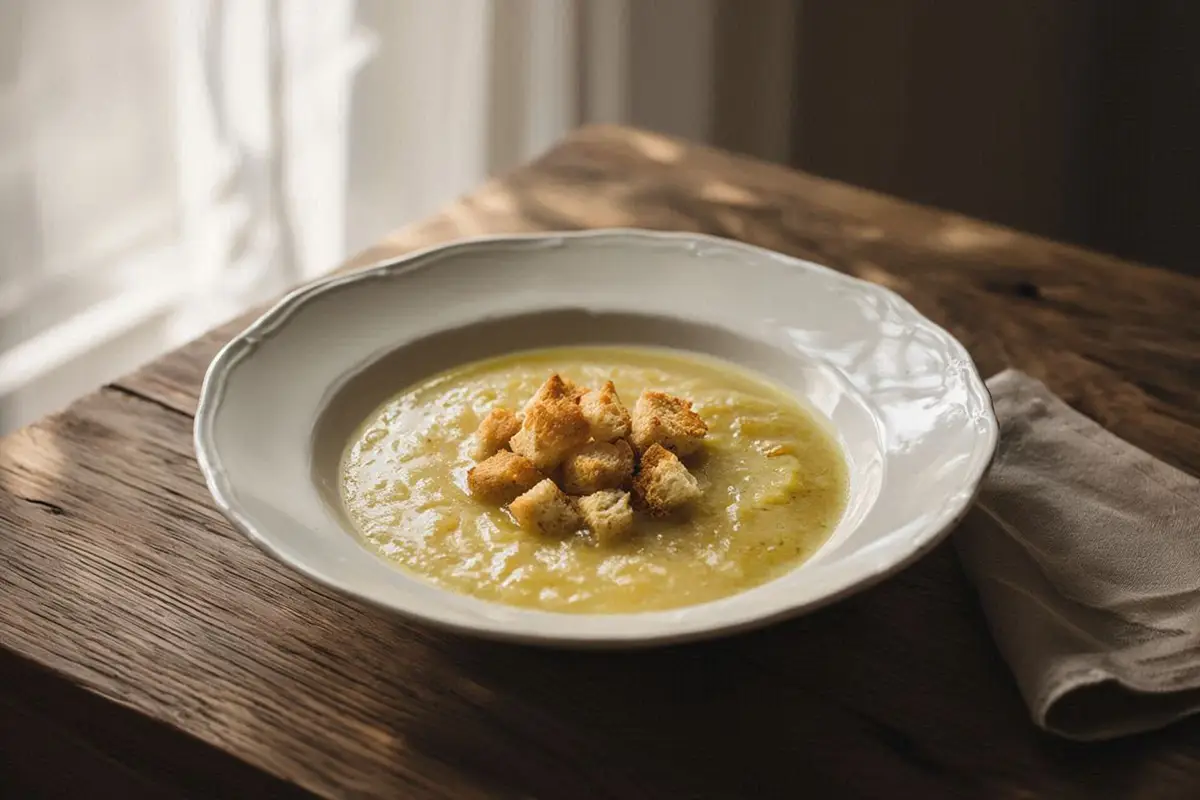
His name survives in the kitchen as both an adjective and a noun. Potage Parmentier — the simple, pure, golden soup of potatoes and leeks — is one of the foundations of classical French cuisine, and a direct descendant of the argument he spent his career making: that humble ingredients, treated with care, are enough.
A Prisoner of War and a Root Vegetable
Parmentier was born in 1737 in Montdidier, in northern France, and trained as a pharmacist — a profession that, in the 18th century, sat at the intersection of chemistry, medicine, and what we would now call nutrition science. When the Seven Years’ War broke out, he served as a military pharmacist and was captured by Prussian forces, spending time in several different camps between 1757 and 1763.
During his captivity, Prussian rations included potatoes as a regular component — something that would have been unusual to a Frenchman. France had, in 1748, officially banned the cultivation of potatoes, citing fears that they caused leprosy. The ban would remain in place until 1772. Parmentier ate the potatoes, did not develop leprosy, and noticed that he was, in fact, adequately nourished on them. This was not a small observation.
When he returned to France, he began serious research into the potato’s nutritional properties. He submitted a prize essay on its merits to the Académie de Besançon in 1772, won, and began what would become a lifelong campaign. The Académie’s prize question had been blunt: what foodstuffs could be used in times of scarcity to replace ordinary bread grain? Parmentier’s answer was equally blunt — the potato, which the French were throwing away.
The Art of Persuasion, 18th-Century Style
Convincing the French to eat potatoes required more than scientific papers. Parmentier understood this intuitively. He was not merely a researcher; he was, by any modern measure, a remarkably skilled communicator and strategist.
His tactics were varied and deliberate. He cultivated a friendship with King Louis XVI, who reportedly wore a potato flower in his buttonhole at a banquet — and Marie Antoinette is said to have worn them in her hair. Whether entirely true or partially embellished, the image did its work: if the royal court treated the potato blossom as an ornament, the vegetable itself could not be entirely low.
His most famous strategy involved a field. Parmentier obtained permission to plant potatoes on the Plaine des Sablons, a patch of infertile ground near Paris, under the protection of royal guards. During the day, the guards were visible and the field appeared protected — valuable property, by implication. At night, Parmentier ensured the guards were withdrawn. Locals, curious about what was worth guarding, came to investigate. They found potatoes. They took them. They planted them. Whether it reads as manipulation or as a beautifully engineered demonstration, the result was the same: potatoes began appearing in Parisian gardens.
He also hosted dinners at which potato dishes were served across every course — potato bread, potato soup, potato dessert — to demonstrate range and palatability. Benjamin Franklin attended at least one such dinner. Thomas Jefferson, who had tasted pommes frites in France, later introduced them to American guests at Monticello. The ripple effects of a single man’s campaign are difficult to trace, but they are measurable.
Why It Mattered Beyond France
The potato’s acceptance in France mattered because France, in the late 18th century, carried enormous cultural weight across Europe. What Parisian tables validated tended to spread.
But the deeper significance was nutritional and agricultural. The potato produces more calories per acre than any grain crop that was then widely grown in Europe. It grows in soils and climates where wheat fails. It stores through winter. It is rich in vitamin C — a fact that would not be understood biochemically for another century, but which sailors and soldiers noticed empirically: populations eating potatoes showed fewer signs of scurvy and general nutritional deficiency.
During the famines and disruptions of the late 18th and early 19th centuries — and there were many, across the continent — the potato became not just an option but a lifeline. In Ireland, its dominance became so complete that the eventual failure of a single variety would bring catastrophe. But in Central Europe, in the Balkans, in mountain communities where grain harvests were unreliable and winters long, the potato arrived as something genuinely salvific.
It arrived in these regions later and more quietly than in the West — carried not by royal campaigns but by practical necessity, by Ottoman administrative agriculture, by Austrian influence in the northern territories, by seeds passed between neighbors when a harvest failed and something had to grow. By the early 20th century, when the recipes in our archive were written down, the potato was already old and native-feeling in these kitchens. The women who wrote those recipes did not think of it as a foreign crop. They thought of it as food.
The Soup and What It Represents
Potage Parmentier is a study in restraint. Potatoes, leeks, water or stock, salt. Cooked until soft, puréed until smooth, finished with a little butter or cream. Nothing is hidden and nothing is wasted. It is the soup of a man who believed that what is plain and nourishing is also, when prepared with attention, what is best.
Julia Child, who understood French cuisine as a system of principles rather than a collection of recipes, gave potage Parmentier its definitive modern form in Mastering the Art of French Cooking. Her version — four ingredients, one pot, forty minutes — became the benchmark precisely because it left nowhere to hide. The quality of the potato and the leek determine everything.
The version in our archive, reconstructed from an early 20th-century handwritten notebook, is closer still to the original. No cream, slightly more leek than potato, finished with a piece of butter stirred in at the end. It tastes like the argument Parmentier spent his life making: that simple food, taken seriously, is sufficient.
Practical Takeaways
The story of Parmentier carries a few lessons that are still relevant in the kitchen:
- Humble ingredients have histories. The potato on your counter was a political argument before it was dinner. Knowing its history changes how you look at it.
- Technique matters more than complexity. Potage Parmentier is four ingredients. What makes it good or unremarkable is entirely in the execution — the balance of leek to potato, the quality of the stock, the final seasoning.
- Variety and storage affect flavor. Parmentier himself experimented with dozens of potato varieties. Floury potatoes (like a Russet or an older variety like Bintje) produce a silkier purée. Waxy potatoes hold together better in chunkier preparations. This is not a modern observation — it was already noted in 19th-century household manuals.
- The simplest soups are the hardest to get right. A complex dish can mask its flaws behind layers of seasoning. A puréed potato soup cannot.
Further Reading
- Smithsonian Magazine — How the Potato Changed the World
- Antoine-Augustin Parmentier
- Oxford Companion to Food (Alan Davidson) — entry: Potato, Parmentier
- Child, Julia — Mastering the Art of French Cooking, Vol. 1 (1961) — Potage Parmentier, p. 37
Attic Recipes — digitizing and adapting Central European home cooking from the early twentieth century.
Frequently Asked Questions
01Who was Antoine Parmentier?▶
Antoine-Augustin Parmentier (1737–1813) was a French pharmacist, agronomist, and nutritionist who became the most influential advocate for the potato in European history. After surviving years as a prisoner of war in Prussia — where potatoes were the primary food source — he returned to France convinced the crop could end famine, and spent decades campaigning for its acceptance.
02Why were potatoes unpopular in France before Parmentier?▶
For most of the 18th century, the French parliament had actually banned potato cultivation, fearing the plant caused leprosy and other diseases. Peasants associated root vegetables with animal feed, and the potato's membership in the nightshade family made many Europeans deeply suspicious of it.
03Did Parmentier really trick people into wanting potatoes?▶
Essentially, yes. His most famous strategy involved planting a field of potatoes outside Paris and posting royal guards around it during the day — then deliberately withdrawing them at night. The implication that something valuable was being protected made curious locals sneak in and steal the plants, spreading potato cultivation exactly as Parmentier intended.
04What dishes are named after Parmentier?▶
Any French dish labeled Parmentier traditionally features potato as a central ingredient. The most iconic is hachis Parmentier — a layered bake of seasoned minced meat topped with mashed potato, broadly comparable to cottage pie. Potage Parmentier, a simple leek and potato soup, is another classic — served cold, the same soup becomes Vichyssoise.
05Was Parmentier the first person to bring potatoes to France?▶
No — potatoes arrived in Europe from South America in the mid-16th century and had been cultivated in parts of France long before Parmentier was born. His contribution was not introduction but legitimization: nutritional research, scientific papers, high-profile dinners built around potato dishes, and relentless lobbying until the crop gained acceptance as human food rather than livestock feed.
06How did Parmentier's prisoner-of-war experience shape his work?▶
During the Seven Years' War, Parmentier was captured by Prussian forces and held prisoner multiple times, subsisting largely on potatoes. Rather than viewing this as hardship alone, he observed that he remained relatively healthy on a potato-based diet — an experience that directly motivated his lifelong mission to see the crop accepted across France.
07Is Parmentier buried with potatoes?▶
In a manner of speaking. Parmentier is buried at Père Lachaise Cemetery in Paris, and visitors have maintained a long-standing tradition of leaving potatoes and potato flowers on his grave — a tribute that has continued for over two centuries.
08How did the potato reach the Balkans?▶
The potato arrived in the Balkans later than in Western Europe, largely through the 19th century — spread by Ottoman administrative agriculture, Austrian influence in the north, and practical necessity during periods of famine and war. It became a staple in mountain communities where grain crops were unreliable.