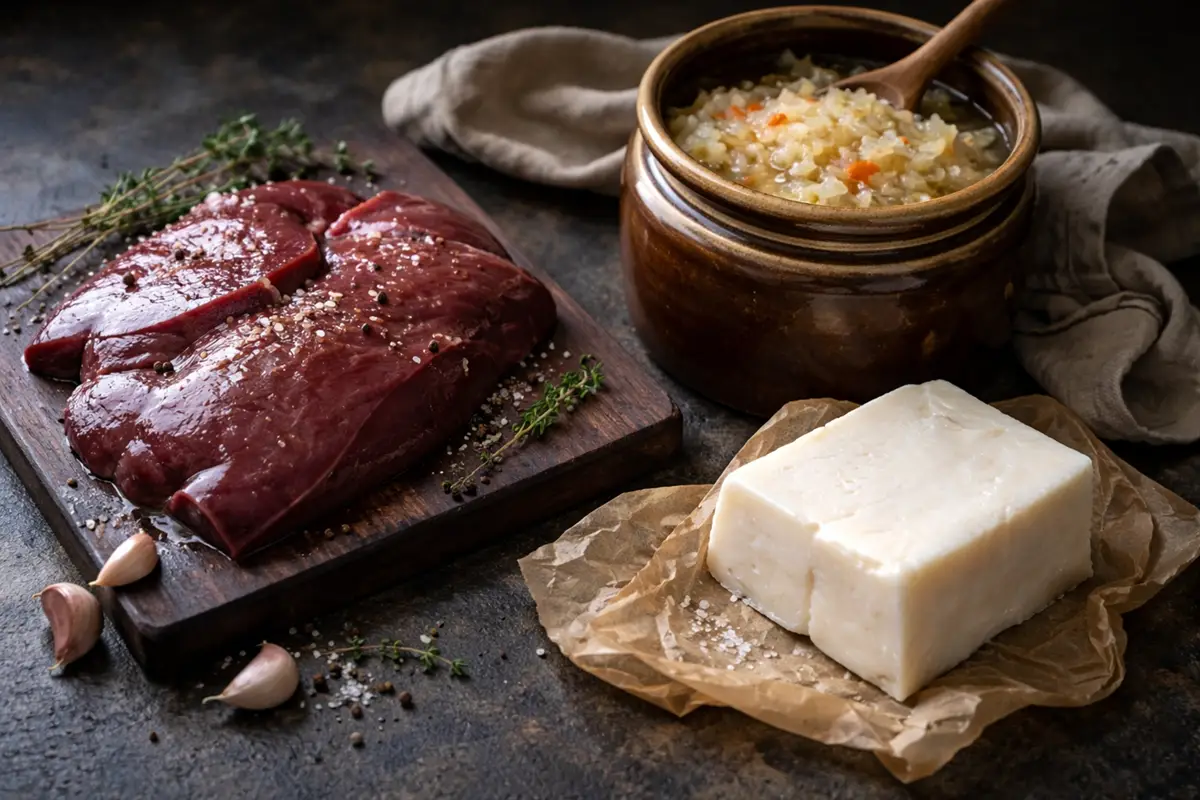
Organ Meats, Animal Fats, Fermented Foods: What Science Actually Says
Three food categories dismissed as unhealthy for decades. Here is what research actually shows — where science changed its view, and where debate continues.
The Problem With Nutritional Reversals
Few areas of public knowledge are more littered with confident claims that were later revised than nutrition science. Eggs were dangerous, then not. Fat was the enemy, then sugar. Margarine was healthier than butter, until it demonstrably was not. Red wine was protective, until the studies were reanalyzed.
This creates a legitimate problem for anyone trying to make sense of old recipes that rely heavily on ingredients — organ meats, animal fats, fermented foods — that spent several decades under a cloud of nutritional suspicion. Were those suspicions justified? Have they been resolved? Where does the evidence actually stand?
This post attempts to answer those questions as accurately as current research allows, with explicit acknowledgment of where the science is settled, where it has genuinely reversed, and where debate continues and certainty is not warranted.
Organ Meats: Nutritional Density and Real Cautions
What the evidence supports
Organ meats — liver, kidney, heart, tongue, tripe — are among the most nutrient-dense foods that exist, in terms of concentration of essential nutrients per calorie.
Beef liver, specifically, contains exceptionally high concentrations of vitamin B12, vitamin A (retinol), folate, riboflavin, copper, iron (in the highly bioavailable heme form), and zinc.1 A 100g serving of beef liver provides more than a full day’s requirement of B12, retinol, riboflavin, and copper, and significant proportions of many other micronutrients.
Heart muscle is high in B vitamins and has a nutritional profile closer to lean muscle meat than to other organs. Kidney is high in B12, selenium, and riboflavin. Tongue is a fatty cut nutritionally similar to other well-marbled muscle meat.
The dismissal of organ meats in mid-twentieth century Western food culture was driven by association with poverty, by cholesterol concerns that have since been substantially revised, and by the industrialization of meat processing that made muscle cuts cheap and abundant. It was not driven by evidence that organ meats were harmful.
Where caution is genuinely warranted
Vitamin A toxicity is a real concern with frequent liver consumption. Liver is the primary storage organ for retinol (preformed vitamin A) in animals, and the concentrations are high. A 100g serving of beef liver typically contains approximately 6,000–10,000 µg of preformed vitamin A — and even a single 68g slice has been reported to exceed the tolerable upper intake level for adults.2 Chronic daily consumption of liver in large amounts can cause hypervitaminosis A — a toxic condition with symptoms including bone pain, liver damage, and neurological effects.3
This is not a reason to avoid liver. It is a reason not to eat very large amounts daily. Traditional recipes that call for liver once or twice a week, in portions of 100–150g, are well within safe ranges for most healthy adults. The European Food Safety Authority sets the tolerable upper intake level for preformed vitamin A at 3,000 µg per day for adults.4
Pregnant women require specific guidance: high retinol intake in early pregnancy is associated with teratogenic risk. Current UK and EU guidance recommends that pregnant women avoid liver and liver products. This is a specific and well-supported recommendation that should be followed.5
Cholesterol content — organ meats are high in dietary cholesterol. However, the relationship between dietary cholesterol and cardiovascular disease has been substantially revised. The 2015 US Dietary Guidelines Advisory Committee removed the previous 300mg daily cholesterol limit, concluding that dietary cholesterol is not a nutrient of concern for overconsumption in the general population.6 Current evidence suggests that for most people, dietary cholesterol has limited effect on blood cholesterol levels compared to saturated and trans fat intake.
Animal Fats: A More Complicated Picture
The saturated fat hypothesis and its revision
The dietary advice to reduce saturated fat — dominant in Western public health guidance from the 1960s through the 2000s — was based primarily on the Seven Countries Study led by Ancel Keys, which found correlations between saturated fat intake and cardiovascular disease mortality across populations.7
Subsequent analysis has identified significant methodological limitations in the Seven Countries Study, including the selection of countries that supported the hypothesis and the exclusion of data that did not.8 This does not mean Keys was entirely wrong — the relationship between saturated fat and LDL cholesterol is real and documented — but the direct link between saturated fat consumption and cardiovascular events has proven considerably more complicated than early guidelines assumed.
A 2010 meta-analysis by Siri-Tarino et al., published in the American Journal of Clinical Nutrition, found no significant association between saturated fat intake and cardiovascular disease in prospective cohort studies.9 A 2020 review in the Journal of the American College of Cardiology concluded that the evidence does not support current blanket recommendations to reduce saturated fat, and that the replacement food matters critically — replacing saturated fat with refined carbohydrates shows no benefit or possible harm, while replacing it with unsaturated fats shows modest benefit.10
This remains an area of active research and genuine scientific debate. The position that saturated fat is neutral or harmless is not a consensus position. The position that it is the primary driver of cardiovascular disease is also no longer well-supported by the totality of evidence. The honest summary is: the relationship is more complex than either strong position allows, and dietary pattern matters more than any single nutrient.
What this means for lard, butter, and tallow
Lard — rendered pork fat — has a fatty acid composition of approximately 40% saturated, 45% monounsaturated, and 11% polyunsaturated fat. Its monounsaturated content is comparable to olive oil. It does not naturally contain trans fats. Partially hydrogenated lard does contain trans fats, and this distinction matters when sourcing it.
Butter contains approximately 63% saturated fat, 26% monounsaturated, and 4% polyunsaturated, plus fat-soluble vitamins A, D, E, and K2. Grass-fed butter contains higher concentrations of conjugated linoleic acid (CLA) and vitamin K2 than grain-fed butter.11
Tallow — rendered beef or mutton fat — has a similar profile to lard with slightly higher saturated fat content.
None of these are neutral foods. But the evidence that they are categorically more harmful than the refined seed oils and partially hydrogenated fats that replaced them in the mid-twentieth century is not strong, and in the case of hydrogenated fats, the opposite has been demonstrated.
Fermented Foods: Strong Tradition, Promising Evidence
What fermentation does
Fermentation transforms food through microbial activity — primarily bacteria and yeasts — that consume sugars and produce acids, alcohols, and gases as metabolic byproducts. The resulting acidic environment preserves the food, changes its texture and flavor, and in live-culture products, populates it with live microorganisms.
The categories relevant to old European recipes are lacto-fermented vegetables (sauerkraut, pickled cucumbers, beet kvass), fermented dairy (yogurt, kefir, cultured butter, aged cheese), and fermented grain products (sourdough bread).
What the evidence shows
The gut microbiome — the community of microorganisms living in the human digestive tract — has emerged as a major area of research over the past two decades. Evidence increasingly associates microbiome diversity and composition with immune function, metabolic health, and other outcomes, though causality in many of these associations remains to be established.12
Dietary fiber and fermented foods are the two dietary factors most consistently associated with favorable microbiome outcomes in current research. A 2021 randomized controlled trial published in Cell by Wastyk et al. — involving 36 healthy adults over 17 weeks — found that a high-fermented-food diet increased microbiome diversity and decreased markers of inflammation, compared to a high-fiber diet.13 This is a single small study and its findings require replication before strong conclusions can be drawn, but it represents direct experimental evidence for fermented food effects on the microbiome.
Specific evidence for individual fermented foods: yogurt and kefir containing live cultures have the strongest evidence base for digestive and immune effects. Sauerkraut and other lacto-fermented vegetables contain live bacteria in unpasteurized form, but pasteurized versions — which constitute most commercial products — do not. Sourdough bread, while made through fermentation, typically contains few or no live cultures in the finished baked product, though it may differ in digestibility from conventional bread due to partial breakdown of gluten and phytic acid during fermentation.14
Important limitations
The evidence for fermented foods is promising but not yet conclusive for specific health claims in healthy populations. Most studies are observational or short-term interventional. The field is complicated by enormous variation in fermented food composition depending on preparation method, microbial strains involved, and processing after fermentation.
Fermented foods are not universally suitable for all people. Individuals with histamine intolerance may react adversely to fermented products. People on certain medications — particularly MAO inhibitors — need to avoid fermented foods containing tyramine. Immunocompromised individuals should seek medical guidance before consuming unpasteurized products.
The Common Thread
Organ meats, animal fats, and fermented foods share a common history in the twentieth century: they were displaced — by industrially produced substitutes, by dietary guidelines based on incomplete evidence, and by changing food culture — before the evidence base for either their harm or their benefit was fully established.
In each case, the current evidence is more nuanced than the strong dismissals that prevailed for several decades. Organ meats are nutritionally exceptional with specific, real cautions. Animal fats are not categorically more harmful than their replacements and in some cases demonstrably less so. Fermented foods show promising associations with health outcomes through mechanisms that are still being characterized.
None of this means old recipes were nutritionally optimized. They were not designed with nutrition in mind. They were designed to feed people with what was available, to taste good, and to preserve food safely. The nutritional outcomes they produced were incidental.
But the incidental outcomes of a diet based on whole animal foods, fermented vegetables, and traditional fats appear, in retrospect, to have been no worse and in some respects considerably better than those of the mid-twentieth century diet that replaced them — a diet centered on refined seed oils, low-fat processed products, and high added sugar.
That is not nostalgia. That is what the current evidence, read carefully and without advocacy, tends to show.
This post reflects current scientific understanding as of the publication date. Nutrition science is an active and contested field. Where findings are preliminary or debated, this is explicitly noted. Nothing in this post constitutes medical or nutritional advice. Consult a qualified healthcare provider for personal dietary guidance, particularly if you are pregnant, immunocompromised, or managing a chronic health condition.
Sources
Footnotes
-
Souci, S.W., Fachmann, W. & Kraut, H. (2008). Food Composition and Nutrition Tables, 7th ed. MedPharm Scientific Publishers, Stuttgart. ↩
-
Wikipedia contributors. “Liver as food.” Wikipedia. Retrieved April 2026. Citing USDA FoodData Central data; a 68g slice of beef liver contains approximately 6,410 µg preformed vitamin A, exceeding the adult UL of 3,000 µg/day. ↩
-
Penniston, K.L. & Tanumihardjo, S.A. (2006). The acute and chronic toxic effects of vitamin A. American Journal of Clinical Nutrition, 83(2), 191–201. https://doi.org/10.1093/ajcn/83.2.191 ↩
-
European Food Safety Authority (2015). Scientific opinion on dietary reference values for vitamin A. EFSA Journal, 13(3), 4028. https://doi.org/10.2903/j.efsa.2015.4028 ↩
-
NHS (2023). Foods to avoid in pregnancy. National Health Service, UK. https://www.nhs.uk/pregnancy/keeping-well/foods-to-avoid/ ↩
-
Dietary Guidelines Advisory Committee (2015). Scientific Report of the 2015 Dietary Guidelines Advisory Committee. U.S. Department of Agriculture and U.S. Department of Health and Human Services. https://health.gov/our-work/nutrition-physical-activity/dietary-guidelines/previous-dietary-guidelines/2015/advisory-report ↩
-
Keys, A. et al. (1966). Epidemiological studies related to coronary heart disease: characteristics of men aged 40–59 in seven countries. Acta Medica Scandinavica, Suppl. 460. ↩
-
Harcombe, Z. et al. (2015). Evidence from randomised controlled trials did not support the introduction of dietary fat guidelines in 1977 and 1983. Open Heart, 2(1), e000196. https://doi.org/10.1136/openhrt-2014-000196 ↩
-
Siri-Tarino, P.W. et al. (2010). Meta-analysis of prospective cohort studies evaluating the association of saturated fat with cardiovascular disease. American Journal of Clinical Nutrition, 91(3), 535–546. https://doi.org/10.3945/ajcn.2009.27725 ↩
-
Astrup, A. et al. (2020). Saturated fats and health: a reassessment and proposal for food-based recommendations. Journal of the American College of Cardiology, 76(7), 844–857. https://doi.org/10.1016/j.jacc.2020.05.077 ↩
-
Dhiman, T.R. et al. (1999). Conjugated linoleic acid content of milk from cows fed different diets. Journal of Dairy Science, 82(10), 2146–2156. https://doi.org/10.3168/jds.S0022-0302(99)75458-5 ↩
-
Sonnenburg, J.L. & Bäckhed, F. (2016). Diet–microbiota interactions as moderators of human metabolism. Nature, 535, 56–64. https://doi.org/10.1038/nature18846 ↩
-
Wastyk, H.C. et al. (2021). Gut-microbiota-targeted diets modulate human immune status. Cell, 184(16), 4137–4153. https://doi.org/10.1016/j.cell.2021.06.019 ↩
-
Gobbetti, M. et al. (2014). How the sourdough may affect the functional features of leavened baked goods. Food Microbiology, 37, 30–40. https://doi.org/10.1016/j.fm.2013.04.012 ↩
Frequently Asked Questions
01Is liver safe to eat regularly?▶
For most healthy adults, yes — in moderate amounts. Liver is exceptionally nutrient-dense but very high in vitamin A (retinol). Chronic overconsumption of preformed vitamin A can cause toxicity. Most nutrition authorities suggest limiting liver to once or twice per week. Pregnant women and people taking medications that interact with vitamin A should consult their healthcare provider before eating liver regularly.
02Does saturated fat cause heart disease?▶
The relationship is more complex than earlier dietary guidelines suggested. Meta-analyses published since 2010 have not consistently found that reducing saturated fat reduces cardiovascular events when the replacement is refined carbohydrates. The picture changes when saturated fat is replaced with unsaturated fat — that substitution does show benefit. Current evidence suggests the overall dietary pattern matters more than any single nutrient.
03Are fermented foods probiotic?▶
Some are, some are not. Live-culture fermented foods — unpasteurized sauerkraut, kefir, traditionally made yogurt, some cheeses — contain live bacteria that may survive transit to the gut. Pasteurized fermented foods do not contain live cultures. The evidence for specific health benefits from dietary probiotics is promising but not yet conclusive for most conditions in healthy populations.
04Is lard worse than vegetable oil?▶
Not categorically. Lard is approximately 40% saturated fat, 45% monounsaturated fat, and 11% polyunsaturated fat. Its fatty acid profile is closer to olive oil than to butter. It does not contain trans fats in its natural form. Partially hydrogenated lard does. The comparison with vegetable oil depends entirely on which oil and how it is processed.
05Are fermented foods safe for everyone?▶
For most people, yes. However, fermented foods are high in histamine, which can trigger reactions in people with histamine intolerance. They are also high in sodium, which matters for people managing blood pressure. Immunocompromised individuals should seek medical advice before consuming unpasteurized fermented products. If you have a diagnosed condition or take regular medication, check with your healthcare provider.