Chicken Stuffed with Crab Meat and Peas
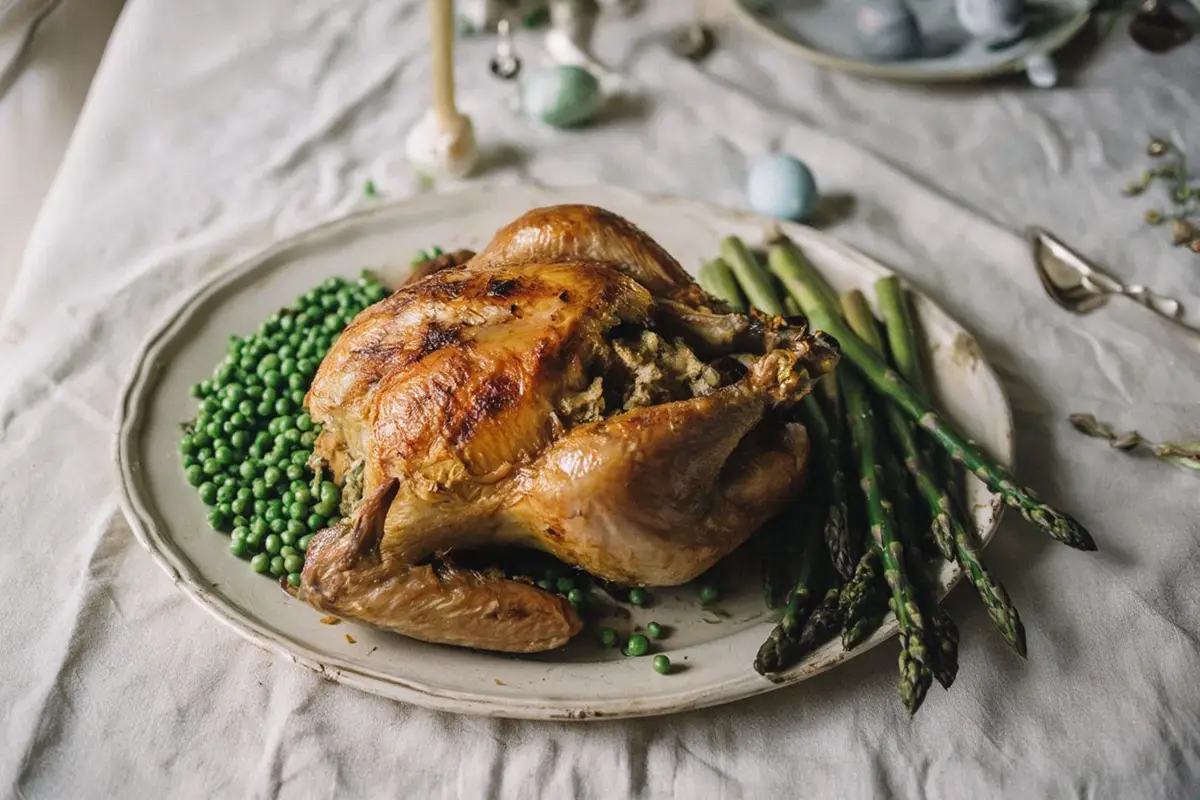
Whole roasted chicken stuffed with crayfish, peas, asparagus and buttered bread — a festive Central European Easter centerpiece.
Quick Summary
Whole roasted chicken stuffed with crayfish, peas, asparagus and buttered bread — a festive Central European Easter centerpiece.
Historical recipe
Modernised adaptation of an early 20th‑century source. Not independently kitchen-tested by Attic Recipes. Quantities, temperatures, and food safety guidance have been updated for a contemporary kitchen — results may vary and errors may exist. Nutritional values, where provided, are estimates only and have not been laboratory tested. Always follow current food safety guidelines for your region. If you have a health condition, allergy, or dietary requirement, consult a qualified professional before preparing this recipe.
Use of this recipe is entirely at your own risk and subject to our Terms of Service and Privacy Policy. Attic Recipes accepts no liability for any adverse outcome.
- Gluten
- Crustaceans
- Dairy
- Eggs
Safety note
This recipe contains crustaceans (crayfish or crab meat) — one of the 14 major allergens under EU Regulation 1169/2011 and a FALCPA-listed allergen. Crustacean allergy is typically severe and lifelong. Symptoms can include anaphylaxis within minutes of exposure. Always disclose the crustacean content when serving this dish to others. There is no in-recipe substitution that eliminates this allergen.
Do not serve to anyone with a known or suspected crustacean or shellfish allergy.
Additional notes
-
Warning
Do not wash raw chicken before cooking. Washing raw poultry spreads Salmonella, Campylobacter, and other bacteria from the chicken surface to the sink, surrounding surfaces, and utensils via water splatter. Bacteria are destroyed by heat during cooking — not by washing. This guidance is consistent across the CDC, NHS, EFSA, and all major food safety authorities globally.
-
Warning
Both the chicken and the stuffing must reach an internal temperature of 74°C (165°F) before serving. A stuffed bird takes significantly longer to reach temperature at the cavity centre than at the thigh. Always verify with a meat thermometer inserted into the centre of the stuffing — do not rely on thigh temperature alone.
If you do not have a meat thermometer, add 15–20 minutes to the roasting time as a precaution.
-
Caution
This recipe contains raw chicken liver placed whole into the cavity. The liver must also reach 74°C (165°F) at its centre. Undercooked poultry liver carries the same Campylobacter risk as undercooked chicken meat.
-
Note
Contains gluten (white buns). Not suitable for those with celiac disease or gluten intolerance unless gluten-free bread is substituted.
Original: Bake until completely cooked and golden brown — or roast on a spit
- 1
Pat the chicken dry with paper towels inside and out. Do not wash raw poultry — see the food safety note in the safety warnings. Set the liver aside.
- 2
Soak the buns (crusts removed) in milk for 5–10 minutes, then squeeze out excess milk firmly.
- 3
In a bowl, combine the squeezed buns with melted butter. Mix and beat until the mixture is smooth and homogeneous.
Tip A fork works well here — you want a cohesive paste, not a lumpy mixture. - 4
Add egg yolks, salt, pepper, and finely chopped parsley to the bun mixture. Stir well to combine.
- 5
Fold in the crayfish meat, boiled peas, and blanched asparagus spears.
- 6
Beat the egg whites in a clean bowl until foamy. Add the cream of tartar (or lemon juice) and continue whisking until stiff peaks form. Gently fold into the stuffing mixture — this keeps the filling light during roasting.
Tip Fold, do not stir — deflating the egg whites will result in a dense, heavy stuffing. - 7
Place the whole chicken liver into the cavity first, positioning it in the centre. Spoon the stuffing around it, filling the cavity evenly. Do not overfill — stuffing expands during cooking.
- 8
Sew the cavity closed with white thread or secure with toothpicks.
- 9
Wrap the drumsticks, breast, and other parts of the chicken with thin bacon strips and tie tightly with kitchen string. This protects the meat during the initial roasting period and keeps it moist.
- 10
Place the chicken in a roasting tin and roast at 190°C conventional (170°C fan-assisted) for approximately 70–75 minutes. The chicken is done when the internal temperature at the thickest part of the thigh reaches 74°C (165°F). The stuffing at the centre of the cavity must also reach 74°C — check with a thermometer inserted through the cavity opening.
Tip A stuffed bird takes longer to reach temperature at the centre than an unstuffed one. Always verify the stuffing temperature, not just the thigh. - 11
About 15–20 minutes before the end of cooking, remove the bacon strips and return the chicken to the oven uncovered. This allows the skin to render and develop a deep golden colour.
- 12
Remove from oven and rest for 10 minutes. Remove all thread, cut into pieces, and serve with braised vegetables or buttered new potatoes.
Nutrition Information per 1 portion (approx. 350g)
Nutritional values are approximate estimates and may vary based on specific ingredients used, preparation methods, and portion sizes.
Pro Tips
- Do not overfill the cavity — stuffing expands during roasting and can burst the seam
- Fold egg whites gently — they keep the stuffing light and airy rather than dense
- Remove bacon 15–20 minutes before the end to get proper golden skin — this step is essential
- Rest the chicken for at least 10 minutes before cutting — the stuffing needs time to set
- Make-ahead friendly: stuff the night before, refrigerate, bring to room temperature before roasting
- River crayfish are traditional — canned crab meat is a convenient and faithful substitute
Serving Suggestions
Serve as the centrepiece of an Easter lunch or festive Sunday dinner. Pairs well with braised spring vegetables, buttered new potatoes, or a light cream-based sauce made from the roasting juices. A dry white wine — Riesling or Pinot Gris — complements the delicate crayfish stuffing.
About This Recipe
This is not an everyday chicken. A whole bird stuffed with crayfish meat, boiled peas, blanched asparagus, and a buttered bread mixture lightened with beaten egg whites — then wrapped in bacon, roasted until golden, and brought to the table whole. It is a dish built for a special occasion, and Easter is its natural home.
The stuffing is what sets this recipe apart: rich but not heavy, held together by the bread and butter base, lifted by the folded egg whites, and made distinctive by the delicate flavour of crayfish. The chicken liver placed at the centre of the cavity adds depth that ties the whole filling together.
Why It Works
Wrapping the chicken in bacon before roasting serves two purposes: it bastes the bird continuously as the fat renders, and it protects the breast meat from drying out during the long roasting time needed to cook the stuffing through. Removing the bacon for the final 15–20 minutes exposes the skin to direct heat, producing the deep golden colour that a bacon-covered bird never achieves on its own.
The egg white foam in the stuffing is a classic technique — air beaten into the whites expands in the oven, keeping the filling light rather than dense and stodgy.
Make-Ahead Notes
The chicken can be stuffed, sewn, and wrapped in bacon the evening before. Cover and refrigerate overnight. Remove from the refrigerator 30 minutes before roasting to take the chill off — a cold-centre bird will need significantly longer in the oven and risks uneven cooking.
On Crayfish
River crayfish were a common and affordable ingredient in Central European spring cooking. Today they are harder to source. Good quality canned or frozen crab meat is a straightforward substitute — use the same weight and treat it identically. The flavour profile is close enough that the dish reads as intended.
A classic of early 20th century home cooking, preserved and adapted for the modern kitchen.
The Story Behind This Recipe
Historical Context
Stuffed whole birds were a centrepiece of festive tables across Central Europe well into the early 20th century. The combination of crayfish, asparagus, and peas places this dish firmly in the spring season — all three were considered premium ingredients available fresh only in late spring, making this a natural Easter dish. The technique of wrapping the bird in bacon before roasting was a practical solution to prevent lean meat from drying out in wood-fired ovens where heat was difficult to regulate.
Modern Kitchen Adaptation
River crayfish, traditional in this preparation, can be substituted with good quality canned or frozen crab meat without compromising the dish. Fresh peas and asparagus are ideal in spring; frozen peas work well year-round. A meat thermometer takes the guesswork out of doneness — check both the thigh and the centre of the stuffing. The chicken can be stuffed the evening before and refrigerated overnight — bring to room temperature 30 minutes before roasting.
This recipe is an independent modern adaptation developed from historical sources in the public domain. It is provided for informational and educational purposes only and does not constitute professional dietary, nutritional, or medical advice. Food preparation involves inherent risks. The reader assumes full responsibility for safe food handling, ingredient sourcing, and adherence to current local food safety guidelines. The site operator accepts no liability for outcomes resulting from the preparation or consumption of this recipe.
One recipe.
Every week.
You Might Also Like
More recipes from the same category

Almond Cream Biscuit Torte
A light sponge layered with almond buttercream and finished with a poured chilled custard sauce — a classic of early 20th century Central European pastry.
Baked Duck with Sage and Onion Stuffing and Apple Sauce
A whole roast duck stuffed with sage and onion, basted with pan drippings, and served with a warm apple sauce — a classic Central European Sunday roast.
Beef Wellington
Aged beef tenderloin coated in a mushroom and caper paste, wrapped in golden puff pastry — a celebration roast from the early 20th century.