Fried Turkey Skin Rolls with Liver, Tongue and Pistachios
Crispy turkey skin rolls filled with ham, tongue, goose liver, capers and pistachios — an elegant Central European festive appetizer.
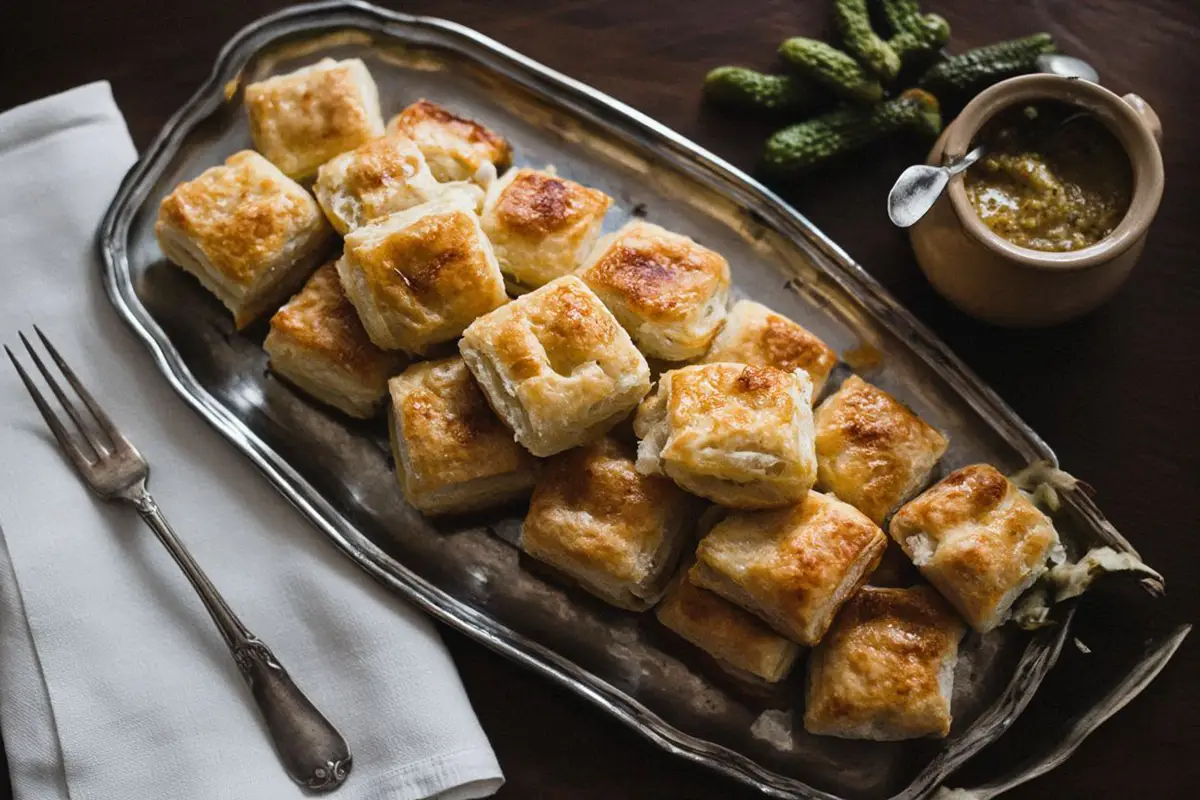
Quick Summary
Crispy turkey skin rolls filled with ham, tongue, goose liver, capers and pistachios — an elegant Central European festive appetizer.
Historical recipe
Modernised adaptation of an early 20th‑century source. Not independently kitchen-tested by Attic Recipes. Quantities, temperatures, and food safety guidance have been updated for a contemporary kitchen — results may vary and errors may exist. Nutritional values, where provided, are estimates only and have not been laboratory tested. Always follow current food safety guidelines for your region. If you have a health condition, allergy, or dietary requirement, consult a qualified professional before preparing this recipe.
Use of this recipe is entirely at your own risk and subject to our Terms of Service and Privacy Policy. Attic Recipes accepts no liability for any adverse outcome.
- Dairy
- Eggs
- Gluten
- Mustard
- Tree Nuts
Additional notes
-
Warning
All meat in the filling must be fully cooked before the rolls are assembled. The frying time on the outside is not sufficient to safely cook raw meat at the centre of a tightly rolled skin sausage. Turkey meat, goose liver, and tongue must all be fully cooked through before combining.
Boil or roast the turkey meat in advance. Pan-fry the goose liver separately until no pink remains. Purchase pre-cooked tongue from a deli or butcher if preparing your own is not practical.
-
Warning
Verify the internal temperature of each roll with a meat thermometer — the centre must reach 75°C (165°F). Well-browned exterior does not guarantee safe internal temperature, particularly in larger or tightly packed rolls.
If the rolls are golden on the outside but not yet at temperature, transfer to a 180°C (350°F) oven for 5–8 minutes to finish safely.
-
Caution
Cooked tongue purchased from a deli or butcher should be consumed within 3–4 days of purchase and kept refrigerated. Do not use tongue that has been open in the refrigerator for more than 4 days.
- 1
Cook the turkey meat before preparing the filling. Boil or roast approximately half the turkey until fully cooked through. Allow to cool, then chop the meat very finely. Set aside.
Tip This step can be done a day in advance. Refrigerate the cooked meat until needed. - 2
Roast the goose liver in a hot pan with a little fat until fully cooked through — no pink remaining, about 4–5 minutes. Allow to cool, then chop finely. Set aside.
Tip The liver must be fully cooked before it goes into the filling. Do not use raw liver in this preparation. - 3
Remove the skin from the turkey by cutting carefully along the back from neck to tail. Work your fingers and a small knife between the skin and the flesh, peeling slowly to keep the skin intact. Take care around the wings and drumsticks where the skin is attached more firmly.
Tip Cold turkey skin tears less easily than warm. Work on a chilled bird straight from the refrigerator. - 4
Lay the skin flat on a clean surface and cut into large rectangular pieces, approximately 10x12 cm. Set aside.
- 5
Combine all filling ingredients in a large bowl: finely chopped cooked turkey meat, ground tongue, ham, roasted goose liver, boiled potatoes, pickles, capers, and pistachios. Add mustard, salt, and pepper. Mix well.
- 6
Add 3 whole eggs to the filling and mix thoroughly until the mixture holds together when pressed.
Tip The filling should be moist but not wet — if it seems too loose, refrigerate for 15 minutes before rolling. - 7
Place a heaped teaspoon of filling onto each rectangle of turkey skin, positioning it near one edge. Roll the skin tightly around the filling like a small sausage, pressing the ends closed as you roll.
Tip Do not overfill — the skin will split during frying. A small, tight roll holds better than a large loose one. - 8
Roll each filled skin sausage first in flour, coating evenly, then dip in beaten egg. Place on a tray and refrigerate for 15 minutes before frying — this helps the coating adhere.
- 9
Heat butter in a wide frying pan over medium-high heat until foaming. Fry the rolls in batches, turning regularly, until deep golden brown on all sides — about 6–8 minutes per batch. Do not crowd the pan.
Tip Clarified butter tolerates higher heat and gives a more even colour. If using regular butter, watch carefully and reduce heat if it starts to brown too quickly. - 10
Verify doneness with a meat thermometer — the centre of each roll must reach 75°C (165°F). If rolls are well coloured on the outside but not yet at temperature, transfer to a 180°C (350°F) oven for 5–8 minutes to finish.
- 11
Arrange the rolls on a long serving platter and serve immediately with fresh salads.
Nutrition Information per 2–3 rolls (approx. 180g)
Nutritional values are approximate estimates and may vary based on specific ingredients used, preparation methods, and portion sizes.
Pro Tips
- Work with a cold turkey — skin from a chilled bird tears far less easily
- Cook all meat components fully before combining in the filling
- Do not overfill the rolls — tight and small holds better than large and loose
- Refrigerate the coated rolls for 15 minutes before frying — coating adheres better
- Use clarified butter for frying — it handles the heat more reliably than whole butter
- If unsure about internal temperature, finish in a 180°C oven for 5–8 minutes after frying
- Rolls can be assembled hours in advance — fry just before serving
Serving Suggestions
Serve as an elegant appetizer with a crisp green salad, cornichons, and a small pot of mustard on the side. Works well as part of a larger festive spread alongside cold cuts and pickled vegetables. A glass of dry sparkling wine or a light white wine is the natural pairing.
About This Recipe
Most recipes use turkey skin as a vehicle for seasoning or discard it entirely. This one makes it the centrepiece. The skin is removed from the whole bird in large pieces, cut into rectangles, filled with a complex mixture of cooked turkey meat, ground tongue, ham, roasted goose liver, potatoes, pickles, capers, and pistachios — then rolled, coated, and fried in butter until golden and crisp.
The result is something between a croquette and a roulade: crispy outside, dense and flavourful inside, rich enough that two or three pieces make a complete appetizer course. This is not a quick dish. It is a dish for an occasion — the kind of preparation that signals to guests that something special is happening at the table.
Why It Works
Turkey skin, properly handled, is strong enough to hold a filling through rolling, coating, and frying without splitting — provided the rolls are not overfilled and the skin is cold when worked. The filling is bound by three whole eggs, which set during frying and hold the mixture together at the centre. The combination of acid ingredients — pickles, capers, mustard — cuts through the richness of the liver, tongue, and butter, keeping the filling from feeling heavy despite its density.
The pistachios are not decorative. They add texture and a quiet sweetness that works surprisingly well against the sharpness of the capers and pickles.
Advance Preparation
This dish rewards planning. The turkey meat and goose liver can be cooked the day before. The tongue, if preparing your own, needs several hours of boiling — do this well in advance. The filling can be mixed and refrigerated overnight. The rolls themselves can be assembled, coated, and refrigerated several hours before frying. When guests arrive, all that remains is the frying — 20 minutes of active work for an appetizer that reads as considerably more ambitious.
A Note on the Skin
Removing turkey skin cleanly is the most technically demanding part of this recipe. A cold bird, a small sharp knife, and patience are the requirements. Cut along the back first, then work slowly with fingers and knife between skin and flesh. The skin around the drumsticks and wings is the most firmly attached — short careful cuts rather than pulling. Any tears can be patched by overlapping two pieces when rolling.
A classic of early 20th century home cooking, preserved and adapted for the modern kitchen.
The Story Behind This Recipe
Historical Context
This preparation belongs to a category of elaborate Central European dishes designed to use every part of a slaughtered bird — including the skin, which in this recipe becomes the wrapper rather than a byproduct. The combination of tongue, liver, ham, capers, and pistachios in a single filling reflects the influence of Viennese and Austro-Hungarian festive cooking, where complex charcuterie-style preparations were a mark of culinary sophistication. Dishes of this kind appeared on holiday tables and at formal dinners, requiring significant advance preparation and skilled knife work — not everyday cooking, but the kind of cooking done for occasions that mattered.
Modern Kitchen Adaptation
The original recipe does not specify whether the turkey meat in the filling is raw or cooked. This adaptation uses fully cooked meat throughout — a straightforward and necessary adjustment for a preparation where the filling is enclosed and the cooking time is short. Clarified butter replaces ordinary butter for frying, giving more reliable colour and heat tolerance. If a whole turkey is not available or practical, turkey skin can sometimes be sourced separately from a good butcher. The rolls can be assembled and refrigerated several hours in advance — fry just before serving.
This recipe is an independent modern adaptation developed from historical sources in the public domain. It is provided for informational and educational purposes only and does not constitute professional dietary, nutritional, or medical advice. Food preparation involves inherent risks. The reader assumes full responsibility for safe food handling, ingredient sourcing, and adherence to current local food safety guidelines. The site operator accepts no liability for outcomes resulting from the preparation or consumption of this recipe.
One recipe.
Every week.
You Might Also Like
More recipes from the same category
Almond Cream Biscuit Torte
A light sponge layered with almond buttercream and finished with a poured chilled custard sauce — a classic of early 20th century Central European pastry.
Baked Duck with Sage and Onion Stuffing and Apple Sauce
A whole roast duck stuffed with sage and onion, basted with pan drippings, and served with a warm apple sauce — a classic Central European Sunday roast.
Beef Wellington
Aged beef tenderloin coated in a mushroom and caper paste, wrapped in golden puff pastry — a celebration roast from the early 20th century.