Roasted Goose Stuffed with Liver and Chestnuts
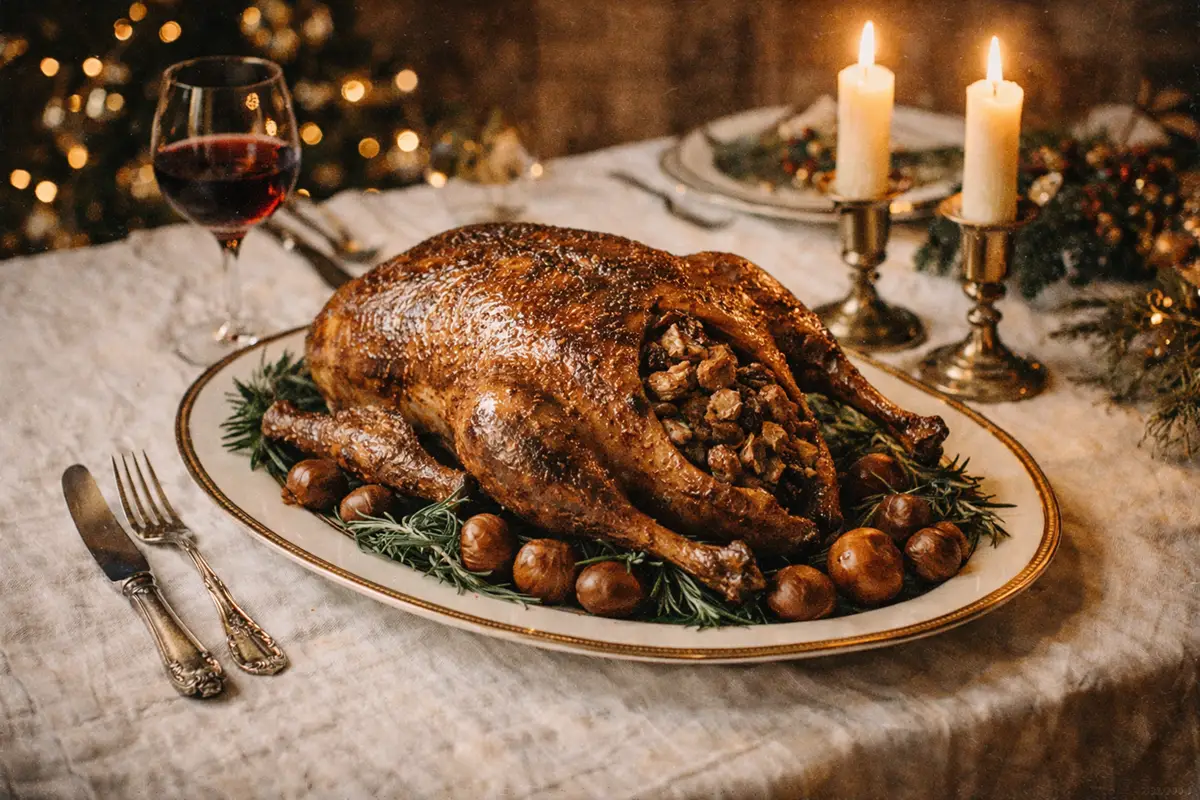
Whole roasted goose filled with a rich stuffing of goose liver, chestnuts and buttered bread — a Central European festive centerpiece.
Quick Summary
Whole roasted goose filled with a rich stuffing of goose liver, chestnuts and buttered bread — a Central European festive centerpiece.
Historical recipe
Modernised adaptation of an early 20th‑century source. Not independently kitchen-tested by Attic Recipes. Quantities, temperatures, and food safety guidance have been updated for a contemporary kitchen — results may vary and errors may exist. Nutritional values, where provided, are estimates only and have not been laboratory tested. Always follow current food safety guidelines for your region. If you have a health condition, allergy, or dietary requirement, consult a qualified professional before preparing this recipe.
Use of this recipe is entirely at your own risk and subject to our Terms of Service and Privacy Policy. Attic Recipes accepts no liability for any adverse outcome.
- Dairy
- Eggs
- Gluten
Additional notes
-
Warning
The goose liver must be fully cooked through before it is added to the stuffing mixture — no pink should remain. Do not place raw liver directly into the cavity and rely on oven heat to cook it. The centre of a stuffed bird may not reach a safe temperature before the exterior is done.
Fry the ground liver in a pan for 3–4 minutes until fully cooked through before combining with the other stuffing ingredients. This step is non-negotiable.
-
Warning
The stuffing at the centre of the cavity must reach 75°C (165°F), independently of the bird's external temperature. Insert a meat thermometer into the middle of the filling through the sewn opening to verify. If the stuffing has not reached temperature, continue roasting regardless of the bird's appearance.
If you do not have a meat thermometer, bake the stuffing separately in a buttered dish alongside the goose for the final 40 minutes and combine on the plate when serving.
-
Caution
Whole frozen goose must be fully defrosted before roasting — a partially frozen bird will cook unevenly and the stuffing may remain dangerously cold at the centre even when the exterior appears done. Defrost in the refrigerator for a minimum of 48 hours.
Buy a fresh goose from a butcher when possible, particularly for stuffed preparations.
-
Caution
Goose renders a very large amount of fat during roasting. The roasting dish must be deep enough to contain it safely. Spoon off excess fat regularly — a dish overfull with hot fat is a burn and fire hazard.
- 1
Remove the goose from the refrigerator 45 minutes before cooking to bring it to room temperature. Pat dry thoroughly inside and out with paper towels — dry skin is essential for a crispy result.
Tip If using a frozen goose, defrost fully in the refrigerator for 48 hours. Never defrost at room temperature. - 2
Soak the buns (crusts removed) in milk for 10 minutes, then squeeze out excess milk firmly. Pass the soaked buns through a meat grinder or process briefly in a food processor until finely ground.
- 3
Trim the goose liver of any greenish bile duct remnants and connective tissue. Pass through the same meat grinder or chop very finely by hand.
Tip Any green-tinged areas must be removed completely — bile makes the liver bitter and the stuffing unpleasant. - 4
Heat 1 tablespoon of fat in a saucepan over medium heat. Add the ground bun mixture and fry, stirring constantly, for 3–4 minutes until lightly coloured and dry. Add the ground liver and cook for a further 3–4 minutes, stirring, until the liver is fully cooked through with no pink remaining.
Tip This step is essential for food safety — the liver must be fully cooked before it goes into the stuffing. Do not skip or shorten it. - 5
Add the finely chopped chestnuts to the pan, stir to combine, and cook for 1–2 minutes. Remove from heat.
- 6
Allow the mixture to cool for 10 minutes. Add the 3 whole eggs, salt, and pepper. Mix well until fully incorporated.
Tip Do not add eggs to a hot mixture — they will scramble. The mixture should be warm, not hot, before adding eggs. - 7
Fill the cavity of the goose with the prepared stuffing. Do not overfill — stuffing expands during roasting. Sew the cavity closed with strong kitchen twine.
- 8
Prick the skin all over the breast, thighs, and fatty areas with a skewer or fork. This allows the fat to render and escape during roasting, producing crispy skin rather than a greasy surface.
- 9
Rub the outside of the goose with fat, salt, and pepper. Place in a deep roasting dish, add 1 tablespoon of fat and 100ml of water or stock to the base of the dish.
- 10
Roast at 200°C / 180°C fan (400°F) for the first 30 minutes to colour the skin. Reduce heat to 170°C / 150°C fan (340°F) and continue roasting for approximately 2.5 hours, basting every 20–25 minutes with the released juices.
Tip Goose releases a large amount of fat during roasting. Carefully spoon off excess fat from the dish every 45 minutes — too much fat in the dish steams rather than roasts the bird. The collected fat is excellent for roasting potatoes. - 11
Check doneness with a meat thermometer: the thickest part of the thigh (away from the bone) must reach 82°C (180°F), and the stuffing at the centre of the cavity must reach 75°C (165°F). If the stuffing has not reached temperature, continue roasting and check every 15 minutes.
- 12
Rest the goose for 15–20 minutes before carving. Remove all thread, cut into pieces, and arrange on a serving platter. Serve with the defatted roasting juices and salads.
Nutrition Information per 1 portion (approx. 400g with stuffing)
Nutritional values are approximate estimates and may vary based on specific ingredients used, preparation methods, and portion sizes.
About This Recipe
A whole goose, stuffed with its own liver ground together with soaked bread and finely chopped chestnuts, sewn closed, and roasted slowly until the skin is deep gold and the fat has rendered into the dish below. This is a dish built for a celebration — Saint Martin’s Day in November, Christmas, or any occasion that calls for something more than the expected.
The stuffing is the centrepiece of the recipe. Liver and chestnuts together produce a filling that is rich without being heavy, earthy without being gamey — and the bread base holds it together through the long roasting time. Nothing about this dish is complicated, but it requires attention and time.
Why It Works
Goose is a fatty bird, and that fat is the dish’s greatest asset if managed correctly. Pricking the skin before roasting allows the subcutaneous fat to escape rather than sitting between skin and flesh, which is what produces the papery, crackling skin the bird is known for. The fat that collects in the roasting dish bastes the bird from below and should be spooned off regularly — not discarded, but saved. Strained goose fat keeps refrigerated for weeks and is one of the finest cooking fats available for roasting potatoes or braising vegetables.
The two-temperature method — high heat initially to colour the skin, lower heat for the long roasting period — gives the exterior the colour and texture it needs while allowing the interior to cook through gently.
A Note on the Liver
The goose’s own liver is the best option — it will be in the giblet pack if you buy a whole bird. The critical point is that the liver must be fully cooked in the pan before it goes into the stuffing. Placing raw liver inside a cavity and trusting the oven to cook it through is not a reliable approach with a modern domestic oven. Three to four minutes in a hot pan produces a fully safe, fully flavoured result.
On Chestnuts
Fresh chestnuts in autumn are the traditional choice and worth the effort if you can find them. Score, boil for 20 minutes, peel while warm. Vacuum-packed pre-cooked chestnuts — widely available year-round — are a straightforward substitute that produces an identical result in the finished dish. Avoid sweetened chestnut products.
Saint Martin’s Day and Christmas
Roast goose is the traditional bird of Saint Martin’s Day (November 11th) across Central Europe — the feast that marked the end of the agricultural year and the beginning of winter. The same bird, the same preparation, appears on Christmas tables across the region. Outside Central Europe, it makes a compelling alternative to turkey at Thanksgiving or Christmas: richer, more flavourful, and entirely different from what most guests will have encountered before.
A classic of early 20th century home cooking, preserved and adapted for the modern kitchen.
The Story Behind This Recipe
Historical Context
Stuffed roast goose was the prestige dish of Central European festive cooking in the early 20th century — present on tables for Saint Martin's Day in November, Christmas, and major family celebrations. In households where geese were raised at home, the liver from the same bird went directly into the stuffing, and the rendered fat collected during roasting was a valued kitchen resource stored for winter cooking. Chestnuts, available fresh in autumn, were a natural pairing with the rich liver and fatty bird. The combination of bread, liver, and chestnuts as a stuffing base appears across the region with minor variations, suggesting a shared culinary tradition rather than a single origin.
Modern Kitchen Adaptation
The most important modern adjustment is pre-cooking the liver before it goes into the stuffing, rather than relying on the oven heat inside the cavity to cook it through. Vacuum-packed pre-cooked chestnuts are an excellent substitute for fresh — same flavour, no boiling and peeling required. Stock replaces water for basting. A meat thermometer replaces guesswork. Serve with braised red cabbage, potato dumplings, or roasted root vegetables. A crisp green salad with vinegar dressing cuts through the richness. The collected goose fat from the roasting dish should be strained and saved — it keeps refrigerated for weeks and is outstanding for roasting potatoes.
This recipe is an independent modern adaptation developed from historical sources in the public domain. It is provided for informational and educational purposes only and does not constitute professional dietary, nutritional, or medical advice. Food preparation involves inherent risks. The reader assumes full responsibility for safe food handling, ingredient sourcing, and adherence to current local food safety guidelines. The site operator accepts no liability for outcomes resulting from the preparation or consumption of this recipe.
One recipe.
Every week.
You Might Also Like
More recipes from the same category
Almond Cream Biscuit Torte
A light sponge layered with almond buttercream and finished with a poured chilled custard sauce — a classic of early 20th century Central European pastry.
Baked Duck with Sage and Onion Stuffing and Apple Sauce
A whole roast duck stuffed with sage and onion, basted with pan drippings, and served with a warm apple sauce — a classic Central European Sunday roast.
Beef Wellington
Aged beef tenderloin coated in a mushroom and caper paste, wrapped in golden puff pastry — a celebration roast from the early 20th century.