Creamed Spinach in Kaiser Rolls
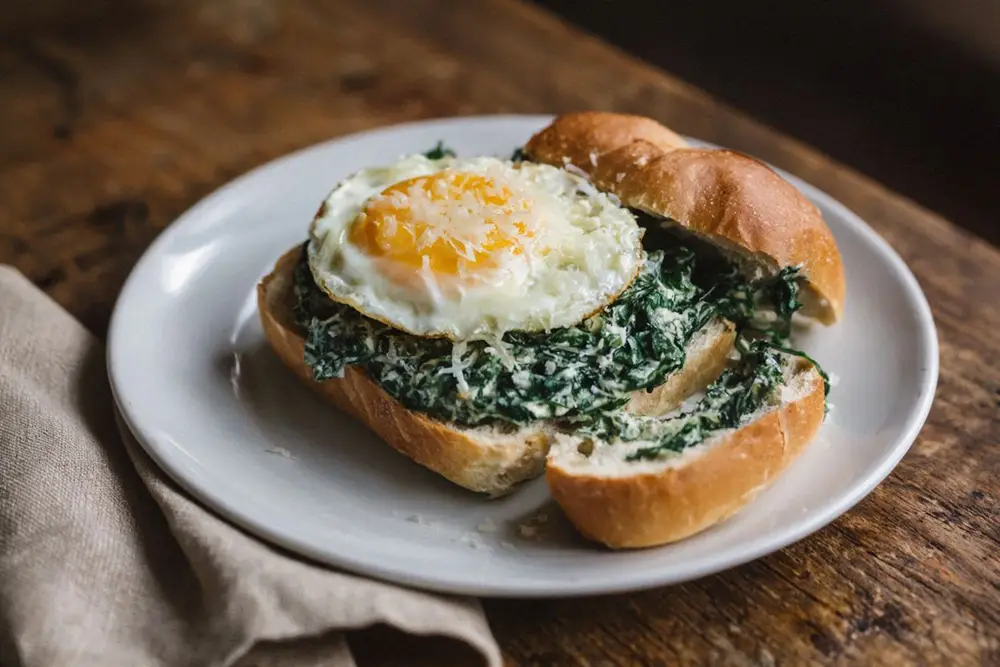
Toasted kaiser rolls hollowed and filled with butter-creamed spinach, topped with a fried egg and grated cheese.
Quick Summary
Toasted kaiser rolls hollowed and filled with butter-creamed spinach, topped with a fried egg and grated cheese.
Historical recipe
Modernised adaptation of an early 20th‑century source. Not independently kitchen-tested by Attic Recipes. Quantities, temperatures, and food safety guidance have been updated for a contemporary kitchen — results may vary and errors may exist. Nutritional values, where provided, are estimates only and have not been laboratory tested. Always follow current food safety guidelines for your region. If you have a health condition, allergy, or dietary requirement, consult a qualified professional before preparing this recipe.
Use of this recipe is entirely at your own risk and subject to our Terms of Service and Privacy Policy. Attic Recipes accepts no liability for any adverse outcome.
- Eggs
- Dairy
- Gluten
Additional notes
-
Warning
This recipe uses egg yolks to thicken the creamed spinach. The mixture must reach 74°C (165°F) and be held at that temperature for at least 15 seconds before serving. Use an instant-read thermometer to verify. Pregnant women, children under 18, elderly individuals, and immunocompromised persons should ensure this temperature is reached before consuming.
Pasteurised egg yolks may be used in place of fresh yolks for additional safety assurance.
-
Note
This recipe contains approximately 13g of saturated fat per serving from butter, egg yolks, and cheese. Individuals monitoring saturated fat intake should be aware.
- 1
Bring a large pot of lightly salted water to a boil. Add 500 g of washed spinach and blanch for 2–3 minutes until fully wilted. Drain immediately and rinse under cold water to stop the cooking. Squeeze out as much water as possible, then pass through a fine sieve or food mill to a smooth purée.
Tip The spinach must be as dry as possible. Place it in a clean tea towel and wring firmly — you will be surprised how much water remains after squeezing by hand. - 2
Preheat the oven to 180°C (350°F) / 160°C fan. Cut the tops off 4 kaiser rolls and hollow out the centres, leaving a wall of approximately 1 cm. Spread the inside of each roll generously with a portion of the 20 g of softened butter. Place on a baking tray and toast in the oven for 5 minutes until lightly crisped. Set aside.
- 3
In a medium saucepan, melt 20 g of butter over low heat. Add the spinach purée and stir to combine. In a small bowl, whisk together 45 ml of whole milk and 3 egg yolks until smooth.
Tip Whisking the yolks with the cold milk before adding them to the hot spinach is a temper — it lowers the risk of the yolks scrambling on contact with the warm pan. - 4
Pour the yolk and milk mixture into the spinach in a slow, steady stream, stirring constantly. Cook over low heat, stirring continuously, for 12–15 minutes until the mixture thickens noticeably and reaches 74°C (165°F) on an instant-read thermometer. Season with salt and white pepper. Remove from heat and stir in 10 g of finishing butter until melted and glossy.
Tip Do not raise the heat to speed this up — the yolks will scramble. The mixture is ready when it holds a shape briefly when dropped from a spoon. - 5
Fry 4 eggs in butter or a lightly oiled pan to your preference — sunny side up is traditional, as the yolk is visible and the presentation is clear. Season lightly.
- 6
Fill each toasted kaiser roll with the creamed spinach. Place one fried egg on top of each filled roll. Sprinkle 40 g of finely grated hard cheese evenly over the four rolls. Serve immediately.
Nutrition Information per 1 filled roll (approx. 280g)
Nutritional values are approximate estimates and may vary based on specific ingredients used, preparation methods, and portion sizes.
Serving Suggestions
Serve immediately — the rolls soften quickly once filled. A simple green salad dressed with a light vinegar dressing works well alongside, cutting through the richness of the yolk-thickened spinach and the fried egg. A glass of cold buttermilk or a light vegetable soup makes this a complete midday meal.
About This Recipe
There is a category of breakfast that does not announce itself as breakfast — it arrives at the table as something more considered, more deliberate, and requires a moment before you understand what you are looking at. A kaiser roll, toasted until just crisp at the rim, hollowed out and filled with a pale green custard of egg yolk-thickened spinach, a fried egg resting on top, a snow of grated hard cheese over everything. It is complete in a way that most morning food is not.
The technique here is older than it looks. Egg yolks as a thickener for cooked vegetables was standard practice in Central European kitchens long before flour-based sauces became the default. The result is not a béchamel with spinach stirred in — it is smoother, richer, and more delicate, with the spinach flavour unobscured by flour. The bread roll is not a novelty but a solution: it absorbs the sauce, holds the filling in place, and contributes its own toasted flavour to every bite.
This is a dish that rewards doing properly. The spinach must be thoroughly squeezed dry. The custard must be cooked slowly, at a temperature low enough that the yolks thicken rather than scramble. The roll must be toasted before filling, or it will soften immediately. None of these steps is difficult. All of them matter.
Why It Works
Egg yolks begin to set at around 65°C and reach full thickening potential at 74°C (165°F) — the same temperature range that makes them both a food safety consideration and a precision tool. Below this range, the custard remains loose; above it, the proteins tighten too quickly and the mixture curdles. The window is approximately ten degrees wide, which is why constant stirring and low heat are not optional. The milk loosens the mixture enough to extend the cooking time and make the temperature easier to control.
Passing the spinach through a sieve removes the last fibrous strands that blanching and squeezing leave behind, producing a purée that incorporates smoothly into the custard without visible texture variation. A blender produces a similar result more quickly, though the sieve gives a finer texture.
Toasting the hollowed roll creates a thin crust on the interior surface that resists soaking for long enough to eat the dish while it is still hot. Without toasting, the roll becomes a soggy container within two or three minutes of filling — edible, but not what this recipe is.
Modern Kitchen Tips
A food mill set to its finest plate works faster than a sieve and produces an equally smooth spinach purée. A blender also works — pulse rather than blending continuously to avoid over-aerating.
The finishing butter — stirred in off the heat at the very end — is the difference between a creamed spinach that looks matte and flat and one that looks glossy and inviting. It takes five seconds and matters more than it should.
If serving more than two people, keep the filled rolls warm in a low oven (100°C) for up to five minutes while you fry the remaining eggs. Any longer and the custard will dry at the edges.
A breakfast from an era when the morning meal was allowed to be a little elaborate — and was better for it.
The Story Behind This Recipe
Historical Context
Early 20th century Central European recipes for creamed spinach commonly used egg yolks as the primary thickener in place of flour or cream, producing a richer and more delicate result than a flour-based béchamel. Home cooks of the period would have passed boiled spinach through a fine hair sieve — a step that required patience but produced a uniformly smooth purée that a modern blender approximates in seconds. Serving creamed vegetables inside hollowed bread rolls was a standard presentation in middle-class Central European households of the era, combining a hot filling with an edible vessel that absorbed the sauce. The addition of a fried egg and grated cheese on top elevated the dish from a vegetable side to a complete breakfast or light lunch.
Modern Kitchen Adaptation
The original recipe specified a cooking time of four hours for the creamed spinach — almost certainly an OCR transcription error. A flour-free egg yolk custard of this type is fully cooked and safe at 74°C (165°F), reached in approximately 12–15 minutes over low heat. Cooking beyond this point would destroy the texture entirely. The finishing butter is a modern addition for texture and gloss; the original specified only 'a piece of butter' without quantity, interpreted here as 10 g. The kaiser rolls are lightly toasted before filling — the original recipe does not specify toasting, but without it the rolls become soggy within minutes of filling. Grated Emmental or Gruyère is a period-appropriate choice; the original named no specific variety.
This recipe is an independent modern adaptation developed from historical sources in the public domain. It is provided for informational and educational purposes only and does not constitute professional dietary, nutritional, or medical advice. Food preparation involves inherent risks. The reader assumes full responsibility for safe food handling, ingredient sourcing, and adherence to current local food safety guidelines. The site operator accepts no liability for outcomes resulting from the preparation or consumption of this recipe.
One recipe.
Every week.
You Might Also Like
More recipes from the same category
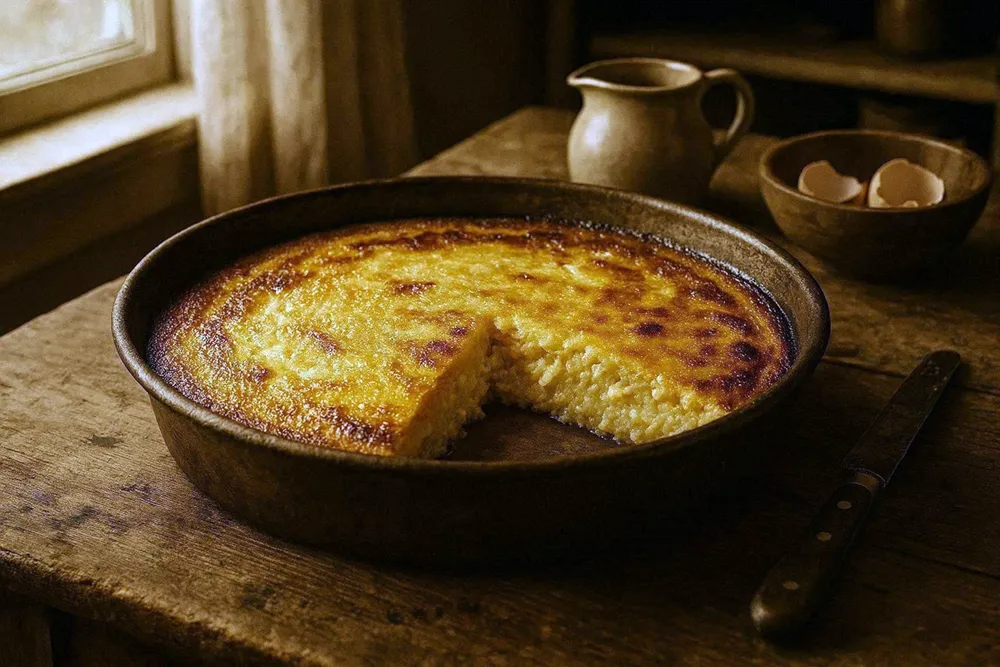
Baked Cornmeal Custard with Kajmak and Cheese
Known as razlevuša, this rustic bake pours a loose cornmeal, kajmak, cheese, and egg batter into a pan and bakes it until golden — a hearty, standalone dish.

Emmental Cheese Bars
Flaky millet pastry strips with Emmental, kajmak, egg yolks, and red pepper—savory tea snack from early 1900s Central Europe.
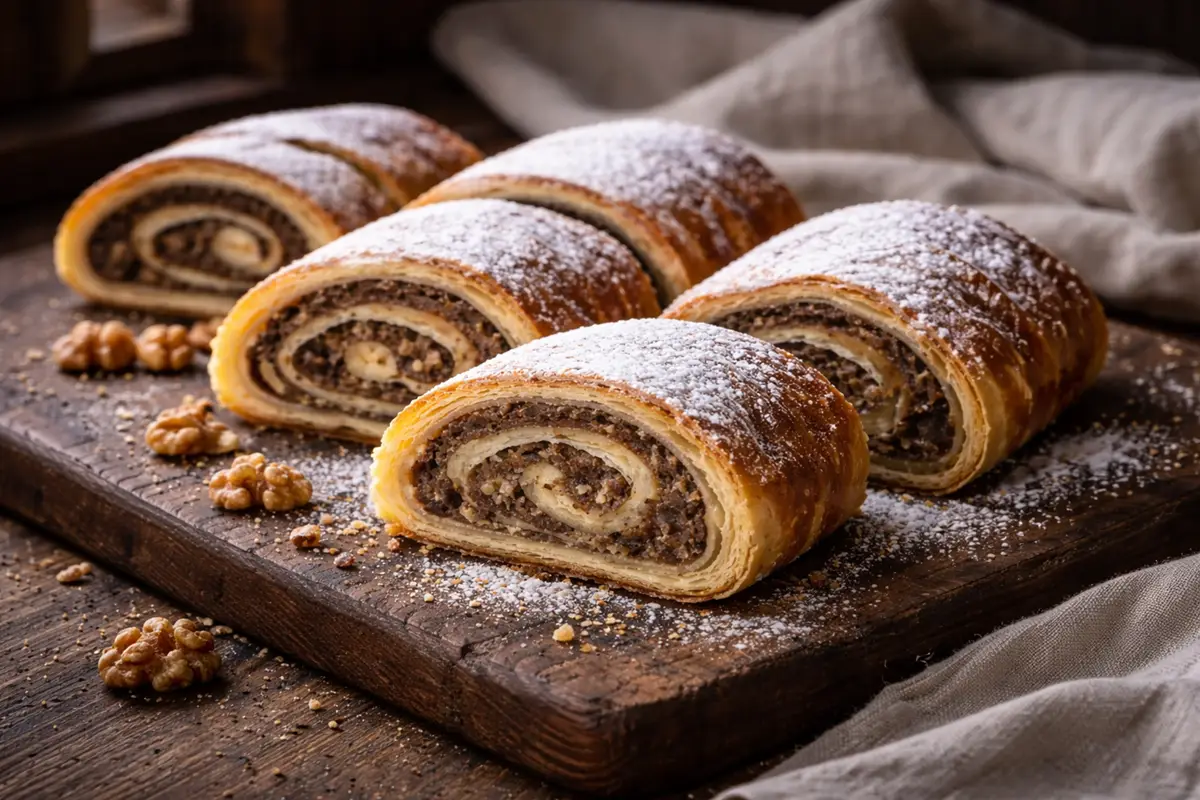
Fatback Walnut Roll
Flaky yeasted pastry laminated with raw pork fatback, filled with milk-cooked walnuts, raisins, and lemon zest. Sliced and dusted with sugar.