Fatback Walnut Roll
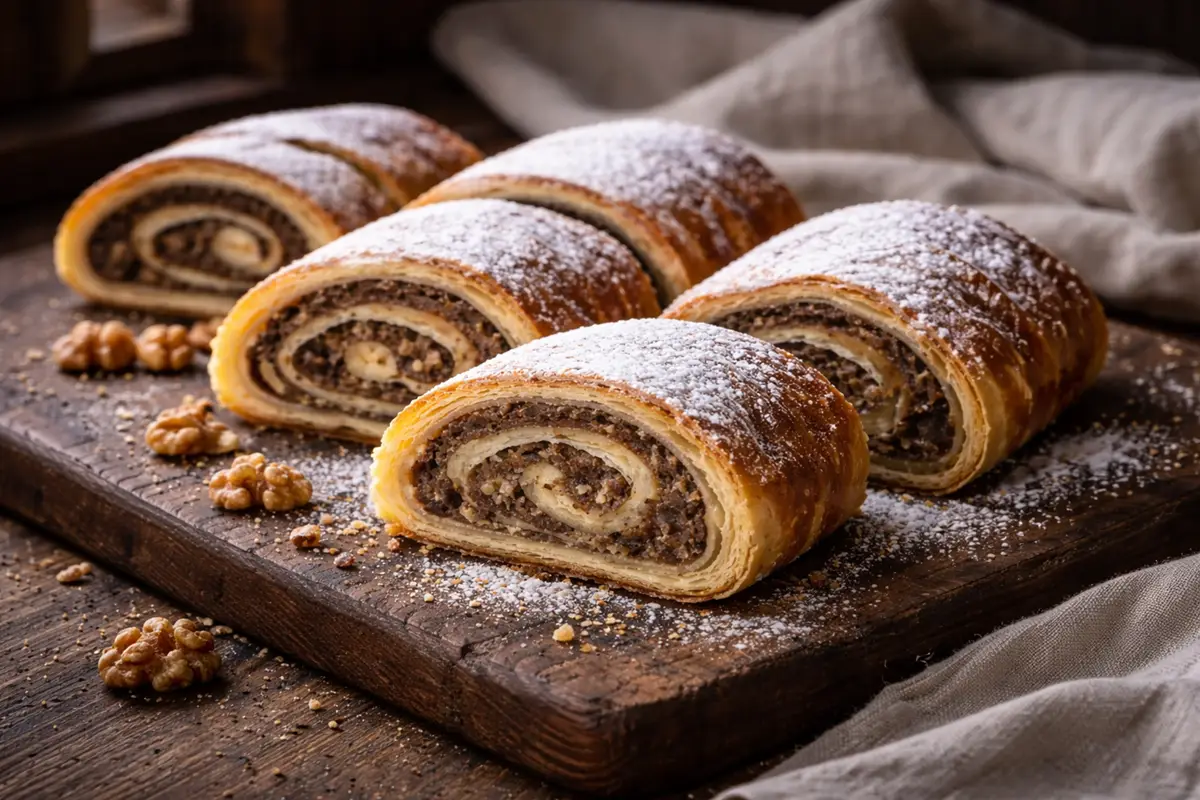
Flaky yeasted pastry laminated with raw pork fatback, filled with milk-cooked walnuts, raisins, and lemon zest. Sliced and dusted with sugar.
Quick Summary
Flaky yeasted pastry laminated with raw pork fatback, filled with milk-cooked walnuts, raisins, and lemon zest. Sliced and dusted with sugar.
Historical recipe
Modernised adaptation of an early 20th‑century source. Not independently kitchen-tested by Attic Recipes. Quantities, temperatures, and food safety guidance have been updated for a contemporary kitchen — results may vary and errors may exist. Nutritional values, where provided, are estimates only and have not been laboratory tested. Always follow current food safety guidelines for your region. If you have a health condition, allergy, or dietary requirement, consult a qualified professional before preparing this recipe.
Use of this recipe is entirely at your own risk and subject to our Terms of Service and Privacy Policy. Attic Recipes accepts no liability for any adverse outcome.
- Dairy
- Eggs
- Gluten
- Tree Nuts
Safety note
This recipe contains walnuts — a tree nut and one of the 14 major allergens under EU Regulation 1169/2011 and a FALCPA-listed allergen. Walnut allergy can cause severe reactions including anaphylaxis. Always disclose the walnut content when serving this to others.
The walnut filling can be replaced with poppy seed filling for a nut-free version.
Additional notes
-
Warning
The egg white in the walnut filling is not fully cooked through in the traditional preparation. The internal temperature of the filling should reach 71°C (160°F) to ensure food safety, particularly for vulnerable groups.
Use pasteurized egg whites if serving to pregnant women, young children, the elderly, or immunocompromised individuals.
-
Caution
High saturated fat content from raw pork fatback. Not suitable for those on low-fat or cardiovascular diets. These pastries are an occasional treat, not everyday food.
Cold unsalted butter can replace fatback, reducing saturated fat slightly and changing the flavor and layer texture.
-
Note
Some commercial raisins contain sulphur dioxide (SO₂) as a preservative — check the label if serving to individuals with sulphite sensitivity. Untreated or organic raisins do not contain added sulphites.
- 1
Make the fat dough: Combine 250g of cleaned, raw pork fatback with approximately one-third of the flour (about 165g). Work together until a uniform, pliable paste forms. Set aside in a cool place.
Tip Use fresh, unrendered fatback — not rendered lard, not butter. The raw fat must stay cold and solid throughout the process. If it softens, refrigerate for 15 minutes before continuing. - 2
Make the yeasted dough: Dissolve the yeast in a small amount of lukewarm milk and allow to activate for 5–10 minutes. Combine the remaining flour (about 335g) with the 2 egg yolks, salt, powdered sugar, and the activated yeast mixture. Knead, adding milk gradually, until you have a stiff but smooth dough — similar in texture to a classic strudel dough. It should not be sticky.
Tip The dough should feel noticeably stiffer than a standard bread dough. Resist adding too much milk. - 3
Divide the yeasted dough into two equal parts. Roll the first part out to approximately 1cm thick. Spread the fat dough evenly across the surface. Roll out the second part of the yeasted dough to the same size and lay it directly on top of the fat layer, sandwiching the fat between the two sheets.
- 4
Laminate: Using a rolling pin, roll the layered dough out as thinly as possible without tearing. Fold all four sides into the center (like an envelope), creating four layers. Rest the dough for 20–30 minutes in a cool place. This is your single lamination pass.
Tip Unlike classic puff pastry, this dough is laminated only once. Over-working will melt the fat and destroy the layers. - 5
Make the walnut filling: Combine ground walnuts and milk in a small saucepan. Cook over medium-low heat, stirring constantly, until the mixture thickens into a spreadable paste. Remove from heat, stir in the vanilla sugar, raisins, and lemon zest. Allow to cool completely. Once cooled, fold in the stiffly beaten egg whites.
Tip The filling must be fully cooled before adding the egg whites, or they will deflate. - 6
Assemble: Divide the rested dough into 3 equal parts. Roll each part out into a thin rectangle. Spread the walnut filling evenly, leaving a 2cm border at the edges. Roll each rectangle tightly into a log (strudel-style). Pinch the ends to seal firmly.
- 7
Place rolls on a lined baking sheet. Brush generously with the beaten egg. Bake at 200°C conventional (180°C fan-assisted) for 30–35 minutes until deep golden brown and the surface is firm to the touch.
Tip Do not open the oven in the first 20 minutes — sudden temperature drops will prevent proper lamination. - 8
Allow to cool for at least 15 minutes before slicing. Use a sharp serrated knife and cut with a gentle sawing motion to preserve the layers. Dust generously with powdered sugar before serving.
Nutrition Information per 1 slice (approx. 60g, 1/14 of yield)
Nutritional values are approximate estimates and may vary based on specific ingredients used, preparation methods, and portion sizes.
Serving Suggestions
Best served at room temperature, sliced thickly and dusted with powdered sugar. Pairs well with strong black coffee or tea. Slices keep well wrapped at room temperature for 2 days, or refrigerated for up to 5 days.
About This Recipe
This walnut roll is built on one of the oldest lamination techniques in Central European baking — raw fatback folded into a stiff yeasted dough to create layers that are both flaky and tender. Unlike butter-laminated pastries, the fatback version has a more neutral, savory depth that lets the walnut filling carry the flavor. It is the kind of pastry that filled Sunday kitchens across the region for generations.
Why It Works
The key to this dough is the distinction between raw fat and rendered fat. Raw pork fatback still contains water — typically 10–15% by weight. During baking, that water turns to steam between the layers, separating them from the inside without any additional folding. Rendered lard, with its water driven off, cannot do this. The yeast, meanwhile, gives the dough enough strength and elasticity to hold the lamination without tearing. The result sits somewhere between a strudel and a croissant — flaky on the outside, soft and yielding within.
On Filling Quantities
The walnut and milk quantities in this recipe — 200g ground walnuts and approximately 100ml milk — are calibrated for 3 rolls from 500g flour and produce a generously filled pastry. Cook the nuts in milk until you have a thick, spreadable paste: this is the correct consistency regardless of exact measurements. Too wet and the filling will leak; too dry and it will crack when rolled.
Troubleshooting
Dough tears during rolling: The dough is too warm. Refrigerate for 10–15 minutes and try again with a lighter touch.
Layers do not separate after baking: The fat melted into the dough during lamination. This happens when the dough or the kitchen is too warm, or when the dough was over-worked. Keep everything cold and work quickly.
Filling leaks during baking: The rolls were not sealed tightly enough at the ends, or the filling was too wet. Ensure the walnut paste is thick before spreading, and pinch the ends firmly.
A classic of early 20th century home cooking, preserved and adapted for the modern kitchen.
The Story Behind This Recipe
Historical Context
This pastry belongs to the tradition of raw-fat laminated doughs common throughout Central European households in the early 20th century, where butter was expensive and fresh pork fatback was the everyday fat. The technique — sandwiching raw fatback between sheets of yeasted dough and folding them together — produces layers that are simultaneously flaky and tender, with a richness that butter doughs rarely match. Walnut rolls of this type were a fixture of Sunday baking and holiday tables across the region.
Modern Kitchen Adaptation
The walnut and milk filling quantities given here — 200g ground walnuts and approximately 100ml milk — are calibrated for 3 rolls from 500g flour and produce a generously filled pastry. Adjust the milk quantity when cooking the walnuts: the paste should be thick and spreadable, not wet. Raw pork fatback can be sourced from a butcher; ask for fresh back fat, cleaned of skin. If unavailable, cold unsalted butter is the closest substitute, though the lamination character will differ.
This recipe is an independent modern adaptation developed from historical sources in the public domain. It is provided for informational and educational purposes only and does not constitute professional dietary, nutritional, or medical advice. Food preparation involves inherent risks. The reader assumes full responsibility for safe food handling, ingredient sourcing, and adherence to current local food safety guidelines. The site operator accepts no liability for outcomes resulting from the preparation or consumption of this recipe.
One recipe.
Every week.
You Might Also Like
More recipes from the same category
Baked Cornmeal Custard with Kajmak and Cheese
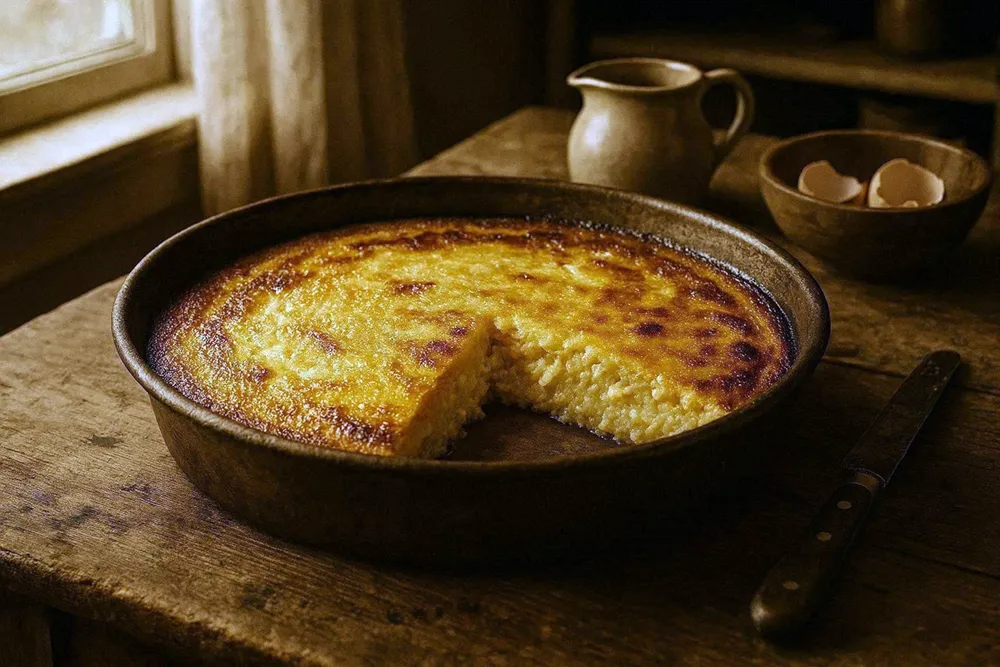
Known as razlevuša, this rustic bake pours a loose cornmeal, kajmak, cheese, and egg batter into a pan and bakes it until golden — a hearty, standalone dish.

Emmental Cheese Bars
Flaky millet pastry strips with Emmental, kajmak, egg yolks, and red pepper—savory tea snack from early 1900s Central Europe.
Flaky Fatback Pastries with Ham or Cheese
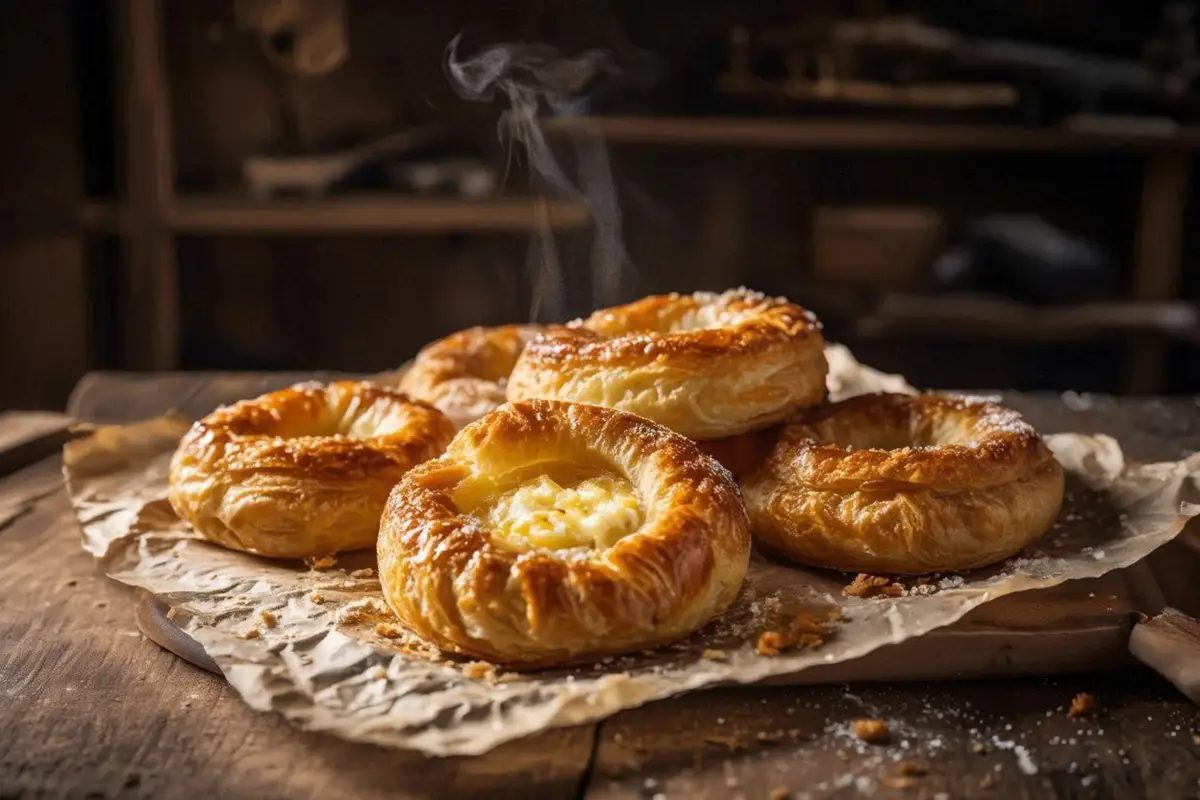
Tender, layered pastries made with hand-laminated pork fatback dough, filled with creamy ham or a rich egg-and-cheese mixture.