Flaky Fatback Pastries with Ham or Cheese
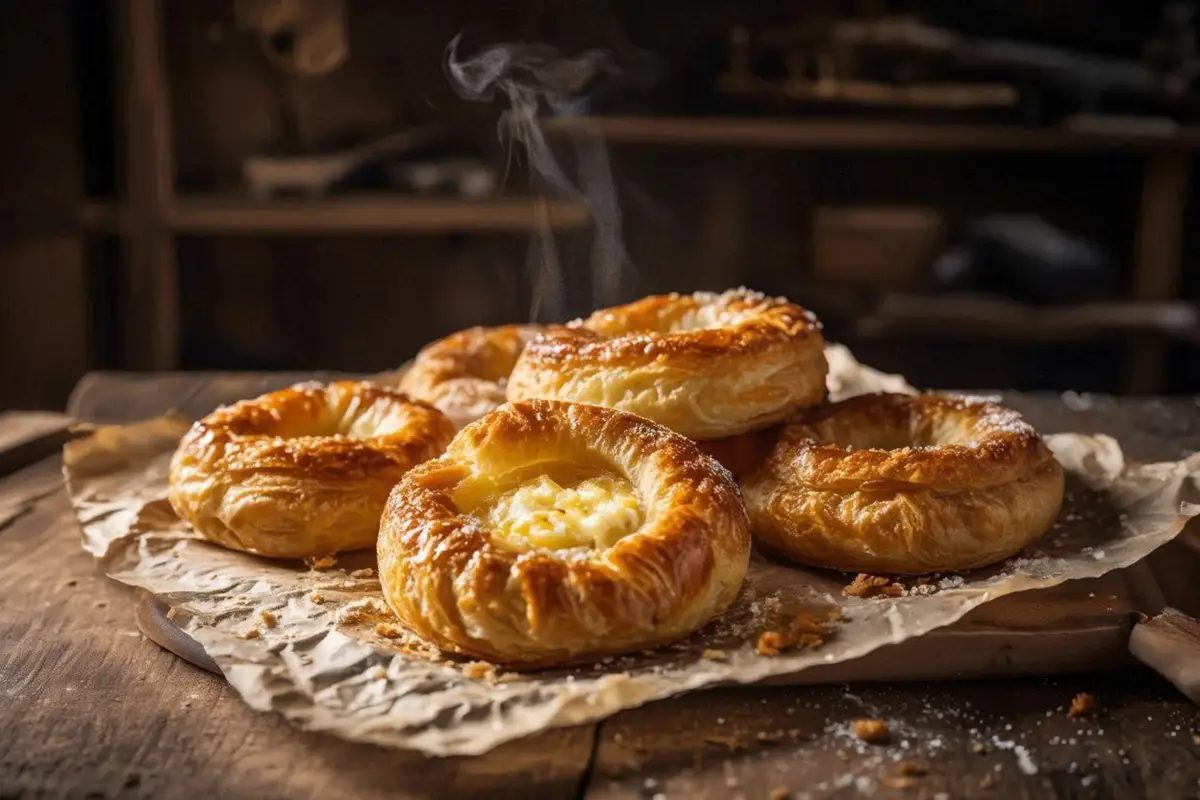
Tender, layered pastries made with hand-laminated pork fatback dough, filled with creamy ham or a rich egg-and-cheese mixture.
Quick Summary
Tender, layered pastries made with hand-laminated pork fatback dough, filled with creamy ham or a rich egg-and-cheese mixture.
Historical recipe
Modernised adaptation of an early 20th‑century source. Not independently kitchen-tested by Attic Recipes. Quantities, temperatures, and food safety guidance have been updated for a contemporary kitchen — results may vary and errors may exist. Nutritional values, where provided, are estimates only and have not been laboratory tested. Always follow current food safety guidelines for your region. If you have a health condition, allergy, or dietary requirement, consult a qualified professional before preparing this recipe.
Use of this recipe is entirely at your own risk and subject to our Terms of Service and Privacy Policy. Attic Recipes accepts no liability for any adverse outcome.
- Dairy
- Eggs
- Gluten
Additional notes
-
Warning
The cheese filling contains raw egg whites folded in before baking. While the pastries are baked at high temperature, the filling centre may not reach full pasteurization throughout. Pregnant women, young children, elderly individuals, and immunocompromised persons should exercise caution or use pasteurized eggs.
Use commercially pasteurized eggs for the cheese filling.
-
Caution
These pastries are high in saturated fat due to the fatback content. They are an occasional treat, not everyday food. Individuals with cardiovascular conditions or on a low-fat diet should be aware.
-
Note
Fresh pork fatback must be sourced from a reliable butcher and kept refrigerated at all times. Do not use fatback that has been at room temperature for more than 2 hours.
- 1
The evening before: Remove the skin from the fatback and scrape the surface clean with a knife. Wash the fatback in several changes of cold water until the water runs clear. Pat dry, place on a board, and roll it in the 50g of flour to coat on all sides. Wrap and refrigerate overnight. The fatback must stay cold and firm for the lamination to work.
Tip Washing the fatback removes surface impurities. The flour coating helps it integrate into the dough layers without sliding. - 2
The next day: Dissolve the crumbled fresh yeast in the warm milk and leave for 5 minutes until slightly foamy. In a large bowl, combine the 500g flour, egg yolks, sour cream, and yeast-milk mixture. Knead into a smooth, pliable dough — about 10 minutes by hand. The dough should be soft but not sticky. Cover and rest for 15 minutes.
Tip Do not let the dough rise fully before lamination — you want it relaxed, not puffy. - 3
On a lightly floured surface, roll the dough out into a large rectangle. Remove the fatback from the refrigerator and place it in the centre of the dough. Fold the dough over the fatback from all four sides, completely enclosing it like an envelope. Press the edges to seal.
- 4
Using a rolling pin, gently roll the parcel out into a rectangle again, working carefully to avoid breaking through the dough. Fold the dough into thirds, like a letter (one third over the centre, then the remaining third on top). This is the first fold. Wrap and refrigerate for 30 minutes.
Tip If the fatback starts to feel soft or the dough tears, stop immediately and refrigerate for 20 minutes before continuing. Cold is everything in this process. - 5
Repeat the rolling and folding process a second time. Wrap and refrigerate for another 30 minutes.
- 6
After the second rest, leave the dough to rest at cool room temperature for 4 hours. This slow rest allows the yeast to develop gently without overproofing.
- 7
After the 4-hour rest, roll out the dough to approximately 1cm thickness (roughly the width of a little finger). Using a round cutter (6–7cm diameter), cut out an even number of rounds. From half of the rounds, use a smaller cutter or thimble (2–3cm diameter) to cut a hole in the centre — these will be the tops.
- 8
Prepare your chosen filling. For ham filling: mix the minced ham with the sour cream until combined. For cheese filling: combine the grated cheese, egg yolks, and sour cream, then gently fold in the stiffly beaten egg whites.
- 9
Place the solid rounds (bottoms) on a parchment-lined baking sheet. Add a teaspoon of filling to the centre of each. Press the ring-shaped rounds (tops) gently on top to sandwich the filling, aligning the edges. The filling should be visible through the hole.
Tip Do not overfill — the filling puffs slightly during baking and can overflow. A level teaspoon is enough. - 10
Preheat the oven to 210°C conventional (190°C fan-assisted). Bake for 18–20 minutes until deeply golden and the layers are visibly puffed and flaky. Serve hot.
Nutrition Information per 2 pastries with ham filling
Nutritional values are approximate estimates and may vary based on specific ingredients used, preparation methods, and portion sizes.
Serving Suggestions
Serve hot from the oven as an appetizer or alongside soup. These pastries are best eaten the day they are baked — the layers soften by the next day, though a few minutes in a hot oven will revive them. Pair with a cold glass of buttermilk or a sharp white wine.
About This Recipe
These pastries occupy a fascinating middle ground between a yeasted roll and a rough puff pastry — flaky and layered from the fatback lamination, but with the slight chew and depth that only a yeasted dough provides. The technique of enclosing a slab of fresh back fat in dough and folding it repeatedly is an old one, rooted in practical Central European baking at a time when butter was expensive and fatback was abundant. The result is genuinely unlike anything made with butter, with a savory richness that makes even a simple filling of ham and sour cream taste exceptional.
Why It Works
Lamination — the process of creating alternating layers of dough and fat through repeated folding — works here for the same reason it works in croissants and puff pastry: when the layers hit the heat of the oven, the fat melts and the steam trapped between the dough layers pushes them apart, creating flakiness. Fresh fatback, being solid and unrendered, behaves like butter in this respect. The yeast in the dough adds a subtle depth and slight chew that pure puff pastry lacks, and the long cool rest allows the gluten to relax fully so the layers do not spring back when rolled.
A Note on Fatback
Fatback is the firm layer of fat from the back of the pig, taken before any rendering. It is not lard, which is fatback that has been melted down and clarified. The distinction matters enormously in this recipe: lard is liquid at room temperature and would be absorbed immediately into the dough, producing a shortcrust rather than a laminated pastry. Fresh fatback stays solid, forms discrete layers, and melts only in the oven. Ask your butcher specifically for fresh, unrendered pork back fat — it is not always displayed but is usually available on request.
Troubleshooting
Dough tearing during rolling? The fatback has warmed up or the gluten is too tight. Refrigerate for 20 minutes and try again with a lighter touch.
No visible layers after baking? The fat was too soft during lamination and smeared into the dough instead of staying in sheets. This cannot be corrected after baking, but the pastries will still taste good — just denser.
Filling overflowing? Too much filling, or the oven was not hot enough to set the pastry quickly. Use a level teaspoon and make sure the oven is fully preheated before the tray goes in.
A classic of early 20th century home cooking, preserved and adapted for the modern kitchen.
The Story Behind This Recipe
Historical Context
Hand-laminated pastries made with fatback rather than butter represent one of the oldest and most practical forms of Central European baking, predating the widespread availability of standardised commercial fats. Across Central Europe, the technique of enclosing a slab of fresh back fat in yeasted dough and folding it repeatedly to create layers was common in both domestic and bakery production. The result — somewhere between a yeasted roll and a rough puff pastry — has a distinctive texture that butter-based laminated doughs do not replicate. The two fillings offered here, ham and cheese, reflect the classic division of savory pastry traditions in the region.
Modern Kitchen Adaptation
Fresh pork fatback (unrendered back fat) is essential to this recipe and cannot be substituted with lard or butter without fundamentally changing the texture. A good butcher should be able to supply it. No oven temperature was specified in the source preparation — 210°C conventional (190°C fan-assisted) is standard for this style of laminated yeasted pastry and produces a deeply golden, flaky result. Fresh yeast can be substituted with 7g of dry instant yeast dissolved in the warm milk.
This recipe is an independent modern adaptation developed from historical sources in the public domain. It is provided for informational and educational purposes only and does not constitute professional dietary, nutritional, or medical advice. Food preparation involves inherent risks. The reader assumes full responsibility for safe food handling, ingredient sourcing, and adherence to current local food safety guidelines. The site operator accepts no liability for outcomes resulting from the preparation or consumption of this recipe.
One recipe.
Every week.
You Might Also Like
More recipes from the same category
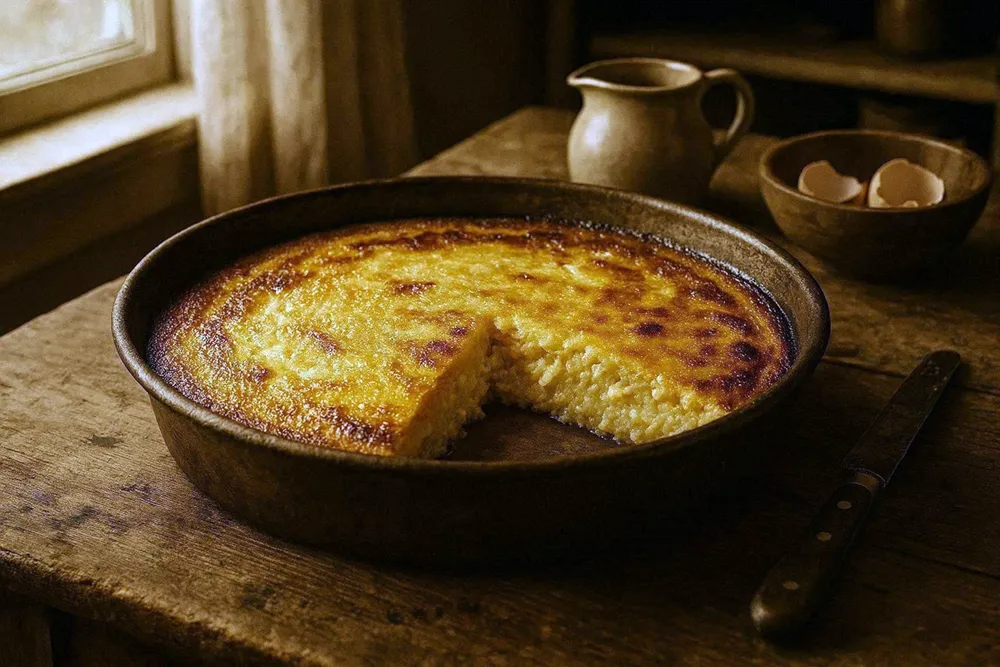
Baked Cornmeal Custard with Kajmak and Cheese
Known as razlevuša, this rustic bake pours a loose cornmeal, kajmak, cheese, and egg batter into a pan and bakes it until golden — a hearty, standalone dish.

Emmental Cheese Bars
Flaky millet pastry strips with Emmental, kajmak, egg yolks, and red pepper—savory tea snack from early 1900s Central Europe.
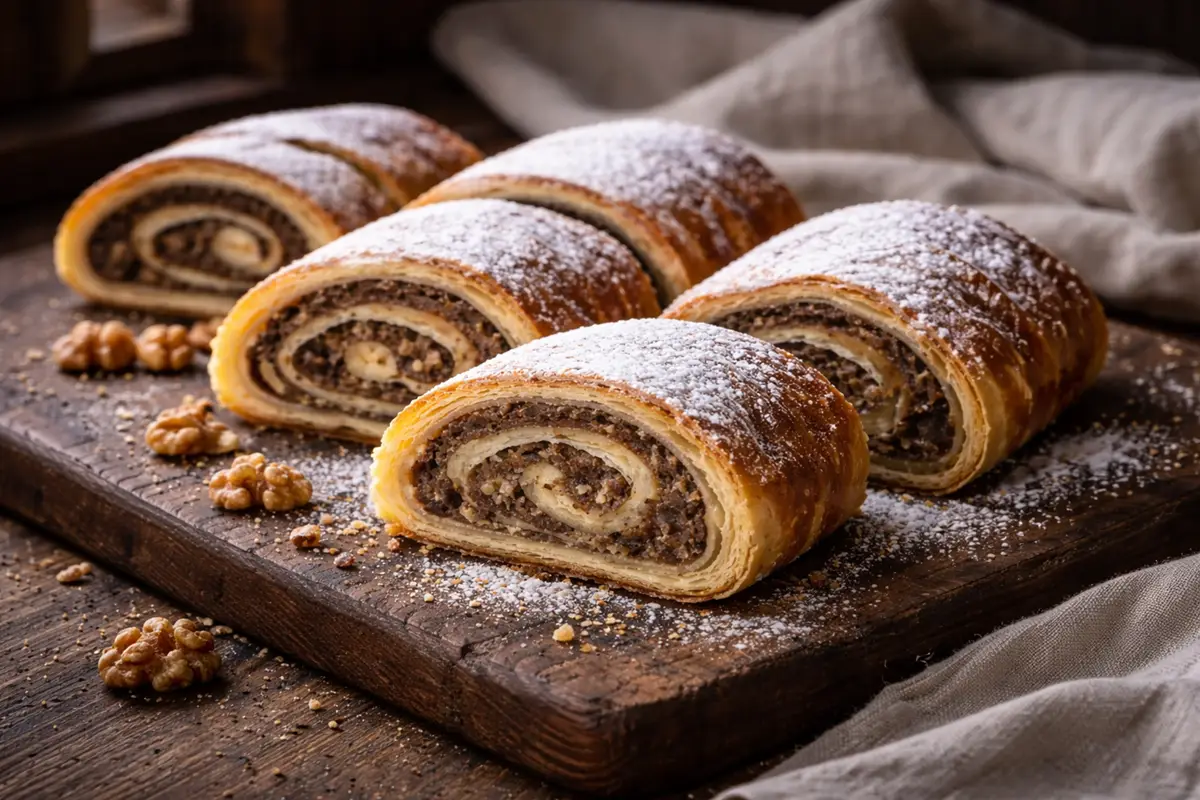
Fatback Walnut Roll
Flaky yeasted pastry laminated with raw pork fatback, filled with milk-cooked walnuts, raisins, and lemon zest. Sliced and dusted with sugar.