The Crab on the Table and in the Stars: Mythology, Folklore, and How to Clean an Adriatic Spider Crab
From Greek mythology to Adriatic fish markets — the surprisingly rich cultural history of the crab, plus a practical guide to cleaning spider crabs at home.
The Creature in the Stars
Before it appeared on anyone’s table, the crab appeared in the sky.
The constellation Cancer — tucked modestly between the brighter Leo and Gemini — owes its name to a story that almost didn’t survive. In the myth of Hercules and the Hydra, while the hero wrestled the nine-headed serpent in the swamps of Lerna, the goddess Hera sent a crab to bite his foot and break his concentration. Hercules, enraged, crushed it under his heel and continued the battle. The crab had failed in its mission, but Hera rewarded its loyalty anyway — placing it among the stars as the constellation Cancer, where it has remained ever since.
It is a minor story. The crab is a minor character — sent not to win but to distract, dispatched to the ankle of a hero and crushed before the scene is over. In Greek and Roman mythology, the crab appears as a fierce, devoted soldier, but ultimately vulnerable — loyal, well-meaning, and not quite the hero. And yet here it is, immortalized in the zodiac, giving its name to an entire sign of the calendar. There is something worth noting in that: the minor character who outlasted the main event.
A Creature the Whole World Has Had Opinions About
The Greeks were not alone in finding meaning in the crab. Cultures on almost every coast have.
In Chinese mythology, the crab is associated with the moon and the yin energy of water. The connection runs through the Mid-Autumn Festival, when hairy crab is a traditional seasonal food — the festival coincides with the crab’s harvest season, and the pairing of lunar celebration and crab has been part of Chinese autumn customs for centuries.
In the Philippines, the Mandaya people of Mindanao told of Tambanokano — a colossal crab born of the union between the Sun and the Moon, so enormous that when it rose toward the moon in anger, it caused eclipses. The story was recorded in 1916 from oral tradition. Communities would shout and beat gongs to frighten it away and release the light.
In ancient Egypt, Greece, and Rome, crabs were associated with various water deities. The image of a crab with its arms fully extended was read as a sun in splendor — a talisman against shadow and uncertainty.
The Aphrodisiac Question
The question of whether crab is an aphrodisiac is older than the word itself — which comes from Aphrodite, the Greek goddess who rose from the sea.
In ancient Rome, the roe of female crabs was prescribed as a physical love potion. In traditional Chinese medicine, crab ovaries were believed to carry a concentrated yin essence that could improve male vitality. Across various coastal cultures, the crab’s association with water, fertility, and the sea gave it a persistent reputation for arousal.
Does the science support any of this? Partially, and in the way that nutrition science usually does — obliquely, probabilistically, without magic.
Crab is high in zinc — one of the more zinc-dense foods available. Zinc is directly involved in testosterone synthesis and has a documented role in reproductive health in both men and women. Crab is also a good source of omega-3 fatty acids, which support cardiovascular function and circulation. Neither of these things is a love potion. But neither are they nothing.
What the ancient prescriptions were probably capturing, without the vocabulary to say so directly, was a simple observation: people who ate well — who had access to fresh seafood, good oil, clean wine — were healthier, more energetic, and more interested in each other. The crab on the table was a marker of abundance. Abundance, in most cultures, has always had erotic implications.
The Crab on the Adriatic Coast
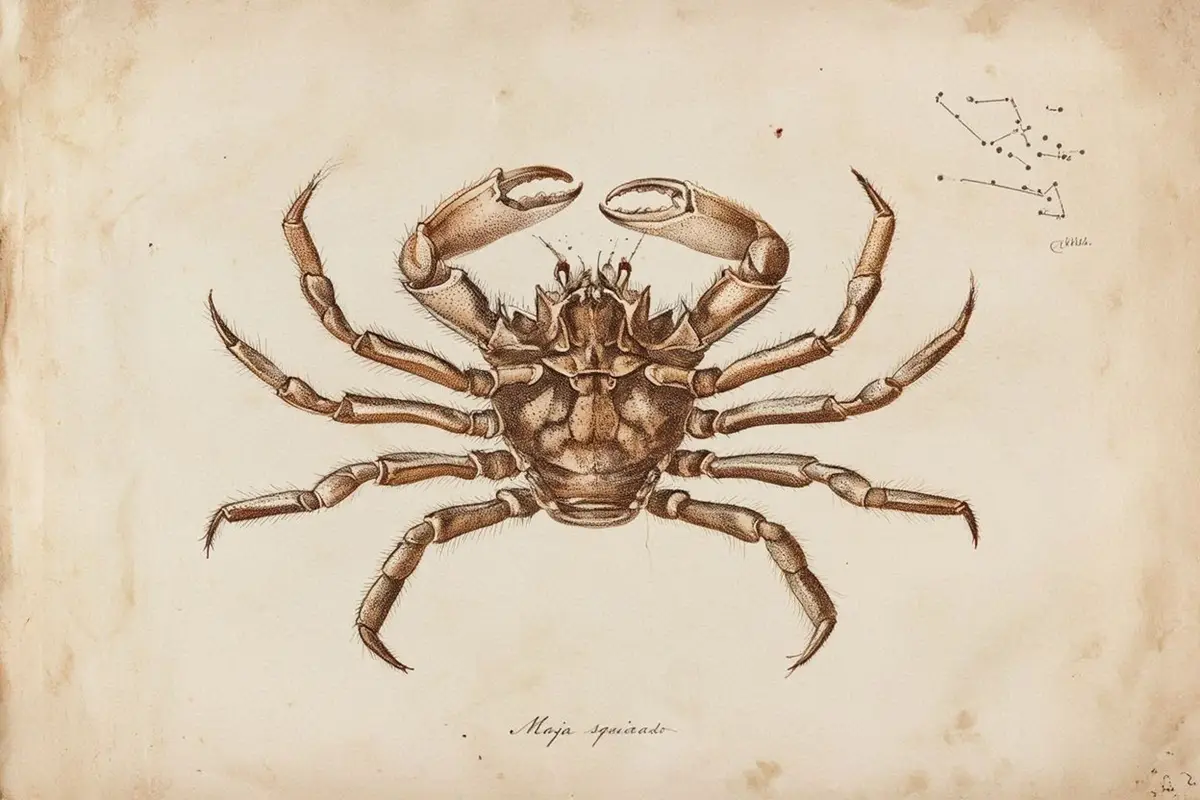
Along the Adriatic coast, the spider crab — Maja squinado, known as rakovica in Serbian and Croatian, grancigula in the island dialects — has been part of the local diet for as long as there have been people fishing the Adriatic. It is not a glamorous creature. It is spiny, awkward, and slow. It looks difficult to eat.
It is not difficult to eat. The shell breaks easily under firm hand pressure. The meat inside is sweet, delicate, and deeply flavored by the sea. It rewards anyone patient enough to clean it properly.
Spider crabs are subject to a closed season in Croatian waters — from June 1 to November 30 — which means the best time to buy them fresh along the coast is December through May. Outside this window, they can sometimes be found in larger fish markets, but the seasonal rhythm is worth respecting. A crab caught in its proper season is a different thing from one that is not.
How to Clean an Adriatic Spider Crab — Step by Step
What you will need: A sturdy surface, a crab cracker or heavy knife for the claws, a pick or thin skewer for extracting body meat, and a bowl for the good parts.
Step 1 — Cook first, clean after. Spider crabs are almost always cleaned after cooking, not before. Bring a large pot of generously salted water to a rolling boil — it should taste like the sea. Add the live crabs and cook for 12–15 minutes depending on size (a medium crab of around 400g needs approximately 13 minutes). Remove and allow to cool completely before handling.
Step 2 — Break the shell. Place the crab on its back. Press the top shell firmly with the heel of your hand. It will crack and give way easily — the shell becomes brittle after cooking. Lift it away entirely and set it aside. Some cooks use the empty shell as a serving bowl.
Step 3 — Remove what you don’t eat. Two things must go:
- The grey feathery gills (dead man’s fingers) — arranged in two rows inside the body cavity. Pull them away entirely. They are not toxic but are indigestible and taste of nothing.
- The stomach sac — a small grey pouch located just behind the eyes. Discard it.
Everything else is edible.
Step 4 — Extract the body meat. The body cavity contains sweet, fine white meat distributed in chambers. Work with your fingers, pulling sections apart and using a pick to reach into the smaller passages. Take your time — the meat is worth the effort.
Step 5 — The brown meat. The hepatopancreas — the brown, creamy matter lining the inside of the shell — is edible and intensely flavored. Some people love it; some find it too strong. In coastal Adriatic cooking it is often stirred into the sauce. Try a small amount before deciding.
Step 6 — Crack the claws. Use a crab cracker or the back of a heavy knife to crack each claw. The meat inside is denser and slightly richer than the body meat. Extract it cleanly and keep it separate — it deserves a moment of its own.
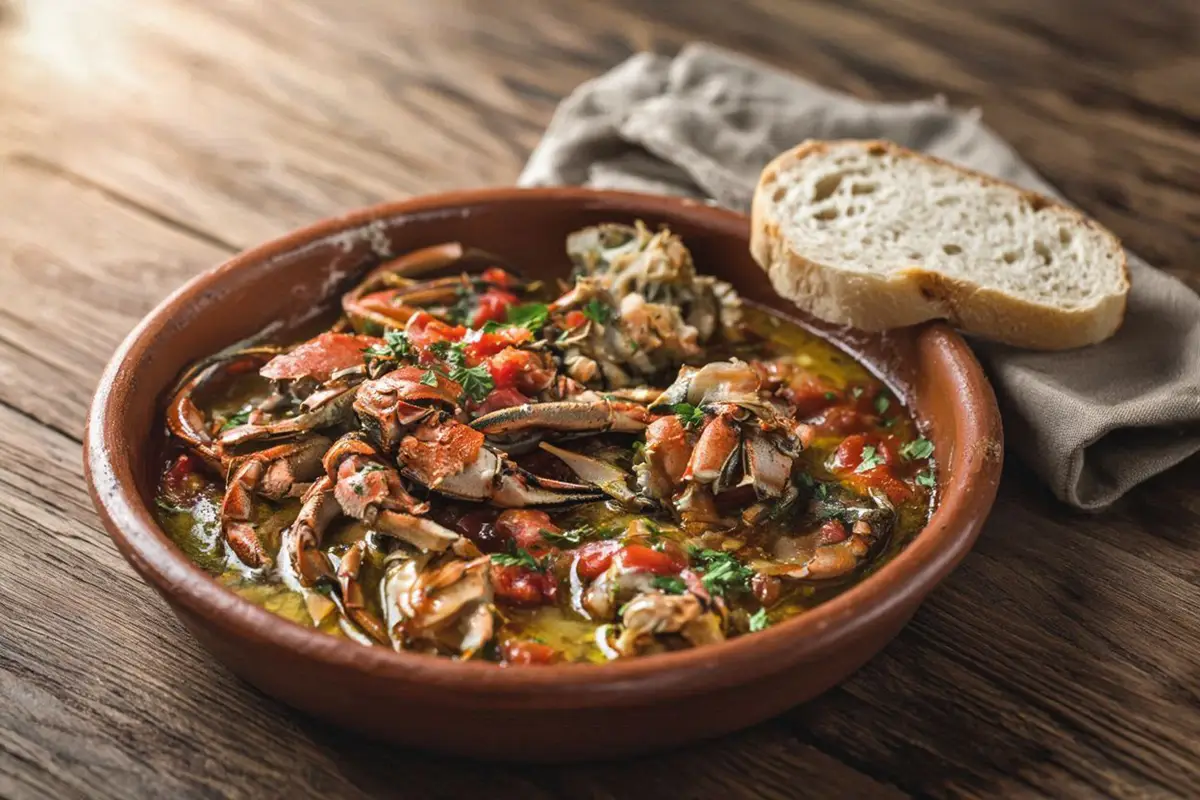
The cleaned meat is now ready to use. In the traditional Adriatic recipe, it goes directly into the olive oil with onion and garlic, then wine, then tomato. From cleaning to table, the whole process takes less than an hour.
A Note on Health and Safety
Crab is a nutritionally dense food — high in protein, rich in zinc, selenium, and omega-3 fatty acids, with a relatively low calorie count for the amount of protein it provides. For most healthy adults, it is an excellent addition to the diet.
Those who should exercise caution:
Crab is a major allergen — shellfish allergy is one of the most common food allergies in adults and can cause severe reactions including anaphylaxis. Anyone with a known shellfish or crustacean allergy must avoid this dish entirely. Cross-contamination is a serious risk in kitchens where other shellfish are handled.
Crab is moderately high in cholesterol. Those managing cardiovascular disease or following a low-cholesterol diet should consume it in moderation and discuss their specific situation with a healthcare provider.
Crab must be fully cooked before consumption. Raw or undercooked crab poses a risk of foodborne illness, including Vibrio infection, which can be severe. The internal temperature must reach a minimum of 63°C (145°F). A properly cooked crab is opaque and white throughout; any translucency indicates undercooking.
Discard any crab that smells of ammonia — before or after cooking. This smell indicates spoilage and the crab should not be eaten under any circumstances.
Crab purchased live should be cooked the same day. Cooked crab can be refrigerated for up to 2 days. It should not be left at room temperature for more than 2 hours.
Practical Takeaways
The spider crab is a seasonal, sustainable, and deeply underused ingredient in most kitchens outside the Adriatic coast. It is available from December through May in Croatian and Adriatic fish markets; in other regions, brown crab or Dungeness crab make excellent year-round substitutes.
Cleaning a spider crab at home is straightforward once you understand the structure. The shell breaks easily; the gills and stomach sac are easy to identify and remove; the meat — body and claw — is sweet, delicate, and richly flavored by the sea.
The mythology is optional. The crab does not need the constellation Cancer or the swamps of Lerna to be worth cooking. But it is a more interesting thing on the plate when you know it has been there, in one form or another, since before the word aphrodisiac existed.
Attic Recipes — digitizing and adapting Central European home cooking from the early twentieth century.
Frequently Asked Questions
01Are Adriatic spider crabs dangerous to handle?▶
When alive, they have strong pincers, so always handle them from the back, gripping the shell firmly between their walking legs. Once cooked, they are harmless, but the sharp spines on their shells can scratch. Use a kitchen towel or gloves when cleaning to protect your hands.
02How do I know if the crab is full of meat?▶
A fresh spider crab should feel heavy for its size. If it feels light or hollow, it likely has less meat inside.
03What part of the crab should I discard when cleaning?▶
Always remove and discard the grey feathery gills, known as dead man's fingers, which run in two rows inside the shell cavity. They are not toxic but are indigestible. Also discard the stomach sac located just behind the eyes. Everything else — body meat, claw meat, and the brown hepatopancreas — is edible.
04Is the brown meat inside the shell safe to eat?▶
Yes, the brown meat — the hepatopancreas — is edible and prized for its rich, briny flavor. However, it can accumulate toxins and heavy metals, so enjoy it in moderation. Many cooks stir it into sauces or spread it on toasted bread.
05What is the best way to get the meat out of the legs?▶
Spider crab shells are delicate. A nutcracker or the back of a heavy kitchen knife is enough to crack the legs. For the body, use a seafood fork or pick to reach into the crevices — the sweetest meat is often tucked away in the smaller chambers.
06What is the difference between rakovica and grancigula?▶
They are the same species — Maja squinado, the Adriatic spider crab. Rakovica is the Serbian and Croatian standard term; grancigula is the coastal island dialect name, still widely used in fish markets along the Adriatic coast.
07When can I buy spider crabs along the Adriatic coast?▶
Spider crabs are subject to a closed season in Croatian waters from June 1 to November 30. They are available in fish markets from December through May. Outside the Adriatic, brown crab, Dungeness crab, and blue swimmer crab are good year-round substitutes.
08Can I use frozen crab instead of fresh?▶
Fresh is strongly preferred. Frozen crab releases a significant amount of water during cooking, which dilutes the sauce and prevents the characteristic reduction. If using frozen, thaw completely, drain thoroughly, and pat dry before adding to the pan.
09Can I cook spider crabs ahead of time?▶
They are best served freshly cooked. If you must prepare them in advance, boil, cool rapidly, and refrigerate for no more than 24 hours. Beyond that, the texture and flavor of the meat deteriorate.
10Is crab actually an aphrodisiac?▶
The belief has ancient roots — Roman physicians prescribed crab roe as a love potion, and traditional Chinese medicine credited crab ovaries with enhancing vitality. Modern nutrition science offers a partial explanation: crab is rich in zinc, which supports testosterone production, and omega-3 fatty acids, which support cardiovascular health and circulation. Whether that counts as an aphrodisiac depends on your definition.