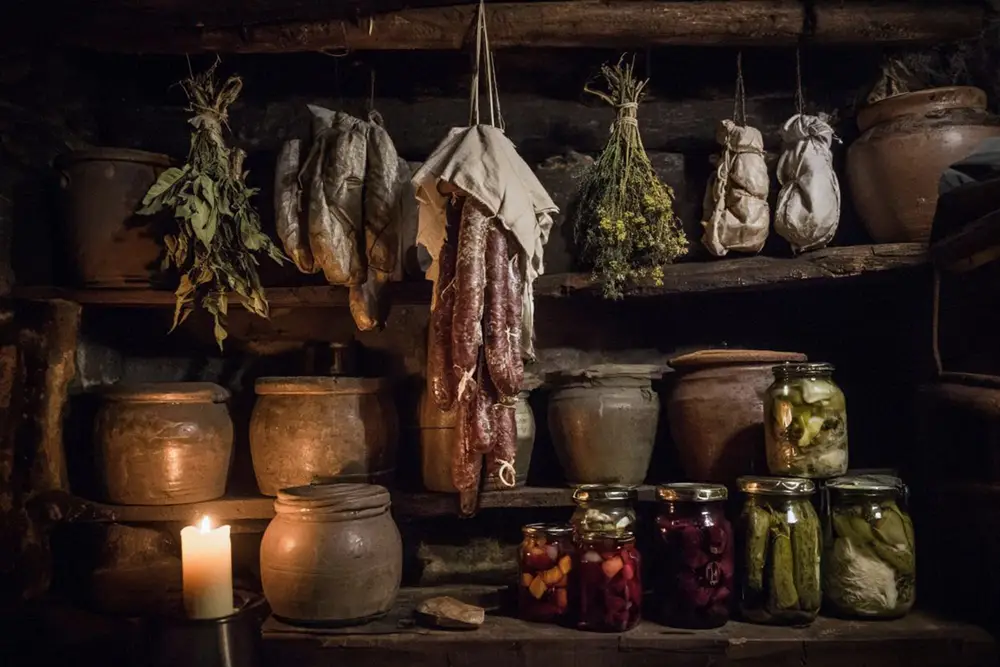
Salt, Smoke, and Cold: How Food Was Preserved Before Refrigeration
Before refrigerators, kitchens relied on salt, smoke, acid, and cold to keep food safe. These were not workarounds — they were precise, tested techniques.
The Refrigerator Is a Very Recent Invention
Household refrigerators became common in Europe and North America only in the 1930s and 1940s. Before that, every kitchen managed food safety through chemistry and environment — not temperature control in the modern sense.
This is the context in which every recipe in a 1930s cookbook was written. The preservation techniques embedded in those recipes — the salt levels, the vinegar, the curing times, the instructions to keep things in a cool cellar — were not stylistic choices. They were functional. They kept food safe and edible across days, weeks, or months without electricity.
Understanding these techniques explains why old recipes taste the way they do, and why certain instructions that seem unnecessary today were once essential.
Salt: The Foundation of Preservation
Salt preserves through osmosis. When salt contacts the surface of meat, fish, or vegetables, it draws water out of the cells. Bacteria require water to survive and reproduce. Reduce the available water enough, and bacterial growth slows dramatically or stops.
This is called reducing the water activity of a food — a concept food scientists now measure precisely, but which old cooks understood through observation and tradition.1 They knew that meat rubbed with enough salt and left in a cool place would not rot. They knew that vegetables packed in salt brine would keep through winter. They did not need the vocabulary to describe why.
Dry curing — rubbing salt directly onto meat — pulls moisture from the surface and interior over days or weeks. The result is a dense, shelf-stable product with a concentrated flavor. Wet curing, or brining, submerges the food in a salt solution. The salt penetrates more evenly and the texture is less compressed. Both methods are found throughout old recipe collections, applied to different purposes.
The salt concentrations in old preservation recipes are not arbitrary. They represent generations of calibration — enough salt to inhibit spoilage, not so much that the product becomes inedible. When adapting these recipes for modern use, it is important to understand that the salt level was doing a job beyond seasoning.
Smoke: Chemistry Disguised as Flavor
Wood smoke is not simply a flavoring agent. It is a delivery system for antimicrobial compounds.
When wood burns incompletely, it produces hundreds of chemical compounds — phenols, carbonyls, aldehydes, and organic acids. These deposit onto the surface of food exposed to the smoke. The phenolic compounds in particular are toxic to bacteria and molds; organic acids lower the surface pH of the food, further inhibiting microbial growth.2 The combination of these compounds, the drying effect of heat, and the reduction of surface moisture creates a hostile environment for microbial growth.
Different woods produce different compound profiles, which is why wood choice affects both preservation efficacy and flavor. Dense hardwoods — beech, oak, cherry, apple — were historically preferred in Central and Northern Europe for their phenol-rich smoke. Resinous softwoods were avoided because they deposit bitter, unpleasant compounds including high levels of terpenes that make the end product unpalatable.
Old recipes that specify smoking time are describing the minimum exposure needed for the antimicrobial compounds to penetrate adequately. Smoking for flavor alone can be much shorter. Smoking for preservation required longer exposure, often combined with prior salt curing, which is why traditional smoked meats were cured first and smoked second.
Fermentation: Controlled Spoilage
Fermentation is a controlled process in which beneficial microorganisms — primarily lactic acid bacteria — convert sugars into acids, primarily lactic acid. The resulting acidic environment inhibits the growth of harmful bacteria, preserving the food while transforming its flavor and texture.3
Sauerkraut, pickled vegetables, fermented dairy — all of these rely on fermentation. The process requires the right salt concentration (to suppress unwanted bacteria while allowing lactic acid bacteria to thrive), the right temperature (cool but not cold), and the right anaerobic conditions (keeping food submerged below the brine surface, away from oxygen).
Old recipes for fermented vegetables specify salt ratios that seem high by modern standards. They are calibrated for preservation, not palatability alone. The tang that develops in properly fermented food is lactic acid — the same compound that makes yogurt sour and sourdough bread complex. It is also what makes the food safe.
Fermentation was not a specialty technique in pre-refrigeration kitchens. It was routine. Crocks of fermenting vegetables were a standard fixture in cellars and pantries throughout autumn and winter in Central Europe. Recipes in old cookbooks that call for sauerkraut, soured cream, or fermented beets as ingredients are assuming the cook either made these or had access to them as staples.
A note on scope: fermented vegetables are accessible and reliable for home preparation when basic salt concentrations and hygiene are observed. Fermented and dry-cured meats — traditional salami, air-dried sausages — operate on different principles and require precise control of temperature, humidity, salt, and pH throughout a multi-week process. They are not equivalent to sauerkraut in terms of complexity or safety margin, and anyone undertaking home meat fermentation should consult dedicated technical resources before beginning.
Acid: Vinegar and Preservation by pH
Bacteria that cause spoilage and foodborne illness generally cannot survive in highly acidic environments. Vinegar — acetic acid in water — lowers the pH of food to a level that inhibits most dangerous organisms.
Pickling in vinegar was one of the most accessible preservation methods available to households without specialized equipment. It required only vinegar, salt, and a clean vessel. Cucumbers, beets, onions, green beans, and many other vegetables were pickled in vinegar brine and stored for months.
Acid also appears in old meat recipes — not always for preservation, but for what it does to the texture of tough cuts. Vinegar or wine in a marinade or braising liquid assists collagen hydrolysis, helping connective tissue break down. This is a separate function from preservation, but both uses appear in old recipes, sometimes in the same dish.
Old recipes that include vinegar in a braise or marinade are drawing on both functions simultaneously — flavor, texture modification, and mild preservation during the marinating period.
Cold: The Cellar as a Refrigerator
Before mechanical refrigeration, the primary cold storage was the cellar. Underground rooms maintain a relatively stable temperature year-round — cool in summer, above freezing in winter — simply because the earth insulates against surface temperature fluctuations.
This stable cool environment was essential for extending the shelf life of preserved foods. Salt-cured meats hung in a cool cellar stayed safe far longer than they would at room temperature. Fermentation crocks held at cellar temperature proceeded at the right pace — fast enough to establish acidity before spoilage could take hold, slow enough to develop flavor.
In colder climates, ice harvested from frozen rivers and ponds in winter was stored in insulated ice houses and used through summer to keep food cold. Ice houses were found on estates and large farms. Urban households without access relied more heavily on chemical preservation — salt, smoke, acid — rather than cold.
Old recipes that specify storing something “in a cool place” or “in the cellar” are assuming an environment that no longer exists in most modern homes. A refrigerator set to 4°C (39°F) is a reasonable substitute for most purposes, though the humidity profile is different and some fermentation processes that require a specific temperature range need adjustment.
Why This Matters for Reading Old Recipes
When you encounter a recipe from this archive that calls for salting meat overnight, or adding vinegar to a braise, or fermenting vegetables before using them, those instructions carry history behind them. They were not developed for flavor alone. They were developed in a kitchen where preservation was a daily concern and the techniques had been refined over generations.
Some of those techniques produce results that modern refrigeration cannot replicate. A salt-cured and smoked piece of meat has a texture, depth, and complexity that a fresh piece cooked the same day cannot match, regardless of how good the fresh meat is. Fermented vegetables have a flavor profile — layered, complex, slightly sour — that vinegar-pickled ones approximate but do not equal.
The refrigerator solved the safety problem. It did not improve on the flavor that the old preservation methods produced as a byproduct.
Practical Takeaways
The four principal preservation methods — salt, smoke, fermentation, and acid — each work through a distinct mechanism: salt by reducing water activity, smoke by depositing antimicrobial compounds, fermentation by generating lactic acid, and vinegar by lowering pH. In practice they were rarely used in isolation. Most traditional preserved foods combined at least two methods, which is why cured-and-smoked meats, salt-fermented vegetables, and acid-marinated fish appear throughout old recipe collections as assumed ingredients rather than special preparations. When following these recipes today, recognizing which preservation function each ingredient is serving helps you adapt them accurately rather than simply reducing salt or skipping vinegar because modern conditions seem to make them redundant.
This post is for informational and historical purposes. Food safety guidelines for home preservation — particularly for cured and fermented meats — vary by jurisdiction and should be verified with current national food safety authorities before undertaking these processes at home.
Sources
Footnotes
-
Leistner, L. (2000). Basic aspects of food preservation by hurdle technology. International Journal of Food Microbiology, 55(1–3), 181–186. https://doi.org/10.1016/S0168-1605(00)00161-6 ↩
-
Lingbeck, J.M., Cordero, P., O’Bryan, C.A., Johnson, M.G., Ricke, S.C. & Crandall, P.G. (2014). Functionality of liquid smoke as an all-natural antimicrobial in food preservation. Meat Science, 97(2), 197–206. https://doi.org/10.1016/j.meatsci.2014.02.003 ↩
-
Leroy, F. & De Vuyst, L. (2004). Lactic acid bacteria as functional starter cultures for the food fermentation industry. Trends in Food Science & Technology, 15(2), 67–78. https://doi.org/10.1016/j.tifs.2003.09.004 ↩
Frequently Asked Questions
01What were the main methods of food preservation before refrigeration?▶
Salt curing, smoking, fermentation, acid preservation (vinegar, lactic acid), drying, and cold storage in cellars or ice houses. Most households used several in combination depending on the season and the food being preserved.
02Why did traditional recipes use so much more salt than modern ones?▶
Salt was doing more than seasoning — it was actively preserving. Higher concentrations create an environment hostile to spoilage bacteria by drawing moisture out of food and raising osmotic pressure. Old recipes calibrated salt levels for preservation, not just flavor. Modern recipes often reduce salt because refrigeration handles what salt once had to — but in preservation contexts, reducing salt below the original quantity can compromise safety.
03Did vinegar strength matter in old pickling recipes?▶
Yes, and it still does. Acidity is what makes pickled foods shelf-stable — vinegar must reach sufficient acidity to reliably inhibit bacterial growth. Old recipes rarely specified a percentage, assuming the reader knew which vinegar to use. Vinegar strength varies significantly by region and market, so always check the label and follow the food safety guidelines of your local health authority for minimum acidity required for safe pickling.
04Did smoking preserve food or just flavor it?▶
Both. Wood smoke deposits antimicrobial compounds — phenols, aldehydes, organic acids — onto the surface of the food. Combined with the drying effect of heat and air movement, smoking significantly extends shelf life. The flavor is a byproduct of the preservation chemistry.
05Is fermented food safe to eat?▶
Yes. Fermentation creates an acidic environment that inhibits the growth of harmful bacteria. Properly fermented vegetables — sauerkraut, pickles — are safe and have been eaten for centuries. The key is maintaining the correct salt concentration and temperature. Fermented and cured meats require more precise control and are not equivalent to vegetable fermentation in terms of complexity or safety margin.
06What does 'seal with lard' mean in old preservation recipes?▶
Pouring a thin layer of rendered lard over the surface of a preserved food — typically potted meat or cooked fat-based preparations — created an airtight seal that blocked oxygen and slowed spoilage. Once the lard solidified, it formed a physical barrier. This method predates rubber-sealed canning jars and was standard practice in Central European households through the interwar period.