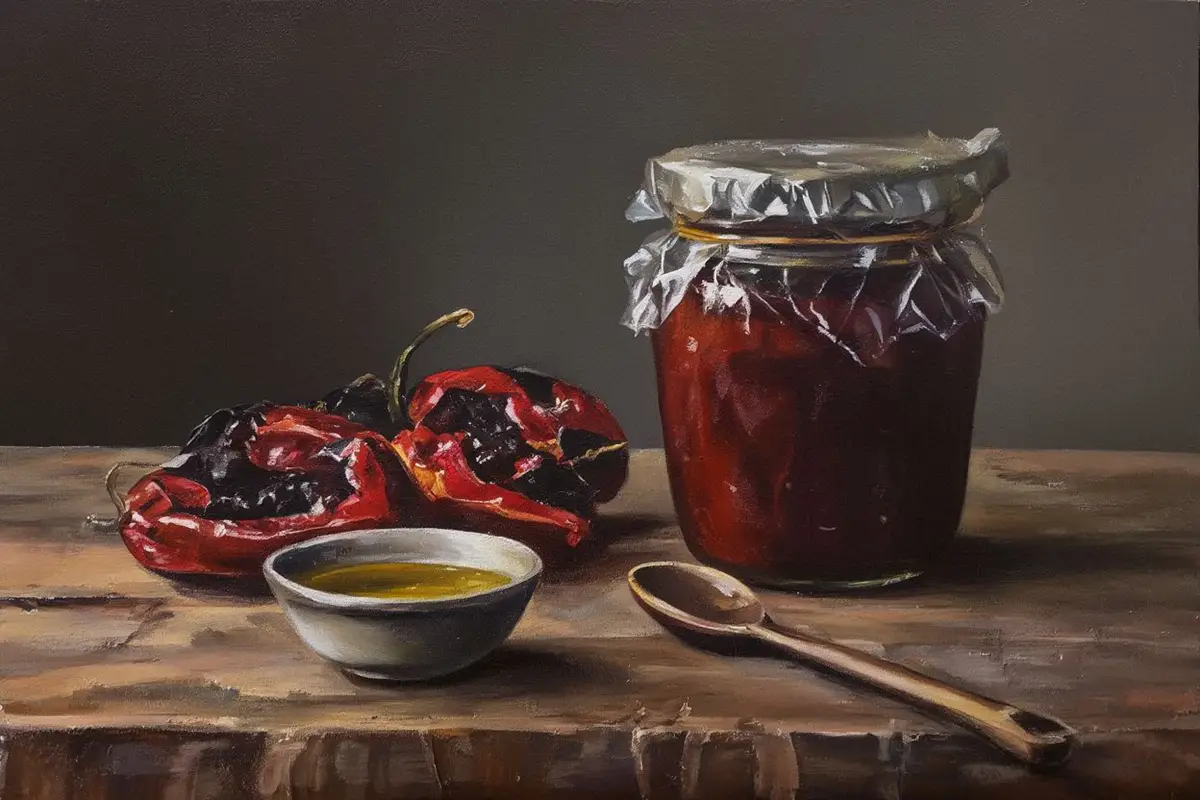
Why Your Grandmother's Ajvar Tasted Different
Sun-drying, wood fire, frying in oil — the old ajvar method produced something darker and deeper than what most jars contain today. What changed and why.
Introduction
There is a particular colour that ajvar should be, and most ajvar is not that colour. The jars in supermarkets are orange-red, bright and uniform. The ajvar my grandmother made in her backyard in September, over a wood fire, from peppers that had been sitting in the sun for three days — that ajvar was almost brown-red, dark and dense, the colour of something that had been transformed rather than simply processed.
The difference in colour is not cosmetic. It is the visible record of a series of choices and techniques that have been, over the past few decades, largely abandoned. Some were abandoned because they required time that modern households do not have. Some because they required equipment — a wood-burning stove called a bubnjara, a yard, dozens of kilograms of peppers — that urban kitchens cannot accommodate. Some simply because the commercial version became available and the old way was forgotten before anyone thought to write it down.
This post is an attempt to write it down. What follows is based on watching my grandmother make ajvar every September for the whole of my childhood. The details are precise because I was there, standing close enough to catch the smell of the fire and get in the way. What follows is not a recipe. It is a description of a technique, and an explanation of why each step produced a result that no shortcut can replicate.
Before the Fire: The Drying
The process began before any heat was applied. After bringing home the wide, fleshy kapija peppers — grown specifically for ajvar, bred for thick walls and low seed content — my grandmother spread them on a clean linen cloth on the terrace, in full sun, and left them for several days. Not to dry completely, but to lose moisture. The skin began to wrinkle slightly; the pepper became denser in the hand. Water was leaving. What remained was more concentrated.
This step has no equivalent in commercial production and is absent from most modern recipes. It seems like patience rather than technique — just waiting. But what it does is significant. Red peppers contain a high proportion of water, and that water dilutes everything: sugar, flavour compounds, the oils that carry aroma. Remove some of it before cooking begins and the pepper that enters the fire is already more itself than it was when it came off the plant. The Maillard reactions, the caramelisation, the smoke absorption during roasting — all of these work on a more concentrated raw material.
The result is that ajvar made from pre-dried peppers starts from a different place. It does not need to cook as long to reach the same depth. Or it can cook just as long and reach a depth that fresh-pepper ajvar cannot.
The Fire: Bubnjara and Early Morning
The roasting happened early. Not because tradition required it, but because there was a lot of pepper and the fire needed to run for hours, and the work was better done before the heat of the day. The bubnjara — a cylindrical wood-burning stove designed specifically for this kind of outdoor cooking — was lit before dawn.
The peppers went directly onto the heat, whole and uncut. They roasted until the skin blackened on each side, blistering and charring, while the flesh underneath softened and collapsed. When each pepper was done, it went into a plastic bag, which was tied closed. The trapped steam loosened the charred skin from the flesh. The peppers cooled and sweated inside the bag. Then they were peeled by hand and the seeds were removed. What remained was a soft, smoky, deeply flavoured roasted pepper.
This is where the first irreplaceable element appears: the smoke. Open flame over wood produces compounds that neither gas burners nor oven roasting can fully replicate. The char is not just an aesthetic detail. It is flavour that will be present in the finished ajvar — a background darkness that sits beneath the sweetness of the pepper and the richness of the oil. I have tried roasting peppers in an oven many times since. They are good. They are not the same.
The Cooking: Oil, Not Water
This is the step that most distinguishes old-method ajvar from everything made after it.
The peeled, cleaned peppers went into a large pot — not with water, not blended smooth, but whole and soft and layered. A generous amount of oil went in. The heat was low. And then the cooking began, which was really a long, slow reduction and transformation that took most of the remaining day.
The peppers were not chopped or processed before cooking. They were cooked whole and soft until they fell apart on their own, breaking down under their own weight and the movement of a large wooden paddle — the handle long enough to keep hands away from the heat and the occasional spattering oil. The oil was the cooking medium, not water. This matters.
Water boils at 100°C. Oil conducts heat differently, surrounding the ingredient more completely, drawing out fat-soluble flavour compounds, enabling caramelisation that water actively prevents. The slow frying of the peppers in oil produces a deeper, more complex flavour than boiling or steaming. The sugars in the pepper caramelise gradually. The oil takes on the flavour of everything cooking in it. The mass darkens — not from burning, but from transformation.
Vinegar, sugar, black pepper, and more oil were added during cooking. The proportions were adjusted by taste, not measurement — something I understood only later, when I tried to write them down and realised I had never seen a measuring spoon come out during ajvar day. The heat stayed low throughout. Stirring was continuous because the mass would catch on the bottom of the pot if left alone.
The Jars: Heat, Rakija, and Cellophane
While the ajvar finished on the stove, the jars were prepared. Washed, then put into the oven to heat. The ajvar went into the jars very hot, and the jars received it hot. Once filled and capped, the jars went back into the oven for a final period of heat — a form of heat processing that helped ensure preservation without chemical additives.
The next day, when the jars had cooled, they were sealed a second time with cellophane soaked in rakija, the local fruit brandy. The alcohol acted as a surface disinfectant. The cellophane provided a physical barrier beneath the metal lid.
This two-layer sealing — heat processing plus alcohol-treated surface barrier — was the old method’s answer to the modern reliance on acidifiers, preservatives, and vacuum sealing. It produced an ajvar that kept well through winter, with no off-flavours from additives, and that tasted, when you opened the jar in February, unmistakably like September.
What Was Lost and What Remains
The commercial ajvar industry developed alongside the urbanisation of the region through the second half of the 20th century. As extended families dispersed and yards gave way to apartment balconies, the collective all-day production of ajvar became impractical. Commercial producers offered convenience — and a product that was recognisably ajvar, if not exactly the same thing.
The differences are real and measurable in the eating. Commercial ajvar is paler because fresh peppers carry more water and the cooking time is shorter. It is smoother because mechanical processing eliminates texture. It is milder because the pre-drying step that concentrates flavour is absent. It is more uniform because uniformity is what industrial production optimises for. None of this is a moral failing — it is a set of trade-offs made in favour of scale and speed.
What was lost is harder to quantify. It is the particular flavour that comes from three days of sun on a terrace before anything is cooked. It is the smoke from a wood fire at five in the morning. It is the texture of a pepper that fell apart on its own rather than being blended. It is the dark colour — almost brown-red — that signals concentration and depth rather than mere processing.
These things can still be made. They require time, outdoor space, the right peppers, and a willingness to spend a day doing one thing. For those who have the circumstances for it, the result is worth the effort in a way that is difficult to explain to someone who has not tasted the difference. For those who do not, the closest approach is to pre-dry peppers before roasting even when making a small batch, to roast directly over flame rather than in an oven, and to cook in oil rather than to blend and heat. Each of these steps, applied individually, moves the result toward what was once simply how it was done.
Practical Takeaways
- Pre-drying peppers before roasting — even for just one to two days in sun or in a warm dry place — concentrates sugar and flavour. This single step is the most accessible part of the old method and produces a noticeable difference.
- Open-flame roasting over wood or gas produces char and smoke that oven roasting cannot replicate. Char is flavour, not just colour.
- Cooking in oil rather than boiling or blending with water produces caramelisation and depth that water-based cooking prevents. Use generous oil and keep the heat low.
- The wooden spoon test is reliable: draw it across the bottom of the pot, and wait. If the path holds for a moment, the ajvar is ready. If it flows back immediately, keep cooking.
- Dark red, not orange is the target colour. Pale ajvar has either started with under-dried peppers, been cooked too briefly, or been diluted with water somewhere in the process.
- Seal hot into hot jars and return to the oven. The old method’s two-layer sealing — heat processing plus rakija-soaked cellophane — is worth understanding even if you adapt it for modern equipment.
Attic Recipes — digitizing and adapting Central European home cooking from the early twentieth century.
Frequently Asked Questions
01What is ajvar?▶
Ajvar is a roasted red pepper condiment traditional across Central Europe, made from fleshy peppers — sometimes with eggplant — roasted, peeled, and slow-cooked with oil. It can be mild or hot, smooth or coarse, and is eaten as a spread or side dish alongside grilled meats and white cheese.
02What are the right peppers for ajvar?▶
The traditional pepper is a wide, fleshy variety called kapija — bred for thick walls and low seed content, giving high yield after roasting. Standard supermarket bell peppers have thinner walls and more water. The closest widely available substitute is a long, fleshy Italian or Romano pepper.
03Why does homemade ajvar taste different from store-bought?▶
Commercial ajvar skips pre-drying the peppers and uses mechanical roasting rather than open flame, producing a paler, milder result. Traditional homemade ajvar involves sun-drying before cooking, open-flame roasting, and slow reduction in oil over hours — each step concentrating flavour in ways industrial methods do not replicate.
04Do I really need to peel every single pepper by hand?▶
Yes, and it cannot be skipped. Peeling removes the bitter, papery charred skin and allows the peppers to break down into the silky, spreadable consistency that characterizes true ajvar. If you skip this step, the texture will be coarse and the flavour will be marred by tough pieces of burnt skin.
05Can I use a modern oven instead of an open fire?▶
You can, but the result will be different. An oven will cook the peppers through, but you will lose the smoky aroma that defines traditional ajvar. If you do not have access to an open fire, charring the peppers briefly over a gas burner or on a grill is the closest approximation.
06How do you know when ajvar is ready?▶
Draw a wooden spoon slowly across the bottom of the pot. If the ajvar parts cleanly and the bottom stays visible for a moment before the mass flows back, it is ready. It should be deeply coloured — dark red, not orange — and glossy from the oil.
07Why did the old ajvar-making techniques disappear?▶
Primarily time and scale. The traditional process requires a full day of collective work, an outdoor cooking setup, and large quantities of peppers. As households urbanised and extended family labour became less available, the method was simplified. Commercial production compressed it further.