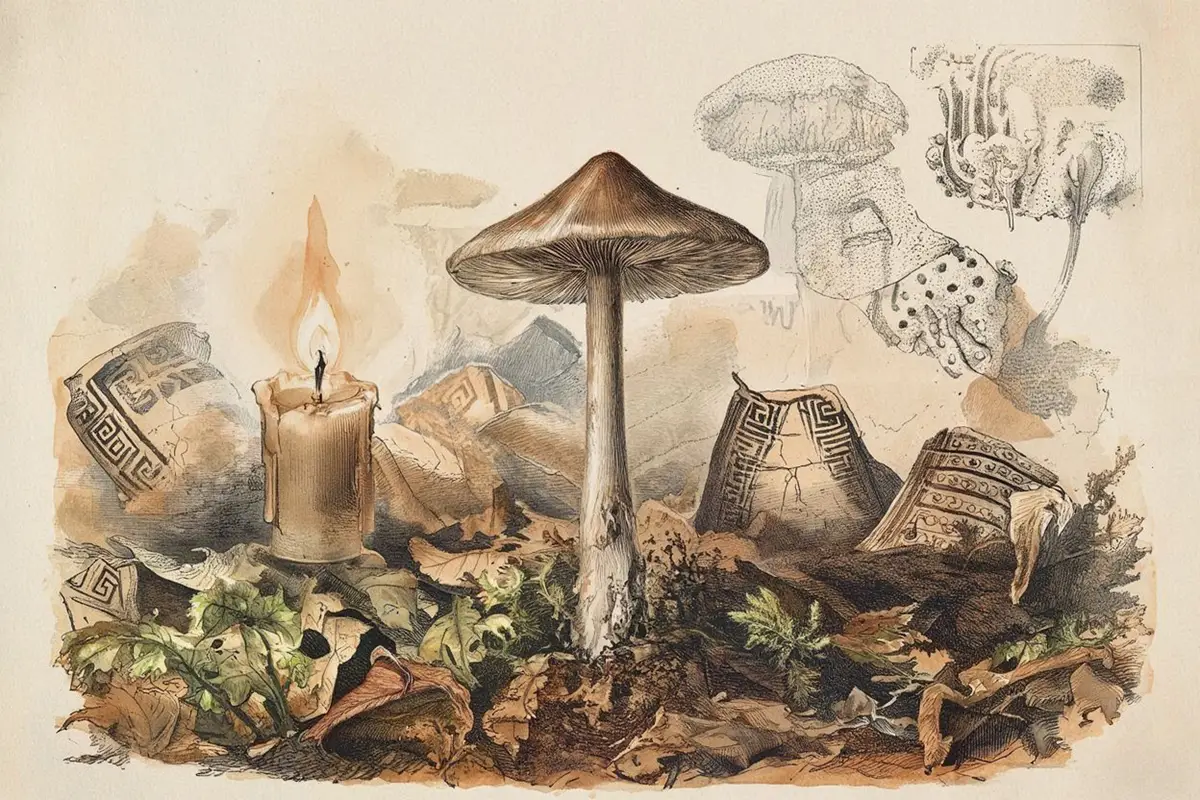
Mushrooms and the Self: A History of Fungi in Human Consciousness
From the Mazatec velada to Johns Hopkins clinical trials — an anthropological and historical overview of humanity's relationship with psychoactive fungi.
Introduction
Important notice: This post is a work of history, anthropology, and science journalism. It covers research into psychoactive fungi in their cultural, historical, and clinical contexts. Nothing in this post constitutes encouragement, advice, or instruction regarding the use of any controlled substance. Psilocybin is illegal in most jurisdictions. This post does not constitute medical or legal advice. The historical and clinical information presented here is accurate to the best of our knowledge and is sourced from peer-reviewed academic literature and reputable journalism.
For most of recorded human history, the encounter between a person and a psychoactive mushroom was not a recreational event. It was a ritual — an occasion of serious cultural, spiritual, or medical significance, conducted by a trained specialist, in a carefully prepared setting, with a specific intention. The velada ceremony of the Mazatec people of Oaxaca, Mexico. The mushroom rites of the Aztecs — teonanácatl, “flesh of the gods.” The Siberian shamanistic use of Amanita muscaria. Possibly the Eleusinian Mysteries of ancient Greece, practiced for nearly two thousand years.
The story of how these practices were encountered, extracted, commodified, and ultimately arrived at a clinical research laboratory at Johns Hopkins University is one of the most extraordinary passages in the history of food, medicine, and culture. It involves a New York banker, a Mazatec curandera, a Swiss chemist who had already synthesized LSD, and the CIA. It also involves serious questions about cultural appropriation, indigenous rights, and who owns knowledge that has been held for millennia by a community that was never asked.
This post covers that history. It is written from a position of genuine intellectual interest, without agenda — neither evangelical nor dismissive. The science is real, the anthropology is rich, and the ethics are complicated.
Before Western Contact: Deep Indigenous Traditions
Humans have consumed psilocybin-containing mushrooms for at least 10,000 years, possibly longer. The earliest evidence of mushroom consumption comes from prehistoric rock art and archaeological sites, and the earliest confirmed date of 13,000 years comes from sites in Chile. Mushroom iconography appears in Pre-Columbian Mesoamerican art across multiple cultures — Aztec, Mixtec, Zapotec, and others.
The Aztec name for psilocybin mushrooms was teonanácatl — most commonly translated as “flesh of the gods,” though more nuanced translations suggest “wondrous mushroom” or “divine mushroom.” The Mazatec people of the Sierra Mazateca in Oaxaca called them ndí xijto — “little things that sprout, landslides” — as well as ‘holy lords,’ ‘little saints,’ and ‘children.’ The language itself reveals a relationship of reverence rather than recreation.
The velada was the ceremonial context in which these mushrooms were used among the Mazatec. It was a nighttime healing ceremony conducted by a curandera — a healer, almost always a woman — in which the mushrooms were consumed with the specific intention of healing the sick. The curandera would enter an altered state and use the experience to diagnose and treat illness, guided by what she understood as direct communication with the divine. This was medicine, in the deepest sense the Mazatec understood the word.
What the Spanish conquest did to this tradition is also part of the story. Catholic persecution is why communities that use psilocybin in modern Mexico are largely limited to remote regions. The mushroom ceremonies went underground for centuries, practiced quietly in the mountains of Oaxaca, until a New York banker arrived in 1955.
R. Gordon Wasson and the 1957 Life Magazine Article
Wasson’s studies in ethnomycology began during his 1927 honeymoon trip to the Catskill Mountains when his wife, Valentina Pavlovna Guercken, chanced upon some edible wild mushrooms. Fascinated by the marked difference in cultural attitudes towards fungi in Russia compared to the United States, the couple began field research that eventually led them to mount expeditions to Mexico to study the religious use of mushrooms by the native population.
Beginning in 1953, Wasson repeatedly traveled to Mexico in search of the mushrooms. On a trip to the town of Huautla de Jiménez in June 1955, Wasson and New York society photographer Allan Richardson participated in a mushroom ritual with curandera María Sabina, where they became, in Wasson’s words, “the first white men in recorded history to eat the divine mushrooms.”
The subsequent Life magazine article, “Seeking the Magic Mushroom,” opened a Pandora’s Box that would see, among other things, the birth of the American psychedelic counterculture, the defilement of the mushroom ritual, and ultimately, the banning of psilocybin across much of the world.
What Wasson did not tell his readers was that the CIA had secretly funded his Mexican expeditions through a shell organization called the Geschickter Fund for Medical Research, as part of its covert mind-control program Project MK ULTRA. Wasson appears to have been an unwitting participant rather than a knowing agent, but the fact that the story that introduced psilocybin to the Western world was partially financed by American intelligence is a detail that tends to complicate the romance of the narrative.
From an indigenous perspective, psilocybin research and drug development tells a story of extraction, cultural appropriation, bioprospecting, and colonization. Wasson had promised María Sabina secrecy and specifically promised not to publish her photographs. He broke both promises. The publicity was disastrous for the Mazatec community, who blamed Sabina for bringing misfortune to the village and defiling the velada ritual. Sabina was briefly jailed and her house was set on fire. She later expressed that she regretted allowing Wasson to participate.
Since the 1957 Life magazine article, chemical compounds derived from Psilocybe mushrooms have been the focus of dozens of attempted and successful patents. Regrettably, the Mazatec indigenous communities who stewarded these traditional medicines for millennia are not party to any of these patents, despite a number of international treaties asserting indigenous rights to their intangible cultural heritage.
Albert Hofmann and the Chemistry
Within two years of Wasson’s Life magazine article, psilocin and psilocybin — the main active compounds in the mushrooms — were isolated, characterized, synthesized, and named by Swiss chemist Albert Hofmann at the Sandoz pharmaceutical company.
Hofmann is a central figure in this story. He had already synthesized LSD in 1938 and accidentally discovered its psychoactive properties in 1943. His synthesis of psilocybin gave Western science a pure, controllable compound with which to study what the Mazatec had been working with for millennia. Hofmann later traveled to Oaxaca himself and met María Sabina. He also collaborated with Wasson on The Road to Eleusis (1978), the book that proposed a psychedelic interpretation of the ancient Greek Eleusinian Mysteries.
Ancient Greece: The Eleusinian Mysteries and the Kykeon
The Eleusinian Mysteries were transformative rituals that took place in ancient Greece, extending out of Mycenaean traditions approximately 1500 BC and lasting for over two millennia. Men, women, slaves, and emperors all went to Eleusis to drink the magical potion called kykeon and to experience healing and spiritual insights.
The Mysteries were dedicated to Demeter and Persephone, and their central theme was death and rebirth — the descent into the underworld and the return. Initiates were forbidden to reveal what happened inside the Telesterion under penalty of death, which is why the essential nature of the experience has never been fully documented.
What is documented is the kykeon — the sacred drink consumed at the climax of the rites, described in the Homeric Hymn to Demeter as a mixture of barley, water, and pennyroyal mint. In 1978, Wasson, Hofmann, and classicist Carl A. P. Ruck proposed in The Road to Eleusis that the kykeon’s psychoactive power came from ergot (Claviceps purpurea), a fungus that infects barley and contains alkaloids chemically related to LSD.
This hypothesis received new experimental support in March 2026, in a study published in Scientific Reports. Researchers demonstrated that boiling ergot fungus in lye at pH 12.5 for two hours detoxifies the toxic ergopeptides while preserving the psychoactive compounds LSA and iso-LSA — and that this process could have been readily performed by the priestesses of Eleusis using methods available in antiquity. Archaeological evidence already supported the connection: excavations at Mas Castellar in Girona, Spain — a site linked to the Eleusinian cult — found fragments of ergot sclerotia inside a chalice associated with the kykeon and within the dental calculus of a human jaw.
The study’s authors are careful to note that chemical feasibility is not historical proof. The Mysteries were not merely pharmacological events — set and setting, fasting, collective ritual, and mythic framing would have amplified any psychoactive effect. But the convergence of archaeological evidence and experimental chemistry makes the hypothesis significantly more plausible than it was even a year ago.
→ Study: Antonopoulos R.K. et al. (2026). “Investigating the psychedelic hypothesis of kykeon, the sacred elixir of the Eleusinian Mysteries.” Scientific Reports. https://doi.org/10.1038/s41598-026-39568-3
Vedic India: The Soma Question
The Rigveda, composed between approximately 1500 and 1200 BCE, contains over 100 hymns dedicated to soma — a plant or substance consumed in sacred ritual and described as producing visions, divine communication, and immortality. The identity of soma has been one of the great unresolved questions of Vedic scholarship.
Wasson, in his 1968 book Soma: Divine Mushroom of Immortality, proposed that soma was Amanita muscaria, the fly agaric — the red-and-white spotted mushroom of fairy tale iconography, which is mildly psychoactive and has documented ritual use in Siberia. Today the mystery of soma lies unresolved, as many of the passages in the Vedas that refer to soma are too vague and their meaning too contested for a definitive identification. Researchers have suggested fly agaric, Syrian rue, ephedra, mandrake, hemp, and psilocybin-containing mushrooms among other candidates. Wasson’s fly agaric hypothesis is not accepted by most Vedic scholars today, but the question itself remains open.
What the soma debate illustrates is a broader pattern: across multiple ancient civilizations — Greek, Indian, Mesoamerican, Siberian — there is credible evidence of the ritual use of psychoactive substances, often fungal in origin, in contexts of religious initiation, healing, and self-transformation. The uniformity of the pattern across cultures that had no contact with each other is itself of anthropological significance.
Siberia: The Amanita Tradition
The ritual use of Amanita muscaria (fly agaric) by Siberian shamans is one of the best-documented cases of entheogenic fungal use outside Mesoamerica. Among several Siberian peoples, including the Koryak and the Chukchi, the fly agaric was used by shamans to enter trance states for healing, divination, and communication with spirits.
One of the most unusual aspects of this tradition is the practice of drinking the urine of someone who had consumed the mushroom — because the psychoactive compound muscimol passes through the body relatively unchanged, making the urine itself psychoactive. This is documented in anthropological literature and represents one of the most striking examples of how deeply integrated the use of these substances was in certain cultures.
Wasson proposed that the Siberian Amanita tradition was connected to the Vedic soma. This remains speculative, but the geographic proximity of Siberia and ancient India — and the documented spread of Amanita muscaria use across northern Eurasia — gives the hypothesis some ethnographic logic.
The Modern Return: Timothy Leary, Counterculture, and Criminalization
Beatniks, hippies, celebrities like Bob Dylan and John Lennon, scientists and seekers of all stripes flooded the village of Huautla de Jiménez after the Life article was published. Among those whose lives were changed by Wasson’s article was Timothy Leary, then a psychology lecturer at Harvard. Leary and his colleague Richard Alpert (later Ram Dass) began conducting psilocybin research with graduate students — research that quickly became undisciplined and was eventually shut down.
Leary’s public campaign — “Turn on, tune in, drop out” — transformed psilocybin from a research subject into a cultural symbol, and a political target. By 1966, psilocybin and LSD were illegal in the United States. The Controlled Substances Act of 1970 classified psilocybin as Schedule I — defined as having no accepted medical use and a high potential for abuse. Human research was effectively halted for nearly three decades.
The criminalization was not driven primarily by evidence of harm. It was driven by politics. The Nixon administration’s “War on Drugs” targeted the counterculture as much as the substances. Nixon’s domestic policy advisor John Ehrlichman later stated explicitly that the War on Drugs was designed to target Black people and antiwar protesters, with drug criminalization as the legal mechanism.
The Clinical Renaissance: Johns Hopkins and Beyond
The research moratorium ended gradually in the 1990s and accelerated significantly in the 2000s. The Johns Hopkins Center for Psychedelic and Consciousness Research, founded in 2019, is now one of the world’s leading institutions for clinical research into psilocybin.
A landmark randomized, controlled clinical trial at Johns Hopkins tested psilocybin-assisted therapy in adults with a major depressive disorder diagnosis. The 4-week primary outcome assessments demonstrated substantial antidepressant effects. A follow-up study published in 2022 found that these effects were largely maintained at 12-month follow-up in the majority of participants. → Study: Davis A.K. et al. (2021). “Effects of Psilocybin-Assisted Therapy on Major Depressive Disorder.” JAMA Psychiatry 78(5): 481–489. https://pubmed.ncbi.nlm.nih.gov/33146667/
A randomized double-blind trial at Johns Hopkins tested psilocybin in 51 participants with life-threatening cancer diagnoses and co-occurring anxiety or depression. Participants showed substantial and sustained decreases in depression and anxiety. → Study: Griffiths R.R. et al. (2016). “Psilocybin produces substantial and sustained decreases in depression and anxiety in patients with life-threatening cancer.” Journal of Psychopharmacology. https://pmc.ncbi.nlm.nih.gov/articles/PMC5367557/
Johns Hopkins researchers also reported that a small number of longtime smokers who had failed many quit attempts succeeded after carefully controlled psilocybin administration in the context of cognitive behavioral therapy.
Imperial College London’s Centre for Psychedelic Research under Robin Carhart-Harris has produced parallel findings. Their research on the neurological mechanisms of psilocybin — including work on “default mode network” suppression — has provided some of the most detailed scientific understanding of how and why the substance produces the experiences it does.
What the clinical researchers emphasize, and what connects their work to the ancient traditions described earlier in this post, is the concept of set and setting — the idea that the therapeutic outcome depends as much on the preparation, the psychological state of the person, the relationship with the facilitator, and the ritual framework as it does on the pharmacology of the compound. This is exactly what the Mazatec velada was built on. The curandera’s chants, the darkness, the fasting, the flowers, the intention — all of it was set and setting. Two thousand years of practice had figured out something that clinical psychopharmacology is only now beginning to quantify.
The Ethics That Remain Unresolved
The clinical renaissance in psilocybin research is genuinely exciting. It is also taking place in an ethical context that has not been adequately addressed.
Psilocybin research and drug development tells a story of extraction, cultural appropriation, and colonization from an indigenous perspective. There are now at least 24 registered patent processes for psilocybin, and no pharmaceutical developer has reached legitimate reciprocal agreements with the Mazatec or any other indigenous community whose knowledge underlies this research.
The Mazatec people did not give the world psilocybin. A banker broke a promise and gave it to a magazine. The substance was then synthesized by a pharmaceutical company, banned by a government, and is now in the process of being patented by commercial interests. The community that developed and held this knowledge for millennia receives nothing.
This is not a new story in the history of ethnobotany and pharmacology. It is, in fact, one of the oldest stories in the relationship between Western science and indigenous knowledge. Naming it does not resolve it, but it is part of any honest account of how we arrived where we are.
Practical Takeaways
This is, at its core, a story about the human need to step outside ordinary consciousness — to encounter something that feels larger than the everyday self, that dissolves the boundary between self and world, and that returns the person changed. Every culture that has found a way to do this reliably has used that way in the service of healing, of spiritual development, of community. None have used it casually.
The clinical research is suggesting that the experiences psilocybin produces — when the substance is administered in a controlled, prepared, intentional context — can have lasting positive effects on depression, anxiety, addiction, and the fear of death. The anthropological record suggests that human beings have known this, in various forms, for at least ten thousand years.
What is new is not the substance or the experience. What is new is the clinical methodology that can measure the outcomes, and the legal and cultural framework — still being constructed, contested, and negotiated — within which those outcomes might eventually be made available, ethically and safely, to people who need them.
Frequently Asked Questions
See the FAQ section above for answers to the most common questions about the history, legality, and science of psychoactive fungi.
Sources and Further Reading
Primary academic sources:
- Wasson, R.G. (1957). “Seeking the Magic Mushroom.” Life Magazine, May 13, 1957.
- Wasson, R.G., Hofmann, A., & Ruck, C.A.P. (1978). The Road to Eleusis: Unveiling the Secret of the Mysteries. New York: Harcourt.
- Wasson, R.G. (1968). Soma: Divine Mushroom of Immortality. New York: Harcourt.
- Davis A.K. et al. (2021). “Effects of Psilocybin-Assisted Therapy on Major Depressive Disorder: A Randomized Clinical Trial.” JAMA Psychiatry 78(5): 481–489. https://pubmed.ncbi.nlm.nih.gov/33146667/
- Griffiths R.R. et al. (2016). “Psilocybin produces substantial and sustained decreases in depression and anxiety in patients with life-threatening cancer.” Journal of Psychopharmacology 30(12). https://pmc.ncbi.nlm.nih.gov/articles/PMC5367557/
- Gukasyan N. et al. (2022). “Efficacy and safety of psilocybin-assisted treatment for major depressive disorder: Prospective 12-month follow-up.” Journal of Psychopharmacology. https://journals.sagepub.com/doi/10.1177/02698811211073759
- Antonopoulos R.K. et al. (2026). “Investigating the psychedelic hypothesis of kykeon, the sacred elixir of the Eleusinian Mysteries.” Scientific Reports. https://doi.org/10.1038/s41598-026-39568-3
- Toro-Troconis M. et al. (2023). “Ethical Concerns about Psilocybin Intellectual Property.” PMC. https://pmc.ncbi.nlm.nih.gov/articles/PMC8033603/
Institutional references:
- Johns Hopkins Center for Psychedelic and Consciousness Research: https://www.hopkinsmedicine.org/psychiatry/research/psychedelics-research
- Imperial College London Centre for Psychedelic Research: https://www.imperial.ac.uk/psychedelic-research-centre
- Project on Psychedelics Law and Regulation (POPLAR), Harvard Law School: https://petrieflom.law.harvard.edu/research/details/project-on-psychedelics-law-and-regulation
Books for further reading:
- Pollan, M. (2018). How to Change Your Mind. Penguin Press. — Accessible, well-researched overview of the history and science of psychedelics for a general audience.
- Stamets, P. (2005). Mycelium Running. Ten Speed Press.
- Benjamin, D.R. (1995). Mushrooms: Poisons and Panaceas. W.H. Freeman.
- McKenna, T. (1992). Food of the Gods. Bantam Books. — McKenna’s “Stoned Ape” hypothesis is not accepted by mainstream paleoanthropology, but the book is an important cultural document.
Full disclaimer: This post is a work of history, anthropology, and science journalism. It does not constitute encouragement, advice, or instruction regarding the use of any controlled substance. Psilocybin and related compounds are illegal in most jurisdictions. Nothing in this post constitutes medical or legal advice. The legal status of psilocybin varies by jurisdiction and is subject to change — always consult current local law. The authors accept no responsibility for decisions made based on this content.
Attic Recipes — digitizing and adapting Central European home cooking from the early twentieth century.