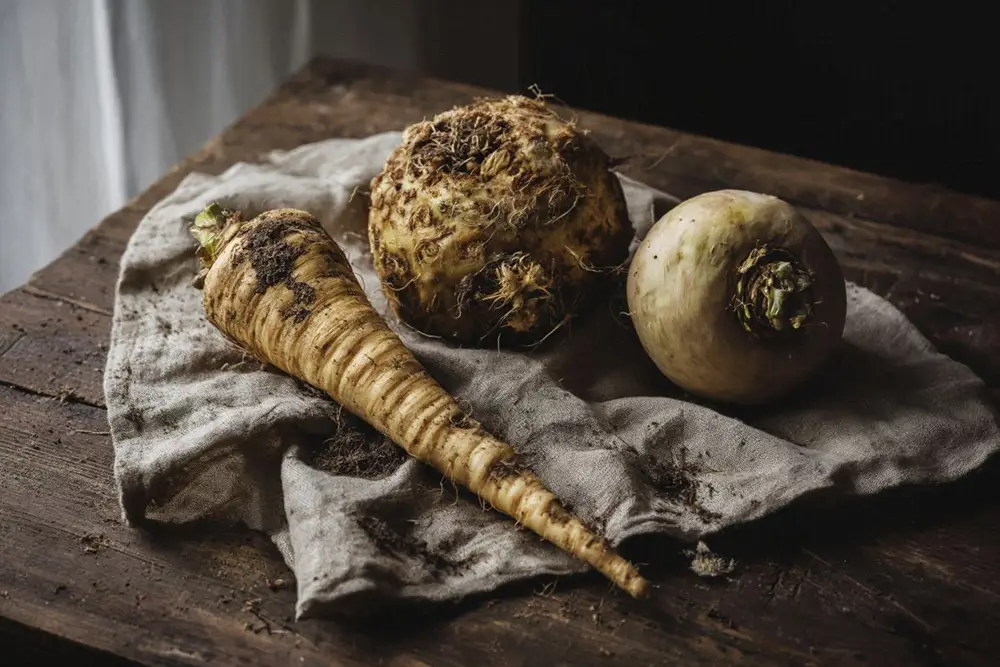
Parsnip, Celeriac, Turnip: The Vegetables That Built Old European Cooking
Before carrot dominated every stock and stew, three other roots did most of the work. Still available, still cheap, and still better at certain jobs.
The Vegetables That Are Always There
Walk into almost any market in Central or Northern Europe and you will find them: celeriac in its knobbled, mud-colored bulk; parsnips pale and tapered next to the carrots they resemble but are not; turnips small and sharp-smelling, white with a purple shoulder.
They are inexpensive. They are available from autumn through early spring, exactly the season when old cooking relied on them most. They have been in European kitchens for centuries, and for most of that time were as central to everyday cooking as the carrot that has since displaced them as the default root vegetable of the modern kitchen.
Old recipes from the 1930s and earlier reach for these three almost automatically. They appear in stock bases, in braising liquids, in soups, in roasted vegetable beds under meat. They are not decorative. They are functional — each one doing a specific job that carrot or potato cannot replicate.
Parsnip: Sweetness With an Edge
The parsnip looks like a white carrot and is often treated as a bland substitute for one. This is a misreading. Parsnip is sweeter than carrot — more intensely sweet, with a slight pepperiness underneath and a faint herbal quality that becomes more pronounced when roasted or caramelized.
In a stock, parsnip contributes a sweetness that is more complex than carrot’s straightforward sugar. It rounds the base flavor without dominating it. Old stock recipes that include parsnip alongside carrot and onion are building a flavor profile with more dimension than carrot alone provides.
In a braise, parsnip softens completely over long cooking and its sweetness merges into the braising liquid. If left in large pieces, it can be served alongside the meat — by that point it has absorbed the flavors of everything around it and given its own back to the sauce.
Roasted, parsnip caramelizes more aggressively than carrot due to its higher sugar content. The edges become deeply golden and slightly sticky, the interior becomes creamy. This is the preparation that shows what the vegetable can do on its own terms rather than as a background ingredient.
Old recipes specify parsnip where they want sweetness with character. Substituting carrot gives sweetness without the edge. The dish will be good, but it will be a different dish.
Celeriac: The Root That Celery Should Have Been
Celeriac is the swollen root of a variety of celery cultivated specifically for its root rather than its stalks. It is ugly in the way that useful things often are — knobbled, fibrous on the outside, with a dense cream-colored interior that reveals itself only after the rough exterior is cut away.
The flavor is celery, but concentrated and transformed. Raw celeriac has a firm, slightly watery texture and a clean, vegetal celery taste with mild anise undertones. Cooked, it softens completely, the sharp edges of the flavor round off, and it becomes something warmer and more complex — earthy, slightly nutty, with the celery note receding to a background hum.
In stocks, celeriac does what celery stalks do but more efficiently. A small piece of celeriac provides the same aromatic contribution as several stalks of celery, and it holds together better during long simmering rather than dissolving into the liquid. Old recipes that specify celeriac for stock were working with a more concentrated ingredient.
In braises and soups, celeriac absorbs surrounding flavors exceptionally well. It takes on the character of whatever liquid it cooks in while giving its own flavor back. In a long beef braise, celeriac cooked from the beginning will be unrecognizable as itself by the end — deeply flavored, soft, almost creamy, tasting of the braise as much as of itself.
Celeriac also works raw, grated or cut into matchsticks and dressed with mustard and cream — a preparation that appears in old Central European recipes as a first course or side dish, where its firm texture and clean flavor are the point rather than its capacity to absorb.
Turnip: Sharp, Seasonal, Underestimated
Turnip is the most assertive of the three. Raw, it is sharp and slightly bitter, with a sulfurous edge that puts many people off. This reputation is not entirely undeserved — but it applies primarily to large, old turnips that have been stored too long. A young turnip, pulled small in early autumn or spring, is mild, slightly sweet, and almost delicate.
The sharpness that turnip develops comes from glucosinolates — sulfur-containing compounds found in brassicas, the plant family that includes cabbage, mustard, and radish. These compounds break down substantially during cooking, which is why cooked turnip tastes considerably milder than raw. Long, slow cooking reduces most of the sharpness, though some bitter edge typically remains — which, in a well-balanced braise, is a feature rather than a flaw.
In old recipes, turnip appears most often in soups and braises where long cooking is expected. Added early to a stock, it contributes a gentle bitterness that balances sweetness from carrot and parsnip and gives the base a slightly more complex, savory edge. Added to a braise, it softens and absorbs the braising liquid while its own sharpness dissipates into the pot.
The bitterness that remains provides contrast — the same function that a small amount of bitter ingredient serves in a well-balanced dish. Old recipes that include turnip in a braise alongside sweeter vegetables are using it deliberately for this reason.
Turnip also roasts well, though it needs more time and higher heat than carrot to develop color. It pairs naturally with fatty cuts — pork shoulder, duck legs, lamb — where its mild bitterness cuts through the richness of the meat.
Why They Were Always Used Together
These three vegetables appear together in old recipes not by accident but because they function as a system. Each contributes something the others do not.
Parsnip provides sweetness with aromatic complexity. Celeriac provides the savory, herbal depth that makes a stock or braising liquid taste rounded rather than flat. Turnip provides a mild bitterness that prevents the whole from becoming too sweet or one-dimensional.
Together with onion — which provides pungency and further sweetness through caramelization — they form the aromatic base that appears at the beginning of almost every old Central and Eastern European stock, soup, and braise. The carrot was part of this system too, but as one ingredient among several rather than the dominant one it has become in modern cooking.
When a recipe from this archive specifies a combination of these vegetables, it is specifying a flavor profile that has been calibrated over generations. Substituting all of them with carrot will produce something sweet and one-dimensional. Using them as written produces something layered.
Finding and Preparing Them
All three are available in most European markets year-round, with peak season from autumn through winter. In North America, celeriac and parsnip are found in well-stocked supermarkets and farmers markets; turnip is widely available but often in the large, older variety rather than the small young ones that old recipes favor.
Parsnip requires only peeling and trimming. It oxidizes slightly when cut and exposed to air — if preparing in advance, keep it in cold water. Celeriac requires more substantial preparation: the rough outer layer must be cut away with a knife rather than peeled, as a peeler cannot handle the irregular surface. The interior is cream-colored and does not discolor significantly. Turnip is peeled like a potato and cut to size.
None of them require special technique. They require only the willingness to buy something that looks less convenient than a bag of baby carrots — and the understanding that what they contribute to a pot is not replaceable by what you are used to using instead.
Attic Recipes — digitizing and adapting Central European home cooking from the early twentieth century.
Frequently Asked Questions
01What does celeriac taste like?▶
Celeriac tastes like celery but rounder and less sharp — earthy, slightly sweet, with a mild anise note that softens significantly during cooking. Raw, it has a firm texture similar to kohlrabi. Cooked, it becomes soft and absorbs surrounding flavors readily.
02Can I substitute parsnip for carrot in old recipes?▶
In most cases, yes — but the result will be different. Parsnip is sweeter and more aromatic than carrot, with a slightly peppery edge. In stocks and long braises, parsnip contributes more complex flavor. In preparations where carrot sweetness is the point, parsnip may be too assertive.
03Is turnip the same as swede or rutabaga?▶
No. Turnip is smaller, white-fleshed, and milder. Swede — called rutabaga in North America — is a cross between turnip and wild cabbage. It is larger, yellow-fleshed, sweeter, and denser. They are related but behave differently in cooking. Old European recipes that call for turnip mean the smaller white variety.
04Why did these vegetables fall out of common use?▶
Largely because of industrialized food production and changing taste preferences after WWII. The carrot was easier to standardize and sweeter, making it more universally appealing. Parsnip, celeriac, and turnip require more preparation and have stronger, more complex flavors that fell out of fashion as food became blander and more convenient.
05How were parsnip, celeriac, and turnip most commonly used in old European cooking?▶
All three were workhorses of the winter kitchen. Parsnip and celeriac went into almost every stock and braise as a matter of course — not as the main ingredient but as the flavor base. Turnip appeared in stews and one-pot dishes where it absorbed the surrounding broth. Celeriac was also eaten raw, grated into salads dressed with mustard or cream. None of them were considered special; they were simply what was available from late autumn through early spring.