Braising Is Not Slow Cooking. Here Is the Difference.
Braising is a precise two-phase technique. Confusing it with slow cooking produces different results. Old recipes knew exactly what they were doing.
What Braising Actually Is
Most modern recipes use the word “braise” loosely, as a synonym for anything cooked slowly in liquid with a lid on.
That is not braising. That is pot cooking, and the distinction matters.
Braising is a two-phase technique:
Phase one: High-heat searing to develop crust, Maillard compounds, and surface structure.
Phase two: Low, moist heat — with the protein only partially submerged — that converts collagen to gelatin over an extended period.
The partial submersion is not an accident. It is the point. The upper portion of the protein cooks in humid air rather than liquid. The two cooking environments produce different textures in the same piece of meat. The result is a protein that is simultaneously moist and structured, with a sauce built from the braising liquid that has been concentrating throughout the process.
Old recipes understood this. They described it in practical language without the vocabulary of food science, but the instructions reflect correct technique.
The Science of Collagen Conversion
Tough cuts — shank, shoulder, neck, cheeks, tongue, kidney-adjacent muscles — are tough because they contain high concentrations of collagen, the structural protein in connective tissue.
Collagen is insoluble at low temperatures. Below approximately 70°C (160°F), it remains tough regardless of cooking time. Above 70°C, it begins to hydrolyze — breaking down into gelatin, a soluble protein with a completely different texture profile.
This conversion is time- and temperature-dependent. At 75°C (167°F), the process is slow. At 80–90°C (176–194°F), it accelerates significantly. At a full boil, it happens faster but the muscle fibers simultaneously become dry and stringy as their own moisture is expelled at high heat.
The goal of braising is to hold the liquid in the 80–90°C range — below a boil — for long enough that collagen converts to gelatin without the muscle fibers drying out. This is why oven braising at 150–165°C (300–325°F) with a tight-lidded heavy pot works: the thermal mass of the vessel and liquid moderates the temperature, keeping it well below boiling throughout the cook.
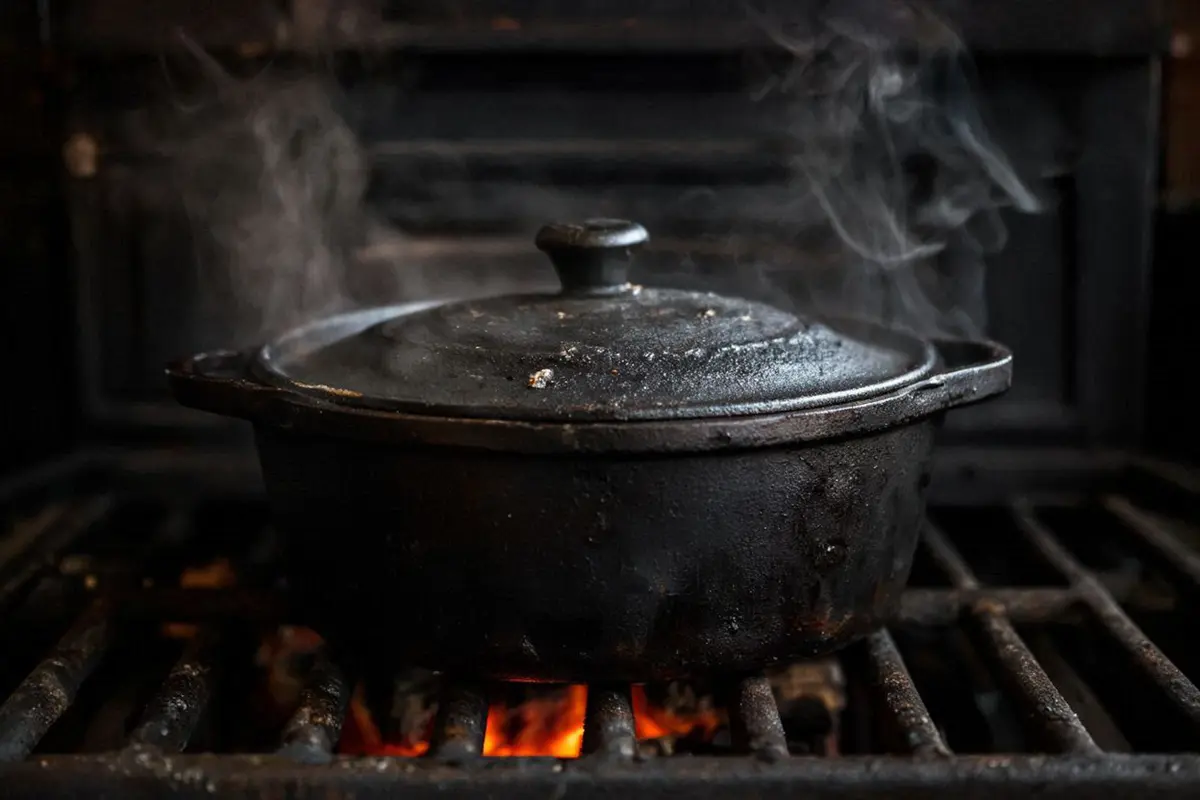
Old cast-iron pots with heavy lids were not incidental. They were the correct tool for this exact thermal problem.
Why the Sear Is Not Optional
Modern slow-cooker recipes often skip the initial sear on grounds of convenience. The result is always inferior, and the reason is chemical, not aesthetic.
The Maillard reaction, which occurs when proteins and sugars meet surface temperatures above approximately 140°C (285°F), produces hundreds of flavor compounds that do not form during moist cooking at any temperature.
When you skip the sear, you lose those compounds entirely. The braised meat will be tender but will taste flat — meaty, certainly, but without the depth that distinguishes a braise from a boiled protein.
Old recipes that specify browning the meat first in fat were not adding a step for texture. They were building the flavor foundation that makes everything else worth doing.
Aromatics and Liquid: What Old Recipes Used and Why
Pre-war braising recipes in Central Europe typically used: one or more root vegetables, onion, bay leaf, peppercorns, and either water, diluted vinegar, wine, beer, or stock as the braising liquid.
Each element has a function.
Root vegetables and onion provide sugars that caramelize during the initial sear and dissolve into the braising liquid, contributing sweetness and body. Bay leaf and peppercorns contribute volatile compounds that dissipate partially during long cooking, leaving a rounded background flavor rather than a sharp one. The acid component — vinegar, wine, sour cream added late — brightens the final sauce and balances the richness of the gelatin.
Old recipes that call for sour cream or vinegar added toward the end are not making a flavor choice alone. They are timing the addition deliberately: acid introduced late preserves its brightness rather than cooking off during the long braise.
Reading Old Braising Instructions
You will encounter phrases like:
-
“Cook covered on low heat until the meat gives easily to a fork.”
-
“Let it simmer gently, never boiling, for two to three hours depending on the cut.”
-
“Add liquid as needed to keep the bottom covered.”
These are precise instructions. They are describing: maintained temperature below boiling (verified by observation), collagen conversion endpoint (fork test), and liquid level management for partial submersion.
The apparent vagueness is actually calibrated to the cook’s sensory feedback, not to a timer. A cook who knows what they are doing does not need a specific time. They need to know what to look for — and old cookbooks trained that observation skill through repetition and clear description of endpoints.
Common Braising Failures and Their Causes
Meat is dry and stringy. The temperature was too high for too long. The muscle fibers expelled their moisture before collagen could fully convert and bind it back into the sauce. Reduce oven temperature or liquid temperature.
Meat is still tough after long cooking. The temperature was too low for collagen conversion to complete, or the cut was not collagen-rich enough to benefit from long braising. Check that the liquid is maintaining 80–90°C. Some cuts simply do not improve with extended moist heat.
Sauce is watery and thin. The lid fit was loose, allowing too much evaporation of steam that re-condensed and diluted the liquid, or too much liquid was added initially. Old recipes specify minimal liquid for a reason. Remove the lid for the final 20–30 minutes to reduce.
Meat surface is pale and soft. The initial sear was skipped or insufficient. Nothing can fix this after the fact. The flavor foundation is not there.
The Specific Cuts That Belong in a Braise
Not every cut benefits from braising. High-collagen cuts do. Low-collagen cuts do not — they become dry long before any conversion occurs.
Cuts suited for braising: shank (any species), shoulder (pork, lamb, beef, veal), neck, cheek, oxtail, short ribs, brisket, tongue, kidney-adjacent muscles, whole bone-in leg portions.
Cuts that should not be braised: loin, tenderloin, rib sections intended for dry cooking, any lean cut without significant connective tissue.
Old recipes were specific about cuts because the technique and the cut were matched deliberately. When a recipe from this archive specifies a cut for braising, that selection is not arbitrary. The note will explain what makes that cut appropriate and what to look for as a substitute if the original is unavailable.
Practical Takeaways
Braising is defined by two conditions: an initial high-heat sear and a long, low, partially submerged moist cook. Remove either condition and the result is something else. The technique is not difficult, but it requires the right cut, the right vessel, and attention to temperature throughout. Old recipes encoded all of this — the language was different, the science was the same.
Attic Recipes — digitizing and adapting Central European home cooking from the early twentieth century.
Frequently Asked Questions
01What is the difference between braising and stewing?▶
In braising, the protein is only partially submerged in liquid. In stewing, it is fully submerged. Braising creates a more concentrated sauce and produces a different texture in the meat surface.
02Can I braise in a slow cooker?▶
Partially. A slow cooker can complete the second phase of braising (collagen conversion) but typically cannot produce the initial high-heat sear, and the lid traps steam differently, diluting the sauce. Results are similar but not identical.
03Why do old recipes not give exact braising times?▶
Because the correct endpoint is sensory, not chronological. The meat is done when it yields without falling apart — a judgment that depends on the specific cut, animal age, and cooking vessel. Time is a guide, not a rule.