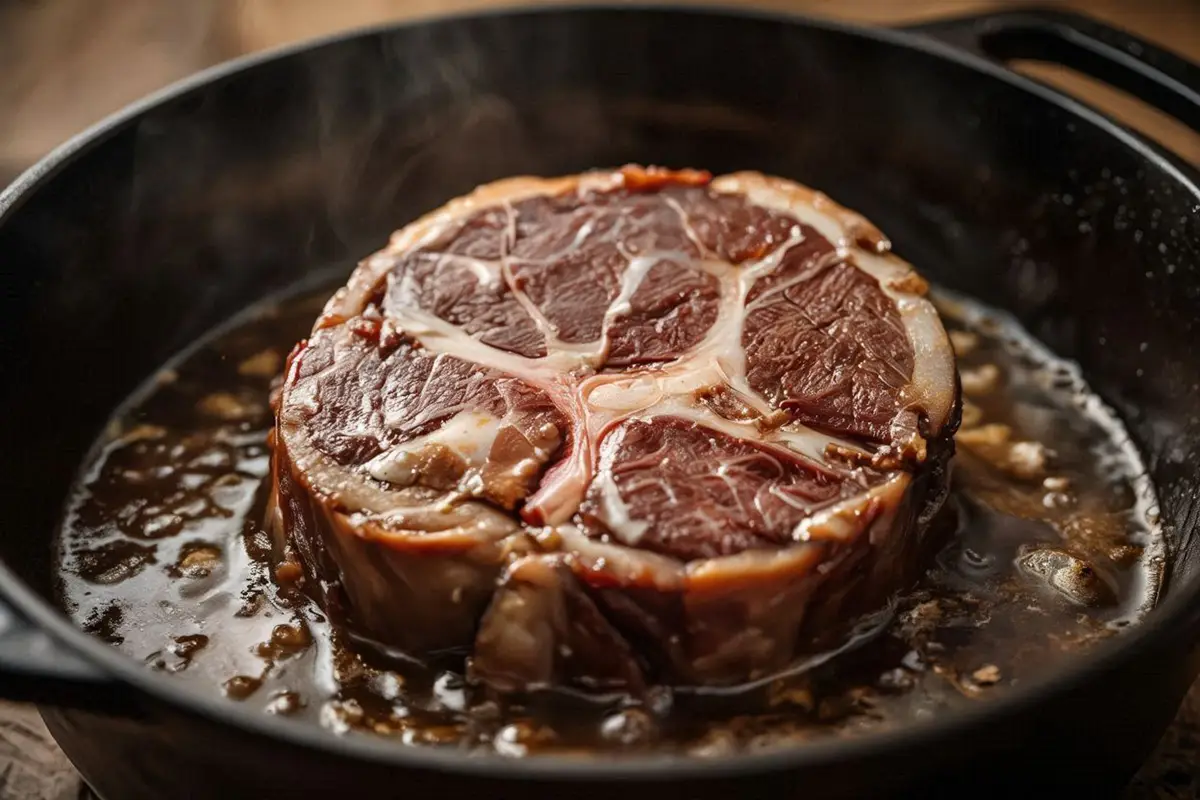
Collagen in the Kitchen: What Old Cooks Knew Without the Science
Old recipes chose the right cuts and temperatures before food science explained why. The answer is collagen — and what heat does to it.
The Problem With Tough Meat
Pick up a beef shank and press it. The resistance you feel is collagen — dense, fibrous, woven through the muscle like a structural web. This is why certain cuts are sold cheaply. Not because they lack flavor, but because most people do not know how to make them yield.
Old cooks knew. Not because they had read food science literature, but because they had watched what happened when they got it wrong. Meat cooked too fast at too high a heat turned dry and stringy. Meat cooked too long at too low a temperature stayed tough. But meat held at the right temperature, in a covered pot, for the right amount of time — that became something else entirely.
They were observing collagen conversion without having a name for it.
What Collagen Actually Is
Collagen is the most abundant structural protein in mammals, including the animals we eat. It forms the connective tissue that holds muscle fibers together, wraps around tendons and joints, and gives cartilage its resistance. In a living animal, this is essential. In a pot, it is a problem — until heat solves it.
At low temperatures, collagen is insoluble. Below approximately 70°C (160°F), it holds its structure regardless of how long you cook it. The meat around it softens slightly as muscle fibers relax, but the collagen network remains intact. The result is meat that is chewy and resistant, even after hours in the pot.
Above 70°C, something changes. The triple-helix structure of collagen begins to unwind. The protein hydrolyzes — it breaks down chemically in the presence of water and heat — and converts into gelatin. Gelatin is soluble, soft, and coats everything it touches with a silky, binding quality. It is what gives a well-made braise its body, and what makes a proper stock set like jelly when it cools.
This conversion is not instant. It is time- and temperature-dependent. At 75°C (167°F), it proceeds slowly. At 80–90°C (176–194°F), it accelerates significantly. At a rolling boil — 100°C — it happens faster, but the muscle fibers surrounding the collagen are simultaneously losing their moisture at a rapid rate. The collagen converts, but the meat around it dries out. The result is stringy, dry meat in a thin, slightly gelatinous liquid. Both things happened, but out of sequence.
Old recipes that specified “a gentle simmer, never boiling” were not being vague. They were describing the precise thermal window where collagen converts without the muscle fibers sacrificing their moisture.
Why Cuts Matter as Much as Technique
Not all meat contains the same amount of collagen. The distribution follows a simple logic: the harder a muscle works in a living animal, the more connective tissue it develops.
The shank — the lower leg — carries the weight of the animal and moves constantly. It is dense with collagen. The shoulder absorbs shock and drives movement. Also high in collagen. The neck supports and turns the head all day. Collagen throughout. The cheek chews, the tongue moves constantly, the tail wags and twitches. All of these are high-collagen cuts.
The loin, by contrast, runs along the spine and does very little mechanical work. It is tender already — low in collagen, high in fine muscle fiber. The tenderloin is almost entirely muscle fiber with minimal connective tissue. These cuts do not benefit from long moist cooking. They have nothing to convert. Cook them too long and you simply dry them out.
Old recipes were explicit about cuts because the cook and the technique were designed for each other. A recipe that calls for neck or shank is not interchangeable with one calling for loin. The underlying biology is different.
When you see a recipe from this archive specifying a particular cut, that specificity is not tradition for its own sake. It is a reflection of what that cut contains and what the cooking method is designed to do with it.
The Role of Gelatin in the Finished Dish
Once collagen converts to gelatin, it does not disappear. It dissolves into the cooking liquid and transforms it.
A braising liquid that began as water, wine, and aromatics becomes something much richer as gelatin accumulates in it over hours of cooking. The liquid thickens slightly. It coats the back of a spoon. When reduced, it becomes a sauce without requiring flour or starch — it has body because it is full of dissolved protein.
This is why old recipes that produce a good result are self-saucing. The liquid that braised the meat becomes the sauce for serving it, reduced to the right consistency by removing the lid near the end of cooking. No thickener needed. The collagen already did the work.
This is also why stock made from bones, feet, and cartilage — all very high in collagen — gels in the refrigerator. A stock that does not gel was either cooked at too low a temperature for too short a time, or it was made from materials with insufficient collagen content. Old cooks tested their stock by chilling a spoonful. If it set, the stock was good. If it stayed liquid, they cooked it longer or added more collagen-rich material.
Reading the Signs in Old Recipes
Once you understand what collagen conversion looks like as a process, certain phrases in old recipes become precise rather than vague.
“Cook until the meat falls easily from the bone” is describing complete collagen conversion in a shank or oxtail — the connective tissue holding meat to bone has dissolved. “The sauce should coat the spoon” is describing gelatin concentration in the braising liquid. “Let the pot simmer gently for two to three hours, checking the liquid level” is describing maintained temperature in the correct range with attention to evaporation.
These phrases encoded the observable endpoints of a chemical process the writers did not have the vocabulary to name. The technique was correct. The description was practical and accurate. The only thing missing was the explanation — which we now have, but which changes nothing about what you should do.
What Goes Wrong and Why
Meat is dry and stringy after long cooking. The temperature was too high. Muscle fibers expelled their moisture faster than gelatin could compensate. Lower the heat. The liquid should be barely moving — not actively simmering, certainly not boiling.
Meat is still tough after two hours. Either the temperature was too low for conversion to complete, or the cut does not have enough collagen to benefit from braising. Verify the liquid temperature — it should be in the 80–90°C range. If the cut is lean, braising is the wrong technique for it.
The sauce is thin and watery. Not enough collagen in the cut, too much liquid added initially, or the lid was loose and steam condensed back in, diluting the sauce. Use less liquid. Remove the lid for the final 20–30 minutes.
The stock did not set. Either the temperature never reached the conversion threshold, the cooking time was too short, or the ingredients were low in collagen. Add more high-collagen material — feet, knuckles, cartilage — and cook longer.
Practical Takeaways
The cuts that old recipes used most frequently for long cooking are the same cuts that most modern shoppers avoid. Shank, shoulder, neck, cheek, oxtail, tongue — these are cheap, available, and contain exactly the material that makes long cooking worthwhile.
The technique old recipes describe — low heat, partial submersion, long time, covered pot — is the correct method for collagen conversion. It was arrived at through observation and repetition over generations, not through food science. The food science simply confirmed what cooks already knew.
If you understand what collagen is and what heat does to it, you can look at any old braising recipe and understand why every instruction is there. You can also troubleshoot when something goes wrong, because you know what the process is supposed to do.
That is the difference between following a recipe and understanding one.
Attic Recipes — digitizing and adapting Central European home cooking from the early twentieth century.
Frequently Asked Questions
01What is collagen in meat?▶
Collagen is the structural protein found in connective tissue — tendons, cartilage, and the membranes around muscle fibers. It is what makes tough cuts tough at low temperatures, and what makes them tender and silky when cooked correctly.
02At what temperature does collagen convert to gelatin?▶
Collagen begins to hydrolyze above approximately 70°C (160°F). The conversion accelerates significantly between 80–90°C (176–194°F). A full boil destroys the muscle fibers before gelatin can do its work — which is why low, sustained heat produces better results.
03Which cuts are high in collagen?▶
Shank, shoulder, neck, cheek, oxtail, short ribs, brisket, and tongue are all high-collagen cuts. These are the cuts that benefit most from long, low, moist cooking.
04Why does stock gel when it cools?▶
Because gelatin — dissolved collagen — is suspended in the liquid. At room temperature or below, it solidifies. A properly made stock that gels in the refrigerator is a sign that collagen conversion was complete during cooking.