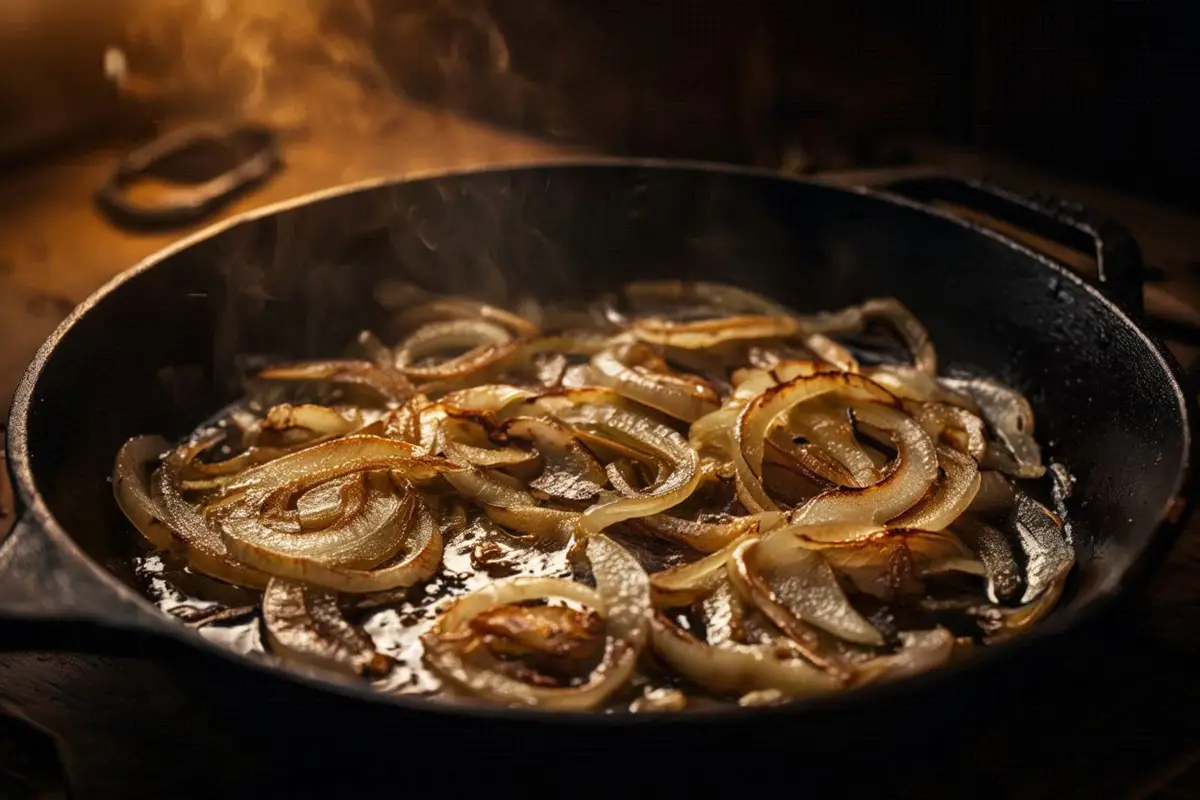
Why Every Old Recipe Starts With Onion in Fat
Almost every old savory recipe begins the same way: onion, cooked in fat, before anything else. This is not habit or tradition. It is chemistry — and it works.
The Instruction That Never Changes
Open almost any savory recipe from the first half of the twentieth century — a soup, a braise, a stew, a sauce — and the first instruction is nearly always the same. Melt the fat. Add the onion. Cook until softened, or golden, or until it begins to color.
Then everything else follows.
This is not coincidence. It is not regional tradition or cultural habit, though it appears across Central Europe, Eastern Europe, and well beyond. It is the correct starting point for building flavor in a savory dish, and the fact that it appears so consistently across different cuisines and different eras reflects how universally cooks arrived at the same conclusion through observation.
What happens when you cook onion in fat is not simple. It is a sequence of chemical events that produces compounds unavailable by any other means — compounds that become the flavor foundation everything else is built on.
What an Onion Actually Contains
A raw onion is approximately 89% water. The rest is sugars — primarily fructose, glucose, and sucrose — along with sulfur-containing compound precursors called S-alk(en)yl cysteine sulfoxides, small amounts of fiber, and trace minerals.
These sulfur precursors are what make raw onion sharp, pungent, and eye-watering. They are part of a defense mechanism: in an intact onion, the precursor compounds and the enzyme that converts them — alliinase — are stored in separate cellular compartments. Cutting or crushing the onion brings them together. The enzyme converts the precursors into volatile sulfur compounds, including thiosulfinates, that irritate the eyes and dominate the flavor of raw onion.
The sugars are present in significant quantity but masked by the sulfur sharpness in raw onion. You can taste them if you eat onion raw — the sweetness is there underneath — but it is not what defines the experience.
Both of these components transform dramatically when heat is applied in the presence of fat.
What Heat and Fat Do
When onion is added to hot fat and the heat is held at a moderate level, several things happen in sequence.
First, the water begins to evaporate. The onion softens as its cell walls break down and release their moisture. This is the sweating stage — the onion becomes translucent, limp, and significantly reduced in volume. The sharp sulfur compounds, being volatile, evaporate along with the water. The pungency diminishes. What remains is sweeter and milder than the raw onion was.
As moisture continues to leave and the surface temperature of the onion rises above the point where water can hold it down, the sugars begin to brown. This is caramelization — the thermal decomposition of sugars into hundreds of new compounds, many of them deeply colored and intensely flavored. The onion turns gold, then amber, then brown at the edges. The flavor shifts from sweet and mild to rich, complex, and savory-sweet.
Simultaneously, the Maillard reaction — the same reaction responsible for the crust on seared meat — begins to occur between the onion’s sugars and its amino acids. This produces a different set of flavor compounds overlapping with but distinct from pure caramelization. The two processes happen together and are difficult to separate in practice, but both contribute to the depth of flavor that a properly cooked onion develops.
The fat participates actively in this process. It transfers heat evenly to the onion surface, preventing the exterior from burning before the interior has softened. It dissolves fat-soluble flavor compounds released by the onion and holds them in the pan, available to flavor everything added afterward. And if the fat itself has flavor — as lard, butter, or schmaltz do — its own compounds enter the mixture and become part of the foundation being built.
An onion cooked in water produces none of this. The temperature never rises above 100°C, which is insufficient for significant caramelization or Maillard reactions. The sulfur compounds dissipate, the onion softens, but the flavor development stops there. This is why onion added directly to a soup without prior cooking in fat tastes flat compared to onion that was cooked first.
The Two Stages Old Recipes Specify
Old recipes distinguish between two end states for the initial onion step, and the distinction matters for the dish that follows.
The first is sweated or softened onion — cooked over low to medium heat until translucent and fully soft, but not yet colored. This takes ten to fifteen minutes done properly, less if the heat is higher but with risk of uneven cooking. Sweated onion is mild, sweet, and almost creamy in texture. It dissolves into whatever liquid is added and becomes part of the background of the dish rather than a distinct element. This is the starting point for delicate soups, cream sauces, and dishes where a clean, sweet base is needed without the assertiveness of browned onion.
The second is golden or browned onion — cooked past the translucent stage until color develops, edges turn amber, and the deeper caramelized flavors emerge. This takes twenty to thirty minutes at moderate heat, longer if the pan is crowded, which it should not be. Browned onion has a richer, more complex flavor with savory depth that sweated onion does not have. It is the starting point for most braises, darker soups, and meat dishes where the sauce needs body and depth from the beginning.
Old recipes that specify “cook the onion until golden” before adding meat or liquid are describing the second stage. Rushing this step — turning up the heat to get color faster — produces burned exterior with undercooked interior and bitter rather than sweet caramelized flavor. The time is part of the instruction.
Why the Fat Type Is Not Incidental
Old recipes specify lard, butter, schmaltz, or occasionally beef dripping for the initial onion step. This is not arbitrary, and substituting a neutral oil produces a different result.
Animal fats carry flavor of their own. Lard has a clean, rich pork undertone. Butter contributes its dairy solids, which also undergo browning reactions at higher temperatures — browned butter has a nutty depth that unbrowned butter does not. Schmaltz — rendered chicken or goose fat — has a savory, poultry character that fundamentally defines the flavor of the dishes it appears in.
When onion cooks in these fats, the fat-soluble flavor compounds from both the onion and the fat combine in the pan. The resulting mixture is not onion flavor plus fat flavor — it is a new compound profile created by their interaction. This is the flavor that then infuses everything added to the pan afterward.
A neutral oil — sunflower, vegetable, refined olive — does not contribute to this. It transfers heat and prevents sticking, but it does not participate in the flavor being built. The onion will still caramelize and develop its own compounds, but the layered quality that comes from the fat’s participation is absent.
This is why the fat specification in old recipes is not a health consideration or a period convention to be updated. It is a flavor specification.
Reading the Pattern Across Old Recipes
Once you recognize this opening step as a deliberate flavor-building technique rather than a default habit, you begin to see it everywhere in old recipe collections — and you begin to understand what varies and why.
Some recipes begin with onion alone. Others add garlic at the same stage, or after the onion has softened, because garlic burns faster and requires shorter cooking time. Some add the root vegetables — carrot, parsnip, celeriac — alongside the onion to caramelize together. Some begin with cured pork — bacon, lardons, smoked fat — rendering their fat first, then cooking the onion in that rendered fat, which carries the flavor of the cured meat into the base before any other ingredient is added.
Each variation is a different approach to the same principle: build flavor in fat at the beginning, before the liquid goes in and temperature drops to the 80–90°C range where Maillard reactions and caramelization can no longer occur meaningfully.
Whatever happens after — whatever meat, liquid, spice, or vegetable follows — is built on top of what was created in that first step. If that step is skipped or rushed, the dish cannot recover it. The foundation determines what is possible for everything that follows.
This is why old recipes that specify twenty minutes for the onion mean twenty minutes. Not five. Not until it looks soft enough. Twenty minutes, at moderate heat, in the specified fat, until the color and aroma tell you the chemistry has done what it needs to do.
Practical Takeaways
The onion-in-fat step is not decoration. It is the first and most important flavor decision in nearly every old savory recipe. Sweated onion builds a clean, sweet base; golden onion builds depth and richness. The fat type is a flavor ingredient, not a neutral medium. The time stated in old recipes is not a suggestion — it is the time the chemistry requires.
Attic Recipes — digitizing and adapting Central European home cooking from the early twentieth century.
Frequently Asked Questions
01Why do recipes say to cook onions before adding other ingredients?▶
Because onion cooked in fat undergoes chemical transformations — moisture evaporates, sugars concentrate and caramelize, sulfur compounds break down into sweeter molecules — that produce flavor compounds unavailable in raw onion. These compounds become the flavor foundation of the entire dish.
02What is the difference between sweating and caramelizing onions?▶
Sweating is cooking onions over low heat until they soften and become translucent, releasing their moisture without browning. Caramelizing continues beyond that point — the sugars begin to brown and develop deeper, more complex flavor. Old recipes often call for both stages in sequence.
03Does the type of fat matter when cooking onions?▶
Yes. Fat carries and amplifies fat-soluble flavor compounds released by the onion. Animal fats — lard, butter, schmaltz — contribute their own flavor to this process. Neutral oils do not. Old recipes that specify lard or butter are not being arbitrary; the fat participates in the flavor being built.
04Can I skip the onion step and add it later?▶
You can, but the dish will taste different. Raw onion added to a liquid cooks differently than onion that has been pre-cooked in fat. The Maillard compounds and caramelized sugars from the fat-cooking step develop only minimally in a water-based environment. The onion flavor will be present but the foundation it would have built is not.
05Was onion in fat always the starting point, or is this a modern convention?▶
It is very old. Onion cooked in fat appears as the opening step in Central European household recipes throughout the nineteenth and early twentieth centuries, long before food science explained why it worked. Home cooks knew empirically that dishes built on this base tasted better — the chemistry came later, the practice came first.