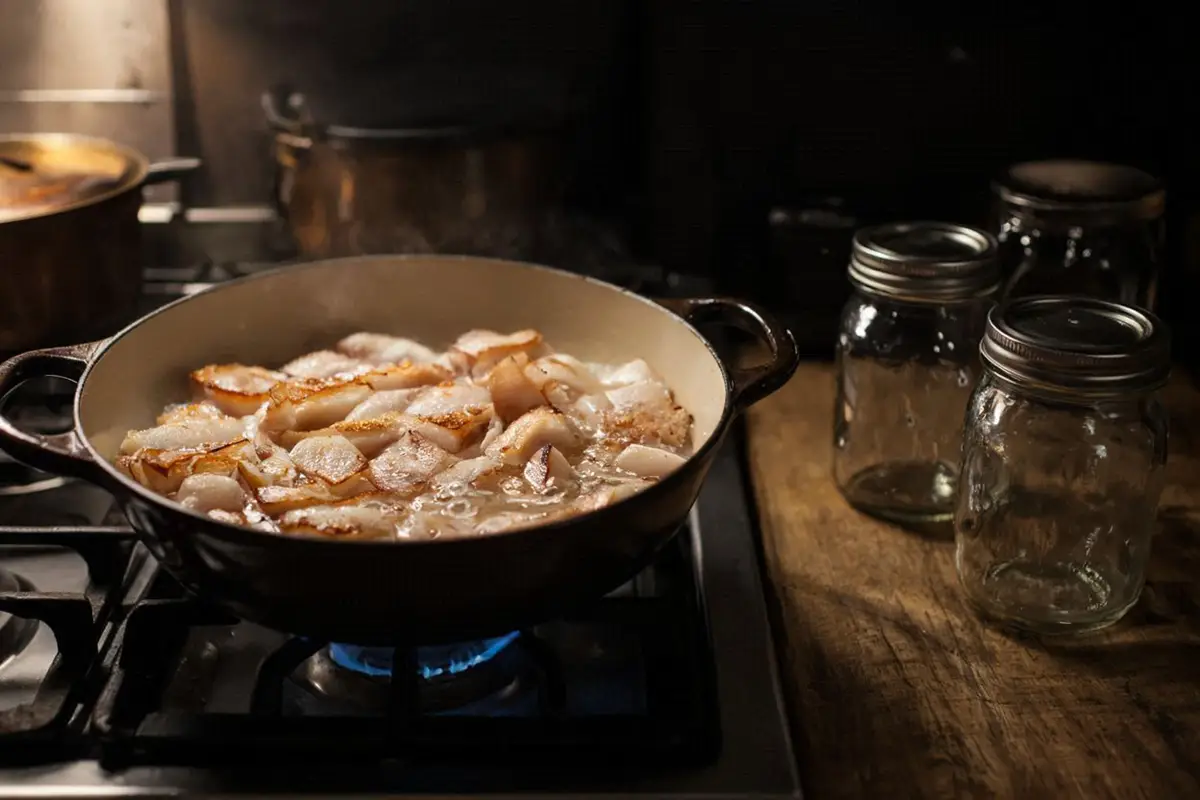
How to Render Fat at Home: Lard, Tallow, and Schmaltz
Rendering animal fat at home takes two hours and basic equipment. Here is how to do it correctly, what the science says, and why it is worth doing.
Why Fat Got a Bad Reputation and How Rendering Fixes Everything
The early 20th century kitchen kept a pot of rendered fat near the stove. Lard for pastry and frying. Tallow for roasting and preserving. Schmaltz — rendered goose or chicken fat — for everything from sautéing onions to spreading on bread. These fats were not incidental ingredients; they were the medium through which most cooking happened.
The disappearance of rendered animal fats from mainstream home kitchens over the second half of the twentieth century was not driven by evidence that they were harmful. It was driven by the industrialization of cooking fat — the creation of cheap, shelf-stable, mass-produced vegetable shortenings and refined seed oils that replaced traditional fats not because they were better but because they were cheaper to produce and market at scale. The trade-off, which took decades to become apparent, was the introduction of industrially produced trans fats into the food supply at significant volume — a demonstrated harm that traditional lard, tallow, and schmaltz do not carry.
This post is about making those fats at home. The process is simple, the equipment is minimal, and the result is a cooking fat of considerably higher quality than anything sold in a supermarket under the label “lard.”
The Three Fats Worth Rendering
Lard — rendered pork fat
Lard consists mainly of triglycerides. Its fatty acid composition is approximately 40% saturated, 45–50% monounsaturated (primarily oleic acid — the same fatty acid that predominates in olive oil), and 11% polyunsaturated. It does not contain trans fats in its naturally rendered form.
The quality and flavor of the finished lard depends significantly on which part of the pig the fat comes from. There are three distinct sources:
Leaf lard — the visceral fat surrounding the kidneys and loin cavity — is the highest grade. It has a smooth, almost creamy texture and a mild, neutral flavor with no pork taste, making it ideal for baking, particularly pie crusts and pastries. When rendered correctly it produces a white, clean fat that can be used anywhere butter or shortening is called for without imparting any savory flavor.
Fatback — the firm subcutaneous fat along the pig’s back — is the next grade. Once rendered, it produces a lard that is slightly yellow in color with a stronger, more pronounced pork flavor. This is an advantage in savory cooking — frying potatoes, sautéing vegetables, braising — where that flavor adds depth. It is not what you want in a delicate pastry.
Caul fat — the lacy membrane surrounding the digestive organs — is rarely rendered into lard. It is more useful as a wrapping for lean roasts, pâtés, and sausages, where it melts away during cooking and adds moisture and flavor.
Tallow — rendered beef or mutton fat
Tallow is made from beef kidney suet — the hard fat surrounding the kidneys — or from other beef or mutton fat trimmings. Kidney suet produces the highest quality result: a firm, white, nearly neutral-flavored fat with a high smoke point and excellent oxidative stability due to its high saturated fat content.
The smoke point of tallow depends on its free fatty acid content and rendering quality. Well-rendered tallow with low free fatty acid content reaches approximately 375–420°F (190–215°C), making it suitable for high-heat frying and roasting.
Tallow was the standard fat for deep frying in British fish and chip shops for most of the twentieth century — a use that persists in traditional establishments today. Central European recipes of the period use it interchangeably with lard in roasting preparations.
Schmaltz — rendered poultry fat
Schmaltz is the Yiddish term for rendered poultry fat, typically from chicken or goose. It occupies a distinct culinary register from lard and tallow: softer at room temperature, with a golden color and a rich, savory flavor that is unmistakably poultry. It is not a neutral fat. It is a flavoring fat.
Chicken fat is approximately 31% saturated, 49% monounsaturated, and 20% polyunsaturated. Goose fat has a similar profile but is slightly more monounsaturated. Both are softer than lard or tallow at room temperature due to their higher unsaturated fat content — this also means they are more prone to oxidation and should be refrigerated promptly after rendering.
Schmaltz is fundamental in Ashkenazi Jewish cooking — for frying, for spreading, for finishing dishes — and appears consistently in Central European recipes where goose and chicken fat were the primary cooking medium.
Equipment You Need
A heavy-bottomed pot — a Dutch oven or large saucepan — is ideal. The mass of a cast iron or heavy stainless pot moderates temperature fluctuations and prevents the fat from scorching at the bottom before the water has fully evaporated.
A fine-mesh sieve or strainer. Cheesecloth or a clean muslin cloth for lining the sieve when filtering the hot fat — this removes all protein particles that would otherwise shorten shelf life and cause off-flavors.
Clean glass jars with lids for storage. Wide-mouth mason jars are ideal. Do not use plastic containers for hot fat.
A ladle or large spoon for transferring the liquid fat.
A thermometer is optional but useful — particularly for tallow, which benefits from monitoring to avoid overheating.
The Rendering Process — Step by Step
The process described here applies to lard (leaf or fatback), tallow (kidney suet or fat trimmings), and schmaltz (chicken or goose fat). The differences between them are noted where they matter.
Step 1: Source and prepare the fat
Ask your butcher specifically for the fat you want. Leaf lard and kidney suet are not standard counter items at most supermarkets; you will generally need to request them in advance from a butcher who handles whole animals. Ethnic butchers and farmers’ markets are often the most reliable sources, and frequently the least expensive.
For lard and tallow, chop or grind the raw fat into small pieces — roughly 1–2cm. The smaller the pieces, the faster and more evenly they render. Some butchers will grind the fat for you on request; this significantly speeds up the process and produces more thorough rendering. If grinding yourself, chill the fat well first — cold fat is much easier to work with than fat at room temperature.
Leaving a small amount of meat on the fat pieces is traditional and intentional: the protein browns during rendering and contributes flavor to the cracklings. This is how most home rendering was done, and it produces better cracklings than pure fat alone.
For schmaltz, trim visible skin and meat from the fat pieces where possible, as these will render differently and can cause burning before the fat is fully extracted.
Step 2: Start with a small amount of water
Place the chopped or ground fat in the pot and add a small amount of cold water — roughly 60ml (a quarter cup) per kilogram of fat. This is the key to even rendering at the start of the process. The water prevents the fat from coming into direct contact with the hot pan surface before it has begun to melt, reducing the risk of scorching. The water will fully evaporate as the rendering progresses; it does not remain in the finished product.
Step 3: Render low and slow
Place the pot over the lowest heat setting your hob allows. The fat should melt gradually — not fry. You are aiming for a temperature of roughly 100–120°C (210–250°F) in the liquid fat. The heat causes the fat to melt and turn liquid, and also ensures that any water evaporates fully. Pork fat naturally contains significant water even in its fatty portions, and this water needs to evaporate completely to produce a stable, shelf-stable lard.
Stir every 15–20 minutes. The fat will slowly liquefy, and the protein tissue (connective tissue, small meat fragments) will gradually sink and then begin to brown and crisp. These are the cracklings.
For schmaltz: Use an even lower heat than for lard or tallow. Poultry fat is more delicate and can take on a bitter flavor if overheated. The process is faster — typically 45–90 minutes rather than 2–3 hours for pork or beef fat.
Step 4: Watch for the signs of completion
The rendering is nearly complete when: the solid pieces (cracklings) have turned golden to light brown; the liquid fat has become clear and stops bubbling actively (the bubbling is water evaporating — when it stops, the water is gone); and the fat smells clean and lightly savory rather than steamy or watery.
Do not allow the cracklings to turn dark brown or black — this means the heat is too high and the fat will take on a burnt flavor that cannot be corrected.
The water test: When you think the rendering is nearly complete, place a small amount of the liquid fat on a cool metal surface. If it solidifies white and clear, the water has fully evaporated. If it looks cloudy or watery, continue rendering.
Step 5: Strain
Remove the pot from heat. Allow to cool for 5–10 minutes — not longer, as the fat should still be fully liquid when you strain it. Line your fine-mesh sieve with cheesecloth and set it over a clean pot or large measuring jug. Ladle the liquid fat through the sieve, pressing the cracklings lightly to extract remaining fat. Do not force the cracklings through — any solids that pass through the cheesecloth will shorten the fat’s shelf life.
Set the cracklings aside. They are not waste.
Step 6: Pour and store
Pour the strained liquid fat carefully into clean, dry glass jars. Leave an inch of headspace if you plan to freeze. Seal loosely until the fat has cooled to room temperature — a sealed jar with hot fat inside can create pressure as steam escapes. Once cool, seal tightly and label with the date and fat type.
Color on cooling: Leaf lard turns bright white when fully cooled and solidified. Fatback lard turns a slightly off-white or very pale yellow. Tallow from kidney suet turns white to ivory. Schmaltz turns a pale gold. If any of these look grey, brown, or cloudy after solidifying, the rendering went too far or was contaminated with too much protein tissue.
Storage: Refrigerated in sealed glass jars — 6 to 12 months for lard and schmaltz, up to 18 months for tallow (which is more saturated and therefore more oxidatively stable). Frozen — up to 2 years for all.
The Cracklings — Do Not Discard Them
The crispy tissue left after rendering is food, not waste. In virtually every culture with a tradition of whole-animal cooking, cracklings are eaten.
In Central European tradition they appear heavily salted, sometimes with paprika and raw onion, served with dark bread and beer. In Poland this is skwarki; in Hungary tepertő; in German-speaking regions Grieben. They are used crumbled into cornbread, bean dishes, potato preparations, and stuffings. They are high in protein, high in fat, intensely savory.
For schmaltz rendering, the browned chicken skin and onion fragments left behind are called gribenes in Yiddish cooking — a traditional snack in Ashkenazi cuisine, often eaten with bread or added to chopped liver.
Cracklings are at their best eaten within a day or two of rendering, while still crispy. They soften on standing.
Smoke Points and Cooking Applications
The smoke point of any rendered fat is not a fixed number — it depends on the free fatty acid content, the purity of the rendering, and storage conditions1. Fats with lower free fatty acid content and better rendering have higher smoke points. Oxidized or poorly stored fat smokes at lower temperatures.
As a practical guide for well-rendered, fresh home fat:
Leaf lard is best for baking (pastry, pie crusts, biscuits) and moderate-heat frying. Its neutral flavor makes it the most versatile fat for applications where you do not want the fat to contribute flavor.
Fatback lard handles high-heat frying well and adds a subtle savory note — ideal for potatoes, eggs, vegetables, and as a cooking medium for braised preparations.
Tallow from kidney suet handles the highest heat of the three and is excellent for deep frying, roasting, and searing. Its firm texture at room temperature makes it useful as a solid fat for pastry in the same way as lard, though with a slightly beefier note.
Schmaltz should not be used at very high heat — it is a lower-heat cooking and finishing fat, best for gentle sautéing, finishing dishes, and spreading.
What Home Kitchens Knew That Got Forgotten
Reading through fat-related passages in period cookbooks, the word “render” appears without explanation, as does the instruction to use “good lard” or “fresh fat.” These are the instructions of books written for cooks who understood where their cooking fat came from and how it was made — who kept a pot of rendered fat near the stove as a matter of course.
The instruction to render fat is not a complicated technique. It is two hours of low heat and occasional stirring, followed by straining into a jar. What made it disappear from home kitchens was not its difficulty but its inconvenience relative to opening a bottle of refined oil — and the decade-long public health campaign, now substantially revised, that positioned animal fats as categorically dangerous.
The campaign was not without basis. Partially hydrogenated vegetable fats genuinely are harmful. But the baby was thrown out with the bathwater, and traditionally rendered lard, tallow, and schmaltz — which contain no trans fats and which sustained European cooking for centuries — went with it.
Making fat at home takes an afternoon. The result is a cooking medium that behaves better at high heat than most refined oils, tastes considerably better than anything from a supermarket lard block, and costs almost nothing if you ask your butcher for what he would otherwise trim away.
Practical Takeaways
Rendering fat at home is a two-hour process that produces a cooking fat significantly better than commercially available alternatives. Use leaf lard for baking, fatback lard for frying and savory cooking, kidney suet tallow for high-heat applications, and schmaltz as a finishing and flavoring fat. Render low and slow, ensure all water has evaporated before straining, store in sealed glass jars, and do not discard the cracklings.
Nothing in this post constitutes medical or nutritional advice. The nutritional science of dietary fats is an active and contested field; where findings are preliminary or debated, this is noted. Consult a qualified healthcare provider for personal dietary guidance.
Sources
Attic Recipes — digitizing and adapting Central European home cooking from the early twentieth century.
Footnotes
-
McGee, H. (2004). On Food and Cooking: The Science and Lore of the Kitchen, revised ed. Scribner, New York. ↩
Frequently Asked Questions
01What is the difference between leaf lard and fatback lard?▶
Leaf lard comes from the visceral fat surrounding the kidneys and loin cavity. It is the highest grade — nearly white when rendered, with a mild, neutral flavor ideal for baking and pastry. Fatback lard comes from the firm subcutaneous fat along the pig's back and renders to a slightly yellower color with a subtle pork flavor, making it excellent for frying and savory cooking.
02How long does home-rendered lard keep?▶
Properly rendered lard — meaning all water has been fully evaporated — keeps for 6 to 12 months refrigerated in a sealed glass jar, and up to 2 years frozen. The key variable is how completely the water was driven off during rendering. Any remaining water dramatically shortens shelf life by promoting rancidity.
03Does home-rendered lard differ from commercially produced lard?▶
Most commercially produced lard is hydrogenated, bleached, and contains additives such as BHT. Naturally rendered lard contains none of these. Home rendering also allows you to choose the source and quality of the fat. Whether this matters for your cooking is a practical question worth considering.
04Can I render other animal fats the same way?▶
Yes — the process is essentially identical for tallow (beef or mutton fat), schmaltz (poultry fat), and duck fat. The primary differences are temperature sensitivity — poultry fat can burn more easily at higher heat — and yield. Beef kidney suet produces the highest quality tallow: neutral in flavor, very stable, with a high smoke point.
05What can I do with the cracklings left after rendering lard?▶
Cracklings are edible and traditionally eaten as a snack across Central Europe — heavily salted, often with paprika and raw onion, served with dark bread. They are used crumbled into cornbread, bean dishes, and stuffings. In Poland they are called skwarki, in Hungary tepertő, in German-speaking regions Grieben. Do not discard them.