Bulgarian Folk Soup with Mixed Beef
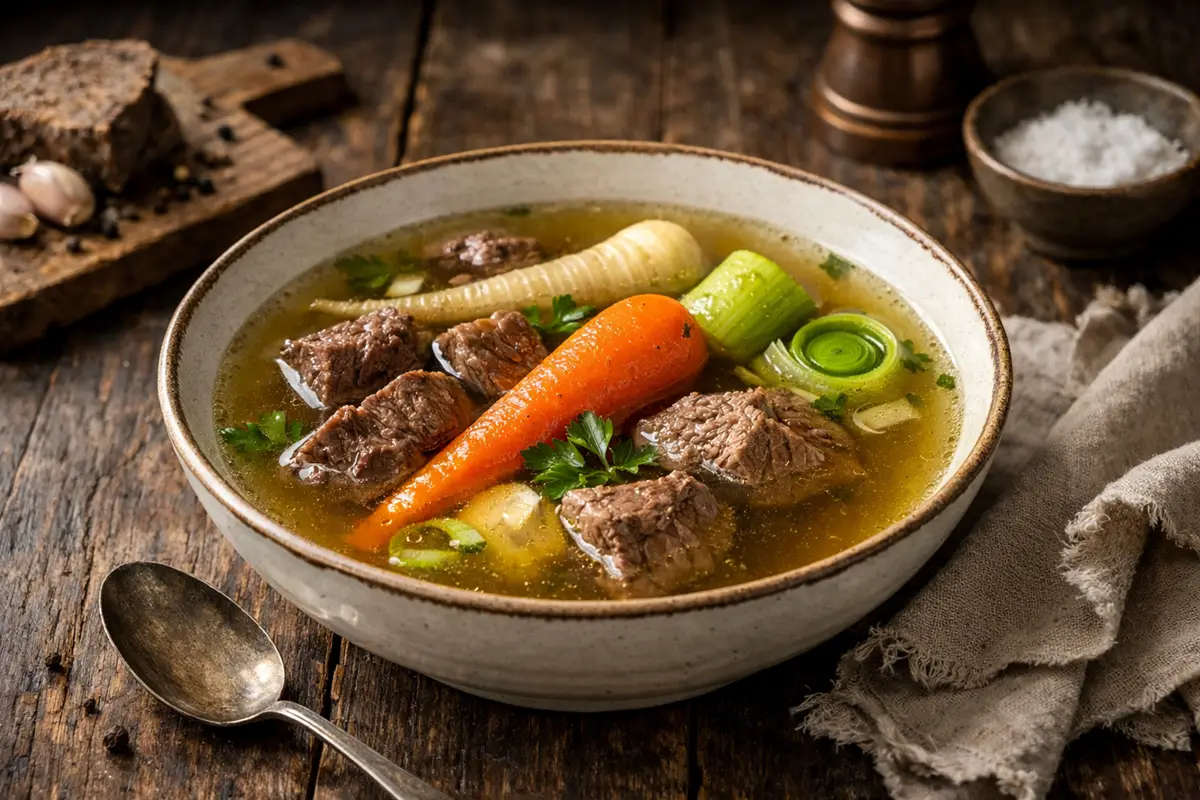
A clear, slow-simmered beef and root vegetable soup — built on mixed cuts, calf leg, and careful skimming.
Quick Summary
Bulgarian Folk Soup with Mixed Beef is a Central European soup of mixed beef cuts, calf leg, and root vegetables simmered in a clear broth. It takes about 170 minutes, with a cold-water start helping produce a crystal-clear, gelatin-rich broth.
Historical recipe
Modernised adaptation of an early 20th‑century source. Not independently kitchen-tested by Attic Recipes. Quantities, temperatures, and food safety guidance have been updated for a contemporary kitchen — results may vary and errors may exist. Nutritional values, where provided, are estimates only and have not been laboratory tested. Always follow current food safety guidelines for your region. If you have a health condition, allergy, or dietary requirement, consult a qualified professional before preparing this recipe.
Use of this recipe is entirely at your own risk and subject to our Terms of Service and Privacy Policy. Attic Recipes accepts no liability for any adverse outcome.
- Celery
Additional notes
-
Caution
Contains beef with moderate cholesterol (141mg per serving). Those with cardiovascular conditions or dietary cholesterol restrictions should be aware.
Skim the fat thoroughly from the surface of the broth during and after cooking to reduce the fat content significantly.
-
Note
If using calf leg or marrow bones, the broth will be rich in collagen and gelatin. This is nutritionally beneficial but may solidify when refrigerated — this is normal and desirable.
Refrigerate leftover soup and skim the solidified fat layer from the top before reheating for a leaner result.
-
Note
Contains celery, a regulated allergen under EU Regulation 1169/2011. Always declare celery when serving to guests with food allergies. Celery can be omitted without significantly affecting the overall flavour of the broth.
- 1
Prepare the meat: Wash the beef and calf leg thoroughly under cold running water, removing any small bone fragments. Place into a large, heavy pot and cover with 3 liters of cold water. Add the salt immediately.
Tip Starting in cold water is essential — it draws out the impurities and blood slowly, which is what allows you to skim a clean foam and achieve a clear broth. - 2
Slow heat and skim: Place the pot over the lowest heat available. Allow it to come to a very slow simmer over 30–40 minutes. As the liquid heats, a grey-brown foam will rise to the surface. Skim it off carefully and thoroughly with a ladle or fine skimmer before the soup reaches a full boil. This step is the key to a light, clear broth.
Tip Do not rush this stage. A high flame will emulsify the fat and foam back into the broth, making it cloudy and impossible to clarify. - 3
Add the vegetables: Once the foam has been fully removed and the broth is clear, add all the vegetables: the whole onions, carrots, parsnip, leek, celery heads, celery stalks, garlic head, parsley roots, parsley bunch, and tomato (if using). Do not cut them small — large pieces release flavour slowly and keep the broth clear.
- 4
Simmer low and long: Continue to cook at the gentlest possible simmer, partially covered, for 1.5 to 2 hours, until the meat is fully tender but still holding its shape. Do not allow it to boil hard at any point.
- 5
Add potatoes: In the last 20–25 minutes of cooking, add the peeled whole potatoes to the broth. Watch them carefully and remove them with a slotted spoon as soon as they are just tender — before they begin to break apart. A falling-apart potato will cloud and starch the broth.
- 6
Serve: Ladle the boiling-hot soup into warmed bowls immediately. Slice or pull the meat and serve it alongside the broth and vegetables, seasoned generously with salt and freshly ground black pepper.
Tip In the traditional serving style, the broth, meat, and vegetables are presented together in a large warmed bowl at the table, with plain white cheese and thick slices of toasted day-old bread on the side.
Nutrition Information per 1 portion (approx. 400ml broth + meat + vegetables)
Nutritional values are approximate estimates and may vary based on specific ingredients used, preparation methods, and portion sizes.
Serving Suggestions
Serve with plain white cheese (such as sirene, feta, or any young brine-ripened cheese) on a small side plate, and toasted or day-old crusty bread. The traditional method of drying leftover hard bread on the stovetop before serving is an elegant way to avoid waste and add texture.
About This Recipe
A soup that is less a recipe and more a philosophy: start cold, heat slowly, skim patiently, and let time do the work. Bulgarian folk soup with mixed beef is a Central European answer to pot-au-feu — a clear, golden broth surrounding tender meat and soft root vegetables, with nothing to hide behind. The quality of the result is entirely a function of the quality of the ingredients and the patience of the cook.
Why It Works
The technique of starting the meat in cold water and heating it gradually is not optional — it is the mechanism by which the broth achieves its clarity. A hot-start causes surface proteins to seize and fragment, distributing throughout the liquid as fine particles that make the broth permanently grey and cloudy. A cold-start draws those proteins to the surface as a cohesive foam that can be cleanly removed. The calf’s leg contributes collagen, which converts to gelatin during the long simmer, giving the broth its characteristic body and lip-coating richness without any added thickener.
Modern Kitchen Tips
- The skim: Give the pot your full attention for the first 30–40 minutes. Once the foam is gone, the soup largely takes care of itself.
- The potatoes: Set a timer when you add them. Overcooked potatoes are the single most common way to ruin an otherwise perfect clear broth.
- Leftover broth: The broth improves significantly the next day. Refrigerate overnight, lift the solidified fat from the surface, and reheat gently for an even cleaner, richer result.
- The bread: The traditional instruction to dry leftover hard bread on top of the stove before serving is worth following — it produces a texture somewhere between toast and crouton that is far better than fresh bread for soup.
A classic of early 20th century home cooking, preserved and adapted for the modern kitchen.
The Story Behind This Recipe
Historical Context
This is one of the most fundamental preparations in the Central European home kitchen — a long-simmered, clear meat broth built around the principle that simplicity and patience produce more flavour than technique. The instruction to use mixed beef cuts (šareno meso — literally 'colourful' or 'mixed' meat) and add a calf's leg or marrow bones reflects the early 20th century household practice of extracting maximum value from every part of the animal. The careful skimming of foam, the prohibition on stock or pre-made broth, and the insistence on a clear broth are all hallmarks of the Central European bourgeois kitchen of the period.
Modern Kitchen Adaptation
A good butcher can prepare a mixed braising pack with chuck, shank, and a split calf's leg. If calf leg is unavailable, beef marrow bones are an excellent substitute and easier to source. A slow cooker set to low for 6–8 hours produces excellent results with no risk of hard boiling. The tomato is optional but adds a subtle acidity and a warm golden colour to the broth — worth including when in season.
This recipe is an independent modern adaptation developed from historical sources in the public domain. It is provided for informational and educational purposes only and does not constitute professional dietary, nutritional, or medical advice. Food preparation involves inherent risks. The reader assumes full responsibility for safe food handling, ingredient sourcing, and adherence to current local food safety guidelines. The site operator accepts no liability for outcomes resulting from the preparation or consumption of this recipe.
One recipe.
Every week.
You Might Also Like
More recipes from the same category

Asparagus Tip Soup
A silky, cream-enriched asparagus soup built on a white roux and finished with tempered egg yolks — an elegant first course from early 20th century cooking.
Beef Broth with Stuffed Dough Dumplings
Rich beef bone broth simmered with golden pan-fried dumplings stuffed with seasoned ground beef, finished with a light roux and fresh lemon juice.

Bean Soup Cooked with Beef
White beans and beef shoulder slow-simmered with a bouquet garni, finished in the oven with a paprika-spiced pan roux. A deeply satisfying one-pot meal.