Bulgarian Spinach Soup with Egg and Sour Milk
A silky Bulgarian spinach soup finished with tempered egg yolks, lemon, and sour milk — nourishing, tangy, and very simple.

Quick Summary
Bulgarian Spinach Soup with Egg and Sour Milk is a traditional Central European soup of butter-wilted spinach, toasted flour, egg yolks, sour milk, and croutons. It takes about 45 minutes, with a silky, tangy finish that balances the broth.
Historical recipe
Modernised adaptation of an early 20th‑century source. Not independently kitchen-tested by Attic Recipes. Quantities, temperatures, and food safety guidance have been updated for a contemporary kitchen — results may vary and errors may exist. Nutritional values, where provided, are estimates only and have not been laboratory tested. Always follow current food safety guidelines for your region. If you have a health condition, allergy, or dietary requirement, consult a qualified professional before preparing this recipe.
Use of this recipe is entirely at your own risk and subject to our Terms of Service and Privacy Policy. Attic Recipes accepts no liability for any adverse outcome.
- Dairy
- Eggs
- Gluten
Safety note
Contains egg yolks that are tempered but may not reach a fully safe internal temperature during normal preparation. The safe threshold for egg-containing dishes is 71°C (160°F). Not suitable for pregnant women, children under 5, elderly individuals, or immunocompromised people due to risk of Salmonella.
Use commercially pasteurised egg yolks, or substitute with 2 tablespoons of heavy cream stirred in at the end for a safe, similarly rich result. If using a thermometer, verify the tempered mixture reaches 71°C (160°F) before adding the sour milk.
Additional notes
-
Warning
High saturated fat content — 14g per serving from butter and egg yolks combined. Those with cardiovascular conditions or on a saturated fat-restricted diet should be aware.
Reduce butter to 50–60g and use one egg yolk only to significantly lower the saturated fat content.
-
Note
Spinach is very high in oxalates. Individuals with a history of calcium oxalate kidney stones should consume in moderation.
Blanching the spinach briefly in boiling water and discarding the water before cooking reduces oxalate content by approximately 30–40%.
-
Caution
Contains dairy (butter, sour milk/yogurt), eggs, and gluten (flour). Common allergens — always declare to guests with relevant allergies.
Use olive oil in place of butter, a dairy-free yogurt alternative, and cornstarch instead of flour for a gluten and dairy-free version.
- 1
Cook the spinach: Place the spinach strips and a pinch of salt into a heavy saucepan. Add approximately 80g of the butter. Cook over medium heat, stirring, until the spinach has fully wilted and is just beginning to catch lightly on the edges — about 8–10 minutes. The spinach should be soft and reduced, not browned.
Tip The butter here is generous by modern standards, but it is the structural base of the soup — do not reduce it significantly or the texture of the finished soup will suffer. - 2
Add the flour and water: Stir in the toasted flour and cook for 1 minute. Then add the hot water slowly, stirring constantly. Bring to a gentle simmer and cook for 10 minutes.
Tip Always add hot water, not cold. Adding cold water to a hot soup drops the temperature suddenly, which affects both flavour development and the final texture. - 3
Temper the egg yolks: In a deep bowl, whisk together the egg yolks with a few drops of cold water and the juice of half a lemon. Begin adding the hot soup to this mixture one ladleful at a time, whisking constantly after each addition. Continue until you have added all the soup and the mixture is smooth and uniform.
Tip Patience here prevents scrambled eggs. The gradual addition of hot liquid slowly raises the temperature of the yolks, allowing them to thicken the soup without curdling. If using a thermometer, the mixture should reach 71°C (160°F) to be fully safe — see safety notes. - 4
Adjust consistency: If the soup is thinner than desired, return it to the saucepan over the lowest possible heat and stir continuously until it thickens to your liking. Do not boil.
- 5
Add the sour milk: Stir the sour milk (or yogurt) vigorously with a wooden spoon to loosen it, then stir it into the soup. Remove from heat. The soup should be warm, not hot — do not return to a boil after adding the milk.
- 6
Make the croutons: In a small frying pan, melt the remaining 20g of butter over medium heat. Add the bread cubes and fry until golden and crisp on all sides. Pile them in the centre of each bowl at serving.
- 7
Serve: Ladle the soup warm into bowls. Top with a pile of butter-fried bread cubes and, if using, a little crumbled aged white cheese placed on top of the bread.
Nutrition Information per 1 portion soup (approx. 350ml) — croutons not included
Nutritional values are approximate estimates and may vary based on specific ingredients used, preparation methods, and portion sizes.
Serving Suggestions
Serve warm, not piping hot — this is explicitly a warm soup, and boiling damages the egg-yogurt liaison. The combination of butter-fried croutons and a little aged white cheese (sirene, feta, or any young brine-ripened cheese) in the centre of the bowl is the traditional presentation and adds both texture and salt contrast. A simple glass of cold water or light white wine completes the meal.
About This Recipe
One of the more quietly extraordinary recipes in the early 20th century Central European domestic canon — a spinach soup that is neither a cream soup nor a broth, but something in between: silky, tangy, and deeply nourishing, with a butter richness that the egg-and-sour-milk finish keeps from feeling heavy. The original text specifically recommends it for convalescents and children, which speaks to both its digestibility and its mild, clean flavour.
Why It Works
The technique here is essentially a liaison — a classic French method of finishing a soup with egg yolks to give it body without flour-heaviness or cream-density. By tempering the yolks gradually with hot soup before returning them to the pot, you achieve a smooth, stable emulsion that coats the spinach and thickens the broth into something closer to a velouté. The lemon juice added to the yolks serves a double purpose: it brightens the flavour and slightly acidulates the proteins, making them more resistant to curdling during the tempering process. The sour milk added at the end introduces a second layer of acidity that keeps the richness in check.
Modern Kitchen Tips
- The hot water rule: The original text devotes an entire paragraph to this point — and it is correct. Cold water added to a hot soup does not just cool it; it causes fat to contract and separate and disrupts the developing flavours. Keep a kettle hot.
- Toasted flour: A dry-toasted flour has a nuttier, more complex flavour than raw flour and thickens more gently. Toast it in a dry pan over medium heat, stirring constantly, until it turns a very light golden colour and smells biscuity — about 3–4 minutes.
- The croutons: Old bread fried in good butter is genuinely better than fresh bread for this purpose. The stale interior absorbs the butter without going soggy, and the crust fries to a satisfying hardness that holds up in the soup.
- The cheese: A small amount of leftover brine-ripened cheese (sirene, feta, or similar) crumbled on top of the croutons adds salt, tang, and creaminess that ties the whole bowl together.
A classic of early 20th century home cooking, preserved and adapted for the modern kitchen.
The Story Behind This Recipe
Historical Context
This soup belongs to a category of light, restorative preparations specifically recommended in early 20th century Central European domestic literature for convalescents, children, and the elderly — a domestic medicine as much as a recipe. The instruction to always keep a tall copper pot of hot water on the fire is a window into the rhythm of the pre-modern kitchen, where the stove was never cold and waste of any ingredient, including heat, was unthinkable. The technique of tempering egg yolks outside the pot — rather than simply whisking them in — reflects French culinary influence on the educated household kitchen of the period.
Modern Kitchen Adaptation
Fresh baby spinach can be used without pre-cutting. The toasted flour can be prepared in batches and stored in a jar — it keeps for weeks and is useful for many traditional soups and stews. Plain whole-milk yogurt is a reliable substitute for overnight sour milk; adding a few drops of lemon juice to the yogurt will approximate the sharper acidity of the original. For a lighter result, the butter can be reduced to 60–70g, though the soup will be noticeably less rich.
This recipe is an independent modern adaptation developed from historical sources in the public domain. It is provided for informational and educational purposes only and does not constitute professional dietary, nutritional, or medical advice. Food preparation involves inherent risks. The reader assumes full responsibility for safe food handling, ingredient sourcing, and adherence to current local food safety guidelines. The site operator accepts no liability for outcomes resulting from the preparation or consumption of this recipe.
One recipe.
Every week.
You Might Also Like
More recipes from the same category

Asparagus Tip Soup
A silky, cream-enriched asparagus soup built on a white roux and finished with tempered egg yolks — an elegant first course from early 20th century cooking.
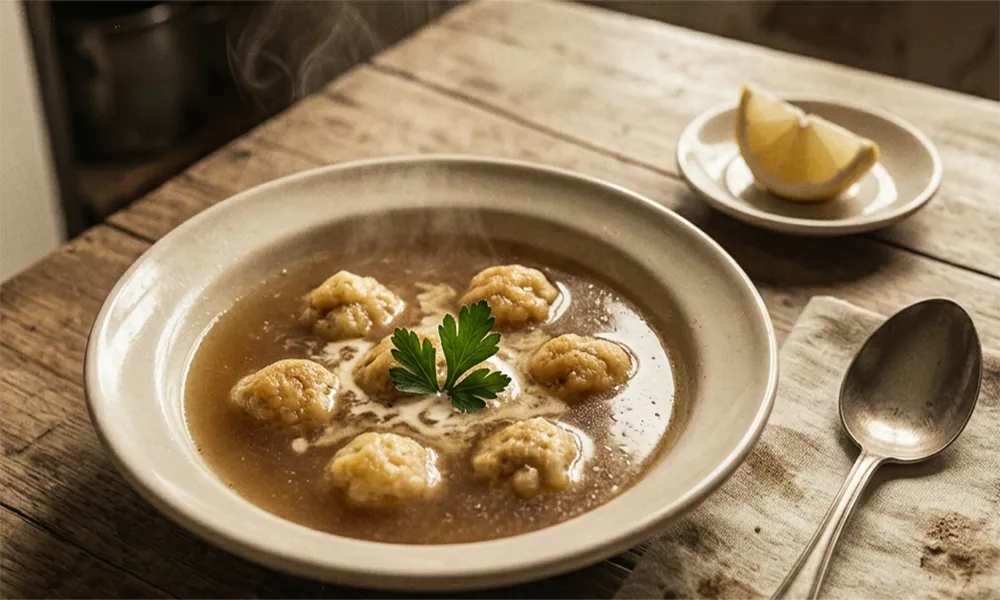
Beef Broth with Stuffed Dough Dumplings
Rich beef bone broth simmered with golden pan-fried dumplings stuffed with seasoned ground beef, finished with a light roux and fresh lemon juice.

Bean Soup Cooked with Beef
White beans and beef shoulder slow-simmered with a bouquet garni, finished in the oven with a paprika-spiced pan roux. A deeply satisfying one-pot meal.