Young Spinach Root Soup with Bacon and Soured Milk
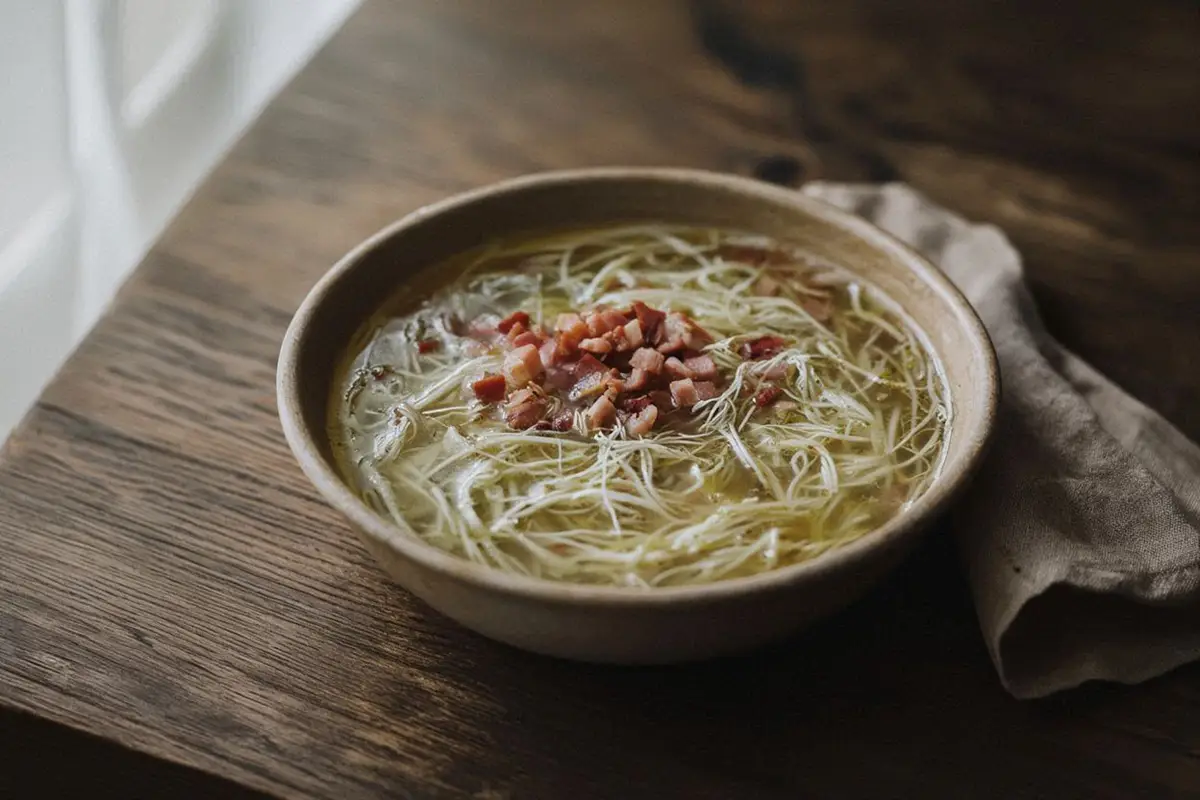
A thrifty Central European peasant soup made from young spinach roots, smoked bacon, and a garlic-soured milk finish. Nothing wasted, everything flavored.
Quick Summary
A thrifty Central European peasant soup made from young spinach roots, smoked bacon, and a garlic-soured milk finish. Nothing wasted, everything flavored.
Historical recipe
Modernised adaptation of an early 20th‑century source. Not independently kitchen-tested by Attic Recipes. Quantities, temperatures, and food safety guidance have been updated for a contemporary kitchen — results may vary and errors may exist. Nutritional values, where provided, are estimates only and have not been laboratory tested. Always follow current food safety guidelines for your region. If you have a health condition, allergy, or dietary requirement, consult a qualified professional before preparing this recipe.
Use of this recipe is entirely at your own risk and subject to our Terms of Service and Privacy Policy. Attic Recipes accepts no liability for any adverse outcome.
- Dairy
- Eggs
- Gluten
Additional notes
-
Warning
Contains a whole egg added to soured milk and stirred into hot soup. Although tempered, the egg may not reach 71°C (160°F) full pasteurization temperature. Not recommended for pregnant women, young children, the elderly, or immunocompromised individuals.
Use a pasteurized egg, or omit the egg entirely — the soured milk alone provides sufficient body and tang.
-
Caution
Contains dairy (soured milk). Not suitable for those with lactose intolerance or dairy allergies without substitution.
Replace soured milk with a full-fat dairy-free yogurt alternative. The flavor will differ but the texture will hold.
-
Caution
Contains gluten (flour in the roux). Not suitable for those with celiac disease or gluten sensitivity.
Replace flour with cornstarch. Make a slurry (1 tbsp cornstarch + 2 tbsp cold water) and add directly to the simmering soup instead of making a roux.
-
Note
Spinach roots contain oxalates, as do the leaves. Individuals with a history of kidney stones (calcium oxalate type) should consume in moderation.
- 1
Prepare the roots: From 1kg of young spinach, select the small white roots — the nodular base from which the leaves emerge. Do not use the leaf stems or dark green parts. Wash the roots very thoroughly in several changes of cold water — they trap soil between the nodes. Trim each root to approximately 1cm lengths.
Tip This is a zero-waste recipe built entirely around the parts most cooks discard. The roots have a mild, earthy flavor distinct from the leaves — slightly bitter, very clean. - 2
Simmer the base: Place the cleaned roots and diced bacon in a pot. Cover with 1.5 liters of cold water. Add a few whole peppercorns. Bring to a boil, then reduce to a gentle simmer. Cook uncovered for 2 hours.
Tip The long cooking time is necessary — the roots are fibrous and need sustained heat to become tender and release their flavor into the broth. - 3
Make the roux: About 10 minutes before the soup is ready, heat the lard or oil in a small pan over medium heat. Add the finely chopped onion and fry until half-softened. Sprinkle the flour over the onion and stir constantly. Continue frying until the roux turns golden brown and smells nutty. This is a blond roux, not a white one.
Tip Unlike the white roux used in cauliflower potage, this roux is taken to golden — it adds color and a toasted depth that suits the rustic character of this soup. - 4
Combine: Scrape the onion roux into the simmering soup and stir well to incorporate. Season with salt. Simmer for a further 5–10 minutes to cook out the flour.
- 5
Prepare the soured milk finish: In a bowl, combine the 500g of room-temperature soured milk, the beaten whole egg, and the finely chopped garlic. Whisk together until smooth.
- 6
Temper and finish: Ladle several spoonfuls of hot soup into the soured milk mixture, whisking constantly to bring it up to temperature gradually. Then pour the entire tempered mixture back into the pot, stirring gently. Do not boil after adding the soured milk and egg — the egg will curdle.
Tip Room-temperature soured milk tempers more easily than cold. Take the pot off the heat before adding the mixture if the soup is at a rolling boil. - 7
Serve immediately in warm bowls with crusty bread.
Nutrition Information per 1 portion (approx. 380ml)
Nutritional values are approximate estimates and may vary based on specific ingredients used, preparation methods, and portion sizes.
Serving Suggestions
Serve as a first course or a light main with dark rye bread. The soup is complete as written — it needs no additional garnish. A small pinch of sweet paprika on top adds color if desired.
About This Recipe
This is a recipe about not throwing things away. When you clean a kilogram of young spring spinach — the kind sold with roots still attached at a farmers’ market — you end up with a small pile of delicate white roots that most people discard without a second thought. This soup is built entirely from those roots. Two hours of gentle simmering with smoked bacon transforms them into a quietly flavorful broth; a golden onion roux gives it body; and a finishing mixture of soured milk, garlic, and egg rounds the whole thing into something that feels complete and considered. It is peasant cooking at its most intelligent.
Why It Works
The two-hour simmer is not negotiable. Spinach roots are fibrous structures designed to anchor a plant in soil — they do not give up their flavor quickly. The long, slow cook extracts everything they have, and the smoked bacon works in parallel, contributing fat and smokiness to a broth that would otherwise be thin. The blond roux added at the end is different in character from a white roux — the toasted flour adds a faint nuttiness that suits the earthy roots.
The soured milk and egg finish is a classical Central European technique for enriching vegetable soups without cream. The garlic is added raw to the cold milk mixture, not cooked — it retains a sharper, more pungent character that cuts through the fat of the bacon and the tang of the milk simultaneously.
Finding the Right Spinach
This recipe only works with young spinach sold with roots still attached — the kind found at farmers’ markets or grown at home, not bagged supermarket spinach, which is always pre-trimmed. The roots should be white or pale yellow, firm, and no longer than 4–5cm. Discard any that are brown, slimy, or smell off. Wash in at least three changes of cold water — the nodes trap remarkable amounts of fine soil.
Soured Milk vs. Yogurt
Kiselo mleko — the cultured milk used here — is thicker than buttermilk and tangier than most commercial yogurts. Full-fat plain yogurt is the closest widely available substitute; thin it with a tablespoon of cold water before using to approximate the consistency. Do not use Greek yogurt without thinning — it is too thick and will not temper smoothly into the hot soup.
Troubleshooting
Soup tastes flat after 2 hours? The roots may have been too mature or the bacon too mild. Add an extra pinch of salt and allow the soured milk garlic mixture to sit for 10 minutes before adding — the garlic will sharpen.
Soured milk curdled in the soup? It was added too cold or the soup was at a rolling boil. Always temper and always take the pot off the heat before adding the dairy mixture.
A classic of early 20th century home cooking, preserved and adapted for the modern kitchen.
The Story Behind This Recipe
Historical Context
Zero-waste cooking was not a modern concept — it was a necessity. In early 20th-century Central European households, every part of a vegetable was used, and the cleaning of young spring spinach reliably produced a pile of small white roots that most contemporary cooks would throw away without thought. This soup is built entirely from those roots, stretched with smoked bacon and finished with the classic pairing of soured milk, garlic, and egg — a combination that appears across the region as a finishing technique for bean soups, vegetable broths, and braised dishes. The result is a bowl that is simultaneously thrifty and deeply satisfying.
Modern Kitchen Adaptation
Young spinach roots are not commercially available — this recipe only makes sense in the context of cleaning fresh, whole young spinach with roots still attached, which is increasingly rare outside farmers' markets and home gardens. The soured milk (kiselo mleko) is a traditional Central European cultured milk product, thicker than buttermilk and tangier than yogurt. Full-fat plain yogurt thinned slightly with a tablespoon of water is the most accurate substitute in markets where kiselo mleko is unavailable.
This recipe is an independent modern adaptation developed from historical sources in the public domain. It is provided for informational and educational purposes only and does not constitute professional dietary, nutritional, or medical advice. Food preparation involves inherent risks. The reader assumes full responsibility for safe food handling, ingredient sourcing, and adherence to current local food safety guidelines. The site operator accepts no liability for outcomes resulting from the preparation or consumption of this recipe.
One recipe.
Every week.
You Might Also Like
More recipes from the same category

Asparagus Tip Soup
A silky, cream-enriched asparagus soup built on a white roux and finished with tempered egg yolks — an elegant first course from early 20th century cooking.

Beef Broth with Stuffed Dough Dumplings
Rich beef bone broth simmered with golden pan-fried dumplings stuffed with seasoned ground beef, finished with a light roux and fresh lemon juice.

Bean Soup Cooked with Beef
White beans and beef shoulder slow-simmered with a bouquet garni, finished in the oven with a paprika-spiced pan roux. A deeply satisfying one-pot meal.