Traditional Tongue Soup
Rich, restorative soup made from beef or veal tongue, thickened with grains and finished with sour cream and lemon juice.
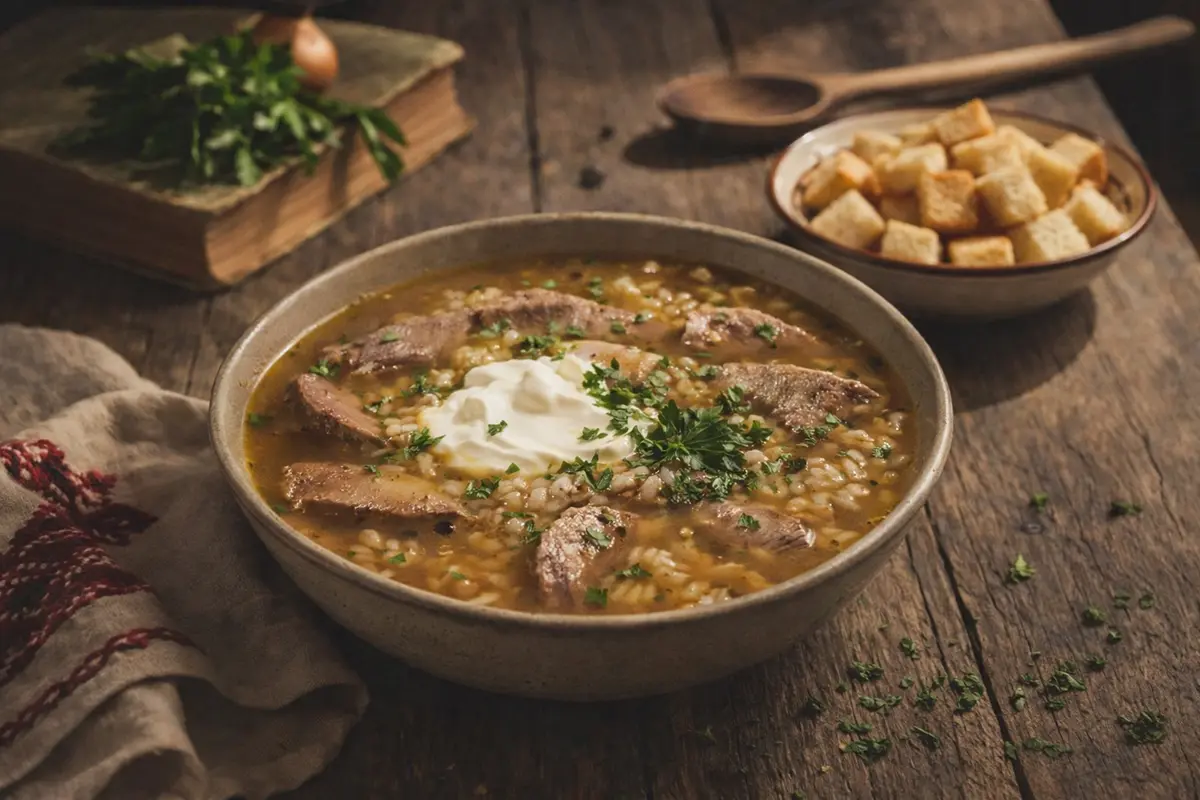
Quick Summary
Rich, restorative soup made from beef or veal tongue, thickened with grains and finished with sour cream and lemon juice.
Historical recipe
Modernised adaptation of an early 20th‑century source. Not independently kitchen-tested by Attic Recipes. Quantities, temperatures, and food safety guidance have been updated for a contemporary kitchen — results may vary and errors may exist. Nutritional values, where provided, are estimates only and have not been laboratory tested. Always follow current food safety guidelines for your region. If you have a health condition, allergy, or dietary requirement, consult a qualified professional before preparing this recipe.
Use of this recipe is entirely at your own risk and subject to our Terms of Service and Privacy Policy. Attic Recipes accepts no liability for any adverse outcome.
- Celery
- Dairy
- Eggs
- Gluten
Additional notes
-
Warning
The egg yolk in the tempering step is not fully cooked — the soup is removed from heat immediately after adding and must not return to boil. This may not reach temperatures sufficient to eliminate salmonella risk. Vulnerable groups including pregnant women, the elderly, and immunocompromised individuals should omit the yolk or use a pasteurized egg yolk.
Use a pasteurized egg yolk, or omit the yolk entirely and use sour cream alone — the soup will be slightly less rich but equally good.
-
Warning
Tongue is an organ meat and must be cooked until completely tender throughout — 74°C internal temperature minimum. The 2–2.5 hour simmer in this recipe achieves this, but verify with a thermometer if unsure.
-
Caution
Tongue is high in cholesterol and saturated fat. Those managing cardiovascular conditions should consume in moderation.
- 1
Wash the tongue thoroughly in several changes of cold water until completely clean.
- 2
Place tongue in a large pot with 3 liters of cold water. Bring to a boil and skim any foam that rises to the surface.
Tip Skimming in the first 10 minutes produces a clearer, cleaner broth. - 3
Add whole onion, garlic, herb bunch, 1 teaspoon of salt, and peppercorns. Reduce to a low simmer and cook until tongue is completely tender, 2 to 2.5 hours for beef, 1.5 to 2 hours for veal.
Tip The tongue is done when a skewer slides in without resistance and the skin peels easily. - 4
Remove tongue from pot and set aside to cool slightly. Strain broth through a fine sieve or cheesecloth-lined strainer. Discard solids.
- 5
While still warm, peel the outer skin from the tongue — it comes off easily at this stage. Slice into thin medallions.
Tip Do not let the tongue cool completely before peeling — the skin becomes much harder to remove. - 6
Return strained broth to the heat. Add your chosen grain and cook until soft and broth has thickened slightly — about 20 minutes for pearl barley, 15 for rice, 5 for semolina.
- 7
In a bowl, whisk together sour cream, egg yolk, and lemon juice until smooth.
- 8
Temper the mixture: slowly ladle two ladles of hot soup into the cream bowl while whisking constantly. Then pour everything back into the main pot. Stir well and remove from heat immediately. Do not return to boil.
Tip Tempering prevents the sour cream from curdling and the egg yolk from scrambling. The soup must not boil after this step. - 9
Add sliced tongue back to the soup. Adjust salt and lemon juice. Serve immediately garnished with fresh parsley.
Nutrition Information per 1 bowl (approx. 350ml)
Nutritional values are approximate estimates and may vary based on specific ingredients used, preparation methods, and portion sizes.
Pro Tips
- Skim foam thoroughly in the first 10 minutes — it makes a significant difference to broth clarity
- Peel tongue skin while still warm — it becomes difficult to remove once cold
- Do not boil the soup after adding the sour cream mixture — it will curdle
- Veal tongue is more delicate and cooks faster than beef — adjust timing accordingly
- Adjust lemon juice at the very end, after tempering, for a clean bright finish
- Leftover sliced tongue is excellent cold — serve on dark bread with mustard
Serving Suggestions
Serve with sliced tongue returned to the bowl and plenty of fresh parsley. Dark rye bread on the side. A wedge of lemon at the table for individual adjustment.
About This Recipe
A whole tongue simmered for two hours with onion, garlic, and herbs until the broth is rich and the meat completely tender. The broth is strained, thickened with pearl barley, and finished with a tempered sour cream and egg yolk mixture that makes it silky without being heavy. The sliced tongue goes back in at the end.
This is slow food in the original sense — most of the time is unattended simmering. The active work is under 30 minutes.
On Cooking Tongue
Tongue intimidates people who have not cooked it before. It should not. The technique is simple: boil it long and slow until completely tender, peel the skin while still warm, and slice. The meat is mild, slightly firm, and takes on the flavor of whatever it is cooked with.
The skin must come off while the tongue is still warm. Once it cools, the skin tightens and becomes difficult to remove. Five minutes after taking it out of the pot is the right moment.
Grain Choice
Pearl barley gives the most traditional result — it thickens the broth gradually and adds a slight nuttiness. It takes about 20 minutes and produces a soup with body.
Rice is faster (15 minutes) and produces a lighter, more delicate soup. Semolina is fastest (5 minutes) and creates a silkier, more uniform texture.
All three work. Choose based on what you have and how much time you want to spend.
The Tempering Step
Tempering is the only technically demanding part of this recipe. The goal is to raise the temperature of the sour cream and egg mixture gradually before adding it to the hot soup — if you pour cold cream directly into boiling broth it will split.
Two ladles of hot soup, added slowly while whisking constantly, is enough. Then pour the warmed mixture back into the pot, stir, and remove from heat immediately. The soup must not boil after this point.
A classic of early 20th century home cooking, preserved and adapted for the modern kitchen.
The Story Behind This Recipe
Historical Context
Tongue soup was considered a restorative dish across Central European kitchens of the early 20th century — served on Sundays or to those recovering from illness. The long braising of the tongue and careful straining of the broth reflect a tradition of extracting maximum flavor from every ingredient. Thickening with pearl barley (known in the region as gersla, from the Hungarian gyöngy árpa) rather than flour is characteristic of the Austro-Hungarian culinary tradition that influenced home cooking across the region during this period.
Modern Kitchen Adaptation
A pressure cooker reduces tongue cooking time to 45–60 minutes for beef, 30–40 minutes for veal. For a clearer broth, double-strain through cheesecloth before adding grains.
This recipe is an independent modern adaptation developed from historical sources in the public domain. It is provided for informational and educational purposes only and does not constitute professional dietary, nutritional, or medical advice. Food preparation involves inherent risks. The reader assumes full responsibility for safe food handling, ingredient sourcing, and adherence to current local food safety guidelines. The site operator accepts no liability for outcomes resulting from the preparation or consumption of this recipe.
One recipe.
Every week.
You Might Also Like
More recipes from the same category

Asparagus Tip Soup
A silky, cream-enriched asparagus soup built on a white roux and finished with tempered egg yolks — an elegant first course from early 20th century cooking.
Beef Broth with Stuffed Dough Dumplings
Rich beef bone broth simmered with golden pan-fried dumplings stuffed with seasoned ground beef, finished with a light roux and fresh lemon juice.

Bean Soup Cooked with Beef
White beans and beef shoulder slow-simmered with a bouquet garni, finished in the oven with a paprika-spiced pan roux. A deeply satisfying one-pot meal.