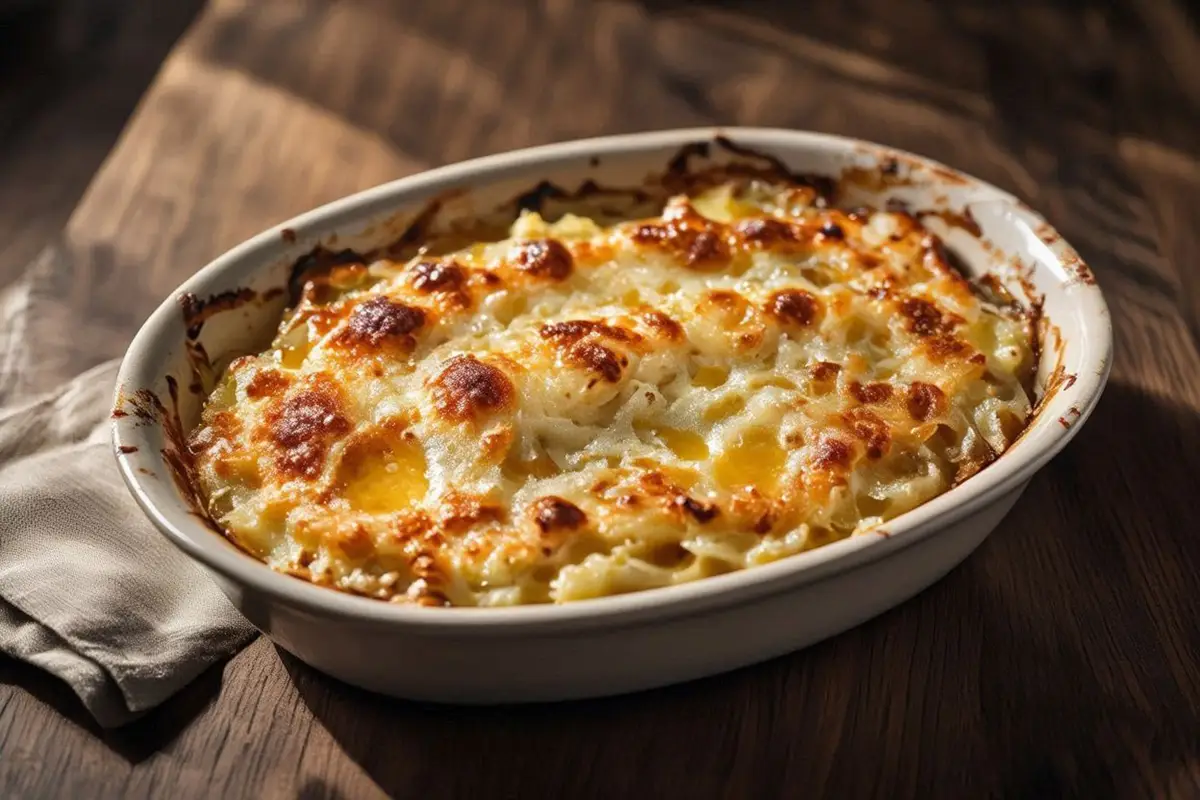
Baked Mashed Potatoes with Egg Yolks and Cheese
Silky mashed potatoes enriched with butter, egg yolks, sour cream and hard cheese, baked until golden.
Quick Summary
Baked Mashed Potatoes with Egg Yolks and Cheese is a Central European side of riced potatoes mixed with butter, egg yolks, sour cream, and grated cheese. It takes about 60 minutes, with a final bake forming a golden, velvety crust.
Historical recipe
Modernised adaptation of an early 20th‑century source. Not independently kitchen-tested by Attic Recipes. Quantities, temperatures, and food safety guidance have been updated for a contemporary kitchen — results may vary and errors may exist. Nutritional values, where provided, are estimates only and have not been laboratory tested. Always follow current food safety guidelines for your region. If you have a health condition, allergy, or dietary requirement, consult a qualified professional before preparing this recipe.
Use of this recipe is entirely at your own risk and subject to our Terms of Service and Privacy Policy. Attic Recipes accepts no liability for any adverse outcome.
- Dairy
- Eggs
Additional notes
-
Warning
Contains 4 egg yolks stirred into hot mash before baking. The yolks are partially cooked by the residual heat of the potato but do not reach full pasteurisation until the oven stage. Baking at 200°C for 10–15 minutes ensures the dish is safe for healthy adults. Not recommended for pregnant women, children under 5, elderly, or immunocompromised individuals without verifying the centre reaches 74°C (165°F).
Use pasteurised liquid egg yolks, or verify the centre of the dish reaches 74°C (165°F) using a probe thermometer before serving.
-
Warning
High saturated fat content (17g per serving) due to butter, egg yolks, sour cream, and cheese. Not suitable as an everyday dish for those on low-fat or low-cholesterol diets.
Reduce butter to 60g, substitute half the sour cream with low-fat plain yogurt, and use 30g of cheese total. The result will be lighter but will lose some of the dish's characteristic richness.
-
Note
Contains dairy (butter, sour cream, cheese) and eggs. Naturally gluten-free — no flour or starch is used in this recipe.
Dairy-free butter and plant-based sour cream can be substituted, though the flavour profile will change significantly.
- 1
Peel and wash the potatoes. Cut into even chunks and boil in well-salted water until completely tender — approximately 20–25 minutes. Drain thoroughly and return to the hot pot for 1–2 minutes over low heat to steam off any remaining moisture.
Tip Dry potatoes make a smoother, lighter mash. After draining, shake the pot over low heat until no visible steam rises from the potatoes — this 30-second step makes a real difference. - 2
Pass the hot potatoes through a potato ricer or press immediately — do not allow them to cool before mashing. Working with hot potatoes produces a smoother result and allows the butter to melt in evenly.
Tip Never use a food processor or blender for mashed potatoes — the starch granules rupture under high-speed mechanical action and the result is gluey and dense. A ricer or hand press is the correct tool. - 3
Add the 125g butter in pieces to the hot riced potatoes and mix vigorously until fully incorporated and the mash is smooth and glossy.
- 4
Add the 4 egg yolks one at a time, mixing well after each addition. Stir in the sour cream and the 50g of grated cheese. Season with salt and taste — the mash should be well seasoned at this stage.
Tip Add the yolks to the hot but not boiling mash. If the mash is still steaming vigorously, wait 2 minutes before adding the eggs to avoid scrambling them. - 5
Preheat the oven to 200°C / 390°F (conventional) or 180°C / 355°F (fan-assisted). Butter a medium ovenproof baking dish generously. Transfer the mash into the dish and smooth the top with a spatula or the back of a spoon.
- 6
Sprinkle the 30g of grated cheese evenly over the surface. Pour the melted butter over the top.
- 7
Bake for 10–15 minutes until the top is golden and the edges are beginning to crisp. The mash itself will not change — only the surface should colour. Watch carefully after 10 minutes.
Tip For a deeper golden crust, switch to the grill/broiler setting for the final 2–3 minutes. Keep the door ajar and watch constantly — cheese burns quickly under direct heat. - 8
Serve immediately from the baking dish alongside roast meats or baked dishes. The crust is at its best straight from the oven.
Nutrition Information per 1 portion (approx. 250g)
Nutritional values are approximate estimates and may vary based on specific ingredients used, preparation methods, and portion sizes.
Serving Suggestions
Serve alongside roast veal, pork, or chicken. Also excellent with baked fish, meat loaf, or stuffed vegetables. The original notes it pairs well with 'various baked dishes'. Equally good on its own with a green salad.
About This Recipe
The original cook described this dish as having “an extraordinary taste” — and on this occasion, the enthusiasm is justified. This is mashed potato taken to its logical extreme: hot riced potato folded with a substantial quantity of butter, four egg yolks, sour cream, and grated hard cheese, transferred to a buttered dish, topped with more cheese and butter, and baked until a golden crust forms over the surface. It is unapologetically rich and entirely delicious.
The technique is important. Potatoes riced hot, butter incorporated while still steaming, yolks added before the mash cools — each step serves the smoothness and richness of the final result.
Why It Works
The egg yolks do two things simultaneously: they enrich the mash with fat and emulsifying lecithin — the same compound that makes egg yolk the basis of mayonnaise and hollandaise — and they contribute to the golden colour of both the interior and the crust. The sour cream adds acidity that cuts through the richness of the butter and yolks, preventing the dish from tasting heavy despite its fat content. The baking step is brief — 10–15 minutes — and its purpose is entirely the crust: the mash itself is already cooked; the oven creates the contrast between the soft interior and the golden, slightly crispy top layer of cheese and butter.
Troubleshooting
Mash too stiff to spread: Add a splash of warm milk or a little more sour cream and mix briefly.
Surface not browning: Oven temperature may be too low or the cheese layer too thick. Switch to the grill/broiler for the final 2–3 minutes — watch constantly.
Mash gluey and dense: The potatoes were over-processed (blended or beaten at high speed) or a waxy variety was used. Always use a ricer and a floury potato variety.
A classic of early 20th century home cooking, preserved and adapted for the modern kitchen.
The Story Behind This Recipe
Historical Context
Enriched baked mashed potato — combined with egg yolks, cream, and cheese and returned to the oven — was a hallmark of the Central European bourgeois kitchen in the early 20th century. The technique of pressing the potato through a ricer rather than simply mashing it reflects the era's pursuit of textural refinement in everyday dishes. The original recipe notes that 'the purée prepared in this way has an extraordinary taste' — one of the few moments of unguarded enthusiasm in the collection.
Modern Kitchen Adaptation
Floury (high-starch) varieties — Russet, Desiree, King Edward, or Yukon Gold — are essential for a smooth, light mash. Waxy potatoes will produce a dense, gluey result regardless of technique. A potato ricer produces a demonstrably smoother result than a hand masher or electric beater and is not interchangeable with a food processor — blending hot potatoes at high speed releases the starch granules and produces a paste-like texture. Four yolks for 1kg of potatoes is a generous enrichment; the finished mash will be noticeably yellow and rich. Any firm, aged, well-salted hard cheese works — Parmesan, Grana Padano, or a good aged sheep's milk cheese. Avoid young, mild cheeses as they will not provide enough flavour.
This recipe is an independent modern adaptation developed from historical sources in the public domain. It is provided for informational and educational purposes only and does not constitute professional dietary, nutritional, or medical advice. Food preparation involves inherent risks. The reader assumes full responsibility for safe food handling, ingredient sourcing, and adherence to current local food safety guidelines. The site operator accepts no liability for outcomes resulting from the preparation or consumption of this recipe.
One recipe.
Every week.
You Might Also Like
More recipes from the same category
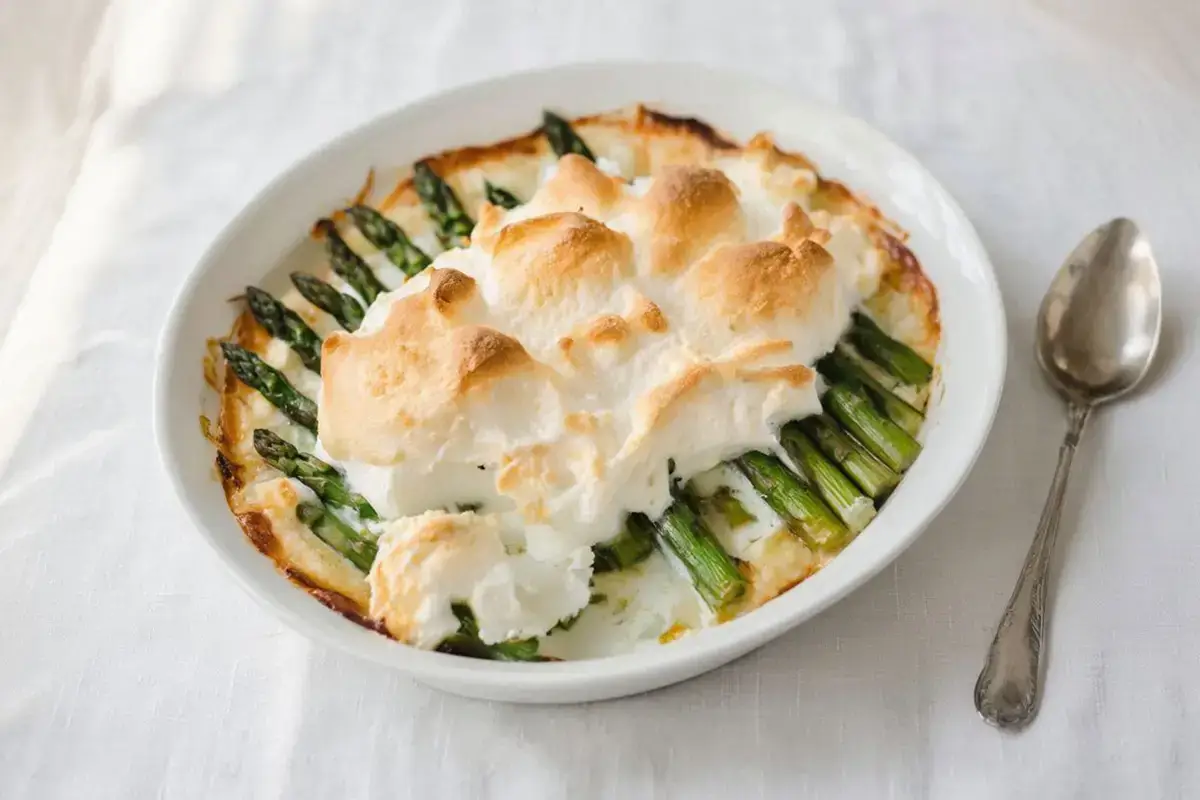
Asparagus Venetian Style
Fresh asparagus baked under a rich egg yolk cream sauce and a golden meringue-cheese topping. An elegant Central European appetizer.
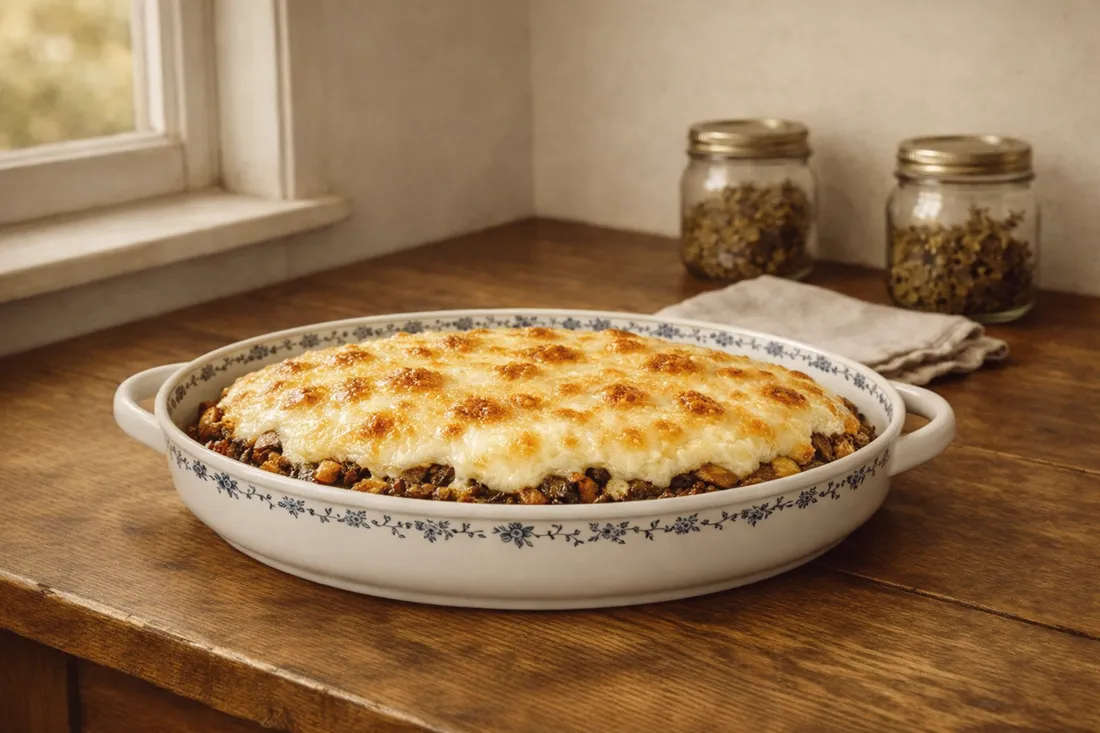
Baked Mushrooms with Hard Cheese and Eggs
Layers of sliced hard-boiled eggs and grated cheese topped with sautéed mushrooms, baked under a rich egg-enriched sour cream topping.
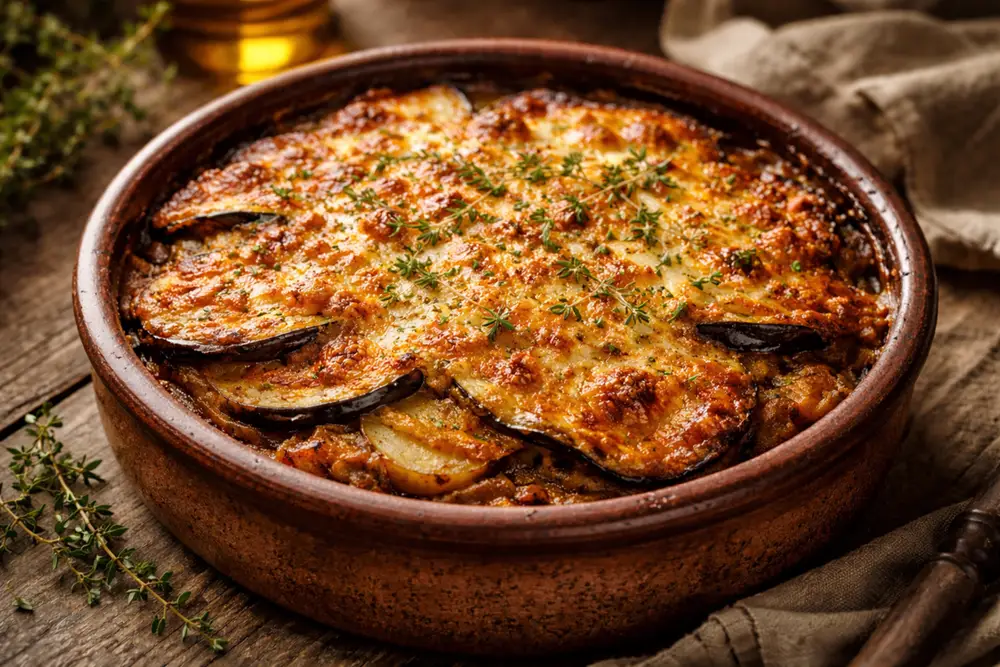
Baked Eggplant with Potatoes
A slow-baked layered casserole of eggplant, parboiled potatoes, golden fried onion, and melted cheese.