Gooseberry Marmalade
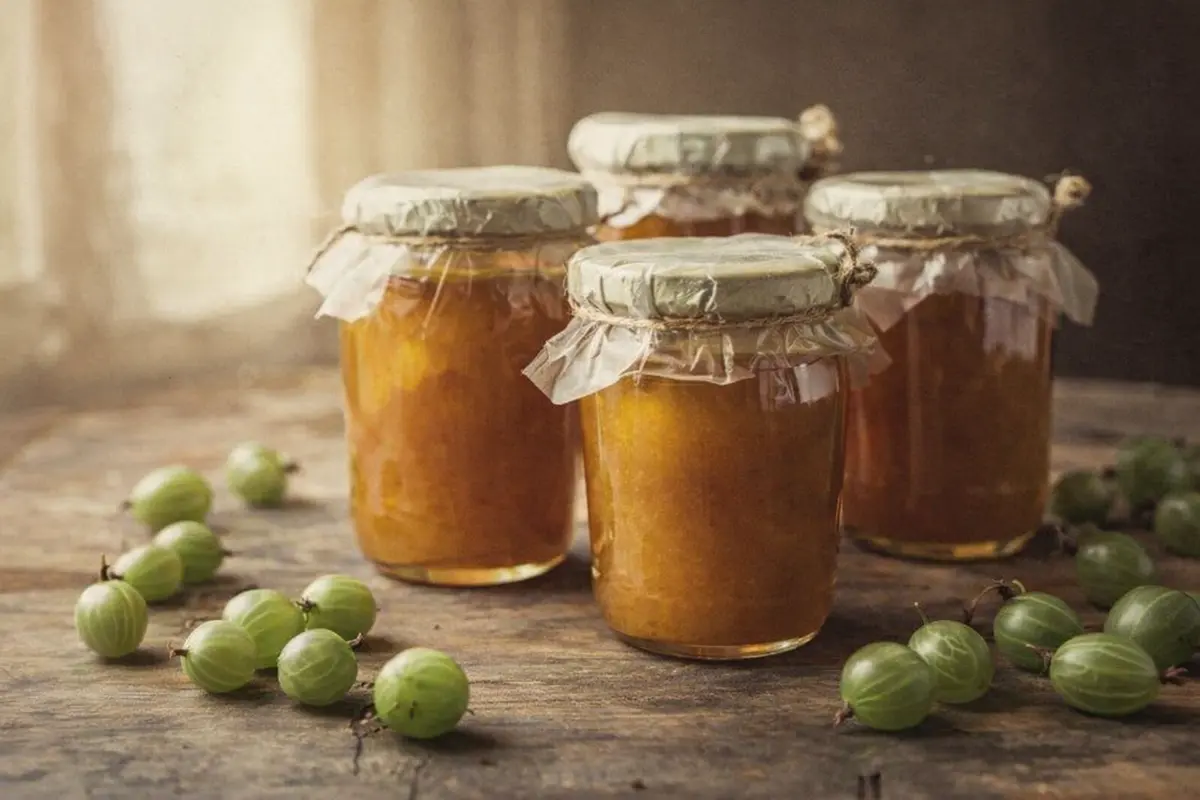
Traditional gooseberry preserve with precise two-stage cooking technique, strained for a smooth texture and perfect set.
Quick Summary
Traditional gooseberry preserve with precise two-stage cooking technique, strained for a smooth texture and perfect set.
Historical recipe
Modernised adaptation of an early 20th‑century source. Not independently kitchen-tested by Attic Recipes. Quantities, temperatures, and food safety guidance have been updated for a contemporary kitchen — results may vary and errors may exist. Nutritional values, where provided, are estimates only and have not been laboratory tested. Always follow current food safety guidelines for your region. If you have a health condition, allergy, or dietary requirement, consult a qualified professional before preparing this recipe.
Use of this recipe is entirely at your own risk and subject to our Terms of Service and Privacy Policy. Attic Recipes accepts no liability for any adverse outcome.
Safety note
The traditional oven method at 65°C does not reach the temperature required for safe long-term preservation. Processing at this temperature does not eliminate Clostridium botulinum spores or mold risk in sealed jars stored beyond 3 months.
Process sealed jars in a boiling water bath at 100°C for 10 minutes. This is the only method that guarantees shelf-stable safety for pantry storage.
Additional notes
-
Warning
Vodka rinsing alone is not sufficient for safe canning. It reduces surface bacteria but does not sterilize jars for sealed long-term storage.
Sterilize jars by boiling in water for 10 minutes before filling, then process in a water bath after sealing.
-
Caution
Contains optional rum. Omit entirely if serving to children, pregnant women, or those avoiding alcohol.
-
Note
No major EU or FALCPA allergens present as required ingredients. The optional rum contains alcohol but is not a regulated allergen. Suitable for most dietary needs including dairy-free, gluten-free, and nut-free diets.
- 1
Wash the gooseberries thoroughly under cold water. Remove all stems and any damaged berries.
- 2
Place gooseberries in a large saucepan with 125ml water. Bring to a boil over medium-high heat and cook until berries are completely soft and broken down, about 15–20 minutes.
- 3
While still hot, strain the cooked gooseberries through a fine cloth or cheesecloth-lined strainer. Press gently to extract all pulp, discarding seeds and skins.
Tip A fine mesh strainer or cheesecloth works equally well. Press firmly to extract maximum pulp. - 4
Weigh the strained pulp carefully. Calculate sugar at 600g per 1kg of pulp. For approximately 1.05–1.1kg pulp from this batch, you will need about 630–660g sugar.
- 5
Return strained pulp to a clean saucepan. Boil without sugar over medium heat, stirring frequently to prevent sticking.
- 6
Cook until the mixture thickens significantly. Test by drawing a wooden spatula across the bottom of the pan — when a clear line appears and holds for a moment, the mixture is ready for sugar. This takes about 15–20 minutes.
Tip This stage concentrates the fruit and ensures proper set. Do not skip it. - 7
Add the calculated sugar to the hot pulp. Stir constantly until completely dissolved.
- 8
Cook at a rolling boil for exactly 12 minutes, stirring constantly to prevent burning. Use a timer.
Tip Gooseberry pectin sets quickly — overcooking beyond 12 minutes produces a stiff, rubbery result. - 9
Test for doneness: place a small spoonful on a cold saucer. Tilt — if the marmalade holds its shape and does not run, it is ready. If it runs, cook for 2–3 more minutes and test again.
- 10
Sterilize jars: wash thoroughly in hot soapy water, rinse, then boil in water for 10 minutes. Remove with tongs and allow to air dry. A vodka rinse can be used additionally but does not replace boiling sterilization.
- 11
Pour hot marmalade into prepared jars, leaving 1cm headspace. If using rum, add 1 tablespoon per jar and stir gently.
- 12
For safe long-term storage: apply canning lids and process sealed jars in a boiling water bath at 100°C for 10 minutes. Remove and allow to cool completely. Do not use the traditional oven method for shelf-stable storage — see safety warnings.
- 13
Let jars cool completely at room temperature overnight without disturbing. Check seals before storing — lids should be concave and firm. Store in a cool, dark place.
- 14
Traditional cellophane sealing: once fully cooled and set, tie cellophane circles over jar tops with string. Suitable for storage up to 3 months in cool conditions only.
Nutrition Information per 1 tablespoon (20g)
Nutritional values are approximate estimates and may vary based on specific ingredients used, preparation methods, and portion sizes.
Pro Tips
- Use fully ripe gooseberries — natural pectin content is highest at full ripeness
- Do not skip the sugar-free boiling stage — it is essential for proper texture and set
- Stir constantly during the 12-minute sugar stage to prevent scorching
- The saucer test is reliable — always test before jarring
- Wait until fully cooled before applying cellophane seal — prevents condensation that can cause spoilage
- Store opened jars in the refrigerator and consume within 3 weeks
- If marmalade is too soft after setting, re-cook briefly with a little more sugar
Serving Suggestions
Spread on fresh bread, toast, or buttered croissants. Use as filling for Linzer cookies or thumbprint cookies. Pairs well with aged cheese. Swirl into plain yogurt or serve alongside roasted pork or game as a tangy accompaniment.
About This Recipe
Gooseberries are one of the few fruits with enough natural pectin to set a preserve without added pectin — but only if you treat them correctly. The two-stage cooking method here is the key: first you concentrate the fruit and drive off water, then you add sugar and cook for exactly 12 minutes. The result is a firmly set, intensely flavored marmalade that keeps well and tastes genuinely of gooseberry rather than sweetened fruit paste.
The Two-Stage Method
Most modern jam recipes add sugar from the start. This recipe does not — and the difference shows in the final texture.
Stage 1 concentrates the fruit. Cooking pulp without sugar drives off water and activates pectin before sweetness enters the equation. The white line test — drawing a spatula across the pan bottom — tells you when enough water has evaporated.
Stage 2 is timed precisely. Exactly 12 minutes at a rolling boil with sugar. Gooseberry pectin sets quickly and overcooking produces a stiff, rubbery result — the timing is worth respecting.
On the Sealing Method
The traditional cellophane-and-string seal works for short-term storage in a cool pantry, up to 3 months. For anything beyond that, use a proper boiling water bath as described in the safety notes and Step 12. The marmalade itself is identical either way — only the sealing step changes.
A classic of early 20th century home cooking, preserved and adapted for the modern kitchen.
The Story Behind This Recipe
Historical Context
This preserve reflects the meticulous two-stage cooking technique common in early 20th century Central European kitchens. Cooking the fruit first without sugar concentrates the pectin and flavor before the precise 12-minute sugar stage sets the marmalade. The horsehair sieve was a prized kitchen tool of the era that produced exceptionally smooth preserves. Sealing with cellophane the day after filling prevented condensation and extended shelf life through winter months.
Modern Kitchen Adaptation
For safe long-term storage, use proper canning lids and process sealed jars in a boiling water bath for 10 minutes. The traditional cellophane method works for shorter storage in cool conditions but is not recommended beyond 3 months. Red or white currants make an excellent substitute if gooseberries are unavailable — similar tartness and natural pectin content.
This recipe is an independent modern adaptation developed from historical sources in the public domain. It is provided for informational and educational purposes only and does not constitute professional dietary, nutritional, or medical advice. Food preparation involves inherent risks. The reader assumes full responsibility for safe food handling, ingredient sourcing, and adherence to current local food safety guidelines. The site operator accepts no liability for outcomes resulting from the preparation or consumption of this recipe.
One recipe.
Every week.
You Might Also Like
More recipes from the same category
Apricot Fruit Paste
Sieved ripe apricots cooked with equal weight sugar and lemon juice, poured into molds and air-dried — from early 20th century Central European kitchens.
Whipped Apricot or Peach Preserve (No-Cook)
A silky, pale fruit spread made by whipping raw apricot or peach puree with sugar - no cooking required.
Blackberry and Cornelian Cherry Marmalade
Rich preserve combining tart cornelian cherries with sweet blackberries, cooked to thick consistency with a traditional two-fruit method.