Grapes in Brandy
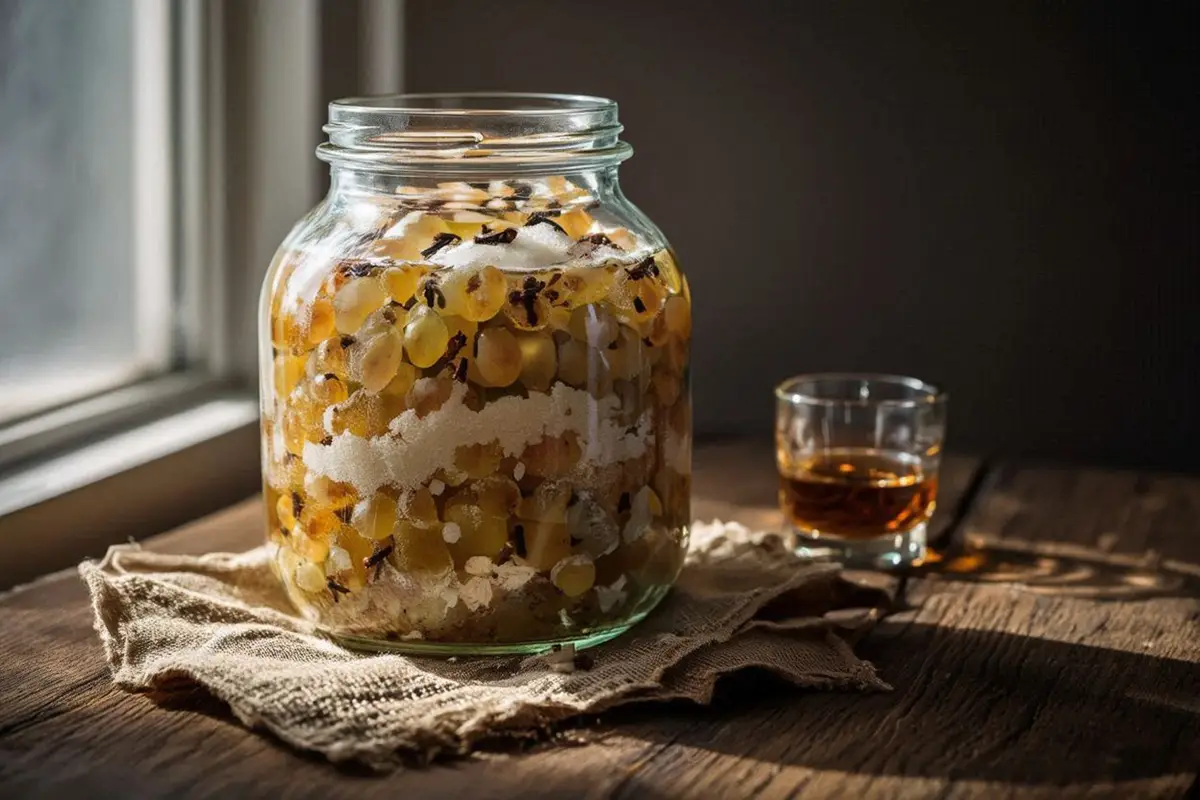
Grape clusters layered with sugar, cloves, and vanilla, covered in bitter brandy and left 6 weeks — Central European winter preserve and homemade liqueur.
Quick Summary
Grape clusters layered with sugar, cloves, and vanilla, covered in bitter brandy and left 6 weeks — Central European winter preserve and homemade liqueur.
Historical recipe
Modernised adaptation of an early 20th‑century source. Not independently kitchen-tested by Attic Recipes. Quantities, temperatures, and food safety guidance have been updated for a contemporary kitchen — results may vary and errors may exist. Nutritional values, where provided, are estimates only and have not been laboratory tested. Always follow current food safety guidelines for your region. If you have a health condition, allergy, or dietary requirement, consult a qualified professional before preparing this recipe.
Use of this recipe is entirely at your own risk and subject to our Terms of Service and Privacy Policy. Attic Recipes accepts no liability for any adverse outcome.
- Sulphites
Safety note
This preserve is not heat-processed and relies entirely on alcohol concentration for preservation. Use brandy of at least 40% ABV — lower-proof spirits will not adequately preserve the fruit.
Use loza, grappa, or any dry unsweetened fruit brandy at 40% ABV or higher.
Safety note
Ensure grapes are completely dry before jarring. Surface water dilutes the brandy and may introduce spoilage organisms.
Drain in a sieve and pat dry with a clean cloth before layering.
Safety note
If mold appears on the surface during the 6-week maceration, the jar has been compromised — discard without tasting.
Additional notes
-
Warning
This preserve has significant alcohol content. Not suitable for children or those avoiding alcohol. The drained brandy syrup is a strong liqueur — serve in small quantities.
- 1
Wash the grapes in two changes of cold water. Place in a sieve and drain completely — no surface water should remain before jarring. Pat dry with a clean cloth if needed.
- 2
Break the large bunches into small clusters of 3–4 berries each, keeping the stalks attached. Do not remove individual berries from their stems.
- 3
Place a layer of grape clusters in the bottom of a clean 3-liter glass jar. Sprinkle a 1 cm layer of finely ground sugar over the grapes. Add 2 whole cloves to the sugar layer. Repeat — grapes, sugar, 2 cloves — until the jar is nearly full.
- 4
For the top layer: mix a portion of fine sugar with the crushed vanilla pod. Spread this vanilla sugar over the final grape layer to a depth of approximately 3–4 cm.
- 5
Pour bitter brandy slowly over the layered jar until the brandy reaches the top and covers everything completely.
- 6
Seal the jar tightly with a hermetic lid or parchment paper tied firmly with string.
- 7
Store in a cool, dark, undisturbed place for exactly 6 weeks. Do not open or shake the jar during this period.
- 8
After 6 weeks, drain the liquid through a fine sieve. The grapes and the brandy syrup are both worth keeping — serve separately or together.
Nutrition Information per 100g grapes with brandy syrup
Nutritional values are approximate estimates and may vary based on specific ingredients used, preparation methods, and portion sizes.
Pro Tips
- Use a brandy you would drink — quality of the spirit is quality of the finished preserve.
- Ensure grapes are completely dry before jarring. Surface water dilutes the brandy and may introduce spoilage.
- Do not disturb the jar during the first weeks of maceration — the sugar layers are still dissolving and shifting the jar can bruise the fruit.
- White and black grapes make beautiful companion jars — the black version produces a deep ruby liqueur with a slightly different flavor profile.
- The drained brandy syrup keeps indefinitely sealed in a bottle at room temperature.
Serving Suggestions
The grapes served cold as a dessert — alone, with thick cream, or over vanilla ice cream. On a cheese board alongside strong aged cheeses. Spooned over chocolate cake or panna cotta. The drained brandy syrup served as a digestif in small glasses, or used as a cocktail ingredient stirred into sparkling wine.
About This Recipe
Six weeks of waiting is built into this recipe. You layer the grapes and sugar and cloves, pour the brandy over everything, seal the jar, and then you leave it alone — in a cool dark place, untouched, while something slow and irreversible happens inside. What happens is maceration: the brandy penetrates the grape skin, the sugar dissolves into the growing liquid, the cloves and vanilla release their aromatics gradually. After six weeks, the jar holds two things — grapes that have absorbed brandy and spice, and a liquid that has absorbed grape, sugar, vanilla, and clove. Both are worth having.
Why It Works
The layering of sugar between the fruit rather than dissolving it into a syrup first is deliberate. Sugar dissolves slowly as the brandy penetrates and the grape juice releases, creating a gradual, even maceration that preserves the fruit’s shape while building complexity in the liquid. The bitter, dry brandy provides the preservation, the aromatic extraction, and the edge; the sugar in the layers provides all the sweetness. A sweet or flavored brandy would unbalance this — the dryness of loza or grappa is structural, not incidental.
Bitter Brandy
The recipe specifies bitter brandy — in Serbian, gorka loza: a dry, unsweetened grape brandy. Use a brandy you would drink. The quality of the spirit is the quality of the finished preserve.
Black Grapes
Black grapes can be used in exactly the same way, with one difference: the brandy will be red. The anthocyanin pigments in dark grape skins leach slowly into the surrounding liquid over six weeks, producing a brandy syrup of deep, translucent ruby — visually dramatic and with a slightly different flavor profile. White and black versions make beautiful companion jars.
After Six Weeks
Drain the jar through a fine sieve. The grapes go one way, the liquid another. The grapes — softened and brandy-saturated — are a dessert in themselves. The liquid is a liqueur: pour it into a clean bottle, seal it, and serve it in small glasses after dinner. It keeps indefinitely.
Layer it in autumn. Open it in winter. Both halves of the jar are worth the wait.
The Story Behind This Recipe
Historical Context
Fruit macerated in brandy is one of the oldest and most widespread preservation traditions in Central European wine-growing regions — a method requiring no cooking, no heat processing, and no equipment beyond a jar and patience. Grape brandy was the natural choice where viticulture was dominant and spirits were abundant and inexpensive. The layering of sugar between the fruit rather than dissolving it into a syrup first is deliberate: the sugar dissolves slowly as the brandy penetrates and the grape juice releases, creating a gradual, even maceration that preserves the fruit's shape while building a complex flavored liquid. Black grapes produce a dramatically different result — the anthocyanin pigments leach into the brandy over six weeks, turning it a deep ruby red and producing what is effectively a homemade grape liqueur.
Modern Kitchen Adaptation
Bitter brandy (loza, grappa, or any dry unsweetened fruit brandy) at minimum 40% ABV is essential — a sweet or flavored brandy will make the finished preserve cloying, and lower-proof spirits will not adequately preserve the fruit. The sugar quantity is intentionally approximate — the 1 cm layers are a visual measure. Approximately 500–600g total for a 3-liter jar is a reasonable estimate. After draining at 6 weeks, bottle the flavored brandy syrup separately — it keeps indefinitely at room temperature due to its alcohol content and functions as a digestif or cocktail ingredient.
This recipe is an independent modern adaptation developed from historical sources in the public domain. It is provided for informational and educational purposes only and does not constitute professional dietary, nutritional, or medical advice. Food preparation involves inherent risks. The reader assumes full responsibility for safe food handling, ingredient sourcing, and adherence to current local food safety guidelines. The site operator accepts no liability for outcomes resulting from the preparation or consumption of this recipe.
One recipe.
Every week.
You Might Also Like
More recipes from the same category
Apricot Fruit Paste
Sieved ripe apricots cooked with equal weight sugar and lemon juice, poured into molds and air-dried — from early 20th century Central European kitchens.
Whipped Apricot or Peach Preserve (No-Cook)
A silky, pale fruit spread made by whipping raw apricot or peach puree with sugar - no cooking required.
Blackberry and Cornelian Cherry Marmalade
Rich preserve combining tart cornelian cherries with sweet blackberries, cooked to thick consistency with a traditional two-fruit method.