Baked Ham Omelette Roll
A soufflé-style baked omelette rolled around a rich ham and bacon filling, finished with a sour cream and cheese sauce. An elaborate Central European classic.

Quick Summary
A soufflé-style baked omelette rolled around a rich ham and bacon filling, finished with a sour cream and cheese sauce. An elaborate Central European classic.
Historical recipe
Modernised adaptation of an early 20th‑century source. Not independently kitchen-tested by Attic Recipes. Quantities, temperatures, and food safety guidance have been updated for a contemporary kitchen — results may vary and errors may exist. Nutritional values, where provided, are estimates only and have not been laboratory tested. Always follow current food safety guidelines for your region. If you have a health condition, allergy, or dietary requirement, consult a qualified professional before preparing this recipe.
Use of this recipe is entirely at your own risk and subject to our Terms of Service and Privacy Policy. Attic Recipes accepts no liability for any adverse outcome.
- Dairy
- Eggs
- Gluten
Additional notes
-
Warning
The sauce contains egg yolks that must reach 74°C (165°F) before serving — use a kitchen thermometer to verify. Do not serve to pregnant women, children under 5, elderly individuals, or immunocompromised persons unless temperature is confirmed.
Use pasteurized eggs throughout if serving to vulnerable groups. Verify sauce temperature with an instant-read thermometer before pouring over the roll.
-
Warning
The filling contains whole eggs cooked in the pan. Ensure the eggs are fully set with no liquid remaining before removing from heat — the filling will be briefly reheated in the final 5-minute oven bake but this alone is not sufficient to guarantee safe internal temperature.
Cook the filling until fully firm and no liquid egg is visible. Use pasteurized eggs if serving to vulnerable groups.
-
Caution
This is a high-sodium dish due to the combination of smoked bacon, cooked ham, and cheese. A single serving may contain a significant portion of the daily recommended sodium intake.
Use low-sodium ham and reduce or omit the added salt. Taste before seasoning — bacon and ham contribute considerable salt on their own.
-
Note
Contains dairy (milk, butter, sour cream, cheese), eggs, and gluten (flour). Not suitable for those with relevant allergies or intolerances.
- 1
Make the omelette base: Whisk the flour and milk together in a saucepan, adding the milk gradually while stirring constantly to avoid lumps. Place on the stove over medium heat and cook, stirring constantly, until the mixture thickens into a smooth, heavy cream. Remove from heat.
Tip Keep stirring even off the heat for the first minute — the residual heat continues to cook the mixture. It should be thick enough to hold a spoon upright briefly. - 2
Transfer the thickened mixture to a bowl and stir continuously on the counter until it cools to room temperature. This is important — adding egg yolks to a hot mixture will cook them.
Tip Speed up cooling by setting the bowl over a larger bowl of cold water and stirring. - 3
Preheat the oven to 180°C / 160°C fan (350°F). Grease a large, rimmed baking tray or shallow baking dish generously with butter and dust with flour, tapping out any excess.
- 4
Once the base mixture has cooled, add the salt and egg yolks one at a time, mixing well after each addition.
- 5
In a separate clean bowl, beat the egg whites to stiff peaks. Fold them into the yolk and flour mixture in three additions, using a large spatula and a gentle folding motion. Work carefully — the beaten whites are what give the omelette its height.
Tip Do not stir or whisk after the whites are added. Fold in wide, slow arcs from the bottom of the bowl upward. Some white streaks remaining is fine. - 6
Pour the mixture onto the prepared tray and spread evenly to a uniform thickness of about 1.5 to 2 cm. Bake at 180°C / 160°C fan for 15 to 18 minutes, until set, lightly golden, and springy to the touch. It should not be brown or crisp.
Tip Check at 15 minutes. The omelette must remain pliable enough to roll without cracking — do not overbake. - 7
While the omelette bakes, prepare the filling: fry the diced bacon in a pan over medium heat until the fat begins to render. Add the chopped ham and sour cream. Break the 3 eggs directly into the pan and cook everything together, stirring, until the eggs are fully set and the mixture is firm throughout. Remove from heat.
Tip The filling must be fully cooked — not just set on the surface. Press gently with a spatula; no liquid egg should run. It firms up slightly more as it cools. - 8
When the omelette is baked, immediately turn it out onto a clean, dry kitchen towel laid flat on the counter. Work quickly — it is much easier to roll while warm and flexible.
- 9
Spread the filling evenly over the surface of the omelette, leaving a 2 cm border at the far edge. Using the towel to help, roll the omelette firmly into a log shape. Transfer seam-side down to a baking dish or tray.
Tip Roll firmly but without forcing — if you feel resistance, stop and ease the roll gently. A crack at the surface is not a disaster; the sauce will cover it. - 10
Make the sauce: melt the butter in a small saucepan over medium heat. Add the flour and stir for 1 minute to cook out the raw flour taste. Add the sour cream and grated cheese, stirring constantly. Remove from heat, add the egg yolks and salt, and stir vigorously to combine. Return to low heat and cook, stirring, until the sauce reaches 74°C (165°F) on a kitchen thermometer — it will thicken slightly and just begin to bubble at the edges. Do not boil.
Tip Add the egg yolks off the heat first, stir vigorously, then return to the lowest possible heat. Direct high heat after adding yolks will scramble them. Use a thermometer — the sauce must reach 74°C to be safe for all guests. - 11
Cut the omelette roll into equal slices while still in the baking dish — this prevents it from unrolling during the final bake. Pour the sauce evenly over the slices. Place in the oven at 200°C / 180°C fan (400°F) for exactly 5 minutes. Serve immediately.
Nutrition Information per approx. 250g
Nutritional values are approximate estimates and may vary based on specific ingredients used, preparation methods, and portion sizes.
Serving Suggestions
Serve immediately from the oven, directly from the baking dish. This is a complete main course — a light green salad alongside is all it needs. Also works well as a substantial brunch centerpiece. A dry white wine or light red complements the ham and cheese.
About This Recipe
This is not a weekday omelette. It is a three-part construction — a soufflé-style baked base, a rich filling of fried bacon, ham, and egg, and a sour cream and cheese sauce — assembled into a roll, sliced, sauced, and returned to the oven for a final five minutes. The result is something between a soufflé roulade and a savory Swiss roll: light and airy from the outside, rich and savory within, finished with a glossy, just-set sauce.
It demands attention and timing, but it is exactly the kind of dish that earns its place at a formal family lunch.
Why It Works
The flour-thickened milk base is the structural element that makes this omelette rollable. Plain beaten eggs would set too firm and crack. The thickened base stays pliable even after baking, flexible enough to roll around a filling without splitting — provided it is not overbaked. The beaten egg whites fold into this base and expand in the oven, giving the sheet its height and lightness.
The three-component structure is also practical: each element can be prepared at its own pace, and the final assembly takes only minutes. The original recipe notes this explicitly — the filling is most conveniently made while the omelette bakes.
On the Temperature Question
The original recipe gives no oven temperatures. In early 20th century home kitchens, wood-fired ranges had no thermostats — cooks judged heat by experience: holding a hand near the open oven door, watching how quickly a dusting of flour browned on the floor of the oven, or simply knowing their stove. This was a genuine skill, developed over years, and entirely normal for the era.
The temperatures given here — 180°C for the omelette base, 200°C for the final five-minute bake — are modern reconstructions. They achieve what the original described: a set, pliable omelette sheet and a briefly gratinéed sauce finish. A cook working a wood fire a century ago would have arrived at the same results by feel alone.
Timing Guide
This dish has several moving parts. Here is a practical order of operations:
- Make and cool the omelette base — 20 minutes including cooling
- Preheat oven, prepare tray — 10 minutes
- Bake the omelette base — 15 to 18 minutes
- Make the filling while the omelette bakes — 10 minutes
- Roll, fill, and slice — 5 minutes
- Make the sauce — 5 minutes
- Final bake — 5 minutes
- Serve immediately
Total active time from start to table: approximately 75 to 80 minutes.
Troubleshooting
Omelette cracks when rolling: It was overbaked. The surface should be set and springy but not dry or brown. Roll while still warm — a cool omelette is much more likely to crack.
Filling too wet: The eggs were not cooked long enough, or too much sour cream was added. Cook until the mixture visibly thickens and no liquid egg remains before removing from heat.
Sauce scrambles: The egg yolks were added while the sauce was too hot, or the heat was too high after adding them. Add yolks off the heat, stir vigorously, then return to the lowest possible heat setting for just long enough to reach 74°C.
Roll unravels in the final bake: Slice the roll before adding the sauce — the slices hold each other in place. Place seam-side down.
A classic of early 20th century home cooking, preserved and adapted for the modern kitchen.
The Story Behind This Recipe
Historical Context
This style of baked, rolled omelette — built on a thickened milk and flour base rather than simply beaten eggs — reflects the strong French culinary influence on Central European bourgeois cooking in the late 19th and early 20th centuries. The technique of folding beaten egg whites into a flour-thickened base to create a light, bakeable sheet is closely related to the French soufflé and roulade tradition, adapted here for home kitchen use with locally available ingredients. Dishes of this complexity were associated with formal family lunches and festive occasions rather than everyday cooking.
Modern Kitchen Adaptation
The original recipe gives no oven temperatures — none were possible to specify. Early 20th century kitchens used wood-fired ranges without thermostats, and experienced cooks judged temperature by holding a hand near the open door, or by tossing a pinch of flour inside to watch how quickly it browned. This skill — reading a fire — was fundamental to the cooking of the era and is now entirely lost. The temperatures given here (180°C for the omelette base, 200°C for the final bake) are modern reconstructions that achieve the described results reliably. The original cook would have managed the same outcomes by feel and experience alone. Lard is the historically correct fat for greasing; butter is used here as a modern equivalent.
This recipe is an independent modern adaptation developed from historical sources in the public domain. It is provided for informational and educational purposes only and does not constitute professional dietary, nutritional, or medical advice. Food preparation involves inherent risks. The reader assumes full responsibility for safe food handling, ingredient sourcing, and adherence to current local food safety guidelines. The site operator accepts no liability for outcomes resulting from the preparation or consumption of this recipe.
One recipe.
Every week.
You Might Also Like
More recipes from the same category
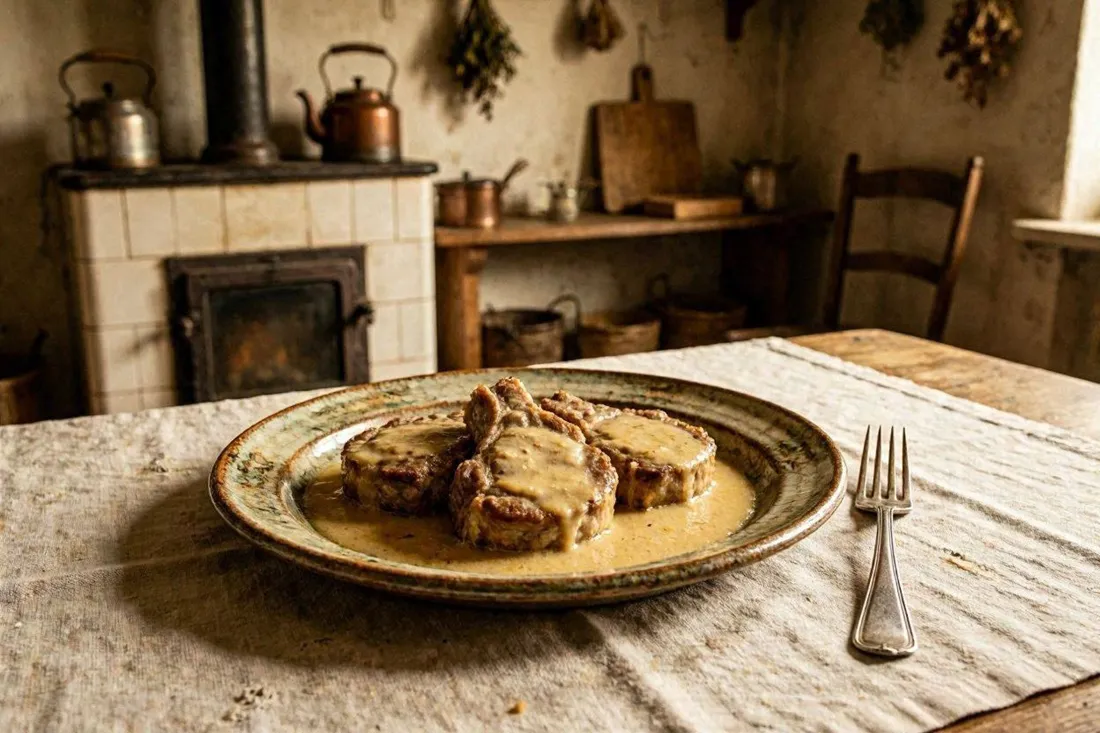
Braised Pork Chops in White Wine and Sour Cream Sauce
Pork loin chops braised with onion, carrot, parsley root, and celery root in white wine, then finished with a strained sour cream sauce.
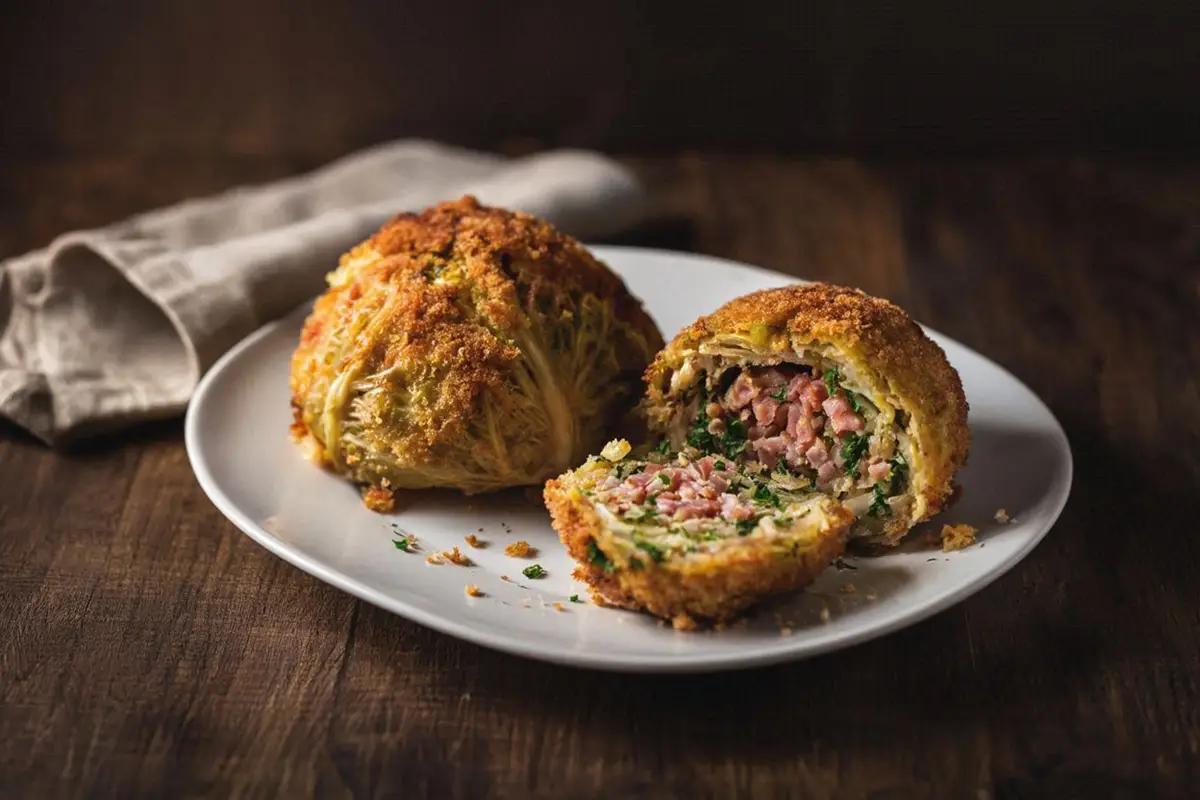
Breaded Savoy Cabbage Stuffed with Ham
Tender young savoy cabbage heads filled with ground ham, fried onion, and herbs, breaded and pan-fried until golden. A hearty Central European classic.
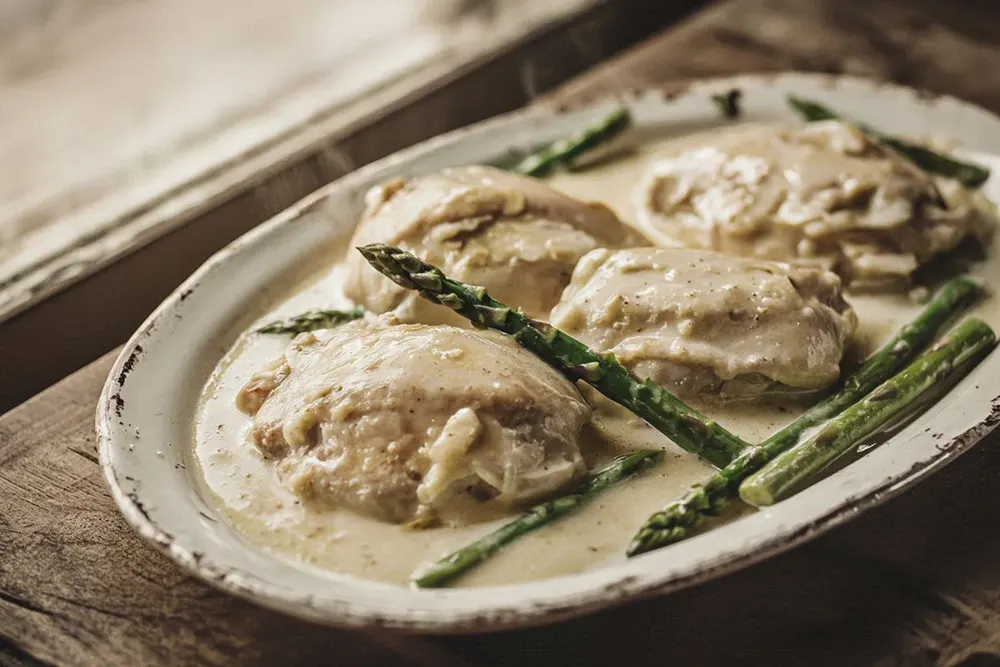
Chicken in Asparagus Sauce
A whole chicken poached in spiced broth, then finished in a silky velouté enriched with egg yolks and cream, garnished with tender asparagus tips.