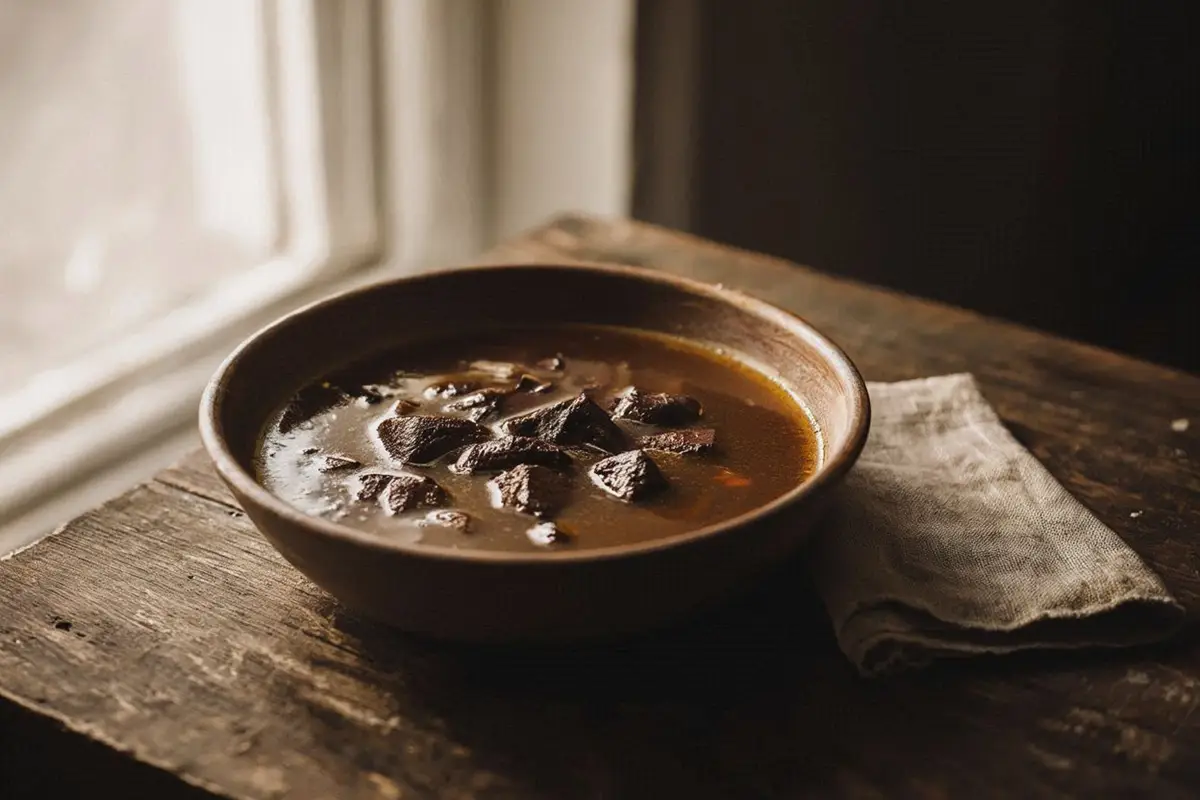
Hunter's Soup — Slow-Braised Game with Bacon, Ham, and White Wine
A rich Central European hunter's soup of slow-braised venison, roe deer, or rabbit neck with smoked bacon, ham, and white wine. Three hours of deep flavor.
Quick Summary
A rich Central European hunter's soup of slow-braised venison, roe deer, or rabbit neck with smoked bacon, ham, and white wine. Three hours of deep flavor.
Historical recipe
Modernised adaptation of an early 20th‑century source. Not independently kitchen-tested by Attic Recipes. Quantities, temperatures, and food safety guidance have been updated for a contemporary kitchen — results may vary and errors may exist. Nutritional values, where provided, are estimates only and have not been laboratory tested. Always follow current food safety guidelines for your region. If you have a health condition, allergy, or dietary requirement, consult a qualified professional before preparing this recipe.
Use of this recipe is entirely at your own risk and subject to our Terms of Service and Privacy Policy. Attic Recipes accepts no liability for any adverse outcome.
- Dairy
- Gluten
- Sulphites
Safety note
Chronic Wasting Disease (CWD): In North America, wild deer and elk can carry CWD, a fatal prion disease with no known treatment. The CDC advises against consuming meat from CWD-positive animals. CWD has not been detected in European deer populations. US and Canadian readers using wild-hunted venison should verify the animal was harvested outside endemic areas, or have it tested before consumption.
US readers: use farm-raised, USDA-inspected venison to eliminate CWD risk entirely.
Safety note
Tularemia (rabbit fever): Wild rabbits can carry Francisella tularensis, a serious bacterial infection. Always cook rabbit to an internal temperature of 74°C (165°F) throughout. Wear gloves when handling raw wild rabbit — the bacteria can enter through skin cuts or abrasions.
Farm-raised rabbit carries no tularemia risk. A meat thermometer is essential when using wild rabbit.
Additional notes
-
Warning
Lead shot contamination: Wild-hunted game shot with lead ammunition may contain lead fragments near the wound channel. Lead is toxic with no safe exposure level. Children, pregnant women, and those planning pregnancy should avoid wild-hunted game shot with lead ammunition.
Farm-raised game contains no lead shot risk. For wild game, request non-lead (copper) ammunition from the hunter, or trim a wide margin around any visible wound channel.
-
Warning
Contains alcohol (white wine). The brief final boil retains approximately 40–45% of original alcohol. Not suitable for children or those avoiding alcohol.
Replace wine with an equal amount of unsalted game or chicken stock with a squeeze of lemon juice.
-
Warning
Elevated sodium: smoked bacon, cooked ham, and seasoned broth combined can bring this soup close to or above 800mg sodium per serving. Those with hypertension, kidney disease, or on sodium-restricted diets should use lower-sodium alternatives and season carefully at the end.
Reduce bacon to 50g, use low-sodium ham, and season only after tasting.
-
Caution
Contains gluten (flour in the roux). Not suitable for those with celiac disease or gluten sensitivity.
Replace flour with a cornstarch slurry — 2 tbsp cornstarch dissolved in 3 tbsp cold water, whisked into the simmering broth.
- 1
Brown the meat: Heat the lard in a large heavy pot over medium-high heat. Add the game meat pieces and brown well on all sides — work in batches if necessary. Do not crowd the pot. This deep browning is the foundation of the soup's color and flavor.
Tip Neck meat has significant connective tissue and bone — it needs a hard sear to develop flavor. Do not skip or rush it. - 2
Add bacon and onions: Add the diced bacon, chopped green onions, and red onions to the browned meat. Stir and cook until the onions are half-softened and the bacon has rendered some of its fat.
- 3
Add ham and develop color: Add the chopped ham, ground pepper, and a pinch of salt. Stir to combine. Continue stewing over medium heat, adding small splashes of water to prevent sticking, until the meat and onions turn a deep golden-brown — this can take 20–30 minutes. Do not rush this stage.
Tip The original recipe is specific: cook until the meat 'turns yellow' (golden brown). This caramelization is what gives the finished soup its dark amber color and depth. It cannot be replicated after water is added. - 4
Slow simmer: Pour over 3 liters of cold water. Bring to a boil, skimming any foam. Reduce to the lowest possible simmer, cover partially, and cook for 3 hours until the meat is completely tender and falling from the bone.
Tip Game neck is tough and full of collagen. The 3-hour simmer is not negotiable — the collagen slowly converts to gelatin, giving the broth its natural body and richness. - 5
Remove and prepare the meat: Using tongs, remove all the meat from the broth. Allow to cool slightly, then pick the meat from the bones. Cut into sugar-cube-sized pieces. Set aside.
- 6
Strain the broth: Pour the broth through a fine sieve into a clean pot, discarding all solids. Return the clear broth to medium heat.
- 7
Make the roux: In a small saucepan, melt the butter over medium heat. Add the flour and stir constantly for 2–3 minutes until the roux is smooth and golden. Whisk into the strained broth and simmer for 5 minutes to thicken slightly.
- 8
Combine: Return the cubed meat to the thickened broth. Stir well and bring back to a gentle simmer.
- 9
Finish with wine: Pour in the white wine. Bring the soup to a full boil one final time and cook for 2–3 minutes. Taste and adjust salt.
Tip Wine goes in last — this preserves its brightness. Cooking it longer would drive off the acidity and leave bitterness. - 10
Serve in deep warmed bowls with crusty dark bread.
Nutrition Information per 1 portion (approx. 400ml broth + meat)
Nutritional values are approximate estimates and may vary based on specific ingredients used, preparation methods, and portion sizes.
Serving Suggestions
Serve in deep bowls with the cubed meat distributed evenly through the broth. Dark rye bread or crusty sourdough alongside. The soup is complete as written — no garnish needed. A small glass of the same dry white wine used in cooking is the natural table accompaniment.
About This Recipe
Lovačka čorba — hunter’s soup — is the dish that turns a hunting trip into a meal worth remembering. The neck is the cut nobody fights over at the butcher, and that is precisely why it ends up in this pot. Three hours of gentle simmering with smoked bacon, cured ham, and onions transforms its collagen-rich toughness into something extraordinary: a dark, gelatinous broth that coats the spoon, and meat so tender it yields to the slightest pressure. A glass of white wine at the very end brings everything into focus.
Why It Works
The entire character of this soup is built in the first 30 minutes, before any water is added. The browning of the meat, the rendering of the bacon, the caramelization of the onions — this is where the dark amber color and complex base flavor come from. The Maillard reaction compounds formed during this stage dissolve slowly into the broth over three hours and cannot be replicated after the fact. A pale sear produces a pale soup, no matter how long it simmers.
The neck is the right cut for the same reason oxtail makes better broth than fillet: abundant collagen that converts to gelatin during the long braise, giving the finished soup its natural body and the meat its silky texture. The roux added at the end is a refinement, not a structural necessity.
Sourcing Game Meat
United Kingdom: Specialist suppliers source and sell venison, rabbit, and other game from farms and estates, delivering to your door. The Wild Meat Company, Fine Food Specialist, and Salter & King all offer seasonal game during October to March, with farmed venison available year-round.
United States: Farm-raised venison is available online, USDA-inspected, and free of antibiotics and hormones. Farm-raised rabbit is also available online year-round from specialist suppliers. Wild-hunted game cannot legally be sold commercially in the US.
Europe: Game is available at specialist butchers and farmers’ markets throughout the season across Central and Eastern Europe. Farmed rabbit is widely available year-round in standard supermarkets.
The Rabbit Neck Question
Rabbit neck is a very small cut — each rabbit yields perhaps 150–200g from the neck alone. In practice, this recipe uses the whole rabbit cut into pieces, with priority given to the bony, collagen-rich portions. For rabbit, plan on 2–3 whole rabbits to reach the 2kg mark. Farmed rabbit is plumper and more tender than wild, and is sourced from specialist suppliers year-round.
Troubleshooting
Broth too pale? The meat was not browned deeply enough at step 1. There is no remedy after the fact — color is built in the first 30 minutes, not during the simmer.
Meat still tough after 3 hours? Keep going. Wild roe deer from an older animal can need 3.5–4 hours at a very gentle simmer. Farm-raised venison typically needs the full 3 hours but rarely more.
Soup too thin after roux? Make a second small roux batch and whisk in gradually until the desired consistency is reached.
A classic of early 20th century home cooking, preserved and adapted for the modern kitchen.
The Story Behind This Recipe
Historical Context
Hunter's soup was a practical solution to a specific problem: what to do with the neck, ribs, and lesser cuts of a freshly hunted animal when the premium cuts went to roasting. Neck meat from roe deer, deer, and rabbit is rich in collagen and connective tissue — unsuitable for quick cooking but ideal for the long braise that defines this dish. The combination of smoked bacon, cured ham, green onions, and game reflects the Central European hunting tradition of cooking in the field with preserved provisions alongside fresh kill. The white wine added at the very end is a refinement that elevates a rustic field preparation into something suitable for a proper table.
Modern Kitchen Adaptation
Roe deer and wild deer neck can be sourced from specialist game butchers in the UK and EU during game season, typically October to March. In the United States, commercially sold venison must be farm-raised and USDA-inspected — wild-hunted venison cannot legally be sold commercially, but farm-raised venison and rabbit are available year-round online. If game is unavailable, bone-in lamb neck (2 kg) makes an excellent substitute — the flavor is less wild but the technique is identical. Lard is the historically correct fat for browning; neutral oil is a suitable modern alternative.
This recipe is an independent modern adaptation developed from historical sources in the public domain. It is provided for informational and educational purposes only and does not constitute professional dietary, nutritional, or medical advice. Food preparation involves inherent risks. The reader assumes full responsibility for safe food handling, ingredient sourcing, and adherence to current local food safety guidelines. The site operator accepts no liability for outcomes resulting from the preparation or consumption of this recipe.
One recipe.
Every week.
You Might Also Like
More recipes from the same category
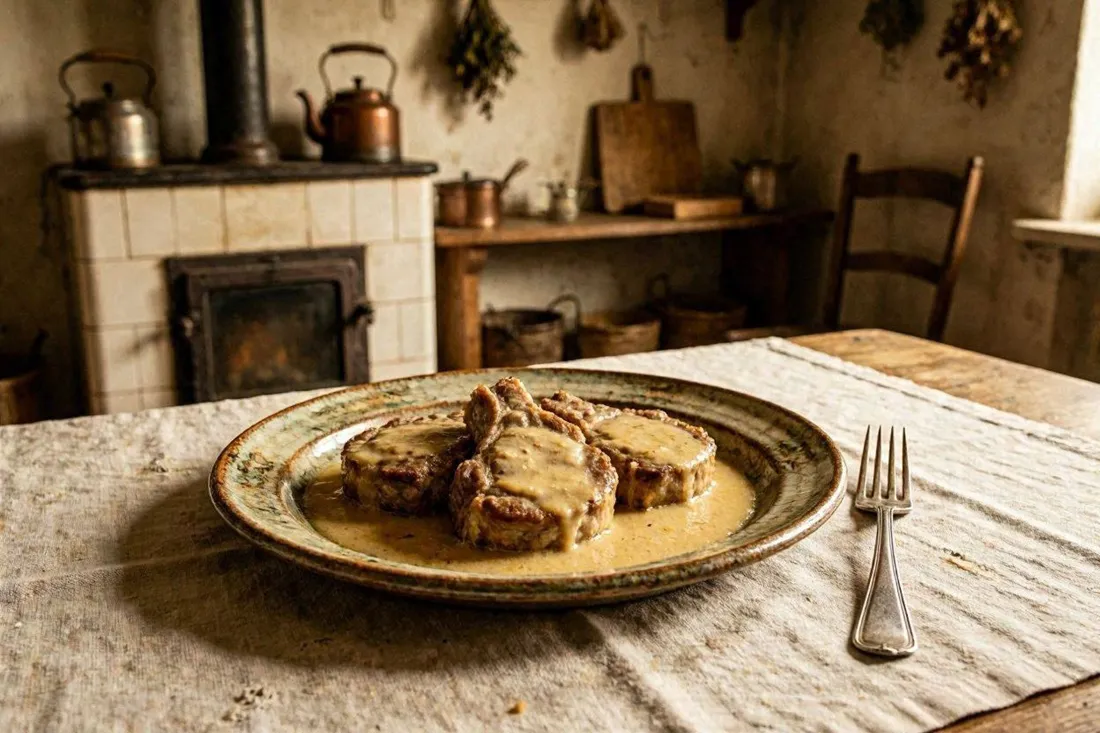
Braised Pork Chops in White Wine and Sour Cream Sauce
Pork loin chops braised with onion, carrot, parsley root, and celery root in white wine, then finished with a strained sour cream sauce.
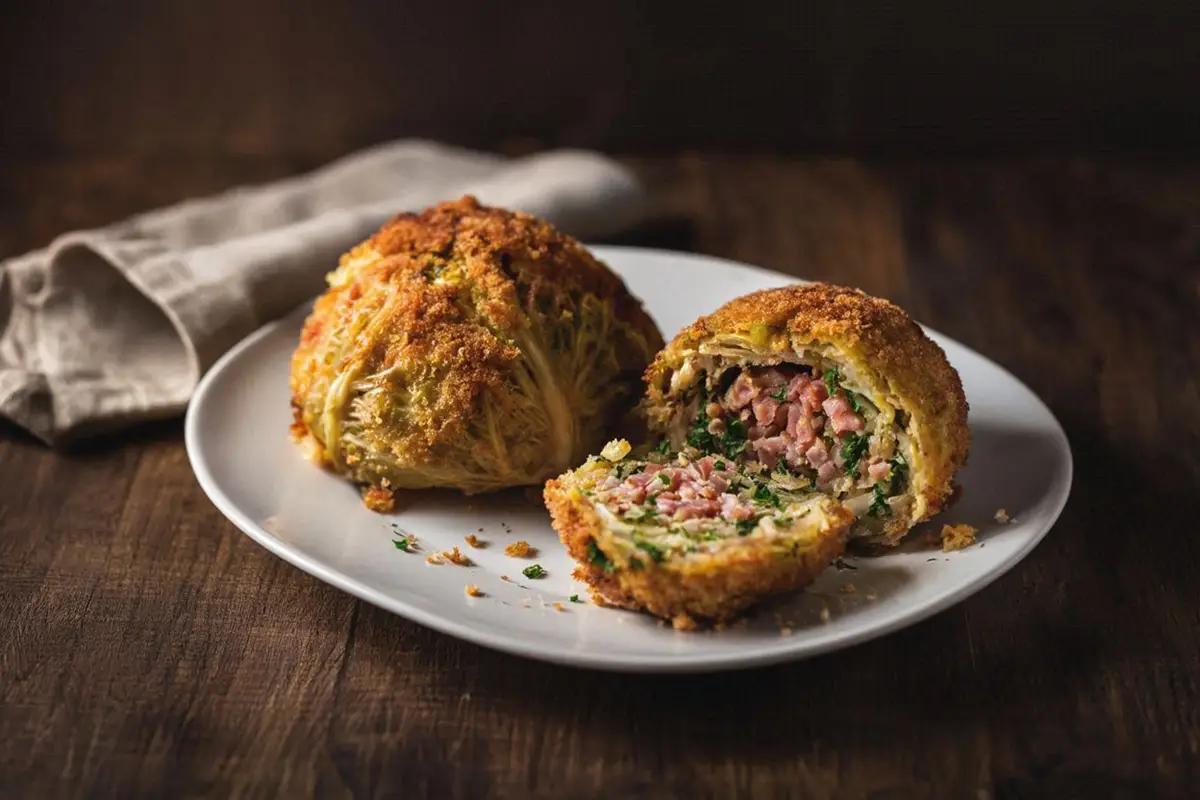
Breaded Savoy Cabbage Stuffed with Ham
Tender young savoy cabbage heads filled with ground ham, fried onion, and herbs, breaded and pan-fried until golden. A hearty Central European classic.
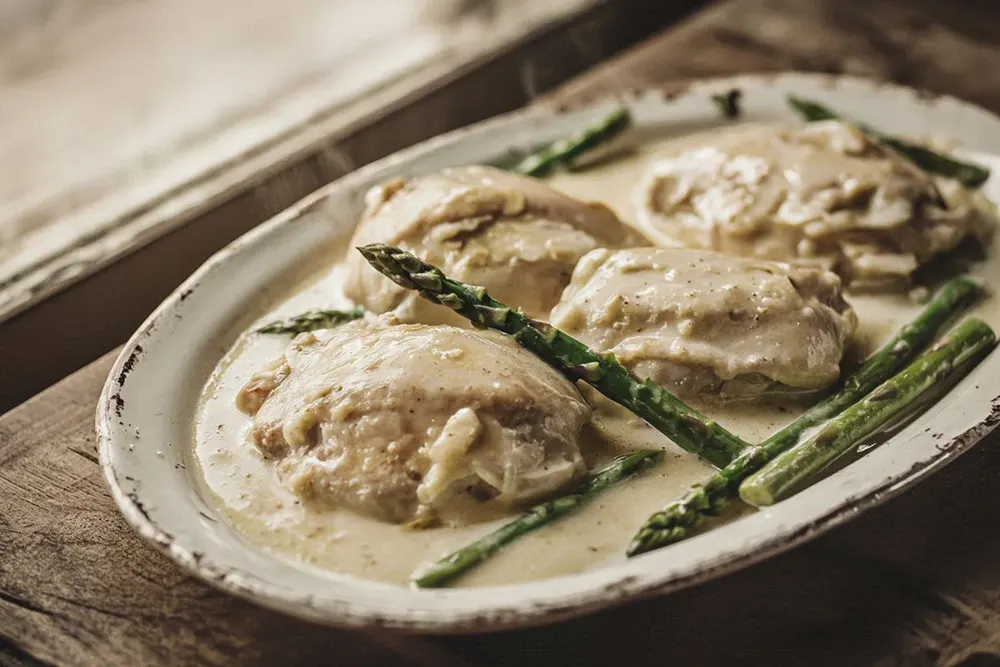
Chicken in Asparagus Sauce
A whole chicken poached in spiced broth, then finished in a silky velouté enriched with egg yolks and cream, garnished with tender asparagus tips.