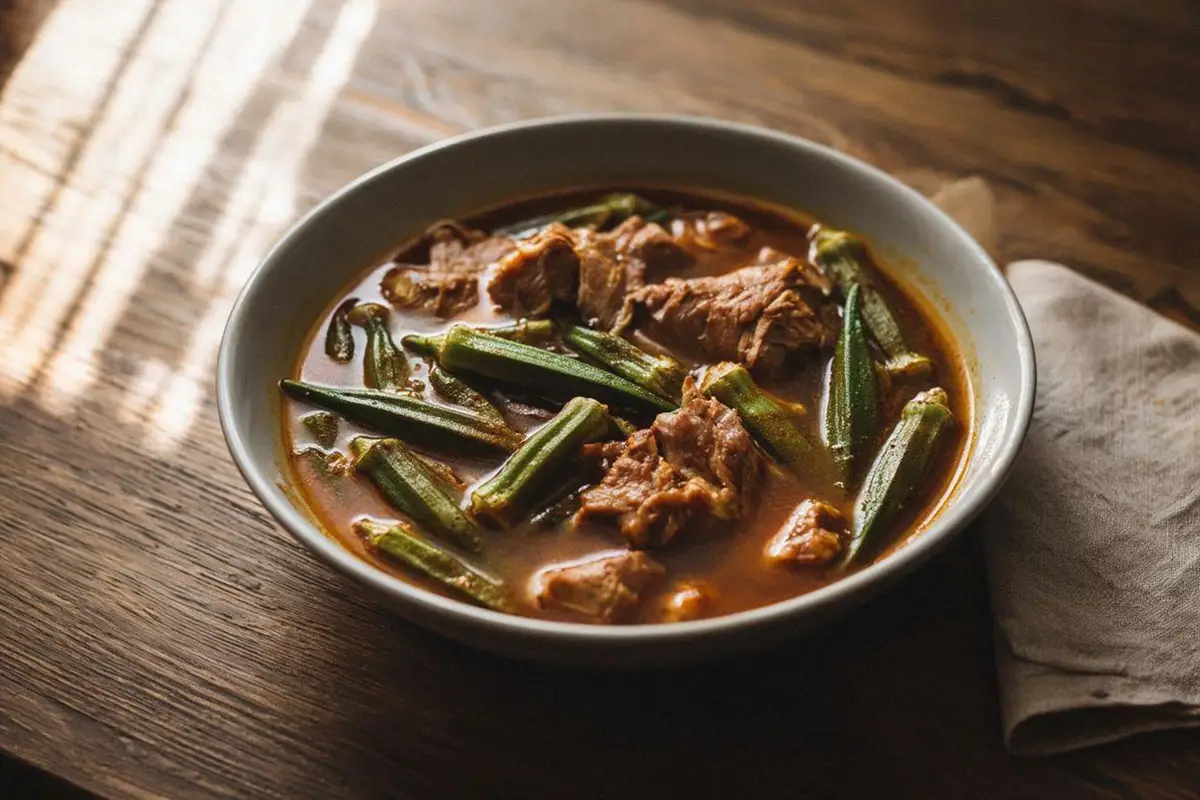
Okra with Pork in Paprika Broth
Tender okra and lean pork slow-braised in rich paprika broth with a golden roux finish and lemon. A classic Central European forgotten vegetable dish.
Quick Summary
Tender okra and lean pork slow-braised in rich paprika broth with a golden roux finish and lemon. A classic Central European forgotten vegetable dish.
Historical recipe
Modernised adaptation of an early 20th‑century source. Not independently kitchen-tested by Attic Recipes. Quantities, temperatures, and food safety guidance have been updated for a contemporary kitchen — results may vary and errors may exist. Nutritional values, where provided, are estimates only and have not been laboratory tested. Always follow current food safety guidelines for your region. If you have a health condition, allergy, or dietary requirement, consult a qualified professional before preparing this recipe.
Use of this recipe is entirely at your own risk and subject to our Terms of Service and Privacy Policy. Attic Recipes accepts no liability for any adverse outcome.
- Gluten
Safety note
Pork must reach an internal temperature of 71°C (160°F) throughout. The par-boiling stage partially cooks the meat — the final simmer must complete the cooking. Do not reduce total cooking time.
Use a meat thermometer to verify pork reaches 71°C before serving.
Additional notes
-
Caution
Contains gluten (flour in the zapršaka). Not suitable for those with celiac disease or gluten sensitivity.
Replace flour with cornstarch — make a slurry (2 tbsp cornstarch dissolved in 3 tbsp cold water) and stir into the simmering stew instead of making a roux.
-
Note
Okra is exceptionally high in Vitamin K, Vitamin C, folate, and soluble fiber. The mucilage (natural sliminess) that many cooks try to minimize is actually a source of prebiotic fiber beneficial for digestive health. Okra has a low glycemic index and is suitable for those monitoring blood sugar.
- 1
Prepare the okra: Wash each pod under cold running water. Rub the surface gently with your hands to remove the fine surface hairs. Rinse in several changes of lukewarm water. Pat completely dry with a clean cloth or paper towel. Do not cut the pods — keep them whole to minimize sliminess.
Tip Moisture is the enemy of okra texture. Wet okra releases significantly more mucilage during cooking. Dry each pod individually if needed — this step takes time but makes a real difference. - 2
Par-boil the pork: Place the pork chunks in a pot, cover with cold water, and bring to a boil. Skim any foam that rises. Cook for 30–40 minutes until the meat is half-cooked — tender but not yet falling apart. Remove the meat and set aside. Reserve the broth.
Tip The broth from the pork is the cooking liquid for the entire stew — do not discard it. - 3
Sauté the onions: Heat the lard or oil in a large wide pan over medium heat. Add the finely chopped onions and fry until soft and translucent — about 8 minutes. Do not brown.
- 4
Add okra and paprika: Add the dried whole okra pods to the onions. Sprinkle with sweet paprika and stir gently to coat. Fry for 3–4 minutes over medium-high heat — the brief high-heat fry helps reduce sliminess before liquid is added.
Tip Stir as little as possible once the okra is in the pan — unnecessary agitation breaks the pods and releases more mucilage. - 5
Add meat and broth: Add the half-cooked pork pieces to the pan. Pour over enough reserved pork broth to partially cover — the okra should not be fully submerged. Bring to a gentle simmer.
- 6
Simmer: Cook uncovered over medium-low heat until the okra is completely tender and the pork is cooked through — approximately 25–30 minutes. The okra is done when it yields easily to a knife with no resistance.
Tip Cook uncovered — the evaporation helps concentrate the broth and reduces sliminess further. - 7
Make the zapršaka: In a small saucepan, heat the lard or oil over medium heat. Add the flour and stir constantly for 2–3 minutes until golden. Remove from heat, add the teaspoon of sweet paprika, and stir immediately — paprika burns in seconds on direct heat. Pour the zapršaka into the stew and stir gently to incorporate. Simmer for 5 more minutes to thicken.
Tip Paprika always goes into the roux off the heat — on direct heat it turns bitter in under 30 seconds. - 8
Finish: Add a generous squeeze of fresh lemon juice just before serving. Season with ground black pepper and salt to taste. The lemon is not optional — it cuts the fat, brightens the paprika, and neutralizes any remaining okra sliminess.
- 9
Serve hot in deep bowls with crusty bread.
Nutrition Information per 1 portion (approx. 350g)
Nutritional values are approximate estimates and may vary based on specific ingredients used, preparation methods, and portion sizes.
Serving Suggestions
Serve hot with crusty white bread for mopping the paprika broth. A simple cucumber salad with vinegar dressing alongside. Leftover okra and pork reheats well and is arguably better the next day — the flavors meld and the sliminess reduces further overnight.
About This Recipe
Okra has been growing in Central European gardens and appearing in regional markets for over a century, arriving via Ottoman trade routes long before it became fashionable in Western cooking. This dish — bamije sa svinjetinom — is one of the oldest and most direct ways to cook it: whole pods braised with par-boiled lean pork in a paprika-rich broth, finished with a golden zapršaka and a generous squeeze of lemon. It is unfussy, deeply flavored, and almost entirely absent from contemporary recipe writing in English. That is a loss worth correcting.
Why It Works
The two-stage cooking method — par-boiling the pork first, then braising with the okra in the reserved broth — solves two problems simultaneously. The pork broth replaces a prepared stock, building a cooking liquid with genuine depth. And the par-boiled meat, already half-tender, finishes cooking at the same rate as the okra, so neither ends up over- or undercooked.
The lemon juice added at the very end is doing multiple things at once: cutting the fat of the pork and roux, brightening the paprika, and neutralizing the remaining mucilage in the okra. It is not optional.
Understanding Okra
Okra’s reputation for sliminess is partly deserved and largely manageable. The mucilage — a natural polysaccharide — is released when the cell walls of the pod are broken, either by cutting, by moisture, or by prolonged gentle cooking. The techniques that reduce it are consistent across every cooking tradition that uses okra:
Dry the pods completely before they go near heat — moisture activates the mucilage immediately.
Keep the pods whole — cutting releases significantly more slime than leaving them intact.
Use high heat initially — a brief high-heat fry before adding liquid helps set the surface of the pods.
Cook uncovered — evaporation concentrates the broth and reduces sliminess.
Add acid at the end — lemon juice, vinegar, or tomato neutralize the mucilage chemically.
This preparation uses several of these techniques in combination: rubbing and rinsing the pods (removing surface residue), frying before adding broth (high heat), and finishing with lemon. It is a technically sound approach, written long before food science had a vocabulary for why it works.
Frozen Okra
Fresh okra is available in larger supermarkets, Asian grocers, Middle Eastern markets, and online. When fresh is unavailable, frozen whole okra is an excellent substitute — add directly to the pan from frozen without thawing. Thawed okra releases water and becomes slimier; frozen okra added to a hot pan behaves almost identically to fresh.
Troubleshooting
Stew too slimy? The okra was wet when added, or stirred too frequently. Add an extra squeeze of lemon and cook uncovered on slightly higher heat for 5 more minutes.
Pork dry and stringy? The lean cut was overcooked. Next time reduce the final simmer to 20 minutes — lean pork loin needs less time than shoulder.
Zapršaka lumpy in the stew? Whisk more vigorously when adding to the stew, or strain through a fine sieve before adding.
A classic of early 20th century home cooking, preserved and adapted for the modern kitchen.
The Story Behind This Recipe
Historical Context
Okra — known as bamije across much of Central Europe and the eastern Mediterranean — arrived in the region via Ottoman trade routes, and its cultivation spread through Bosnia, Serbia, and Bulgaria by the 19th century. By the early 20th century it was a familiar summer vegetable in regional markets, used in stews and braises that combined it with pork, lamb, or veal. The technique of par-boiling the meat separately and using its broth as the cooking liquid — rather than a prepared stock — is characteristic of the period's practical approach to building flavor from a single animal.
Modern Kitchen Adaptation
Fresh okra is available in larger supermarkets, Asian and Middle Eastern grocery stores, and online year-round. When fresh is unavailable, frozen whole okra is an excellent substitute — do not thaw before using, add directly to the pan frozen to reduce sliminess. The key techniques for managing okra's mucilage are consistent across all cooking traditions: dry the pods thoroughly before cooking, cook at high heat initially, cook uncovered, and add an acidic element (lemon juice, vinegar, tomato) at the end.
This recipe is an independent modern adaptation developed from historical sources in the public domain. It is provided for informational and educational purposes only and does not constitute professional dietary, nutritional, or medical advice. Food preparation involves inherent risks. The reader assumes full responsibility for safe food handling, ingredient sourcing, and adherence to current local food safety guidelines. The site operator accepts no liability for outcomes resulting from the preparation or consumption of this recipe.
One recipe.
Every week.
You Might Also Like
More recipes from the same category
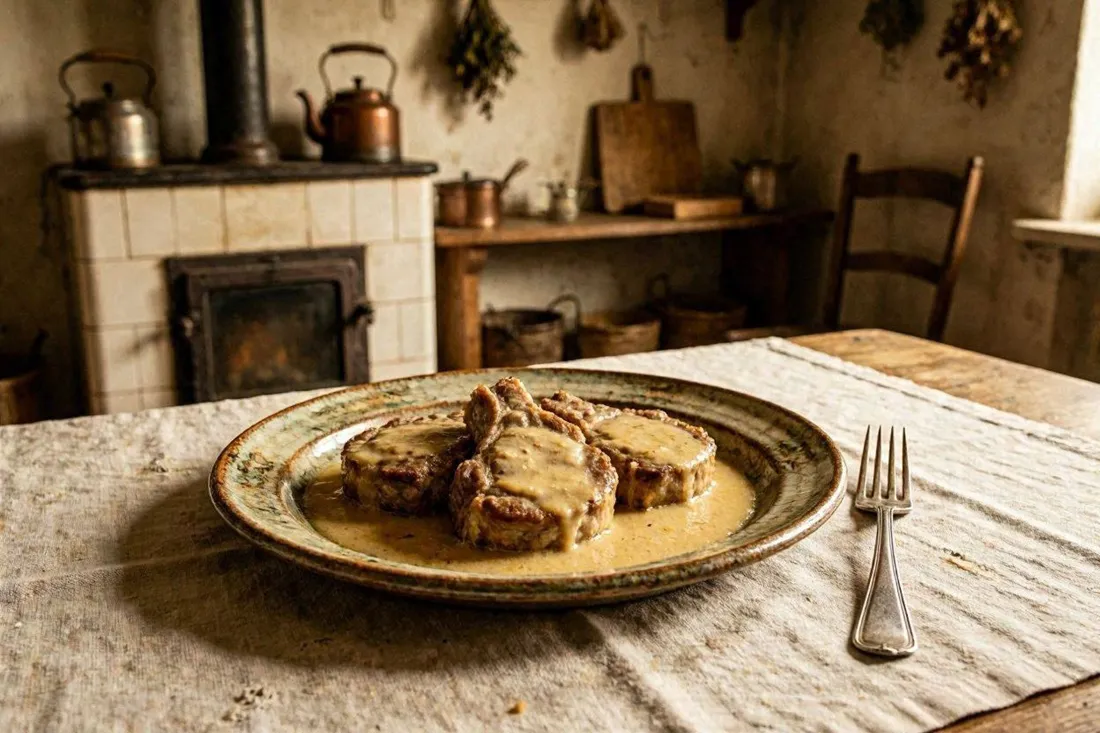
Braised Pork Chops in White Wine and Sour Cream Sauce
Pork loin chops braised with onion, carrot, parsley root, and celery root in white wine, then finished with a strained sour cream sauce.
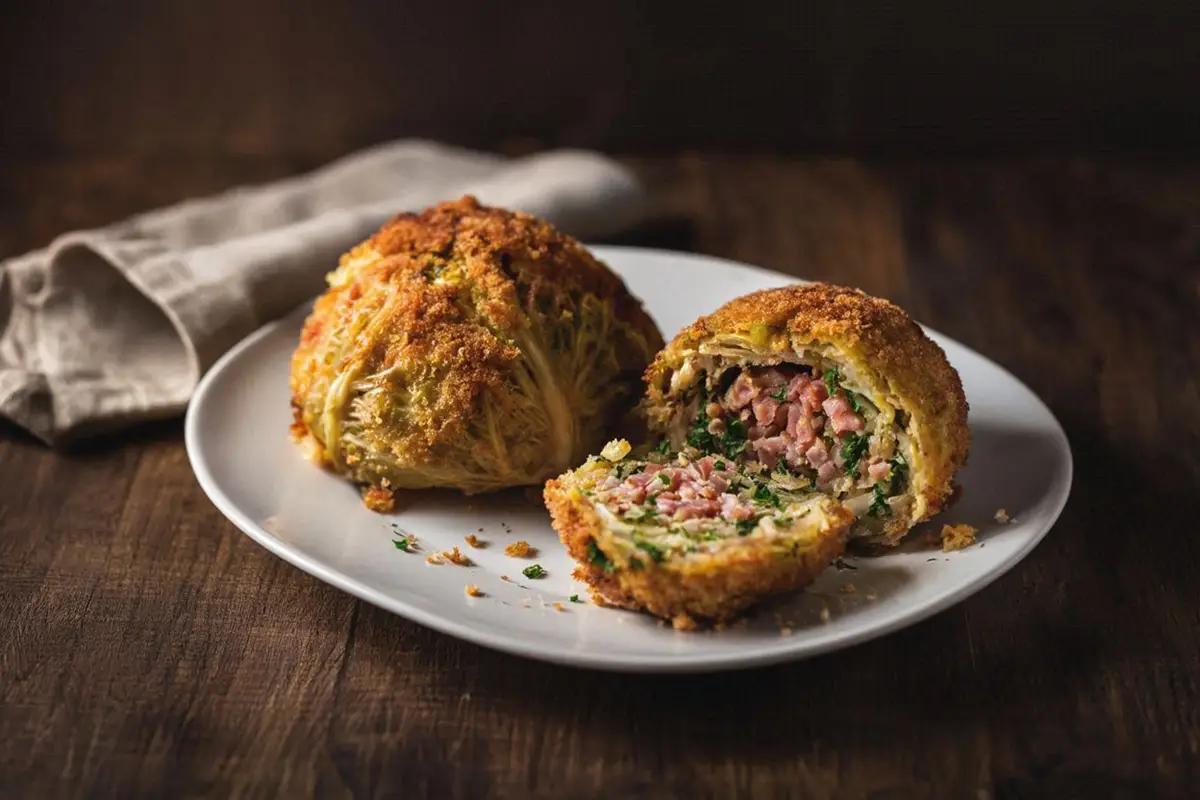
Breaded Savoy Cabbage Stuffed with Ham
Tender young savoy cabbage heads filled with ground ham, fried onion, and herbs, breaded and pan-fried until golden. A hearty Central European classic.
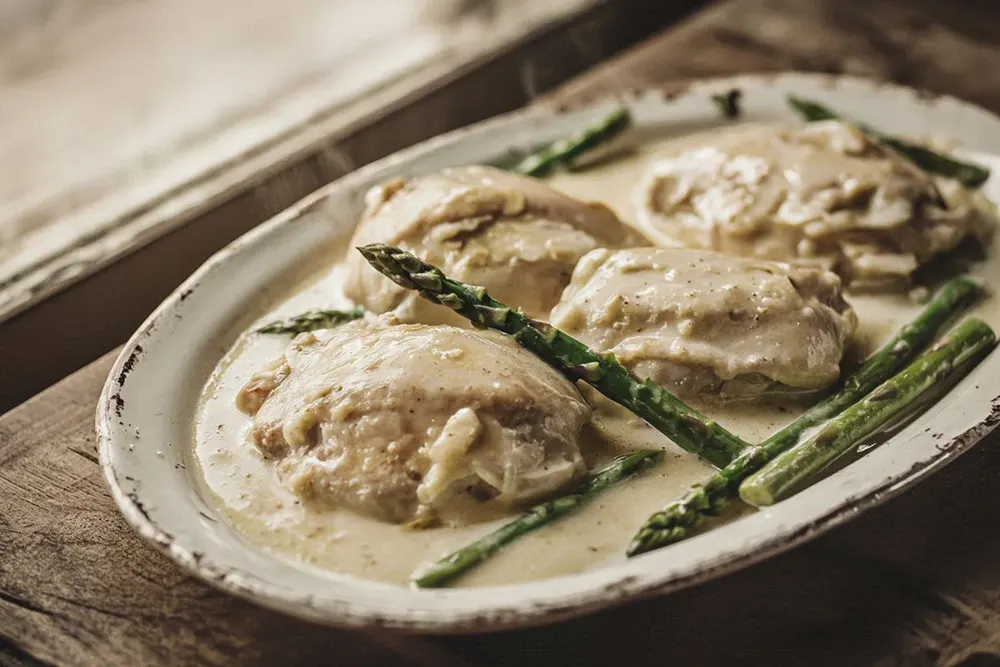
Chicken in Asparagus Sauce
A whole chicken poached in spiced broth, then finished in a silky velouté enriched with egg yolks and cream, garnished with tender asparagus tips.