Pigeons Roasted on a Spit with Sauce
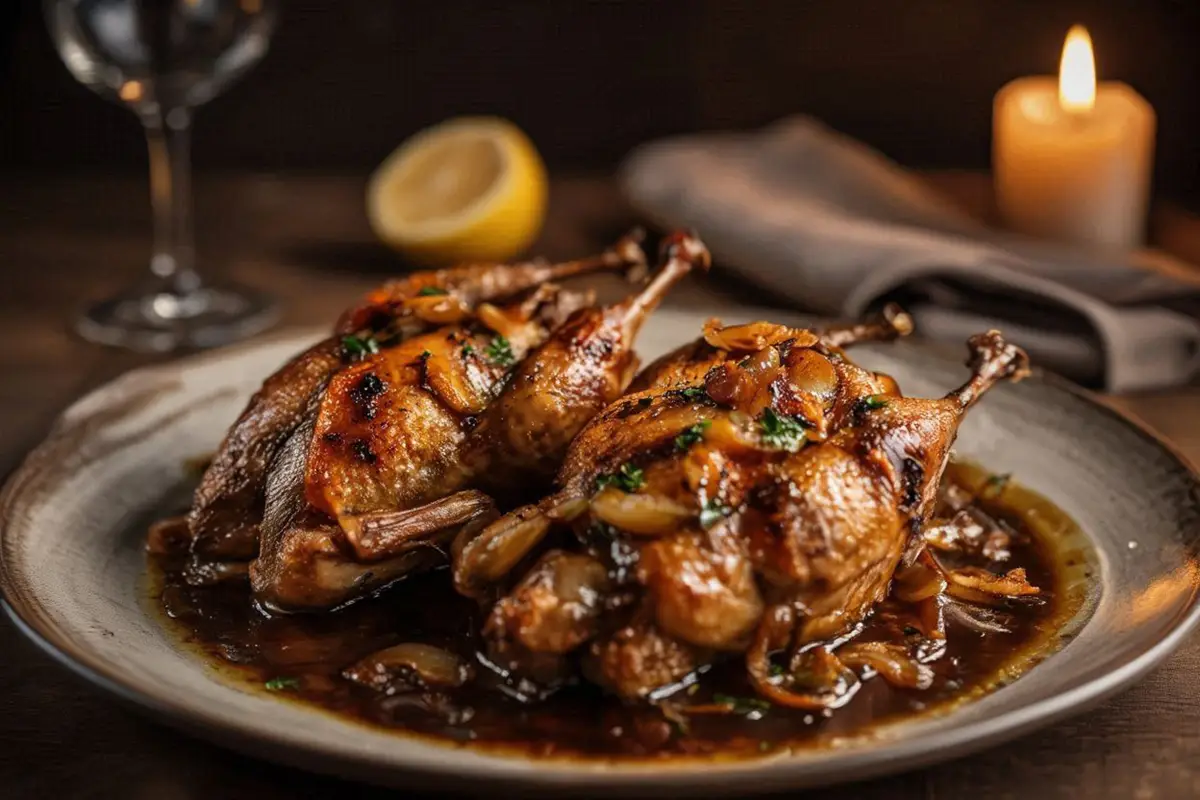
Young pigeons marinated for two days, larded with bacon, spit-roasted over a sardine-onion pan sauce, and finished with sour cream and lemon.
Quick Summary
Young pigeons marinated for two days, larded with bacon, spit-roasted over a sardine-onion pan sauce, and finished with sour cream and lemon.
Historical recipe
Modernised adaptation of an early 20th‑century source. Not independently kitchen-tested by Attic Recipes. Quantities, temperatures, and food safety guidance have been updated for a contemporary kitchen — results may vary and errors may exist. Nutritional values, where provided, are estimates only and have not been laboratory tested. Always follow current food safety guidelines for your region. If you have a health condition, allergy, or dietary requirement, consult a qualified professional before preparing this recipe.
Use of this recipe is entirely at your own risk and subject to our Terms of Service and Privacy Policy. Attic Recipes accepts no liability for any adverse outcome.
- Dairy
- Fish
- Gluten
- Sulphites
Additional notes
-
Warning
Wild pigeon (wood pigeon) may carry Chlamydophila psittaci (psittacosis/ornithosis), a bacterial infection transmissible to humans through contact with feathers, droppings, and raw tissue. Always handle raw wild pigeon wearing gloves, avoid touching your face, and wash hands and all surfaces thoroughly with soap and hot water. The bacteria is destroyed at cooking temperature — fully cooked pigeon is safe. Farmed squab does not carry this risk.
Use farmed squab (young pigeon) from a reputable butcher or game supplier to eliminate psittacosis risk entirely. Farmed squab is oven-ready, consistently young and tender, and widely available from specialty retailers.
-
Warning
Wild pigeon may contain lead shot fragments if hunted rather than farmed. Inspect the meat carefully before and after cooking. Children, pregnant women, and elderly individuals should not consume wild-shot game as a precaution against lead exposure.
Use farmed oven-ready squab to eliminate all lead shot risk.
-
Warning
The 48-hour marinade must be conducted in the refrigerator at all times — never at room temperature. Marinating poultry at room temperature creates conditions for rapid bacterial growth. Always discard used marinade that has been in contact with raw poultry; do not reuse it as a sauce without bringing it to a full boil first.
-
Caution
Sour cream must be added off the heat. Adding sour cream to an actively boiling sauce will cause it to split and curdle. Remove the pan from heat completely before incorporating sour cream.
Substitute crème fraîche for sour cream — it is significantly more heat-stable and can withstand gentle simmering without splitting.
-
Note
This recipe contains sardines, a fish product. Individuals with fish allergy should not consume this dish as written. The sardines dissolve into the sauce during roasting and cannot be removed after cooking.
Replace sardines with 1 tsp of soy sauce or Worcestershire sauce for a similar umami base without the fish content. Note that Worcestershire sauce also contains anchovies — use soy sauce only for a fish-free version.
- 1
Make the marinade: combine the red wine, vinegar, sliced onion, bay leaves, peppercorns, allspice, garlic, and thyme or rosemary in a bowl or deep dish. Place the cleaned pigeons in the marinade, turning to coat all surfaces. Cover and refrigerate for 48 hours, turning the birds once or twice each day.
Tip The 2-day marinade is not optional — it significantly tenderizes the lean pigeon meat and removes gaminess. Do not shorten it to less than 24 hours. - 2
After 48 hours, remove the pigeons from the marinade. Pat completely dry inside and out with paper towels. Reserve 50–80ml of the marinade for the sauce. Discard the rest.
- 3
Season the pigeons inside and out with salt. Fill each cavity loosely with the finely chopped bacon (80g total). Drape the thin bacon rashers (40g total) over the breast of each bird. Truss the birds lightly with kitchen twine to hold their shape and secure the rashers during roasting.
- 4
Thread all four birds onto a long metal skewer or spit. The skewer should rest across the walls of a deep roasting dish below — the birds hang above the dish and drip their juices into it during roasting. If a spit is not available, see the modern adaptation note for a conventional roasting pan method.
Tip The skewer method is the original technique, designed so the dripping juices continuously baste the onion and sardine base below, building the sauce as the birds roast. It is worth replicating as closely as possible. - 5
Prepare the roasting dish: place the lard or oil, finely chopped red onions, chopped sardines, and parsley in the roasting dish below the skewer. Spread evenly.
- 6
Place in the oven preheated to 200°C / 180°C fan (390°F). Roast for 25–35 minutes, turning the skewer every 5–7 minutes and spooning the pan drippings over the birds regularly. The birds are done when the skin is deep golden brown and the internal temperature at the thickest part of the thigh reaches 74°C (165°F).
Tip Pigeons are a red meat bird — the breast can remain slightly pink at 74°C thigh temperature, which is correct and safe. Do not overcook: pigeon breast becomes dry and tough very quickly beyond this point. - 7
Remove the pigeons from the skewer and set aside to rest on a warm plate, loosely covered with foil, for 10 minutes.
- 8
Make the sauce: place the roasting dish with its contents (onion, sardines, parsley, and drippings) on the stovetop over medium heat. Stir in 1 tbsp of flour and cook for 1 minute. Pour in 50–80ml of reserved marinade, stirring and scraping up any brown bits from the base of the dish. Simmer for 3–4 minutes until the sauce thickens slightly. Season with salt and ground pepper.
- 9
Remove the sauce from heat. Stir in the sour cream and lemon juice. Taste and adjust seasoning. Pour the sauce over the rested pigeons and serve immediately.
Nutrition Information per 1 whole pigeon with sauce (approx. 380g)
Nutritional values are approximate estimates and may vary based on specific ingredients used, preparation methods, and portion sizes.
About This Recipe
Pigeons Roasted on a Spit with Sauce is a dish of considerable ambition and reward. Young pigeons are marinated for two full days in red wine and aromatics, stuffed with bacon, threaded onto a skewer, and roasted directly over a pan containing finely chopped onion, sardines, and parsley — so that every drop of fat and juice from the rotating birds falls into the sauce building below. When the birds are done, the pan goes onto the stovetop: flour, reserved marinade, sour cream, lemon juice, and the result is a complex, deeply savory sauce that could only have come from underneath those four birds. Nothing is wasted. Everything counts.
Why It Works
The spit-over-drip-pan method is not theatrical — it is functional. As the birds rotate and roast, their fat renders and drips continuously into the sardine-onion base below, effectively slow-frying the aromatics in game fat over 25–35 minutes. The sardines dissolve almost completely in this process, leaving behind a concentrated umami depth that is the defining character of the sauce. Sardines — or anchovies, their close equivalent — were used exactly this way across Austro-Hungarian cooking: not as fish, but as a flavor amplifier for meat dishes, borrowing the French technique of building sauce bases with cured fish. The sour cream and lemon added at the end cut through the richness and bring the sauce into balance.
The Marinade
A standard Central European game bird marinade has been composed for this recipe:
500ml dry red wine + 100ml red wine vinegar + sliced onion + bay leaves + peppercorns + allspice + garlic + thyme or rosemary
This is the classic combination used for game across the Austro-Hungarian tradition. The wine tenderizes, the vinegar penetrates more quickly, the aromatics infuse the meat with background flavor that the short roasting time alone cannot achieve. If you have a family or regional marinade for game, it will work here — the key components are acid (wine + vinegar), aromatics (bay, pepper, allspice), and enough liquid to submerge the birds.
Modern Adaptation: No Spit Available
Most modern kitchens do not have a spit or long skewer. The technique can be adapted as follows:
Place a wire roasting rack inside a deep roasting dish. Arrange the bacon-wrapped pigeons on the rack, breast-side up. Place the lard, onions, sardines, and parsley in the dish below the rack — not under the birds directly, but spread across the pan floor. The birds will still drip into the pan during roasting; you will need to baste manually every 8–10 minutes with a spoon rather than relying on rotation. The result is very close to the original, without the skewer.
On Pigeon Availability
Pigeon is not a standard supermarket bird in most markets. Here is where to find it:
Europe: Wood pigeon (wild) is available from game butchers September–February. Farmed squab is available year-round from specialty retailers and online game suppliers in France, Italy, UK, and most of Central Europe.
North America: Farmed squab is available from specialty butchers and online game retailers (D’Artagnan and others). Wild pigeon is regulated — check local hunting regulations.
Australia / New Zealand: Wild pigeon is available from game suppliers. Farmed squab from specialty butchers in major cities.
If pigeon is unavailable: Small poussin or Cornish game hen are the closest structural substitutes — reduce roasting time to 40–45 minutes at 180°C / 160°C fan. The flavor will be milder but the technique and sauce work identically.
A Note on the Sardines
If you have never cooked with sardines as a sauce base rather than as a fish ingredient, this recipe will be a useful introduction. Two or three canned sardines, finely chopped into the roasting pan with onion and fat, dissolve almost entirely over 30 minutes of heat and dripping pigeon juices. The finished sauce does not taste of fish. It tastes of something deeper and more savory than onion and lemon juice alone can produce — a background richness that is difficult to identify but immediately noticeable in its absence. This is the technique at work.
A classic of early 20th century home cooking, preserved and adapted for the modern kitchen.
The Story Behind This Recipe
Historical Context
Spit-roasting birds over a drip pan was the dominant roasting technique across Central European kitchens well into the 20th century, predating the closed oven roasting that became standard after the Second World War. The technique of positioning a skewer across a deep dish so that the rotating birds continuously baste their own dripping juices into a sauce base below is both elegantly practical and self-sufficient — the sauce builds itself while the birds roast. The use of sardines in the roasting pan base is characteristic of Austro-Hungarian bourgeois cooking, where anchovy and sardine were used as umami-building flavor bases in meat dishes rather than as fish ingredients per se — a technique borrowed from French cuisine and widely adopted across the region.
Modern Kitchen Adaptation
The marinade components are not specified in period records — a standard Central European game bird marinade (red wine, vinegar, bay, peppercorn, allspice, garlic, thyme) has been composed. All other unmarked quantities (fat, bacon, flour, marinade for sauce) are standard culinary estimates. The skewer-over-dish method has been preserved from the original; a conventional alternative is provided below for modern kitchens without a spit. Oven temperature was not specified — 200°C / 180°C fan (390°F) is the modern standard for whole pigeon roasting, yielding golden skin and medium doneness in 25–35 minutes. Internal temperature target is 74°C (165°F) at the thigh.
This recipe is an independent modern adaptation developed from historical sources in the public domain. It is provided for informational and educational purposes only and does not constitute professional dietary, nutritional, or medical advice. Food preparation involves inherent risks. The reader assumes full responsibility for safe food handling, ingredient sourcing, and adherence to current local food safety guidelines. The site operator accepts no liability for outcomes resulting from the preparation or consumption of this recipe.
One recipe.
Every week.
You Might Also Like
More recipes from the same category
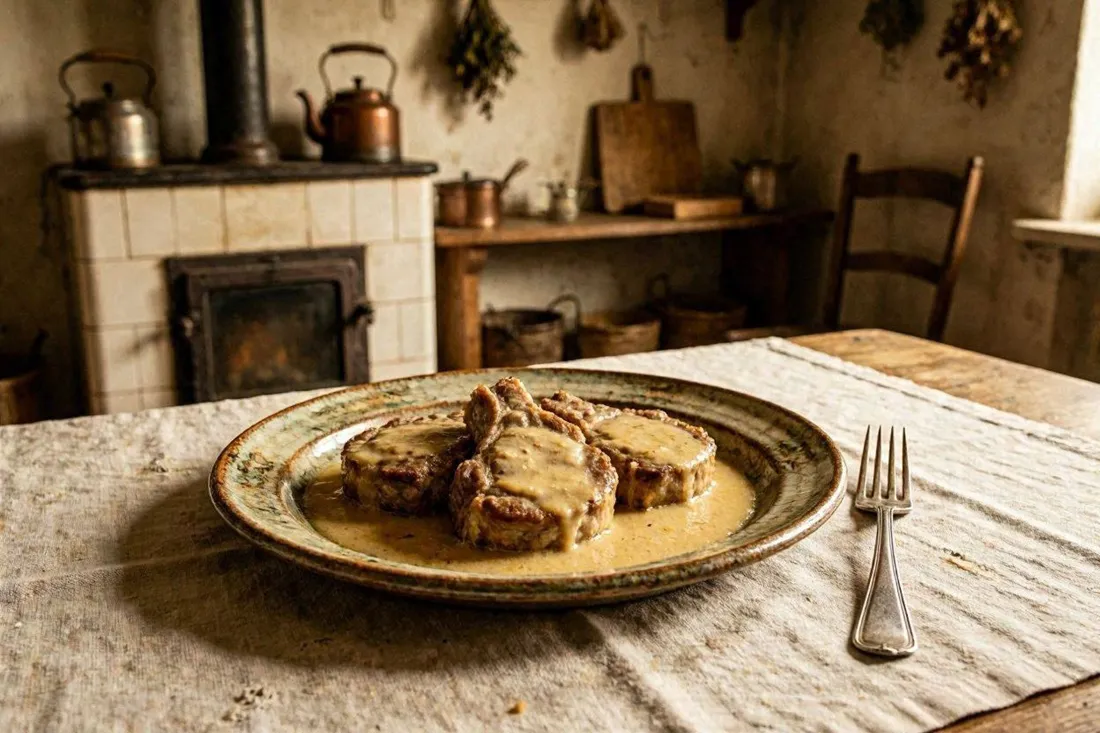
Braised Pork Chops in White Wine and Sour Cream Sauce
Pork loin chops braised with onion, carrot, parsley root, and celery root in white wine, then finished with a strained sour cream sauce.
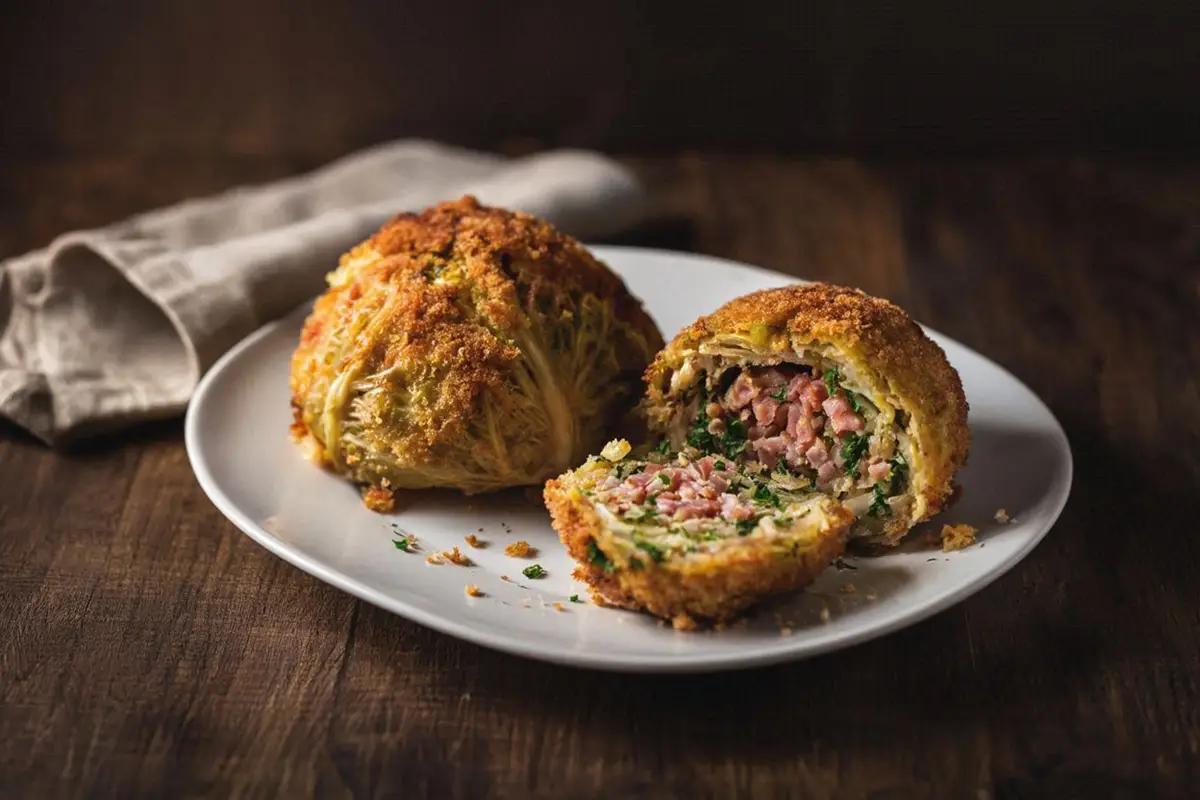
Breaded Savoy Cabbage Stuffed with Ham
Tender young savoy cabbage heads filled with ground ham, fried onion, and herbs, breaded and pan-fried until golden. A hearty Central European classic.
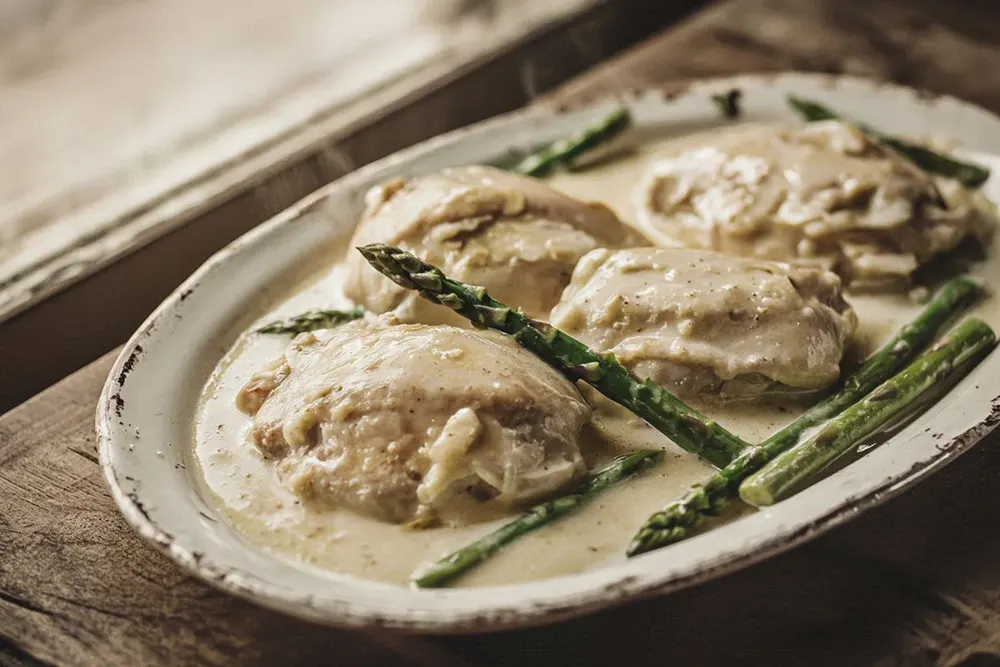
Chicken in Asparagus Sauce
A whole chicken poached in spiced broth, then finished in a silky velouté enriched with egg yolks and cream, garnished with tender asparagus tips.