Rabbit "On Dalmatian"
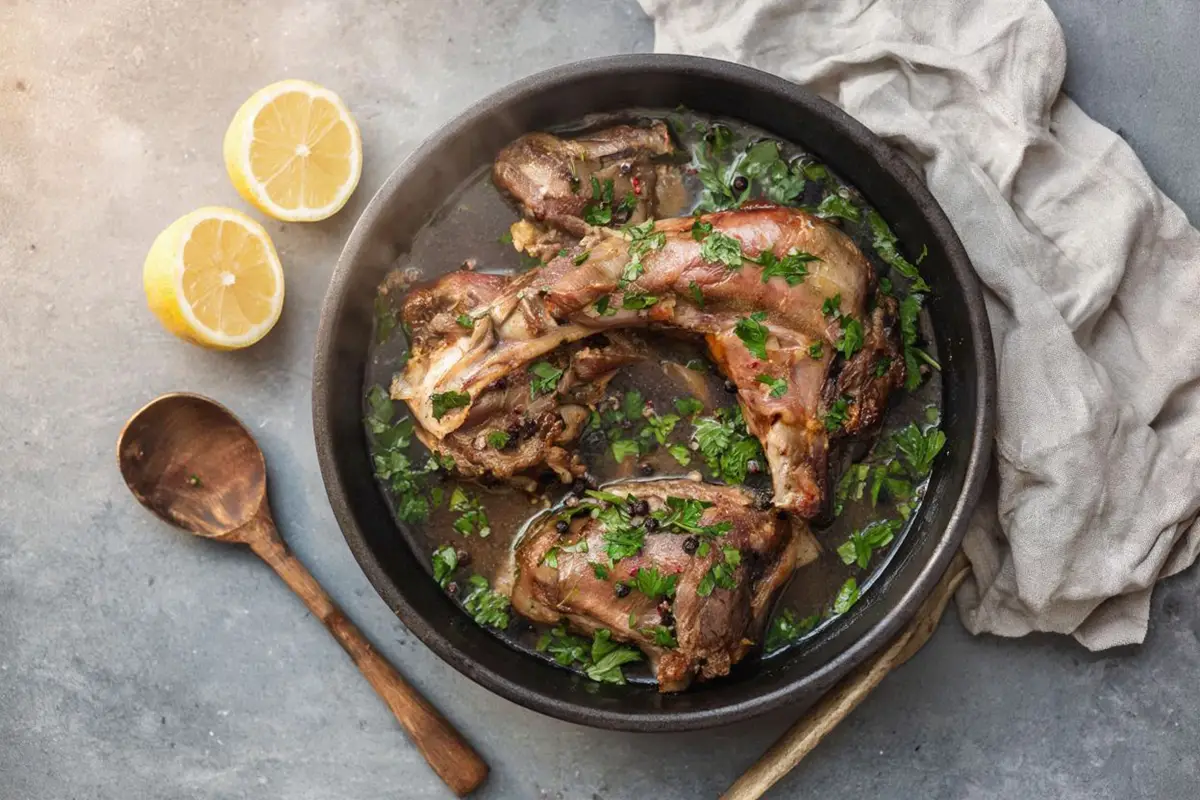
Slow-braised rabbit larded with bacon, finished in olive oil, white wine, lemon, garlic, and abundant parsley — a bold Dalmatian coast classic.
Quick Summary
Slow-braised rabbit larded with bacon, finished in olive oil, white wine, lemon, garlic, and abundant parsley — a bold Dalmatian coast classic.
Historical recipe
Modernised adaptation of an early 20th‑century source. Not independently kitchen-tested by Attic Recipes. Quantities, temperatures, and food safety guidance have been updated for a contemporary kitchen — results may vary and errors may exist. Nutritional values, where provided, are estimates only and have not been laboratory tested. Always follow current food safety guidelines for your region. If you have a health condition, allergy, or dietary requirement, consult a qualified professional before preparing this recipe.
Use of this recipe is entirely at your own risk and subject to our Terms of Service and Privacy Policy. Attic Recipes accepts no liability for any adverse outcome.
- Sulphites
Additional notes
-
Warning
This recipe uses raw rabbit organ meat (heart and liver) added directly to the braising liquid. Although the organs are cooked during the 1.5–2 hour braise, they must reach a minimum internal temperature of 74°C (165°F) to eliminate the risk of Salmonella, Campylobacter, and Toxoplasma gondii, which can be present in rabbit organs. Immunocompromised individuals, pregnant women, elderly, and children under 5 should exercise caution.
Pre-cook the chopped heart and liver in a small pan until fully cooked through before adding to the braising liquid. This guarantees safety without altering the flavor profile of the dish.
-
Warning
Wild-caught rabbit can carry Tularemia (rabbit fever), a bacterial infection transmissible through contact with blood and raw tissue. Always wear gloves when handling raw wild rabbit, avoid touching your face, and wash hands and all surfaces thoroughly with soap and hot water. Thoroughly cooked rabbit meat is safe to eat — the bacteria is destroyed at cooking temperatures.
Use farmed oven-ready rabbit to eliminate the risk of Tularemia entirely.
-
Caution
Rabbit liver is high in Vitamin A (retinol). Pregnant women should limit consumption of liver-containing dishes to avoid exceeding safe Vitamin A intake levels during pregnancy.
Omit the liver and use only the heart in the braising liquid. The dish remains complete and flavorful.
-
Caution
This recipe uses 200–250ml of olive oil in the braising liquid, making it high in total fat per serving. The fat content listed in nutrition values reflects the full braising liquid; if you consume less sauce, fat intake will be lower.
-
Note
The 24-hour cold water soak is a traditional preparation technique, not a food safety measure. Always store the rabbit in the refrigerator during soaking — never at room temperature — and change the water with cold water only.
- 1
Place the cleaned whole rabbit in a large bowl or pot and cover completely with cold water. Refrigerate for 24 hours, changing the water 3–4 times. This draws out blood, reduces gaminess, and produces a milder, cleaner flavor in the final dish.
Tip This step is non-negotiable for wild or recently slaughtered rabbit. For commercially farmed rabbit it can be reduced to 4–6 hours, but the full soak produces a noticeably better result. - 2
Remove the rabbit from the water and pat completely dry inside and out with paper towels. Set the heart and liver aside in the refrigerator. Using a small sharp knife, make deep punctures all over the rabbit — breast, thighs, shoulders, back — as frequently and deeply as the meat allows. Push a strip of dry smoked bacon into each cavity.
Tip Larding — inserting fat into lean game meat — was the standard technique for keeping rabbit moist before the era of foil and covered roasting pans. The bacon strips melt during roasting and baste the meat from the inside. - 3
Rub the entire rabbit generously with lard and season with salt. Place in a roasting pan and put in the oven preheated to 180°C / 160°C fan (350°F). As soon as the rabbit is well heated and beginning to color (about 15 minutes), pour a cup of hot water over it. Continue roasting, basting frequently with the pan juices, for approximately 40–50 minutes total — until the rabbit is slightly more than half-cooked. The meat should be golden but not yet fully cooked through.
Tip If the pan juices run dry before the half-cooked stage, add small amounts of hot water. Do not allow the pan to go dry — the bacon fat and lard will burn. - 4
Remove the rabbit from the oven and allow it to cool slightly. Cut it into serving pieces: separate the front shoulders, remove the hind legs and cut each into 3–4 pieces. Cut the saddle (back) into portions. Set aside.
- 5
In a heavy-lidded pot — ideally earthenware, or a cast-iron Dutch oven — combine the olive oil, white wine, lemon juice, finely chopped garlic, parsley, coarsely ground black pepper, finely chopped heart, and finely chopped liver. Stir everything together well.
Tip The original recipe emphasizes an earthenware pot for this stage. If using one, make sure it is appropriate for stovetop use. Cast-iron Dutch oven is the most practical modern equivalent. - 6
Add the rabbit pieces to the pot, pressing them into the braising liquid. Cover with the lid and place over low heat. Bring gently to a simmer — do not allow it to boil hard. Braise for 1.5 to 2 hours, checking occasionally, until the meat is almost falling off the bone.
Tip Low and slow is essential here. A hard boil will tighten the proteins and make the rabbit tough. The liquid should barely tremble. - 7
Once the rabbit is done, move the pot to the side of the heat — or turn to the lowest possible setting — so it does not cool down but is no longer actively cooking. Let it rest for 1 full hour. This resting period is not optional: the flavors of the wine, lemon, garlic, and parsley need time to meld into the meat.
- 8
While the rabbit rests, prepare the dumplings or your chosen side dish. Serve the rabbit directly from the pot, spooning the rich braising liquid generously over each portion.
Nutrition Information per ¼ rabbit with sauce (approx. 320g)
Nutritional values are approximate estimates and may vary based on specific ingredients used, preparation methods, and portion sizes.
Pro Tips
- Do not skip the 1-hour resting period after braising. The sauce transforms noticeably as it cools slightly and the flavors integrate.
- The braising liquid will be intensely acidic from the lemon and wine. This is correct — it is the defining character of the dish. Taste before adding extra salt.
- If rabbit is unavailable, bone-in chicken pieces (legs and thighs) work structurally in this recipe. Reduce braising time to 45–55 minutes. The flavor will be milder but the technique is identical.
Serving Suggestions
Serve directly from the pot over potato dumplings, bread dumplings, or thick slices of crusty white bread to absorb the braising liquid. Polenta is an excellent modern alternative in keeping with the Adriatic character of the dish. A simple green salad with lemon dressing on the side. The braising liquid is intensely flavored — serve it generously.
About This Recipe
Rabbit “On Dalmatian” — Zec na dalmatinski — is a dish of two acts. First, the whole larded rabbit roasts in the oven until golden and half-cooked. Then it is cut into pieces and transferred to a heavy pot with a braising liquid of extraordinary character: half a liter of dry white wine, the juice of three lemons, abundant olive oil, garlic, a large bunch of fresh parsley, coarsely ground black pepper, and the finely chopped heart and liver of the rabbit itself. It simmers for nearly two hours, then rests for one more. The result is game meat that falls from the bone, swimming in a sharp, aromatic, deeply savory sauce unlike anything produced by gentler cooking traditions.
Why It Works
The two-stage method is not accidental. The initial roasting with lard and frequent basting drives the Maillard reaction — building the brown, roasted flavor and crust that no amount of braising can replicate. The subsequent braise does what roasting cannot: it relaxes the tough connective tissues of lean game rabbit over time, converting collagen to gelatin and producing the fall-apart texture the original recipe describes. The acid from the wine and lemon does double duty — it tenderizes the meat further and cuts through the fat of the olive oil and bacon, balancing what would otherwise be a very rich dish. The organ meat enriches the braising liquid with iron and depth, acting almost as a natural stock.
On the Olive Oil
The quantity of olive oil — 200 to 250ml — will seem excessive by modern standards. It is not a mistake. This is the Dalmatian coast tradition, where olive oil is used generously as a cooking medium, not a condiment. The oil becomes part of the sauce, emulsified with the wine and lemon into a glossy, intensely flavored braising liquid. Use the best extra-virgin olive oil you can find — the flavor will define the dish. A mild, buttery Dalmatian or Italian oil is ideal; avoid very peppery or intensely grassy oils.
Rabbit Availability — A Global Note
Rabbit is a mainstream cooking ingredient across Southern and Central Europe, but availability varies significantly elsewhere.
Europe: Farmed rabbit (whole, oven-ready) is widely available from butchers, supermarkets, and specialty retailers in France, Italy, Spain, Portugal, Croatia, and most of Central Europe. Seasonal wild rabbit is available from game suppliers.
North America: Farmed rabbit is available from specialty butchers, farmers’ markets, and online game meat retailers (D’Artagnan and others). It is not a common supermarket item outside of ethnic grocery stores (French, Italian, Spanish, Portuguese).
Australia / New Zealand: Wild rabbit is abundant and available from game meat retailers. Farmed rabbit is available from specialty butchers.
Substitute: Bone-in chicken pieces (legs, thighs, bone-in) are the closest practical substitute. Use 1.2–1.4kg of bone-in chicken pieces, reduce braising time to 45–55 minutes, and proceed identically. The flavor will be considerably milder, but the technique and sauce character are preserved.
Make-Ahead Notes
This is an ideal make-ahead dish. The full recipe — roasting, braising, and resting — can be completed the day before serving. Reheat gently, covered, over very low heat for 20–25 minutes. The flavor deepens considerably overnight as the braising liquid continues to penetrate the meat. Do not reheat at high temperature or the meat will tighten.
A Note on the Resting Hour
The one-hour rest after braising reflects the genuine wisdom of slow cooking. During this period, the braising liquid — still warm — continues to be absorbed by the meat, the acidity of the wine and lemon softens slightly, and the flavors of parsley, garlic, and black pepper come into balance. Serving immediately after braising will give you a sharper, more acidic dish; serving after the rest gives you something rounder and more complete. Both are good. The rest is better.
A classic of early 20th century home cooking, preserved and adapted for the modern kitchen.
The Story Behind This Recipe
Historical Context
This preparation belongs to the tradition of Dalmatian coastal cooking, where Mediterranean ingredients — olive oil, lemon, wine, and abundant fresh herbs — met the game birds and animals of the inland hinterland. The two-stage method of first roasting then braising in wine and acid was common across the Adriatic coast and reflects Italian influence through centuries of Venetian presence in Dalmatia. The use of organ meat (heart and liver) finely chopped into the braising liquid is a characteristic of peasant and bourgeois cooking alike — nothing was wasted, and the organs enriched the sauce with iron, depth, and body that lean rabbit meat alone could not provide.
Modern Kitchen Adaptation
The original recipe specifies no quantities for parsley, black pepper, or the exact amount of olive oil — ranges and standard culinary proportions have been applied throughout, with notes on the original text. Oven temperature was not specified in the original; 180°C (350°F) has been applied based on current guidelines for whole rabbit roasting. A 24-hour cold water soak is preserved as written — it is a genuine and worthwhile step even for modern farmed rabbit. Internal temperature of the finished braised rabbit should reach 74°C (165°F).
This recipe is an independent modern adaptation developed from historical sources in the public domain. It is provided for informational and educational purposes only and does not constitute professional dietary, nutritional, or medical advice. Food preparation involves inherent risks. The reader assumes full responsibility for safe food handling, ingredient sourcing, and adherence to current local food safety guidelines. The site operator accepts no liability for outcomes resulting from the preparation or consumption of this recipe.
One recipe.
Every week.
You Might Also Like
More recipes from the same category
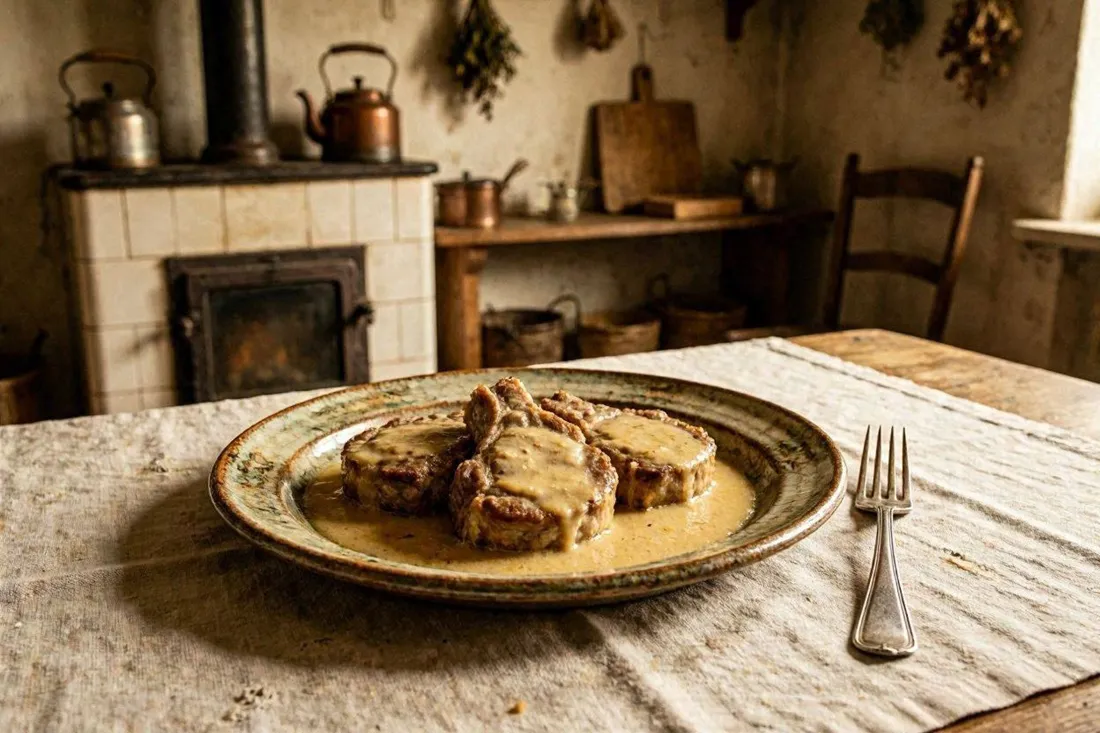
Braised Pork Chops in White Wine and Sour Cream Sauce
Pork loin chops braised with onion, carrot, parsley root, and celery root in white wine, then finished with a strained sour cream sauce.
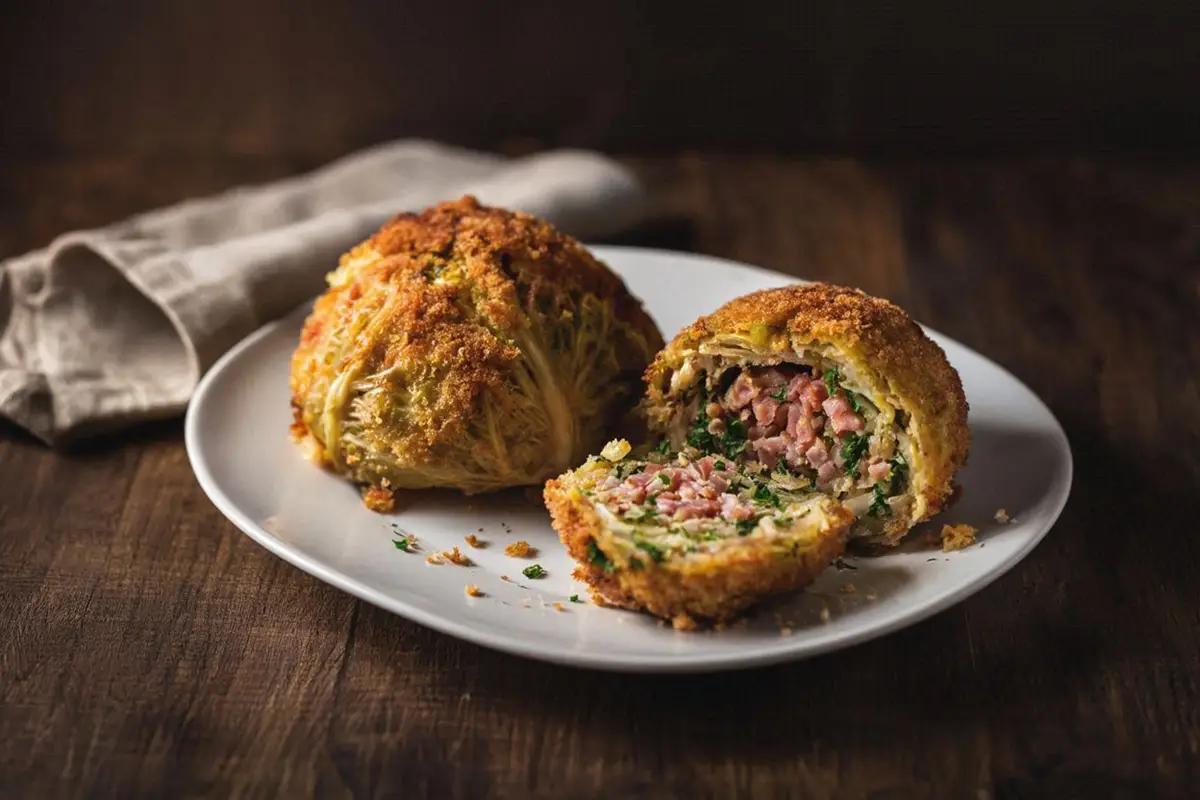
Breaded Savoy Cabbage Stuffed with Ham
Tender young savoy cabbage heads filled with ground ham, fried onion, and herbs, breaded and pan-fried until golden. A hearty Central European classic.
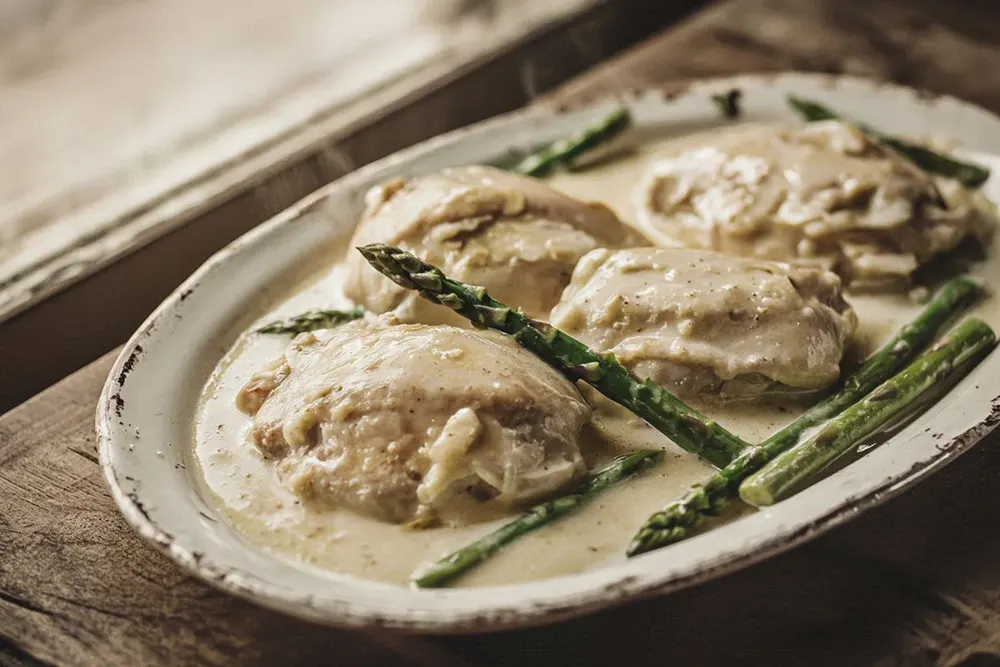
Chicken in Asparagus Sauce
A whole chicken poached in spiced broth, then finished in a silky velouté enriched with egg yolks and cream, garnished with tender asparagus tips.