Rabbit Roasted with Onion
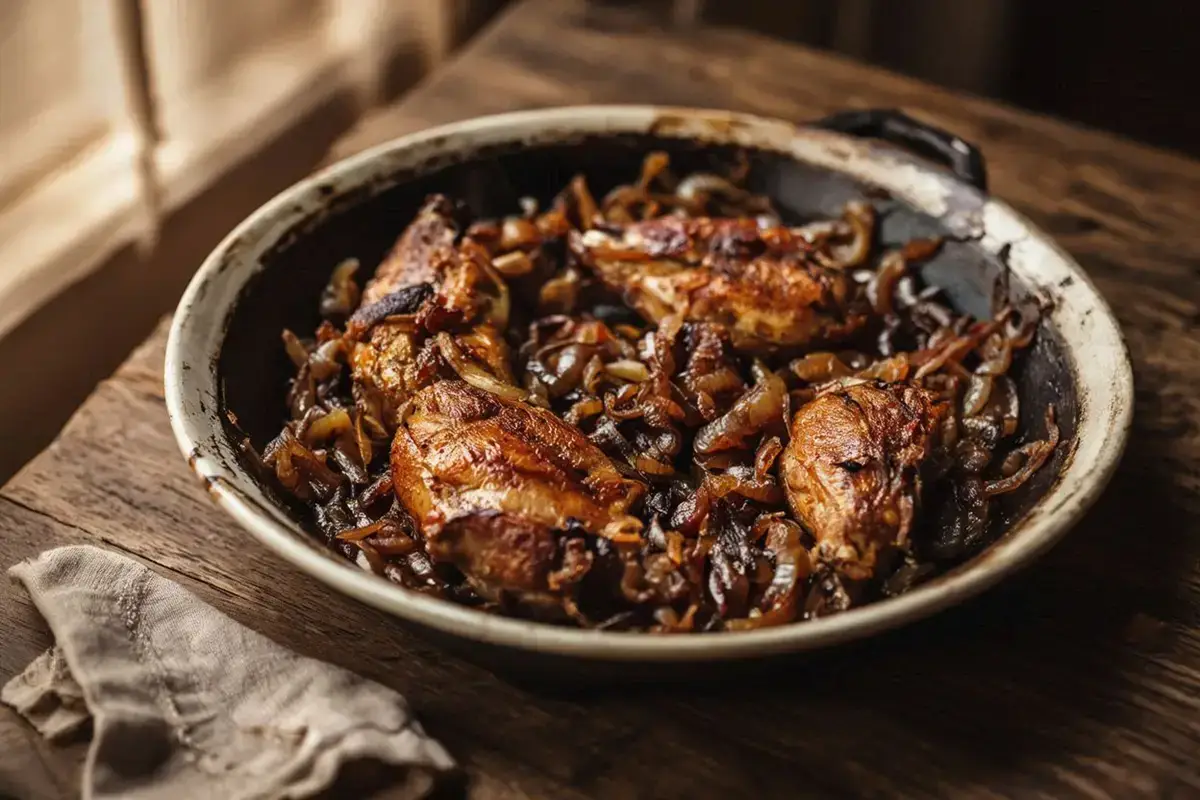
Rabbit thighs and back slow-fried in lard with caramelized onion — a simple, deeply flavourful Central European stovetop roast.
Historical recipe
Modernised adaptation of an early 20th‑century source. Not independently kitchen-tested by Attic Recipes. Quantities, temperatures, and food safety guidance have been updated for a contemporary kitchen — results may vary and errors may exist. Nutritional values, where provided, are estimates only and have not been laboratory tested. Always follow current food safety guidelines for your region. If you have a health condition, allergy, or dietary requirement, consult a qualified professional before preparing this recipe.
Use of this recipe is entirely at your own risk and subject to our Terms of Service and Privacy Policy. Attic Recipes accepts no liability for any adverse outcome.
Additional notes
-
Warning
This recipe is high in total fat (38g per portion) and saturated fat (14g — 70% of the recommended daily intake), primarily from lard. Individuals with cardiovascular disease, high cholesterol, or on a fat-restricted diet should use the reduced-fat modern adaptation.
Reduce lard to 3–4 tablespoons (45–60ml) or substitute with neutral oil. Fat per portion drops to approximately 12–14g with this change.
-
Warning
Rabbit must be cooked until the internal temperature reaches 74°C (165°F) and the meat pulls cleanly from the bone. Unlike chicken, rabbit is not always widely familiar to home cooks — undercooked rabbit poses a Tularemia risk if the animal was wild-caught. Farm-raised rabbit (standard in butcher shops) carries significantly lower risk but should still be cooked through.
-
Caution
If using wild-caught rabbit, exercise additional caution: always wear gloves when handling raw wild rabbit and cook to a minimum internal temperature of 74°C (165°F). Wild rabbit should not be prepared by or served to immunocompromised individuals.
Use farm-raised rabbit from a butcher or supermarket. It is safer, more consistent in size, already cleaned, and virtually indistinguishable in taste for most home cooks. Farmed rabbit does not carry Tularemia risk.
-
Note
Rabbit is a very lean white meat with an exceptionally high protein-to-calorie ratio. The high fat content in this dish comes entirely from the cooking lard, not the meat itself. Prepared with reduced lard, rabbit is one of the leanest meats available.
- 1
Separate the rabbit into pieces: both hind thighs, the saddle (back), and front legs if using. Season all pieces generously with salt and ground black pepper on all sides. Set aside to rest for 15–20 minutes.
Tip Letting the salt rest on the meat before cooking draws out some moisture and helps develop a better crust when frying. - 2
Melt the lard in a wide, deep saucepan or casserole over medium-high heat. When hot, add the rabbit pieces and fry until golden brown on all sides — about 10–12 minutes total, turning as needed.
Tip Do not crowd the pan. Brown in two batches if necessary — steaming instead of frying will prevent proper colour development. - 3
Add the roughly chopped onion to the pan around the meat. Add a splash of water (about 50ml). Stir the onion so it sits in the fat and begins to soften alongside the meat.
- 4
Reduce heat to medium-low. Cover loosely and cook for 50–60 minutes, turning the meat and stirring the onion every 15 minutes. Add small splashes of water as needed to prevent the onion from burning — the goal is deep golden, not scorched.
Tip The onion is as important as the meat here. It should be completely soft, sweet, and deeply caramelized by the end — not just softened. Patience at this stage makes the dish. - 5
When the meat is completely tender and pulls easily from the bone, and the onion is uniformly golden brown, taste and adjust seasoning with salt and pepper.
- 6
Transfer the rabbit pieces to a serving bowl, spoon the caramelized onion and pan juices over the top, and serve immediately.
Nutrition Information per 1 portion (approx. 160g rabbit + onion)
Nutritional values are approximate estimates and may vary based on specific ingredients used, preparation methods, and portion sizes.
Serving Suggestions
Serve with polenta, crusty white bread, or boiled potatoes — all absorb the caramelized onion and lard pan juices well. A sharp pickled vegetable or vinegar-dressed salad on the side balances the richness of the lard-cooked meat.
About This Recipe
This is one of those recipes that proves simplicity is not the same as plainness. Four ingredients — rabbit, lard, onion, water — cooked low and slow until the meat is falling off the bone and the onion has collapsed into something sweet and golden. The 250g of lard is not a mistake: in the original kitchen, this was the cooking medium, the basting liquid, and the sauce all at once, creating a semi-confit environment that no modern pan-fry with a tablespoon of oil can replicate. Make it once the original way before you lighten it.
Why It Works
Rabbit is an exceptionally lean meat — leaner than chicken breast — which means it dries out quickly over dry heat but becomes extraordinarily tender in fat. Cooking it slowly in a generous quantity of lard keeps the muscle fibres moist throughout the long cook while allowing the surface to brown. The onion, meanwhile, spends the same time slowly losing its water content and concentrating its natural sugars in the hot fat — by the end, it is less a vegetable and more a sweet, unctuous condiment that coats every piece of meat on the plate. The occasional addition of water creates brief bursts of steam that help the meat cook evenly without the fat temperature spiking too high.
On the Opening Line
The original recipe opens with a short poetic line — a device common in cookbooks of this era, where a culinary observation or proverb would precede the practical instructions. The note that rabbit is a white meat and that the portion is small reflects both the frugality of the period and a certain dry humour about the modesty of the dish. It is a reminder that these recipes were written not just as instructions but as small pieces of domestic literature.
Troubleshooting
Onion burning before meat is tender: Heat is too high. Reduce immediately, add a splash of water, and stir. The fat should be simmering gently, not smoking.
Meat not pulling from bone after 60 minutes: Continue cooking — older or larger rabbits can take up to 90 minutes. Add water in small amounts and keep the lid on.
Too much fat in the finished dish: Tilt the pan and spoon off excess lard before serving, leaving just the onion-enriched juices behind.
A classic of early 20th century home cooking, preserved and adapted for the modern kitchen.
The Story Behind This Recipe
Historical Context
Rabbit was a common and economical meat across Central European households throughout the early twentieth century — widely raised at home, affordable, and available year-round. This stovetop preparation, cooked slowly in a generous quantity of lard with caramelized onion, reflects the practical cooking style of the era: no oven required, few ingredients, maximum use of the available fat for both cooking medium and flavour. The technique is closer to a semi-confit than a modern pan-fry — the meat sits in hot lard for an extended period, rendering it extraordinarily tender while the onion slowly sweetens in the same fat. The cryptic line that opens the original recipe — a poetic note about rabbit as white meat and the smallness of the portion — was a common literary device in cookbooks of this period, where recipes were sometimes prefaced with a culinary observation or proverb.
Modern Kitchen Adaptation
The original recipe specifies 250g of lard, which creates a semi-confit cooking environment authentic to the period. Modern cooks may reduce this to 3–4 tablespoons (45–60ml) of neutral oil or butter for a lighter result — the dish will still be flavourful but the onion will caramelize differently and the meat will be less unctuous. The water quantity is not specified beyond 'a little' — 100ml total across the cook is sufficient. As a modern variation, 1dl of dry white wine can replace the water entirely or be added alongside it: the acidity complements the rabbit and the sweetness of the caramelized onion very effectively, though this is not part of the original recipe. Farmed rabbit is a safe and flavour-equivalent substitute for wild rabbit — the taste difference is minimal for most home cooks, and farmed rabbit carries no Tularemia risk.
This recipe is an independent modern adaptation developed from historical sources in the public domain. It is provided for informational and educational purposes only and does not constitute professional dietary, nutritional, or medical advice. Food preparation involves inherent risks. The reader assumes full responsibility for safe food handling, ingredient sourcing, and adherence to current local food safety guidelines. The site operator accepts no liability for outcomes resulting from the preparation or consumption of this recipe.
One recipe.
Every week.
You Might Also Like
More recipes from the same category
Baked Fish with Tomatoes
Whole fish baked over ripe tomatoes with generous olive oil and lemon — a simple, fragrant Central European oven dish.
Beef Kidney with Wine
Beef kidney marinated in red wine, braised with herbs, finished with sour cream. Tender, rich, and deeply flavored.
Beef Tongue in Mushroom Sauce
Tender sliced beef tongue layered in a rich dark mushroom sauce, finished with sour cream, Parmesan, and a golden oven crust.