Rice Steaks with Mushroom Sauce
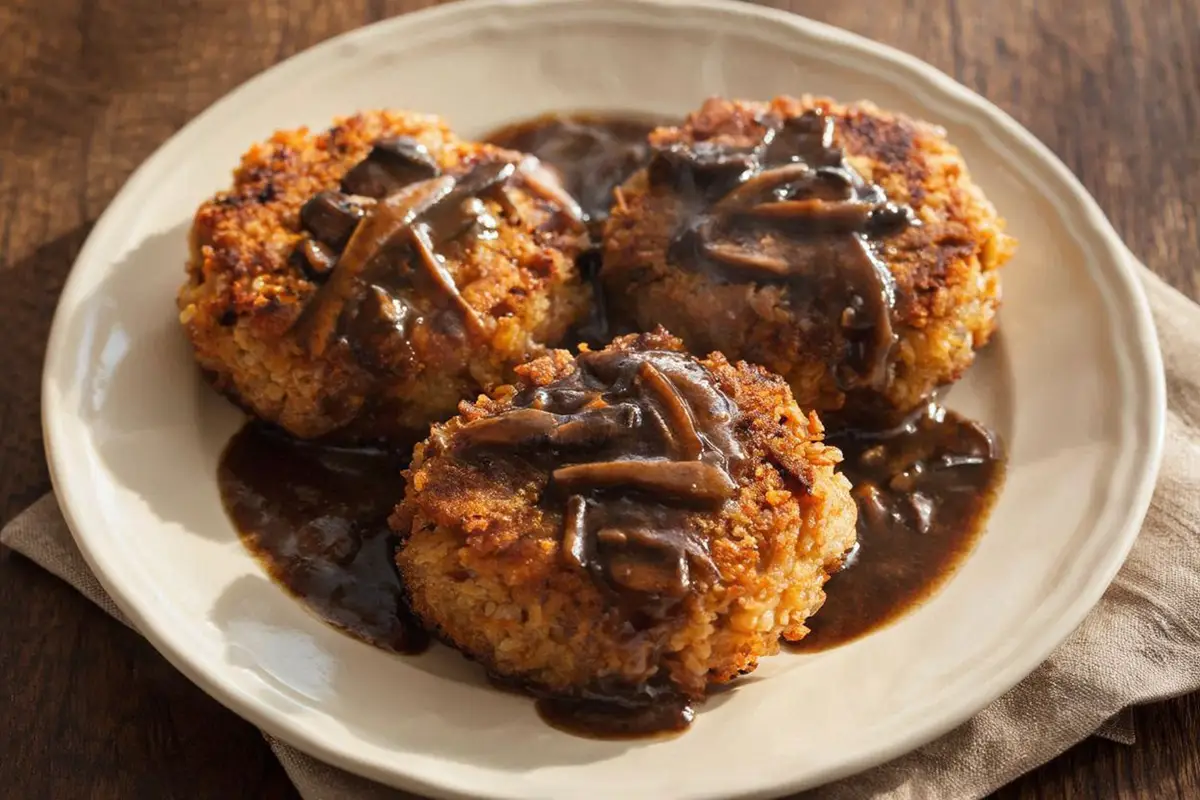
Crispy fried rice patties seasoned with pepper, served with a rich, creamy dried mushroom sauce — a satisfying Central European vegetarian main.
Quick Summary
Crispy fried rice patties seasoned with pepper, served with a rich, creamy dried mushroom sauce — a satisfying Central European vegetarian main.
Historical recipe
Modernised adaptation of an early 20th‑century source. Not independently kitchen-tested by Attic Recipes. Quantities, temperatures, and food safety guidance have been updated for a contemporary kitchen — results may vary and errors may exist. Nutritional values, where provided, are estimates only and have not been laboratory tested. Always follow current food safety guidelines for your region. If you have a health condition, allergy, or dietary requirement, consult a qualified professional before preparing this recipe.
Use of this recipe is entirely at your own risk and subject to our Terms of Service and Privacy Policy. Attic Recipes accepts no liability for any adverse outcome.
- Dairy
- Gluten
Additional notes
-
Warning
Cooked rice must be cooled and stored correctly. Bacillus cereus, a bacterium naturally present in rice, can multiply rapidly in cooked rice left at room temperature. Cool cooked rice quickly, refrigerate within 1 hour, and use within 24 hours. Never reheat rice more than once.
Spread freshly cooked rice on a wide tray to cool rapidly rather than leaving it in the pot. Refrigerate immediately once at room temperature.
-
Note
Dried mushrooms, particularly porcini, are high in purines. Those managing gout should consume in moderation.
Reduce the mushroom quantity or substitute with fresh cultivated mushrooms, which are lower in purines.
- 1
Cook the rice in salted water until fully tender. Drain well and spread on a tray or wide plate to cool completely. The rice must be cold and dry before mixing — warm rice will not hold together.
Tip Day-old refrigerated rice is ideal. If cooking fresh, allow at least 30 minutes of cooling time. The drier the rice, the better the patties will hold their shape. - 2
Place the dried mushrooms in a bowl and cover with warm water. Soak for 20–30 minutes until fully rehydrated. Lift the mushrooms out carefully (do not pour — any sand settles at the bottom). Reserve the soaking liquid if it is clean. Rinse the mushrooms briefly, then cut into thin, noodle-like strips.
Tip The soaking liquid is valuable — it is deeply flavoured. Pour it slowly through a fine sieve or a coffee filter to remove any grit, then use it in place of broth for the sauce. - 3
In a bowl, combine the cold cooked rice with 1 tablespoon of flour, salt, and pepper. Mix thoroughly until the flour is evenly distributed and the mixture begins to hold together when pressed. Shape into 4 flat oval patties approximately 1.5cm thick.
Tip Press each patty firmly — compact shaping prevents them from breaking apart during frying. If the mixture is too loose, add flour half a tablespoon at a time. - 4
Coat each patty lightly in flour, shaking off the excess. Heat a generous amount of oil in a wide frying pan over medium-high heat. Fry the rice patties for 3–4 minutes per side until deeply golden and crispy. Do not move them during frying — let the crust form before attempting to flip.
Tip The crust is everything with rice patties. Resist the urge to check underneath too early. When the patty releases cleanly from the pan without sticking, it is ready to flip. - 5
Set the fried patties aside on a warm plate. In the same pan or a small saucepan, heat 1 tablespoon of oil or butter over medium heat. Add the mushroom strips and fry for 2–3 minutes until lightly coloured.
- 6
Add 1 tablespoon of flour to the mushrooms and stir constantly for 1 minute to cook out the raw flour taste. Gradually pour in the broth (or mushroom soaking liquid), stirring continuously to prevent lumps. Simmer for 3–4 minutes until the sauce thickens to a smooth, medium consistency.
- 7
Remove the sauce from the heat. Stir in the sour cream and season with salt. Do not return to the boil after adding the sour cream — it will split.
Tip The finished sauce should coat a spoon but still pour freely. If it is too thick, add a splash of hot water or broth. If too thin, simmer for another minute before adding the cream. - 8
Arrange the warm rice patties on a heated serving plate. Pour the mushroom sauce generously over the top and serve immediately.
Nutrition Information per 1 patty + sauce (approx. 200g)
Nutritional values are approximate estimates and may vary based on specific ingredients used, preparation methods, and portion sizes.
About This Recipe
This is pantry cooking at its most intelligent. Cooked rice, a tablespoon of flour, salt, and pepper — shaped into patties, crisped in oil, and served under a sauce made from dried mushrooms, broth, and a spoonful of sour cream. The ingredients are humble; the result is not. The contrast between the crispy exterior of the rice patty and the dark, earthy mushroom sauce is genuinely satisfying, and the technique is straightforward enough for a weeknight.
The dried mushroom sauce is the soul of the dish. Fifteen grams of dried porcini — reconstituted, cut into thin strips, and built into a cream sauce with their own soaking liquid — produce a depth of flavour entirely disproportionate to the quantity or cost of the ingredient.
Why It Works
Cold, starch-retrograted rice binds with flour far more effectively than warm rice — the cooled starch forms a firmer network that holds the patty together through frying. The flour coating creates a barrier between the moist interior and the hot oil, producing the crispy exterior that makes these patties satisfying rather than merely filling. The sauce technique — frying the rehydrated mushrooms before adding flour and liquid — layers flavour at each step: first the concentrated mushroom taste from soaking, then the Maillard browning from frying, then the body from the roux, then the richness from the cream.
On Dried vs Fresh Mushrooms
Fresh mushrooms can be substituted (200–250g, sliced), but the dish will taste different — lighter, less intense, less complex. Dried mushrooms are specified for good reason: the concentration process of drying increases the glutamate content dramatically, which is precisely what gives the sauce its depth. If using fresh mushrooms, add a small piece of dried porcini to the sauce regardless, or a teaspoon of good mushroom powder, to approximate the original flavour profile.
Make-Ahead Notes
The rice patties can be shaped and refrigerated (uncooked, uncovered) for up to 12 hours before frying — this actually improves their structure. The mushroom sauce reheats well over low heat with a splash of broth; do not boil after the sour cream has been added.
A classic of early 20th century home cooking, preserved and adapted for the modern kitchen.
The Story Behind This Recipe
Historical Context
Rice patties — known across the Austro-Hungarian tradition as Reisschnitzel or riževi kotleti — were a practical solution to two persistent household problems: stretched budgets and meatless days. The technique of binding cooked rice with a small amount of flour and shallow-frying it into a crispy, schnitzel-like patty produced a satisfying main course from almost nothing. Paired with a dried mushroom sauce — itself a pantry preparation relying on shelf-stable preserved mushrooms rather than fresh — the dish was entirely independent of season or market availability. The instruction to cut the rehydrated mushrooms into 'thin noodles' is a precise detail that reflects the period's attention to visual presentation even in economical cooking.
Modern Kitchen Adaptation
**On rice:** Cold, day-old rice makes significantly better patties than freshly cooked rice. The starch retrogrades during cooling, making the grains firmer and less sticky — they bind more readily with the flour and hold their shape better during frying. If cooking rice fresh for this recipe, spread it on a tray and refrigerate for at least 30 minutes before mixing. **On dried mushrooms:** The original calls for approximately 15g of dried mushrooms — a modest amount, but dried mushrooms are highly concentrated in flavour. Porcini are the classic Central European choice and the most widely available. For a more intense sauce, increase to 25–30g. The mushroom soaking liquid, strained carefully, is one of the most useful cooking liquids in the kitchen — always use it in place of plain water or broth if it is clean. **On fat:** The original uses oil throughout. Butter in the sauce adds richness and a more refined flavour — a small amount of butter to finish the sauce (stirred in with the sour cream) is a worthwhile addition. **On sour cream:** Full-fat sour cream is essential — low-fat versions are prone to splitting when added to a hot sauce. Always add off the heat and stir gently rather than whisking. Serve on a warm plate with the mushroom sauce poured over. A simple green salad or pickled vegetables make a good accompaniment. Also works well alongside boiled potatoes or egg noodles to extend the dish for a larger table.
This recipe is an independent modern adaptation developed from historical sources in the public domain. It is provided for informational and educational purposes only and does not constitute professional dietary, nutritional, or medical advice. Food preparation involves inherent risks. The reader assumes full responsibility for safe food handling, ingredient sourcing, and adherence to current local food safety guidelines. The site operator accepts no liability for outcomes resulting from the preparation or consumption of this recipe.
One recipe.
Every week.
You Might Also Like
More recipes from the same category
Frog Risotto (Risotto di Rane)
A rich pureed frog broth with tomato and aromatic vegetables, used as the cooking base for a deeply flavored Central European risotto.
Mushroom and Rice Rolls
Crispy breaded rolls of earthy mushrooms and rice, bound with egg and parsley — a classic Central European side served alongside roast meats.
Layered Polenta with Parmesan and Scrambled Eggs
Firm polenta layered with grated hard cheese and soft scrambled eggs. A Central European home dish that turns humble cornmeal into a rich, satisfying meal.