Steaks Stuffed with Kale
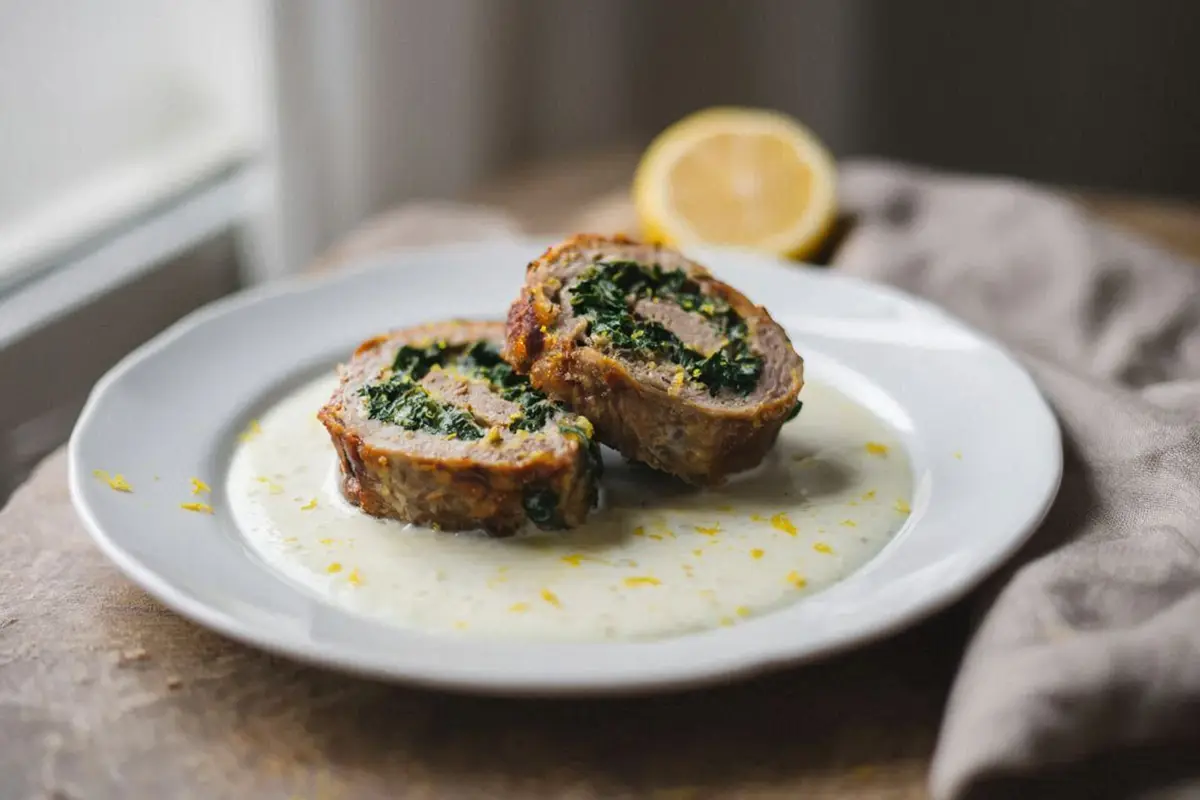
Tender veal steaks rolled sarma-style around a kale, tomato, and egg filling, pan-fried golden, then finished in a lemon-sour cream sauce.
Quick Summary
Tender veal steaks rolled sarma-style around a kale, tomato, and egg filling, pan-fried golden, then finished in a lemon-sour cream sauce.
Historical recipe
Modernised adaptation of an early 20th‑century source. Not independently kitchen-tested by Attic Recipes. Quantities, temperatures, and food safety guidance have been updated for a contemporary kitchen — results may vary and errors may exist. Nutritional values, where provided, are estimates only and have not been laboratory tested. Always follow current food safety guidelines for your region. If you have a health condition, allergy, or dietary requirement, consult a qualified professional before preparing this recipe.
Use of this recipe is entirely at your own risk and subject to our Terms of Service and Privacy Policy. Attic Recipes accepts no liability for any adverse outcome.
- Dairy
- Eggs
- Gluten
Additional notes
-
Warning
This recipe contains a raw egg mixed into the kale filling, which is then pan-fried inside the veal roll. The egg and filling must reach a minimum internal temperature of 74°C (165°F) to eliminate the risk of Salmonella. Since the filling is enclosed inside the roll, the only reliable way to verify this is with a meat thermometer inserted into the center of the roll, not just the meat. Pregnant women, children under 5, elderly individuals, and immunocompromised persons are most at risk from undercooked egg.
Use a pasteurized egg to eliminate Salmonella risk without changing the recipe. Alternatively, lightly scramble the egg in the pan for 30 seconds before adding it to the filling — it will still bind the mixture when cool.
-
Caution
Sour cream will split if the sauce is brought to a boil after it is incorporated. Always add sour cream off the heat or over the lowest possible flame, stirring continuously. If the sauce splits, remove from heat and whisk vigorously — it will often re-emulsify.
Substitute creme fraiche for sour cream — it is significantly more heat-stable and far less likely to split.
-
Caution
Veal is a red meat and should reach an internal temperature of at least 71°C (160°F) at the thickest part. Since these rolls are stuffed and tied, the center heats more slowly than the exterior — a meat thermometer inserted through the side of the roll into the filling center is the only reliable check.
-
Note
Kale is high in Vitamin K, which affects blood clotting. Individuals taking warfarin or other anticoagulant medications should maintain consistent kale consumption and consult their healthcare provider rather than suddenly increasing or eliminating it.
- 1
Prepare the kale: remove the tough outer leaves and wash the rest thoroughly. Cut the leaves into quarters and blanch in boiling salted water for 5-7 minutes until tender but not mushy. Drain well, cool completely, then chop very finely — the filling should be almost a paste, not chunky.
Tip Squeeze all excess moisture from the blanched kale before chopping. A wet filling will make the rolls soggy and difficult to seal during frying. - 2
Make the filling: heat 1 tbsp lard or oil over medium heat. Fry the chopped onion until soft and golden, about 5 minutes. Add the peeled chopped tomatoes and fry together for 3-4 minutes. Add the finely chopped kale, mix well, and simmer on low heat for 5 minutes until cohesive and the moisture has reduced. Remove from heat and cool completely to room temperature.
Tip The filling must be completely cool before the egg is added — adding egg to a hot filling will scramble it. - 3
Once the filling is cool, crack in 1 whole egg and stir thoroughly to bind. Season with about 1/2 tsp fine salt, or to taste. Mix until the filling is cohesive.
- 4
Prepare the veal: if not already thin, place each escalope between two sheets of cling film and pound with a meat mallet or rolling pin to approximately 5mm thickness. Work from the center outward. Be careful not to split or tear the meat. Season both sides with some of the 1 tsp fine salt.
- 5
Assemble the rolls: lay each escalope flat on a cutting board. Place a portion of kale filling in the center, leaving a 2cm border on all sides. Fold in the sides, then roll tightly like a sarma. Secure with kitchen string or toothpicks. Repeat for all escalopes.
Tip Do not overfill — a heaped tablespoon of filling per escalope is usually enough. Overfilled rolls burst during frying. - 6
Heat 1 tbsp lard or oil in a wide frying pan over medium-high heat. Place the rolls seam-side down first and fry, turning carefully on all sides, until evenly golden brown — about 8-10 minutes total. Reduce heat to medium and continue until the veal and filling are cooked through (internal temperature at the center of the roll 74°C / 165°F). Remove and set aside in a warm place. Do not remove the string yet.
Tip Work in batches if the pan is crowded — overcrowding steams instead of fries. - 7
Make the sauce in the same pan: add 1 tbsp flour to the remaining fat and stir, cooking for 1 minute. Gradually pour in either stock or milk (choose one — see note below), stirring constantly to prevent lumps. Add the lemon juice and a little lemon zest. Simmer for 3-4 minutes until the sauce thickens. Season with about 1/2 tsp salt and freshly ground black pepper to taste.
- 8
Remove the pan from heat. Stir in the sour cream until smooth. Return to the lowest possible heat — do not boil. Remove string or toothpicks from the rolls. Place the rolls into the sauce and let them warm through gently for 2-3 minutes, spooning sauce over them.
- 9
Carefully transfer the rolls to a serving dish, pour the sauce generously over the top, and serve immediately with potatoes, noodles, or bread to make this a complete main course.
Nutrition Information per 2 rolls with sauce (approx. 320g)
Nutritional values are approximate estimates and may vary based on specific ingredients used, preparation methods, and portion sizes.
Pro Tips
- Stock vs. milk — stock gives a deeper, more savory sauce that pairs better with the kale and lemon; milk gives a paler, more neutral sauce that lets the sour cream flavor come forward. Both are correct — choose based on what you have and what flavor you prefer.
- If the sauce becomes too thick, thin with a tablespoon of warm stock or water at a time — do not add cold liquid, which can cause the sour cream to curdle.
- The lemon zest is specified in the original and should not be omitted — it adds a brightness that the juice alone does not provide.
Serving Suggestions
Serve with boiled new potatoes, egg noodles (spatzle), or crusty bread to absorb the lemon-sour cream sauce. A simple cucumber salad with dill or a lightly dressed green salad balances the richness of the dish. The sauce is the star — serve it generously as part of a complete main course.
About This Recipe
Steaks Stuffed with Kale are a dish of quiet elegance — thin veal escalopes pounded flat, filled with a slow-cooked mixture of kale, onion, tomato, and egg, then rolled tightly like a sarma and fried until golden. The rolls are finished in a lemon-sour cream sauce built in the same pan, bright with zest and acid, rich with cream. The result is a complete dish in a single pan: the vegetable filling, the meat, and the sauce all built sequentially from the same base. It is the kind of recipe that looks more complicated than it is, and tastes better than it looks.
Why It Works
The sarma technique — wrapping a filling inside a flat wrapper before cooking — solves two problems simultaneously. The veal holds the filling together and seasons it from the outside during frying; the filling keeps the thin veal moist from the inside, preventing it from drying out in the pan. The egg in the filling binds the kale and tomato into a cohesive mass that does not fall apart when the rolls are cut at the table. The lemon-sour cream sauce adds the acidity that veal’s mild flavor needs — without it, the dish would be pleasant but flat.
Stock or Milk? Choosing Your Sauce Base
The original recipe offers both without preference. They produce noticeably different results:
Stock (chicken or veal): Produces a deeper, more savory sauce with a golden color. The meat flavor carries through the lemon and sour cream. This version pairs better with heartier sides like egg noodles or boiled potatoes. Recommended if you have good homemade or high-quality stock.
Milk: Produces a paler, more neutral sauce in which the sour cream and lemon are the dominant flavors. Lighter on the palate and slightly more delicate. This version pairs well with a simple green salad or cucumber salad alongside. A reasonable choice if stock is unavailable.
Both are correct. The original recipe makes no distinction — use what you have or prefer.
A Note on Kale
The kale specified in this recipe is the traditional broad-leafed variety common to Central European gardens — a firm, dark green leaf that blanches well and chops into a dense, flavorful filling. Modern curly kale (the most common variety in supermarkets globally) works identically in this recipe; Tuscan kale (cavolo nero) is an equally good substitute with a slightly more bitter, mineral flavor. Any variety of kale will work — what matters is that it is thoroughly blanched, squeezed dry, and chopped finely before use.
Make-Ahead Notes
The kale filling can be made up to 24 hours ahead without the egg — add the egg just before assembling the rolls. The assembled uncooked rolls can be refrigerated for up to 4 hours before frying. Do not assemble and refrigerate overnight, as the moisture from the filling will begin to soften the veal. Cooked rolls in sauce can be refrigerated for up to 2 days; reheat gently in a covered pan over low heat with a splash of stock.
A classic of early 20th century home cooking, preserved and adapted for the modern kitchen.
The Story Behind This Recipe
Historical Context
Stuffed veal rolls of this type — thin escalopes wrapped around a vegetable filling and tied before frying — were a standard preparation in Central European bourgeois cooking of the early 20th century. The technique draws on the wider tradition of wrapping a savory filling in a leaf or thin slice before cooking, familiar across Central and Southeastern Europe and in Ottoman-influenced cuisines more broadly. The use of kale rather than the more common spinach or mushroom filling reflects the seasonal and regional availability of robust winter greens in inland Central Europe. The lemon-sour cream sauce, with its characteristic acidity, is a signature of the Austro-Hungarian sauce tradition — sharp enough to cut through the richness of fried veal.
Modern Kitchen Adaptation
The original recipe specifies 1/2 kg of veal for a smaller household quantity; this version increases the veal to 750g to provide generous portions for 4 people while keeping the original proportions of filling and sauce. All other quantities were specified in the original except the sauce liquid, which was described as a little soup or milk with no measure. Both options are provided with flavor notes. Internal temperature of 71–74°C (160–165°F) for veal and the enclosed egg filling follows current food safety guidelines. Sour cream is added off the heat to prevent splitting, which the original recipe does not specify but which modern food science recommends.
This recipe is an independent modern adaptation developed from historical sources in the public domain. It is provided for informational and educational purposes only and does not constitute professional dietary, nutritional, or medical advice. Food preparation involves inherent risks. The reader assumes full responsibility for safe food handling, ingredient sourcing, and adherence to current local food safety guidelines. The site operator accepts no liability for outcomes resulting from the preparation or consumption of this recipe.
One recipe.
Every week.
You Might Also Like
More recipes from the same category
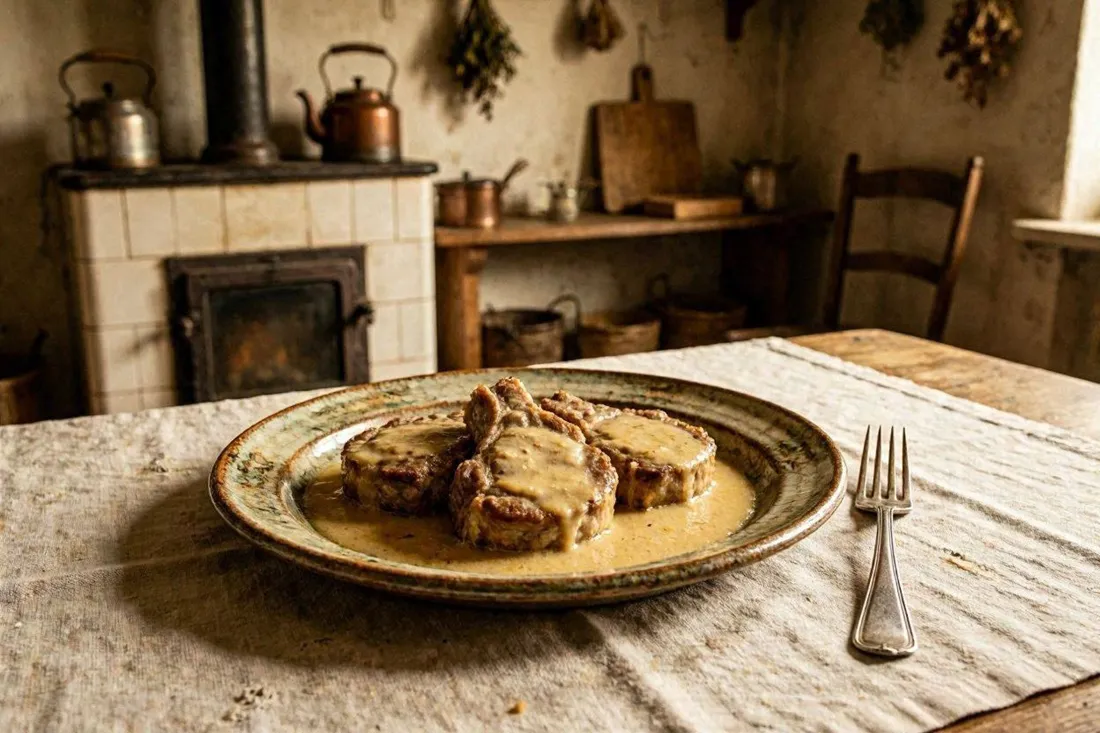
Braised Pork Chops in White Wine and Sour Cream Sauce
Pork loin chops braised with onion, carrot, parsley root, and celery root in white wine, then finished with a strained sour cream sauce.
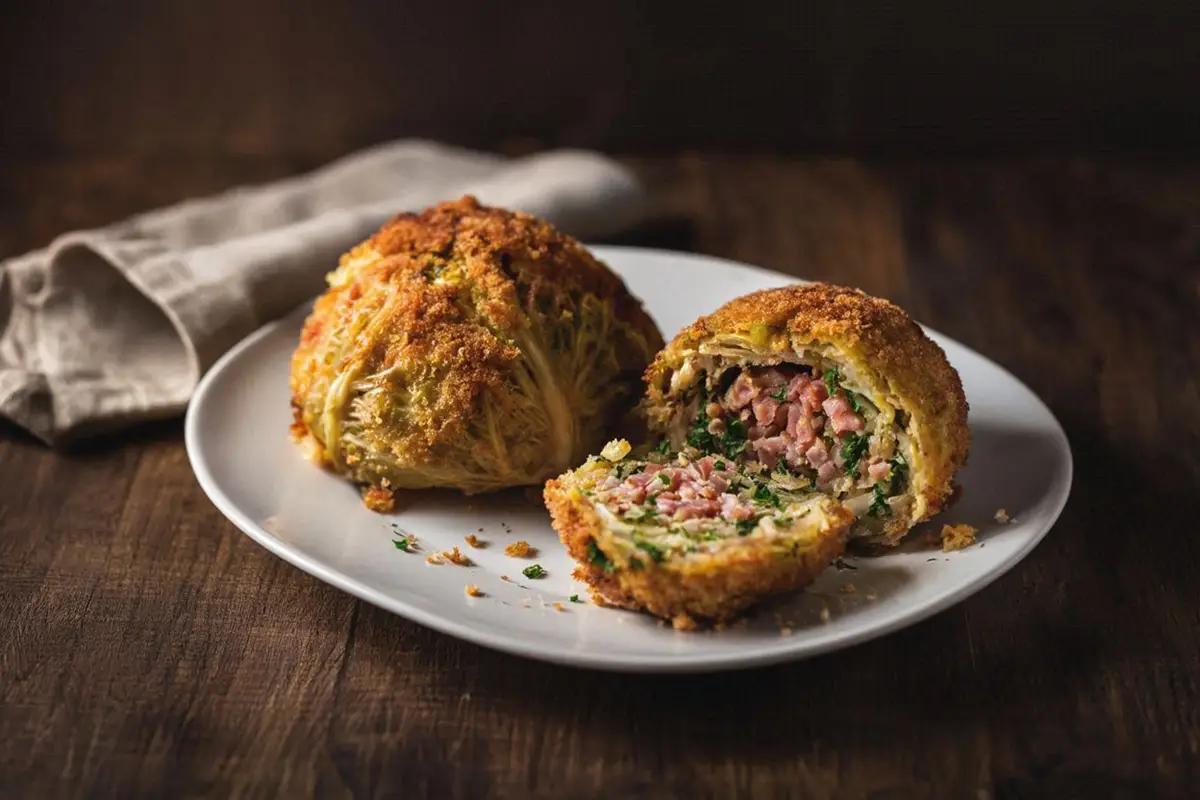
Breaded Savoy Cabbage Stuffed with Ham
Tender young savoy cabbage heads filled with ground ham, fried onion, and herbs, breaded and pan-fried until golden. A hearty Central European classic.
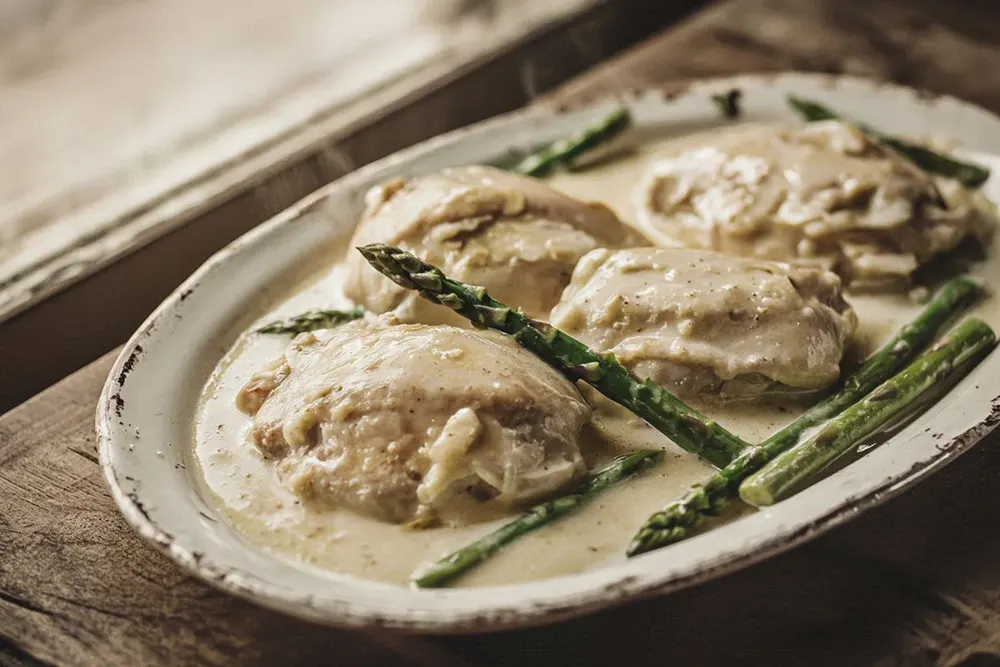
Chicken in Asparagus Sauce
A whole chicken poached in spiced broth, then finished in a silky velouté enriched with egg yolks and cream, garnished with tender asparagus tips.