Stuffed Calf Ears
Veal ears filled with minced veal, ham and egg, tied and braised for 3 hours in a rich onion-cream sauce — a forgotten Central European delicacy.
Quick Summary
Veal ears filled with minced veal, ham and egg, tied and braised for 3 hours in a rich onion-cream sauce — a forgotten Central European delicacy.
Historical recipe
Modernised adaptation of an early 20th‑century source. Not independently kitchen-tested by Attic Recipes. Quantities, temperatures, and food safety guidance have been updated for a contemporary kitchen — results may vary and errors may exist. Nutritional values, where provided, are estimates only and have not been laboratory tested. Always follow current food safety guidelines for your region. If you have a health condition, allergy, or dietary requirement, consult a qualified professional before preparing this recipe.
Use of this recipe is entirely at your own risk and subject to our Terms of Service and Privacy Policy. Attic Recipes accepts no liability for any adverse outcome.
- Dairy
- Eggs
- Gluten
Safety note
The minced veal filling must reach an internal temperature of at least 74°C (165°F) before the braising phase begins. Ground/minced meat has a higher bacterial contamination risk than whole cuts. Use a meat thermometer to verify filling temperature after frying, before covering and braising.
An instant-read thermometer inserted into the thickest part of the filling through the ear is the only reliable check. Do not rely on colour alone.
Additional notes
-
Warning
This dish is high in sodium — approximately 1570mg per portion (about two-thirds of a typical recommended daily intake). The primary source is cured ham. Individuals managing hypertension, heart disease, or on a sodium-restricted diet should use low-sodium ham or reduce the ham quantity.
Substitute cured ham with an equal quantity of unsmoked, unsalted pork mince mixed into the veal filling. This significantly reduces sodium without altering the texture of the stuffing.
-
Warning
Veal ears must be cleaned meticulously before use, including removal of all hair from the inner folds. Improperly cleaned ears pose a hygiene risk. If in doubt about the cleaning standard, request pre-cleaned ears from your butcher and still perform the blanching step.
-
Caution
This recipe contains a whole raw egg in the filling. The egg is cooked through during frying and the subsequent 3-hour braise, making it safe for consumption, provided the filling reaches at least 74°C (165°F) as noted above.
-
Caution
This recipe is high in saturated fat (19g per portion — close to a full typical recommended daily intake). Individuals with cardiovascular conditions or elevated cholesterol should consume in moderation.
-
Note
Veal ears are cartilage-rich and collagen-dense. They are not suitable for individuals with difficulty chewing or swallowing, even after 3 hours of braising. The texture remains firmer than standard braised meat.
- 1
If the ears have not been pre-cleaned, blanch them: place in a pot of boiling water for 5 minutes, remove, and clean thoroughly under cold running water, removing any hair or residue from all crevices. Pat dry and discard the blanching water.
Tip A stiff brush or the back of a knife helps clean the deep folds of the ear. This step is essential — do not skip it even with pre-cleaned ears from the butcher. - 2
Make the filling: heat the lard in a small pan and briefly soften the finely chopped tablespoon of onion — about 2 minutes. Remove from heat. In a bowl, combine the minced veal, chopped ham, parsley, egg, and the softened onion. Season lightly with about 1/2 tsp salt and a little pepper and mix thoroughly until uniform.
Tip Do not over-season — the ham is already salty. Fry a teaspoon of the filling in the pan and taste before stuffing all four ears. - 3
Open each ear as wide as possible and pack the minced filling firmly into the inner cavity. Tie each ear crosswise with cotton string in two directions to hold the filling securely inside.
Tip The filling shrinks during cooking — pack tightly. Any leftover filling can be shaped into small meatballs and braised alongside the ears in the sauce. - 4
Heat the butter in a wide, heavy pan over medium-high heat. Place the stuffed ears in the pan and fry until golden brown on all exposed sides — about 8–10 minutes total, turning carefully. The surface of the filling at the openings should begin to brown.
- 5
Check the internal temperature of one ear by inserting an instant-read thermometer into the center of the filling through an opening. It should register at least 74°C (165°F) before you proceed. Return the ears to the pan if needed to reach this temperature.
- 6
Remove the fried ears and set aside. In the same pan, add the finely chopped onion for the sauce and fry over medium heat until soft and golden — about 5 minutes.
- 7
Add the flour to the onion and stir for 1–2 minutes to form a zaprška (roux). Gradually pour in the beef broth, stirring constantly, until a smooth sauce forms and comes to a gentle boil.
- 8
Lower the stuffed ears into the sauce. The liquid should come at least halfway up the ears. Cover and simmer on very low heat for 3 hours, turning the ears once halfway through. Check liquid level every 45 minutes and top up with warm broth or water as needed.
Tip Three hours is not excessive — the cartilage in the ear requires this time to soften completely. Do not raise the heat to speed things up; the ears will tighten and toughen. - 9
When the ears are fully tender, remove the pan from heat. Stir the sour cream and lemon juice into the sauce. Return to the lowest possible heat for 5 minutes to warm through — do not boil after adding the cream.
- 10
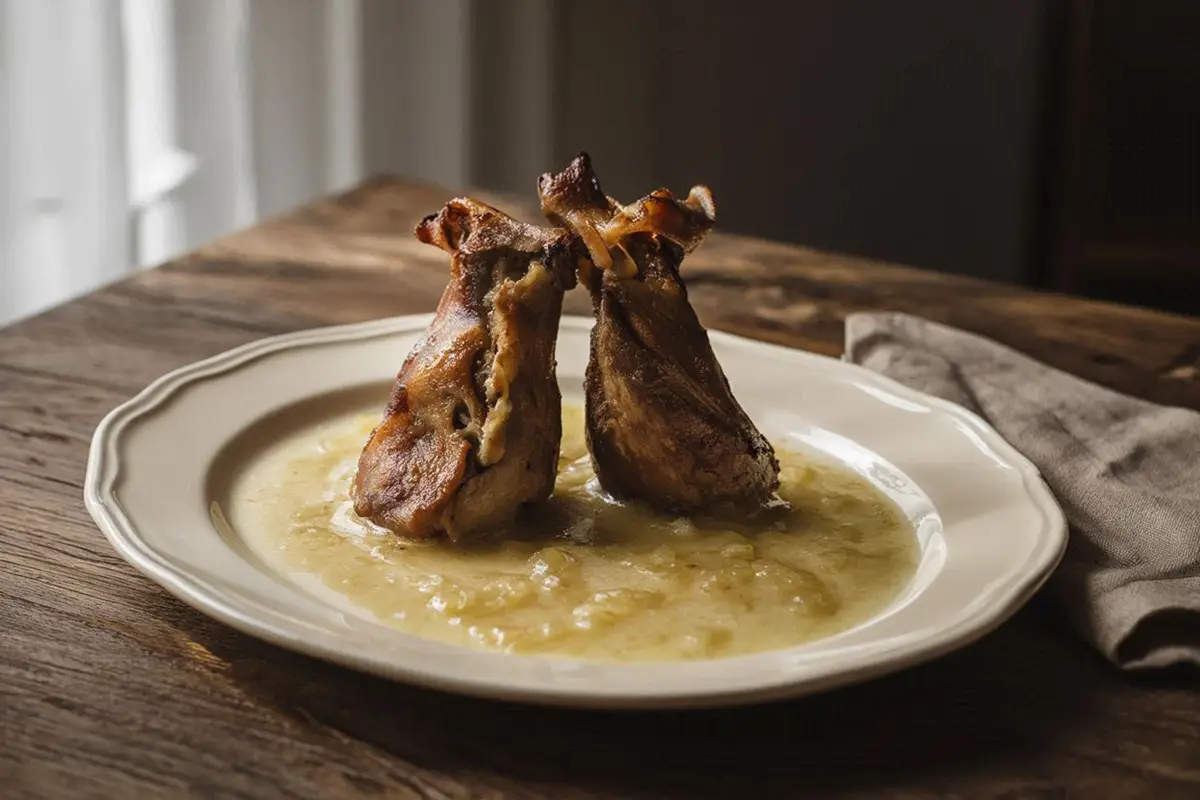
Carefully cut and remove the cotton string from each ear. Arrange the ears upright on a serving platter or deep plates, pour the sauce around them, and serve immediately while very hot.
Nutrition Information per 1 stuffed ear + sauce (approx. 320g)
Nutritional values are approximate estimates and may vary based on specific ingredients used, preparation methods, and portion sizes.
Serving Suggestions
Serve with mashed potatoes or fresh bread to absorb the sauce. A simple green salad with a sharp vinegar dressing provides contrast to the richness of the braised ears and cream sauce.
About This Recipe
Stuffed calf ears are one of those dishes that test a cook’s patience and reward it generously. The ear — cartilage-rich, gelatinous, deeply flavoured — becomes something remarkable after three hours in a zaprška-thickened beef broth sauce: tender enough to cut with a spoon, with the stuffing held firm inside by the cotton ties throughout the cook. Arranged upright on the plate and surrounded by cream sauce, it is a dish that looks laborious and tastes exactly like it sounds — rich, meaty, and old.
Why It Works
The ear’s high collagen content is both its challenge and its asset. Collagen requires prolonged moist heat to convert to gelatin, which is why three hours of covered simmering is non-negotiable. That same gelatin, once released into the braising liquid, gives the sauce a natural body and gloss that no amount of flour alone could replicate. The minced veal and ham filling, packed tightly before the long braise, essentially becomes a terrine inside the ear — compressed, cohesive, and flavourful. The cotton ties are not just practical; they maintain the ear’s shape throughout, so the presentation — ears standing upright — is achievable without fuss.
Sourcing
Veal ears are not a supermarket item. Contact a specialist butcher or a farm butcher directly — they are almost always available on request, often at very low cost, as they are an undervalued cut. Eastern European butchers in most large cities carry them regularly. Ask for pre-cleaned ears to simplify preparation, but always perform the blanching step regardless.
Troubleshooting
Filling falling out during frying: The cotton string has worked loose. Re-tie before returning to the pan. Pack the filling more tightly next time.
Sauce too thin after 3 hours: Remove the ears and reduce the sauce uncovered over medium heat for 10 minutes before adding the sour cream.
Ears still tough after 3 hours: Continue braising — add a splash of warm broth, re-cover, and check every 20 minutes. Older or larger ears can take up to 4 hours.
Sauce curdled after sour cream: Heat was too high. Remove from heat immediately, whisk vigorously. The flavour is unaffected even if the texture is slightly grainy.
A classic of early 20th century home cooking, preserved and adapted for the modern kitchen.
The Story Behind This Recipe
Historical Context
Stuffed veal ears represent a tradition of nose-to-tail cooking that was standard across Central European households in the early twentieth century. Nothing from the animal was wasted — ears, feet, tail, and tongue all appeared on the table with the same regularity as prime cuts. The technique of stuffing and tying the ear, then braising it upright in a roux-thickened sauce, reflects the refined household cooking style of the period: labour-intensive, technically considered, and deeply economical at the same time. The zaprška — a cooked flour-and-fat roux used to thicken sauces — is a defining element of the Central European kitchen of this era, appearing in many braised dishes of the period.
Modern Kitchen Adaptation
The period recipe specifies beef broth or soup without a quantity — a common omission where the cook was expected to judge by eye. A modern standard of 400ml low-sodium beef broth produces the right sauce consistency for four ears. Carton or canned beef broth is a fully appropriate substitute for the era's homemade bone broth; choose low-sodium to manage the overall salt level, which is already elevated by the cured ham. The cotton string instruction has been retained — food-safe unbleached cotton string is the correct modern equivalent. Minced veal quantity is set at 500g to match the intended proportion of filling to ears after correcting an early transcription error that doubled this amount.
This recipe is an independent modern adaptation developed from historical sources in the public domain. It is provided for informational and educational purposes only and does not constitute professional dietary, nutritional, or medical advice. Food preparation involves inherent risks. The reader assumes full responsibility for safe food handling, ingredient sourcing, and adherence to current local food safety guidelines. The site operator accepts no liability for outcomes resulting from the preparation or consumption of this recipe.
One recipe.
Every week.
You Might Also Like
More recipes from the same category
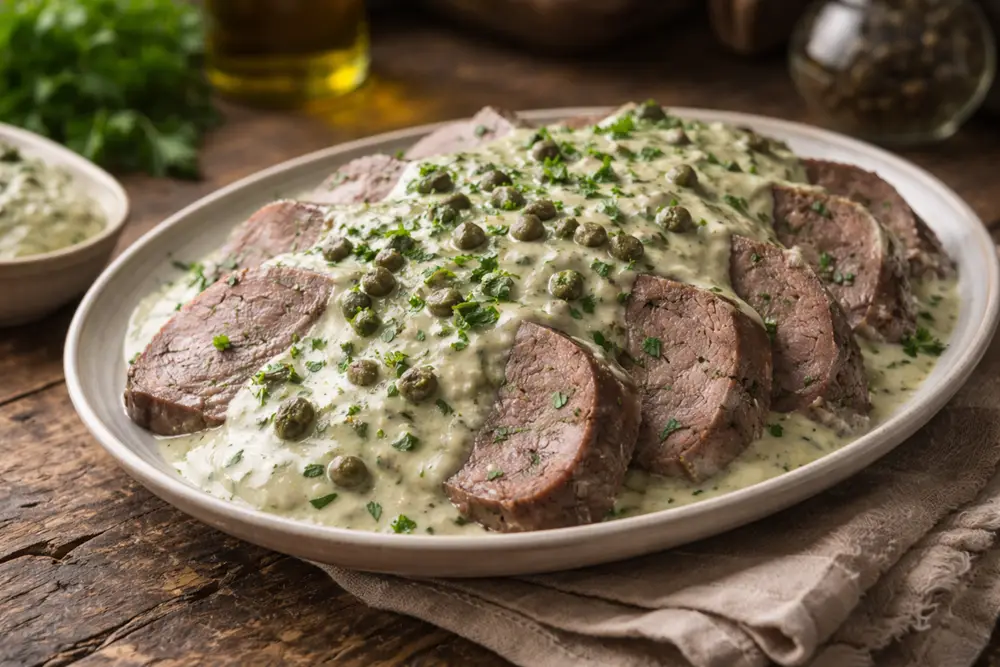
Baked Tongue in Green Sauce
Beef tongue braised with herbs, larded with bacon and roasted until golden, served in a green sauce of capers, anchovy, parsley and sour cream.
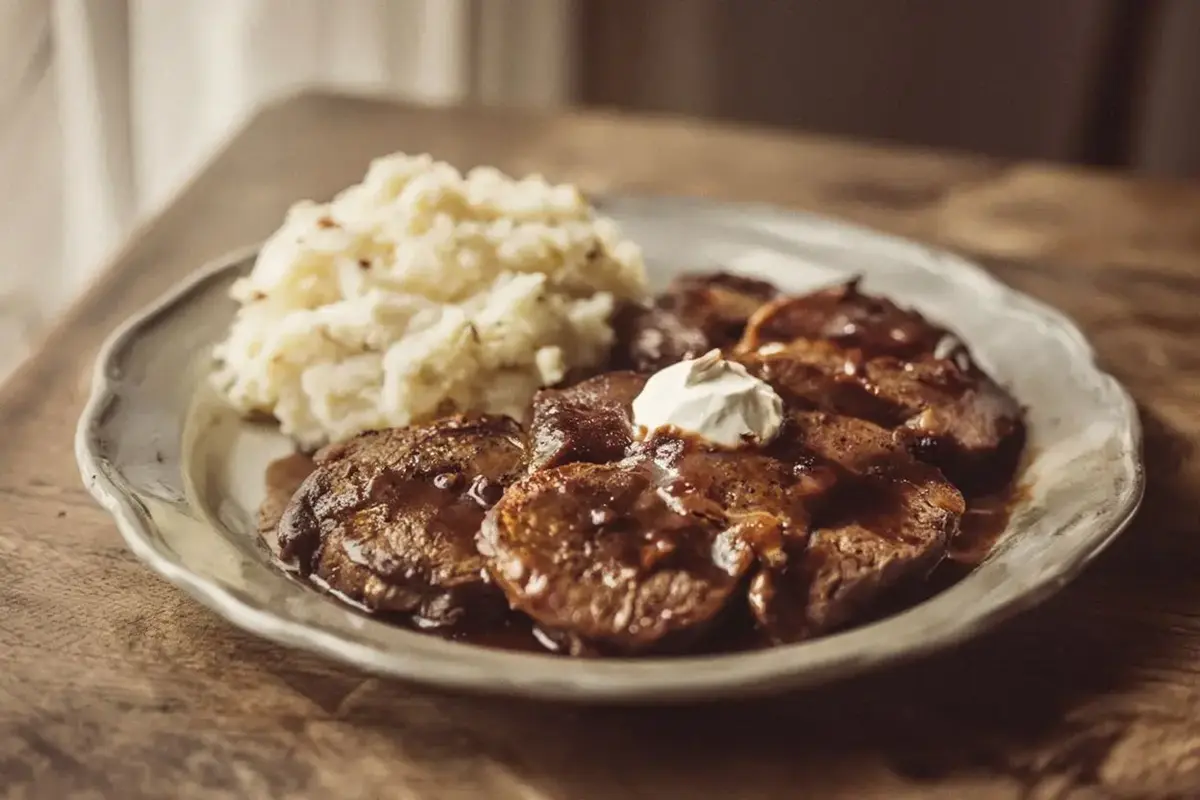
Beef Kidney with Wine
Beef kidney marinated in red wine, braised with herbs, finished with sour cream. Tender, rich, and deeply flavored.
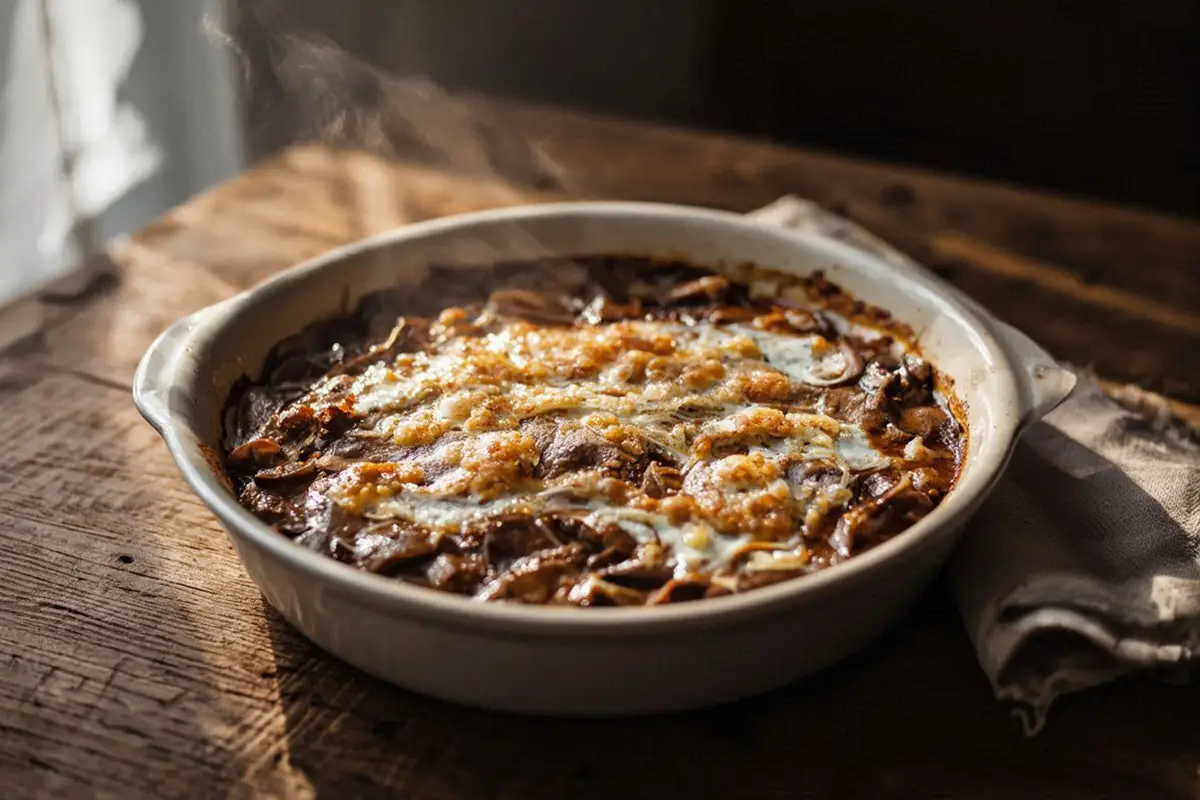
Beef Tongue in Mushroom Sauce
Tender sliced beef tongue layered in a rich dark mushroom sauce, finished with sour cream, Parmesan, and a golden oven crust.