Tomatoes in Sugar (Slatko)
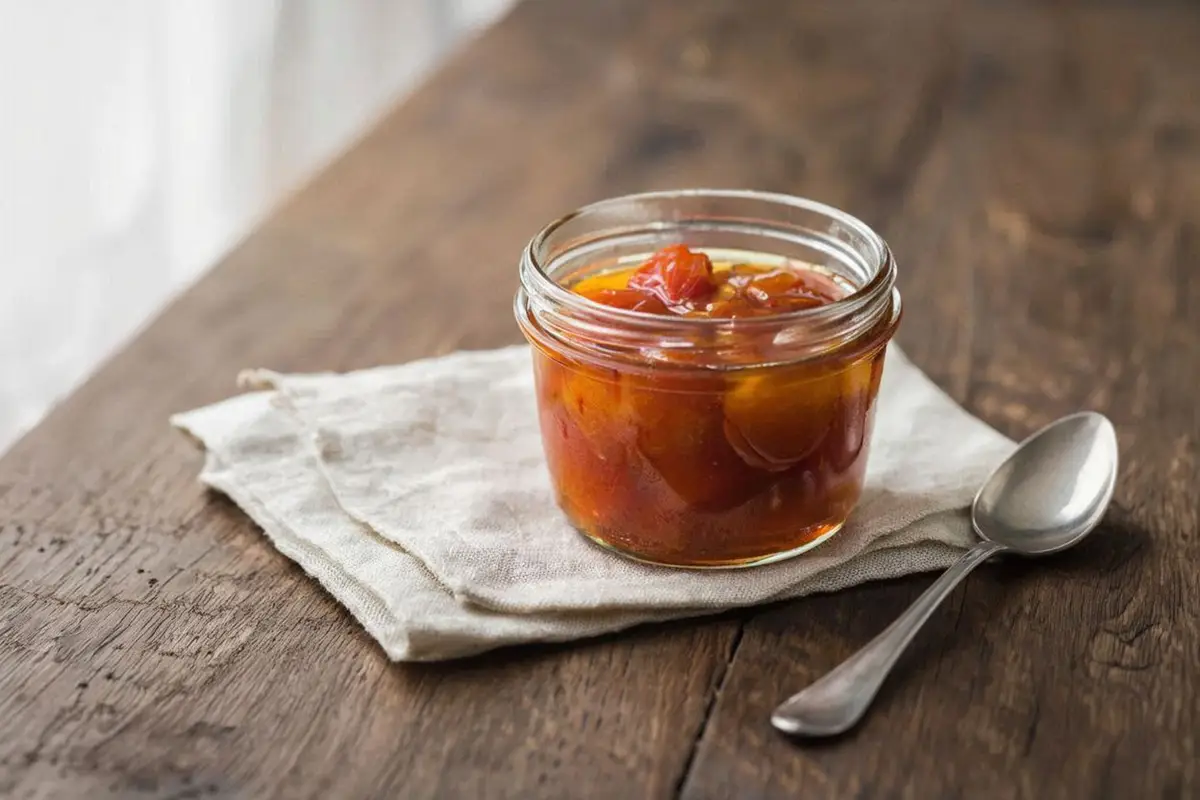
Firm tomato pieces soaked in lime water, then cooked in heavy sugar syrup until glass-clear and translucent.
Quick Summary
Firm tomato pieces soaked in lime water, then cooked in heavy sugar syrup until glass-clear and translucent.
Historical recipe
Modernised adaptation of an early 20th‑century source. Not independently kitchen-tested by Attic Recipes. Quantities, temperatures, and food safety guidance have been updated for a contemporary kitchen — results may vary and errors may exist. Nutritional values, where provided, are estimates only and have not been laboratory tested. Always follow current food safety guidelines for your region. If you have a health condition, allergy, or dietary requirement, consult a qualified professional before preparing this recipe.
Use of this recipe is entirely at your own risk and subject to our Terms of Service and Privacy Policy. Attic Recipes accepts no liability for any adverse outcome.
Safety note
Do not use the ammonia ether called for in older versions of this recipe. Ammonium hydroxide is a corrosive substance not approved for home food preparation and must not be used under any circumstances.
Lemon juice provides sufficient acidity for preservation. A pinch of citric acid can be added if desired.
Safety note
Use only food-grade culinary lime (calcium hydroxide / pickling lime). Builder's lime, garden lime, and slaked lime are not food-safe and must not be substituted under any circumstances.
Food-grade pickling lime is sold in preserving supply stores and online. Check the label carefully before purchase.
Additional notes
-
Warning
Boiling sugar syrup reaches temperatures above 105°C and causes severe burns on contact with skin. Keep children away from the pot during the cooking stages. Use a long-handled spoon and handle the pot with care.
A wide, stable heavy-bottomed pot reduces the risk of spillage.
-
Warning
Rinse the tomatoes thoroughly in at least 4–5 changes of cold water after the lime soak. Taste a small piece before proceeding — residual lime affects both flavour and safety of the finished preserve.
-
Warning
High sugar content (44g per 40g serving). Not suitable for those with diabetes or insulin sensitivity without medical guidance.
Serve in the traditional way — a single spoonful per person.
-
Note
Ensure jars are fully sterilized before filling. Check seals after cooling — lids should be concave and firm. Any lid that flexes has not sealed properly; refrigerate and consume within two weeks. Discard if fermentation, cloudiness, or off odour develops.
- 1
Prepare the lime water: dissolve 1 tbsp of food-grade culinary lime in 1 litre of cold water. Stir well, then leave to settle for 15–20 minutes. Use only the clear liquid above the sediment — do not disturb the bottom.
Tip Use only food-grade pickling lime (calcium hydroxide). Builder's lime and garden lime are not food-safe under any circumstances. - 2
Wash the tomatoes. Place in a clean enamel pot and pour boiling water over them. Leave until the skins begin to loosen — approximately 30–60 seconds. Peel immediately.
- 3
Cut each peeled tomato into quarters. Place the pieces in the clear lime water and soak for exactly 1 hour. The lime water firms the flesh by strengthening cell walls — this is what allows the tomatoes to remain intact and become transparent rather than collapsing during cooking.
- 4
Remove the tomato pieces from the lime water. Using a small needle or toothpick, carefully remove the seeds from each piece. Rinse the tomatoes thoroughly under cold running water — at least 4–5 changes of water — until no trace of alkaline taste remains when a small piece is tasted.
Tip Thorough rinsing is critical. Residual lime will make the finished preserve taste soapy and will affect the syrup's clarity. - 5
Combine 2kg sugar with 125ml of water in a wide, heavy-bottomed pot. Bring to a boil over medium heat, stirring until the sugar fully dissolves. Continue cooking without stirring until the syrup reaches 105°C on a candy thermometer.
Tip A candy thermometer gives the most reliable result. Alternatively, the syrup is ready when a drop placed on a cold plate holds its shape and does not spread immediately. - 6
Add the prepared tomato pieces to the hot syrup. Reduce to a steady simmer and cook, skimming foam regularly, until each piece becomes completely transparent — glassy and clear throughout with no remaining opaque flesh. This typically takes 45–60 minutes. Do not raise the heat to speed the process.
Tip The doneness test is visual: the tomatoes are ready when light passes through each piece cleanly. Raising the heat causes collapse before clarity is achieved. - 7
When the tomatoes are fully transparent, add the juice of 1 lemon. Stir gently and remove from heat immediately.
- 8
Skim off any remaining foam. Leave to cool completely in the pot without disturbing — at least overnight.
- 9
The following day, spoon the cold preserve into sterilized jars. Seal tightly and store in a cool, dark place. Check seals after cooling — lids should be concave and firm. Any lid that flexes has not sealed properly; refrigerate and consume within two weeks.
Nutrition Information per 40g (approx. 1 heaped tablespoon)
Nutritional values are approximate estimates and may vary based on specific ingredients used, preparation methods, and portion sizes.
Serving Suggestions
Served in the traditional way — a spoonful in a glass of cold water as a welcome to guests. As a topping for vanilla ice cream or thick yogurt. Alongside strong black coffee as a sweet. On a cheese board with fresh white cheese or ricotta. Spooned over cheesecake or panna cotta.
About This Recipe
Of all the preserves in this culinary tradition, tomato slatko is the one that surprises people most. The idea of a tomato as a sweet — cooked in sugar until it turns glass-clear, served in a spoonful alongside cold water or coffee — sits oddly against the modern assumption that tomatoes belong exclusively in savoury cooking. But this assumption is recent. For much of the 19th and early 20th century, tomatoes were treated with the same versatility as any other fruit, which botanically they are. This recipe produces something genuinely beautiful: firm, translucent pieces of tomato suspended in thick amber syrup, each one clear as glass after an hour of careful cooking.
Why It Works
Calcium hydroxide dissolved in water penetrates the tomato’s cell walls and binds with the pectin there, strengthening the structure before it is subjected to heat and sugar. Without this step, the tomatoes would dissolve into the syrup rather than remaining intact and becoming transparent. The 2:1 sugar-to-fruit ratio creates a syrup so concentrated that spoilage organisms cannot survive — the same principle that preserves any high-sugar fruit preserve through winter.
Transparency as the Goal
The doneness test for this preserve is visual, not temperature-based: the tomatoes are ready when each piece has become completely transparent — glassy and clear throughout, with no remaining opaque flesh. This takes a steady, patient simmer of 45–60 minutes. Raising the heat to speed the process will cause the tomatoes to collapse before they clarify.
On Ammonia Ether
An older version of this recipe calls for a small amount of ammonia ether added at the end of cooking — a historical pharmacy ingredient used in early 20th century confectionery as a clarifying and preserving agent. It is not included in this adaptation and must not be used at home. Ammonium hydroxide is a corrosive substance not approved for home food preparation. The lemon juice performs the necessary functions without it, and the finished slatko does not suffer from its absence.
A classic of early 20th century home cooking, preserved and adapted for the modern kitchen.
The Story Behind This Recipe
Historical Context
Tomato slatko reflects a time when tomatoes were treated as a versatile ingredient rather than exclusively a savoury one. Slatko — meaning 'sweet' — belongs to the broader Eastern Mediterranean tradition of whole-fruit preserves served as a welcome gesture to guests: a small spoonful offered in a glass of cold water on arrival. The use of lime water to firm fruit before cooking in sugar syrup is a technique found across Central and Southern European confectionery, still used today in traditional preparations. An older version of this recipe also calls for ammonia ether — a dilute ammonium hydroxide solution used historically in early 20th century confectionery as a clarifying agent. This ingredient is not included in this adaptation and must not be used at home.
Modern Kitchen Adaptation
The lime water step is essential and must not be skipped. Use only food-grade culinary lime (calcium hydroxide), sold as pickling lime in preserving supply stores — builder's lime and garden lime are not food-safe. Rinse the tomatoes extremely thoroughly after soaking; taste a small piece before proceeding to confirm no alkaline flavour remains. The ammonia ether called for in the older version of this recipe was a historical pharmacy ingredient not approved for modern home food use; the lemon juice performs the preservation and anti-crystallization functions adequately. A small pinch of citric acid (available from pharmacies and brewing suppliers) can be added alongside the lemon juice as an additional preservative if desired.
This recipe is an independent modern adaptation developed from historical sources in the public domain. It is provided for informational and educational purposes only and does not constitute professional dietary, nutritional, or medical advice. Food preparation involves inherent risks. The reader assumes full responsibility for safe food handling, ingredient sourcing, and adherence to current local food safety guidelines. The site operator accepts no liability for outcomes resulting from the preparation or consumption of this recipe.
One recipe.
Every week.
You Might Also Like
More recipes from the same category
Apricot Fruit Paste
Sieved ripe apricots cooked with equal weight sugar and lemon juice, poured into molds and air-dried — from early 20th century Central European kitchens.
Whipped Apricot or Peach Preserve (No-Cook)
A silky, pale fruit spread made by whipping raw apricot or peach puree with sugar - no cooking required.
Blackberry and Cornelian Cherry Marmalade
Rich preserve combining tart cornelian cherries with sweet blackberries, cooked to thick consistency with a traditional two-fruit method.